Essential characters from the Harley Quinn universe: Poison Ivy (partner and ally), the Gotham City Sirens (Catwoman, Ivy, Harley), the Birds of Prey, Punchline (modern rival), the Joker (founding relationship), and Power Girl: a universe that evolved from a simple sidekick to a major independent franchise.
Harley Quinn is one of the rare characters born outside of comics (Batman: The Animated Series, 1992) to have conquered a central place in the DC universe. His first comic book appearance in Batman Adventures #12 (1993) has become one of the most sought-after and expensive modern issues on the market.
The Harley universe has expanded considerably in recent years, going from the Joker's simple companion to an independent anti-heroine surrounded by her own cast. For the collector, this represents ever-expanding territory with key issues steadily increasing in value.
Essential first appearances
Harley Quinn: origins
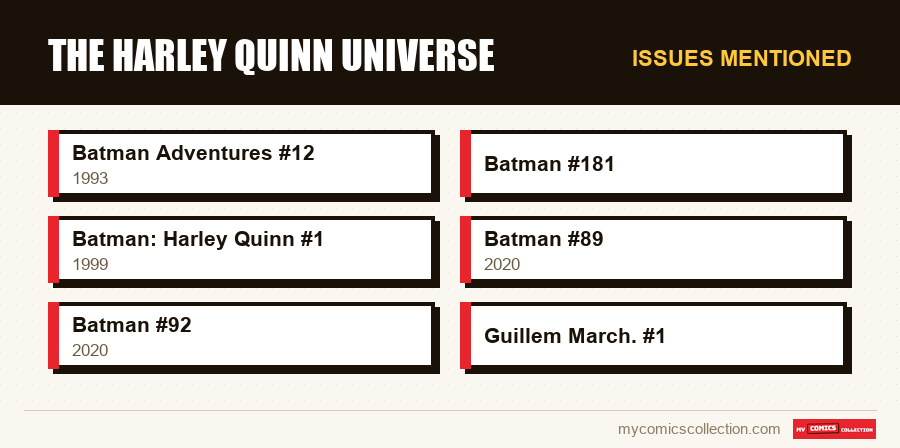
Batman Adventures #12 (1993) is the absolute grail: Harley's first comic book appearance. In main DC continuity, she appears in Batman: Harley Quinn #1 (1999) by Paul Dini. Both issues are centerpieces of any modern DC collection.
Punchline: the rival
Alexis Kaye aka Punchline appears in Batman #89 (2020, cameo) then fully in Batman #92 (2020). Created by James Tynion IV as the Joker's new partner, she represents Harley's direct antagonist in the modern era.
Allies and supporting cast
Poison Ivy
Pamela Isley appears in Batman #181 (1966). His relationship with Harley-first friendship and then canon romance-became one of DC's most popular duos. Their dynamic is at the heart of many modern series.
Gotham City Sirens
The Harley/Ivy/Catwoman trio forms the Gotham City Sirens in the eponymous series (2009-2011, 26 issues) by Paul Dini and Guillem March. #1 has become a key number sought after for his team formation.
Birds of Prey
Harley joins various incarnations of the Birds of Prey in modern adaptations. The Cinematic Connection (2020) propelled the value of several numbers related to this team.
Derivative series and essential runs
The Harley Quinn solo series include: the initial run (2000-2004, 38 issues), the Conner/Palmiotti run (New 52, 2013-2016, 30 issues) considered the best, then their continuation Rebirth (2016-2020). The series Harley Quinn: Black + White + Redder (2023) offers short stories by diverse creators.
Essential related titles: Harley Quinn & Poison Ivy (2019-2020), Gotham City Sirens (2009-2011), Harley Quinn: Breaking Glass (OGN 2019), and the multiple annual one-shots.
Collection strategy
Batman Adventures #12 is the flagship issue but its price is high: aim for a mid-grade copy or start with Batman: Harley Quinn #1 (1999). The Conner/Palmiotti run is complete and affordable. Artgerm and other cover variants are particularly popular. Consult our guides on harley quinn key numbers and the character story to go deeper.
Build your Harley Quinn collection methodically. Our app helps you track every series, variant, and first appearance in the growing universe of Gotham's Queen of Chaos.
Reading and collecting the Harley Quinn universe in four steps
The Harley Quinn universe spans more than thirty years of publications, and there is no obvious entry point. Here is a four-step path that follows both reading chronology and collector logic.
Step 1: the origins
Harley was born on screen in Batman: The Animated Series in 1992, then arrived in comics in Batman Adventures #12 (1993). In main DC continuity, her first appearance is Batman: Harley Quinn #1 (1999), by Paul Dini. If Batman Adventures #12 is out of budget, this second issue is a more accessible starting point.
Step 2: the trio and the allies
Poison Ivy, who first appeared in Batman #181 (1966), becomes Harley's most important ally, first as a friendship then as a canonical romance. Gotham City Sirens (2009-2011, 26 issues, Paul Dini and Guillem March) brings together Harley, Ivy and Catwoman. It is a short series, easy to complete.
Step 3: the solo series
Three blocks stand out. The initial run (2000-2004) has 38 issues. The Conner and Palmiotti run (New 52, 2013-2016, 30 issues) is considered the best and continues with their Rebirth continuation (2016-2020). For short stories, Harley Quinn: Black + White + Redder (2023) brings together varied creators.
Step 4: the modern era
Punchline, created by James Tynion IV as the Joker's new partner, appears in a cameo in Batman #89 (2020) then fully in Batman #92. She is Harley's direct rival in the modern era. Also worth reading: Harley Quinn & Poison Ivy (2019-2020) and the graphic novel Harley Quinn: Breaking Glass (2019).
Points of caution
- Don't buy everything at once. Move step by step and count what you still have to find before moving to the next.
- Tell the series apart. Several series carry the title Harley Quinn: check dates and series before buying, especially for #1 issues.
- Handle variants with care. Cover variants like Artgerm are prized, but they do not replace first appearance issues.
- Think about format. The 2019 graphic novel and the annual one-shots do not shelve like a regular series.
This progression gives you a clear thread: from the screen debut to the independent antihero, without missing the allies and rivals who make up the universe.
Frequently Asked Questions
Batman Adventures #12 (1993), the absolute grail of the Harley universe. The character was born outside comics, in Batman: The Animated Series (1992). In main DC continuity, she appears in Batman: Harley Quinn #1 (1999), by Paul Dini.
Alexis Kaye, aka Punchline, appears in a cameo in Batman #89 (2020), then fully in Batman #92 (2020). Created by James Tynion IV as the Joker's new partner, she is Harley's direct rival in the modern era.
The trio of Harley, Ivy and Catwoman, brought together in the eponymous series by Paul Dini and Guillem March (2009-2011, 26 issues). #1 has become a sought-after key issue for its team formation.
The Conner and Palmiotti run (New 52, 2013-2016, 30 issues), extended by their Rebirth continuation (2016-2020). The initial run (2000-2004) has 38 issues. These series are complete and more affordable than the first appearances.
Batman Adventures #12 is the flagship issue but its price is high: aim for a mid-grade copy or start with Batman: Harley Quinn #1 (1999). The Conner and Palmiotti run is complete and affordable. Cover variants, such as those by Artgerm, are particularly prized.