Essential characters from the Joker universe: Harley Quinn (former accomplice), Punchline (new partner), Joker's Daughter (Duela Dent), Red Hood (Jason Todd, victim turned anti-hero), the Jokerz (futuristic gang from Batman Beyond): a universe of chaos that has spawned some of the most sought-after issues in comic book history.
The Joker is more than a villain: he's a universe unto himself. Since Batman #1 (1940), the Clown Prince of Crime has generated around him an ecosystem of characters, victims turned heroes, and minions who carry his legacy of chaos. For the collector, this means dozens of the most valuable key issues on the market.
The Joker's evolution-from eccentric '40s gangster to modern psychopath-is reflected in the characters who revolve around him. Each era produced new jokeresque satellites, and each first appearance became an object of desire for DC collectors.
Satellite characters and first appearances
Harley Quinn: the original accomplice
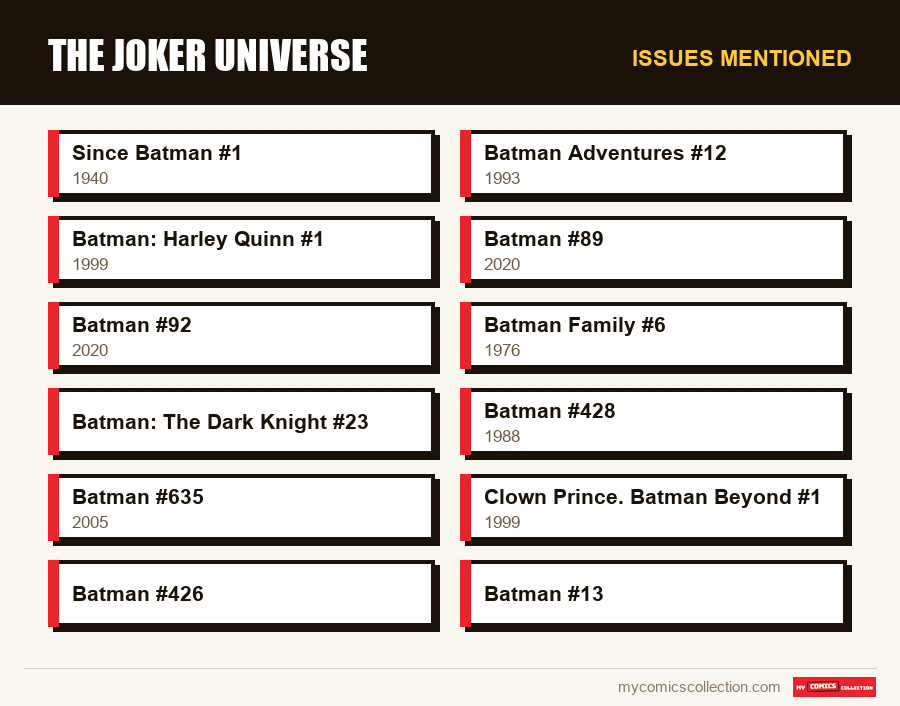
Created for Batman: The Animated Series (1992), Harley appears in comics in Batman Adventures #12 (1993) then in continuity in Batman: Harley Quinn #1 (1999). His toxic relationship and then his emancipation from the Joker constitute one of DC's most popular story arcs.
Punchline: the new era
Alexis Kaye appears in Batman #89 (2020, cameo) and Batman #92 (2020, full premiere). Created by James Tynion IV, she represents a more ideological and dangerous version of the Joker's accomplice: a true believer rather than a romantic victim.
Joker's Daughter (Duela Dent)
A complex character with multiple origins, Duela Dent appears in Batman Family #6 (1976). The New 52 version in Batman: The Dark Knight #23.4 (2013) adopts the Joker's cut-out face, creating a sought-after Villains Month issue.
Red Hood: the victim turned anti-hero
Jason Todd and the Legacy of the Joker
The death of Jason Todd in Batman #428 (1988, "A Death in the Family") is the Joker's most notable act. Jason's return as Red Hood in Batman #635 (2005) then Under the Hood transforms a victim into an anti-hero. Both issues are major issues directly linked to the Joker universe.
The Jokerz and the Future Legacy
In Batman Beyond, the Jokerz gang continues the legacy of the Clown Prince. Batman Beyond #1 (1999) and the Return of the Joker series explore this theme. The concept was taken up in future DC comics, offering an additional dimension to the collection.
Essential Joker-centric series and arcs
The final arcs: The Killing Joke (1988, OGN by Alan Moore and Brian Bolland), A Death in the Family (Batman #426-429, 1988), Death of the Family (Batman #13-17, 2012-2013), Endgame (Batman #35-40, 2014-2015), et Joker War (Batman #95-100, 2020). The solo series The Joker (2021-2022, James Tynion IV) explores the character on the run.
Notable one-shots and minis: Joker (2008, Brian Azzarello), Batman: Three Jokers (2020, Geoff Johns), Joker: Year One (ongoing in Batman).
Collection strategy
Batman #1 (1940) is inaccessible to most. Focus on The Killing Joke (first printing), Batman #251 (iconic Neal Adams cover), Batman #428 and #635. The Tynion IV issues (Batman #89, #92, Joker #1) are still affordable and represent the future. Consult our guides on Joker key numbers and the character story.
Master the chaos of your Joker collection. Our application allows you to track each appearance, each satellite and each arc so as not to miss anything in the universe of the greatest villain in comics history.
Reading the Joker universe in order: guide and points of vigilance
The Joker's universe is vast, and the simplest way to find your bearings is to read it in layers: the stories where he is at the center, then the characters orbiting him. Here is a reading and collecting order that relies solely on the titles cited in this guide.
Step 1: the arcs where the Joker is the subject
Start with his great stories: The Killing Joke (1988, Alan Moore and Brian Bolland), A Death in the Family (Batman #426-429, 1988), then Death of the Family (Batman #13-17, 2012-2013), Endgame (Batman #35-40, 2014-2015) and Joker War (Batman #95-100, 2020). One-shots and minis such as Joker (2008, Brian Azzarello) and Batman: Three Jokers (2020, Geoff Johns) are read separately, without depending on these arcs.
Step 2: the satellites, in order of appearance
- 1970s: Duela Dent, alias Joker's Daughter, in Batman Family #6 (1976).
- 1990s: Harley Quinn, from the animated series, first in comics in Batman Adventures #12 (1993), then in continuity in Batman: Harley Quinn #1 (1999). Batman Beyond #1 (1999) introduces the Jokerz.
- 2000s and 2010s: Jason Todd returns as Red Hood in Batman #635 (2005). The New 52 version of Duela Dent appears in Batman: The Dark Knight #23.4 (2013).
- 2020s: Punchline, by James Tynion IV, in a cameo in Batman #89 then in full first appearance in Batman #92 (2020), and the solo series The Joker (2021-2022).
Cameo or first appearance: reading the clue
Several of these issues are partial first appearances. Batman #89 is a Punchline cameo, and Batman #92 her full first appearance: both count, but not in the same way. The same logic applies to Duela Dent, whose origins are multiple: check which version you are buying before committing.
Points of vigilance for the collector
- Separate the layers. A Joker-centered collection does not contain the same issues as a Harley- or Jason Todd-centered one: decide on your focus before buying.
- Watch for villains month issues. Batman: The Dark Knight #23.4 (2013) is a sought-after issue of this format: check the number and cover carefully.
- Keep the big arcs whole. Death of the Family, Endgame and Joker War span several issues: buying a single issue leaves you with an incomplete story.
- Think about the recent period. James Tynion IV's issues (Batman #89, #92, Joker #1) are still affordable and represent the future of the subject.
A simple method to move forward
Choose an arc (for example The Killing Joke), add the satellite you like best, then extend the collection by era. Tick off each issue as you buy: with so many crossing characters, an up-to-date list avoids duplicates.
Frequently asked questions
Harley Quinn (former accomplice), Punchline (new partner), Joker's Daughter (Duela Dent), Red Hood (Jason Todd, a victim turned antihero) and the Jokerz, the futuristic gang from Batman Beyond. Each era has produced new satellites.
In Batman #89 (2020) in a cameo, then in Batman #92 (2020) in full first appearance. Created by James Tynion IV, she represents a more ideological and dangerous version of the Joker's accomplice, a true believer rather than a lovestruck victim.
His death in Batman #428 (1988, "A Death in the Family") is the Joker's most striking act. He returns as Red Hood in Batman #635 (2005), then in Under the Hood, which turns a victim into an antihero. Both issues are major key issues.
The Killing Joke (1988), A Death in the Family (Batman #426-429), Death of the Family (Batman #13-17), Endgame (Batman #35-40) and Joker War (Batman #95-100). The solo series The Joker (2021-2022) explores the character on the run.
The Killing Joke in first printing, Batman #251 (iconic Neal Adams cover), Batman #428 and #635. Batman #1 (1940) is out of reach for most, and the Tynion IV issues remain affordable.