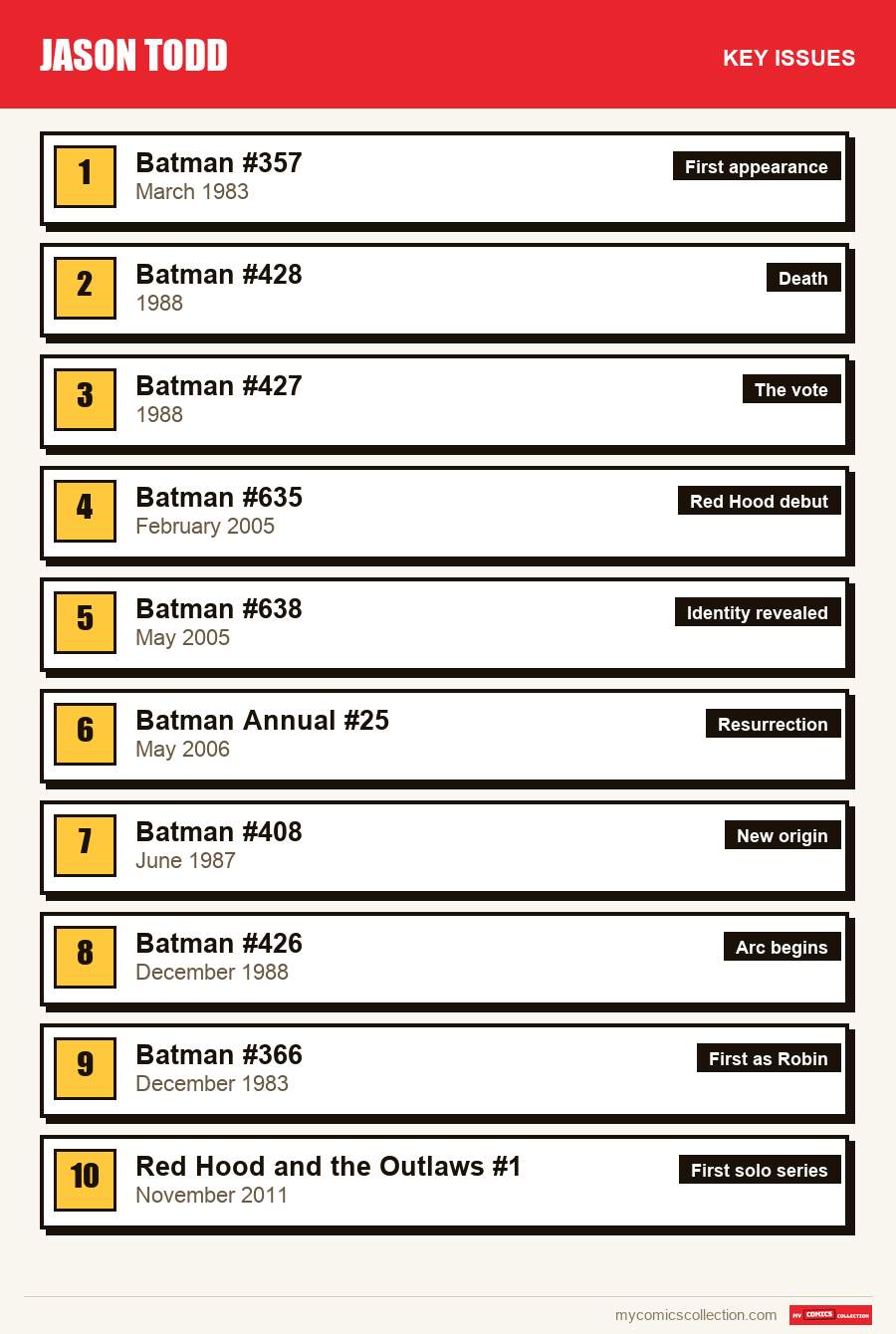
Jason Todd first appears in Batman #357 (March 1983, Gerry Conway and Don Newton) as the second Robin. In 1988, in A Death in the Family ( Batman #426-429, Jim Starlin and Jim Aparo), DC organizes an unprecedented telephone vote which decides his death at the hands of the Joker, with only 72 votes difference out of more than 10,600 voters. Resurrected in the mid-2000s arc Under the Hood by Judd Winick, he becomes the Red Hood, an anti-hero with a radical moral code who remains today one of the most sought-after characters by Batman comic collectors.
Few supporting characters in the DC Universe have as rocky an editorial career as Jason Todd. Created to replace Dick Grayson in the role of Robin, he was initially a pale replica of his predecessor before being completely reinvented, killed by a vote of paying readers, then brought back to life by a script decision that made people cringe for years. This chaotic trajectory, rare in the history of American comic books, is precisely what makes key issues related to Jason Todd so sought after today.
Unlike many characters whose popularity is based on a single notable appearance, the collector's interest around Jason Todd is spread over several very distinct pivotal moments: his creation in 1983, the retcon of his origin in 1987, his death in 1988, his resurrection in the mid-2000s and his transformation into Red Hood. Each of these milestones corresponds to one or more specific numbers, with their own market dynamics.
This article traces this history in detail, based on verifiable editorial facts: publication dates, creators, exact numbers and documented market elements. The objective is to give collectors, whether they are discovering the character or looking to complete an already advanced collection, a clear vision of what makes each stage of Jason Todd's editorial life valuable and interesting.
From circus origins to street retcon: the birth of Jason Todd
Jason Todd makes his appearance in Batman #357, dated March 1983, from the pen of Gerry Conway and the pencil of Don Newton. Its editorial mission is clear: to offer a successor to Dick Grayson, who left the role of Robin to become Nightwing and strike out on his own in the New Teen Titans. DC needs a young partner for Batman, and Conway builds a Jason Todd modeled almost exactly on Dick Grayson: a young red-haired circus acrobat, orphaned after the murder of his artist parents. This same issue also contains another notable first appearance, that of Killer Croc, in the form of a cameo.
This original version by Jason Todd, very close to that of his predecessor, does not completely convince the editorial staff or the readership over time. After the passage of DC continuity by the maxi-series Crisis on Infinite Earths, the publisher is taking advantage of the major cleaning of its universe to rework the character in depth. It is the screenwriter Max Allan Collins who signs this retcon in Batman #408 to #411, published in 1987. Exit the circus acrobat: Jason Todd becomes a street urchin of Gotham, surprised by Batman while he tries to remove the tires of the Batmobile parked in Crime Alley, the same place where Bruce Wayne's parents were murdered. Touched by this disturbing echo with his own history, Batman takes the teenager in and trains him for six months before entrusting him with the Robin costume.
This new Jason Todd, more crude, more impulsive and sometimes insubordinate under the pen of Jim Starlin who then took over the series, was not unanimously accepted by readers of the time. The character is perceived as less endearing than Dick Grayson, sometimes even annoying in his recurring disobedience to Batman's instructions. This mixed reception, documented by numerous testimonies from the time, will directly motivate the most radical editorial decision ever taken on a secondary character in the Batman universe: letting readers vote on his death.
A Death in the Family: the vote that sealed Robin's fate
In the summer and fall of 1988, DC released A Death in the Family, an arc in four parts distributed over Batman #426 to #429, written by Jim Starlin and drawn by Jim Aparo, with covers notably by Mike Mignola for volume #427. The story follows Jason Todd who goes to Ethiopia in the footsteps of his biological mother, Sheila Haywood, who turns out to be involved with the Joker in international trafficking. The Joker captures Jason and Sheila in a warehouse.
This is where DC makes an unprecedented decision in the history of general public comic books: rather than deciding Robin's fate itself, the publisher prints on the back of Batman #427 a small ad inviting readers to call one of two premium rate 1-900 numbers to vote. One number (1-900-720-2660) left Jason Todd alive, the other (1-900-720-2666) sentenced him to death. The line remained open for 35 hours, starting at 9 a.m. Eastern Time on September 15, 1988, in the United States and Canada, with each call charging 50 cents. At the end of the count, 10,614 votes were recorded, and it was the death of Jason Todd who won, just 72 votes apart. Jim Starlin himself later said he was surprised by such a narrow gap, even though he expected a clearer decision from the public.
In Batman #427, the Joker beats Jason Todd with a crowbar before blowing up the warehouse where he locked him up with his mother. In #428, Batman, arriving too late, can only pull the lifeless body of his partner from the rubble. The scene, of rare violence for the time in a comic featuring such a young character, left a lasting impression and helped make this arc one of the most commented on Batman stories in the entire history of the publisher. Issue #429 closes the story on the consequences of this death for Batman, who then goes through a period of mourning and questioning that will infuse several years of the monthly series.
In terms of the market, A Death in the Family remains one of the most requested arcs of the modern Batman period of the 1980s, alongside The Dark Knight Returns and of The Killing Joke. The very high grade copies of issues #426 to #429, in particular those having preserved the telephone voting advertising insert in #427, are particularly followed by collectors specializing in pivotal moments in DC editorial history.
Batman #357, the first appearance that remains the cornerstone
Despite the notoriety of A Death in the Family , It's good Batman #357 which remains the absolute reference for any collector looking to own a founding milestone of the character: this is his very first appearance, coupled with that of Killer Croc. The market confirms this sustained interest: a CGC 9.8 graded copy sold for $615.25 at auction in June 2025, a level which illustrates the constant demand for copies in near perfect condition of this seminal issue, more than forty years after its publication.
From the Grave to the Lazarus Pit: The Resurrection of Jason Todd
For nearly seventeen years, the death of Jason Todd remained one of the few regular character deaths in the DC Universe to never be canceled, almost established as an editorial principle: "no one resurrects Jason Todd". It is this status quo that Judd Winick came to shake up in 2005 with the arc Under the Hood, published in the monthly series Batman starting with issue #635 and continuing for several issues until #650, with Doug Mahnke drawing part of the arc. The story opens with the appearance of a mysterious masked vigilante called Red Hood, who takes control of Gotham's criminal underworld with a brutality that Batman himself refuses to employ.
The narrative mechanism chosen to justify this return is directly linked to the event Infinite Crisis which takes place in the same period: Superboy-Prime, locked in a paradise dimension with the heroes of pre-Crisis Earth, begins to strike at the very structure of reality, causing a series of retroactive changes to DC continuity. One of these alterations fixes the death of Jason Todd, who wakes up in his own coffin and manages to get out on his own. There follows a long period where the character, amnesiac, wanders like a vagabond for about a year, before being recognized by a petty criminal who alerts Talia al Ghul. This makes him plunge into a Lazarus Pit, alongside his father Ra's al Ghul, which restores both his physical health and his memory, but also a form of definitive rage towards Batman, whom he holds responsible for not having avenged his death by killing the Joker.
The Red Hood's identity is confirmed to be that of Jason Todd in Batman #638, and the complete explanation of the mechanism of its survival is developed in Batman Annual #25, published in May 2006, which notably includes an epilogue page signed again by Jim Starlin and Jim Aparo, giving retroactive meaning to the scene of the 1988 explosion. This creative choice remains one of the most commented on and debated of the period, some readers welcoming the new moral complexity brought to the character, others regretting that the death of 1988 lost part of its original dramatic weight.
The Red Hood today: an anti-hero apart in the Batman universe
Since his resurrection, Jason Todd has occupied a unique place in the Bat-Family: neither a true ally nor a permanent enemy, he operates according to a moral code which does not exclude killing criminals he considers irredeemable, in direct rupture with Batman's absolute rule. The very name Red Hood is not insignificant for long-time readers: it is the criminal identity used, decades earlier in DC continuity, by the man who would become the Joker, before his fall into a vat of chemicals. By choosing this name, Jason Todd literally appropriates the starting point of the executioner who killed him.
In 2011, as part of the New 52 editorial relaunch, DC launched a dedicated series, Red Hood and the Outlaws, written by Scott Lobdell with Kenneth Rocafort drawing. Jason Todd forms an unlikely trio with Arsenal (Roy Harper) and Starfire, far from Gotham and Batman's supervision. The series had a mixed critical reception upon its release, particularly regarding the treatment of the character Starfire, but it permanently established Jason Todd as a character capable of carrying his own series, a status subsequently confirmed during the Rebirth era with a new version of Red Hood and the Outlaws Then Red Hood: Outlaw. Most recently, in 2025, DC announced a miniseries titled Robin & Batman: Jason Todd, signed Jeff Lemire and Dustin Nguyen, looking back at the beginnings of the character in the costume of Robin, proof that editorial interest in this founding period has not weakened nearly forty years after its creation.
Collecting this series?
Track what you own, what you are missing and what your collection is worth. 7 day trial.
Start my trial →The impact of adaptations on the rating
As with many secondary characters who have become cult, the audiovisual adaptations played a decisive role in Jason Todd's notoriety among an audience who did not necessarily follow the original comics. The animated film Batman: Under the Red Hood, released in 2010 and directed by Brandon Vietti, is the most striking example: with Jensen Ackles dubbing Jason Todd and Bruce Greenwood in the role of Batman, the film freely adapts Under the Hood and is today considered by a large part of critics as one of the best DC animated films ever produced. Its success has permanently placed the character at the center of attention, ten years after his resurrection in comics.
DC subsequently exploited this same ground with Batman: Death in the Family, an interactive animated film released in 2020, which uses part of the cast of the 2010 film (Bruce Greenwood, John DiMaggio) but this time entrusts the role of Jason Todd to Vincent Martella, Jensen Ackles not being in the cast. The concept of the film, which allows the viewer to choose different outcomes of the story, directly echoes the historic telephone vote of 1988.
The video game Batman: Arkham Knight, developed by Rocksteady Studios and released in 2015, also made an impression by revealing that the title character, the Arkham Knight, is none other than Jason Todd, returned to take revenge on Batman after having survived a long captivity with the Joker. Although this twist was considered predictable by some of the specialized press, it introduced the character to a whole generation of players discovering the Batman universe through video games rather than comics. On the small screen, the television series Titans, broadcast from 2018 to 2023, also offered Jason Todd a live-action incarnation with actor Curran Walters, who played the character over several seasons, from his time in the Robin costume to his evolution into that of Red Hood.
These multiple adaptations, spread over more than a decade and covering animation, video games and live-action fiction, maintain a constant base of demand for the character's founding comics. They do not have the isolated peak effect that the announcement of a single film on a hitherto confidential character can produce, but rather a cumulative effect which keeps Jason Todd on the radar of collectors over time, particularly around the three major milestones of his creation, his death and his resurrection.
Buying Guide: How to Collect Jason Todd
Before embarking on the purchase of an issue related to Jason Todd, a few points of reference allow you to guide your research and avoid the most common pitfalls linked to this type of comics with high editorial demand.
- Distinguish editorial milestones. Jason Todd has at least four very distinct key moments on a collector's level: his first appearance (Batman #357), its original retcon (Batman #408-411), his death ( Batman #426-429) and his resurrection as Red Hood (Batman #635-650 and Batman Annual #25). Each milestone has its own demand dynamics, they should not be confused when searching.
- Check the voting insert in Batman #427. Direct sales copies of this issue contained the telephone voting announcement on the back cover; its presence and state of conservation are elements that picky collectors examine closely when making a purchase.
- Don't overlook the signed covers. The cover of Batman #427 is attributed to Mike Mignola, a name that also attracts collectors interested in his later Hellboy work, which may influence demand regardless of narrative content.
- Compare prints and reissues. A Death in the Family has been the subject of multiple collections and facsimile editions over the decades; A buyer aiming for a vintage issue must check the format precisely (single issue vintage vs. reprint or trade paperback) before validating an offer.
- Rely on recent actual sales rather than fixed price guides. The differences observed over time on the same number and the same grade can be significant; consulting the most recent completed sales remains the most reliable method for assessing a consistent purchase price.
- Prioritize conservation status over supposed rarity. Jason Todd-related issues from the 1980s had relatively large regular series print runs for the time; it is more the state of conservation that distinguishes premium copies than the raw rarity of the initial print run.
- Follow your collection number by issue. To keep a clear overview of the milestones already achieved and those still missing, the collection management application allows you to centralize your Batman numbers with their condition and origin.
The key issues to know
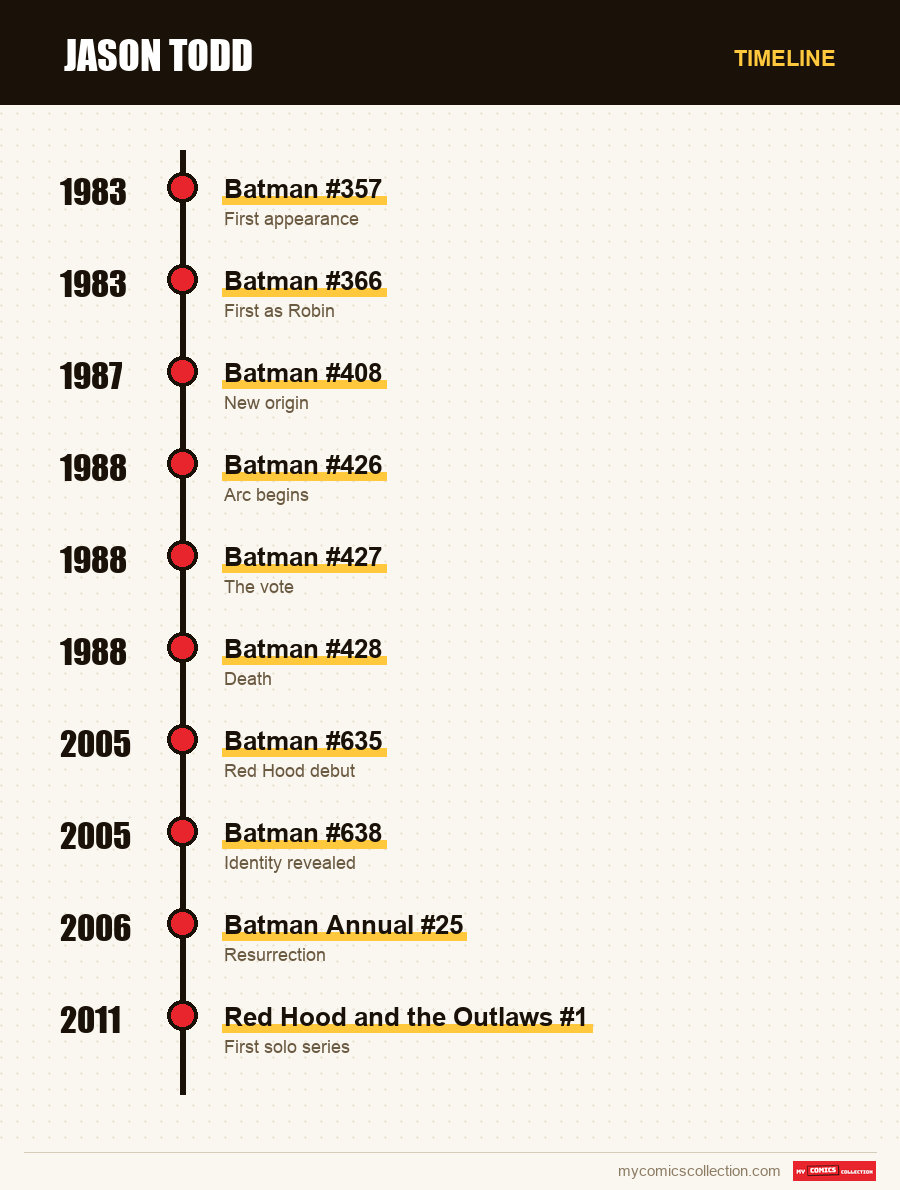
Batman #357
Gerry Conway and Don Newton introduce Jason Todd, Dick Grayson's future successor as Robin. The same issue also marks Killer Croc's first appearance. It is where the character's whole journey begins.
Batman #428
The readers' vote is settled: Batman searches the rubble of the warehouse and finds Jason's body, while his mother Sheila Haywood dies as well. Written by Jim Starlin and drawn by Jim Aparo, this is the issue that seals the second Robin's death.
Batman #427
Jason finds his biological mother, who hands him over to the Joker. Tortured, he is left in the rigged warehouse and the issue ends with the explosion. Readers were then invited to vote by phone to decide his fate: 10,614 votes, with death winning by 72.
Batman #635
The first chapter of "Under the Hood", by Judd Winick and Doug Mahnke: a new criminal in a red helmet takes on Batman and muscles into Gotham's underworld. Nobody yet knows who is under the helmet. It is the start of Jason Todd's return.
Batman #638
After leaving the Joker unconscious, the Red Hood takes off his helmet in front of Batman: he is Jason Todd, the former Robin killed by the Joker. This fourth chapter of "Under the Hood" ends nearly seventeen years of editorial death. A major turning point for the character.
Batman Annual #25
Judd Winick and Shane Davis explain how Jason Todd survived, tying his return to Infinite Crisis, and how he took the Joker's old name, Red Hood. The issue also includes a one-page alternate ending to "A Death in the Family", written by Jim Starlin and drawn by Jim Aparo.
Batman #408
After Crisis on Infinite Earths, Max Allan Collins and Chris Warner rewrite Jason's beginnings. One night in Crime Alley, Batman finds that someone has stolen the Batmobile's tires: this is how he meets a street kid. The story continues through #411.
Batman #426
The first chapter of "A Death in the Family" by Jim Starlin and Jim Aparo. Benched by Batman, Jason sets off to find his biological mother while the Joker prepares a new scheme. Mike Mignola provides the arc's covers.
Batman #366
Written by Doug Moench and pencilled by Don Newton, Jason Todd appears in a Robin costume for the first time, in a story against the Joker. He only officially becomes Robin a few issues later, in #368. An often overlooked milestone of the pre-Crisis era.
Red Hood and the Outlaws #1
The New 52 launch of the first ongoing series centered on Jason Todd, by Scott Lobdell and Kenneth Rocafort. The Red Hood teams up with Roy Harper and Starfire, far from Gotham. The series establishes Jason as a character who can carry his own title.