
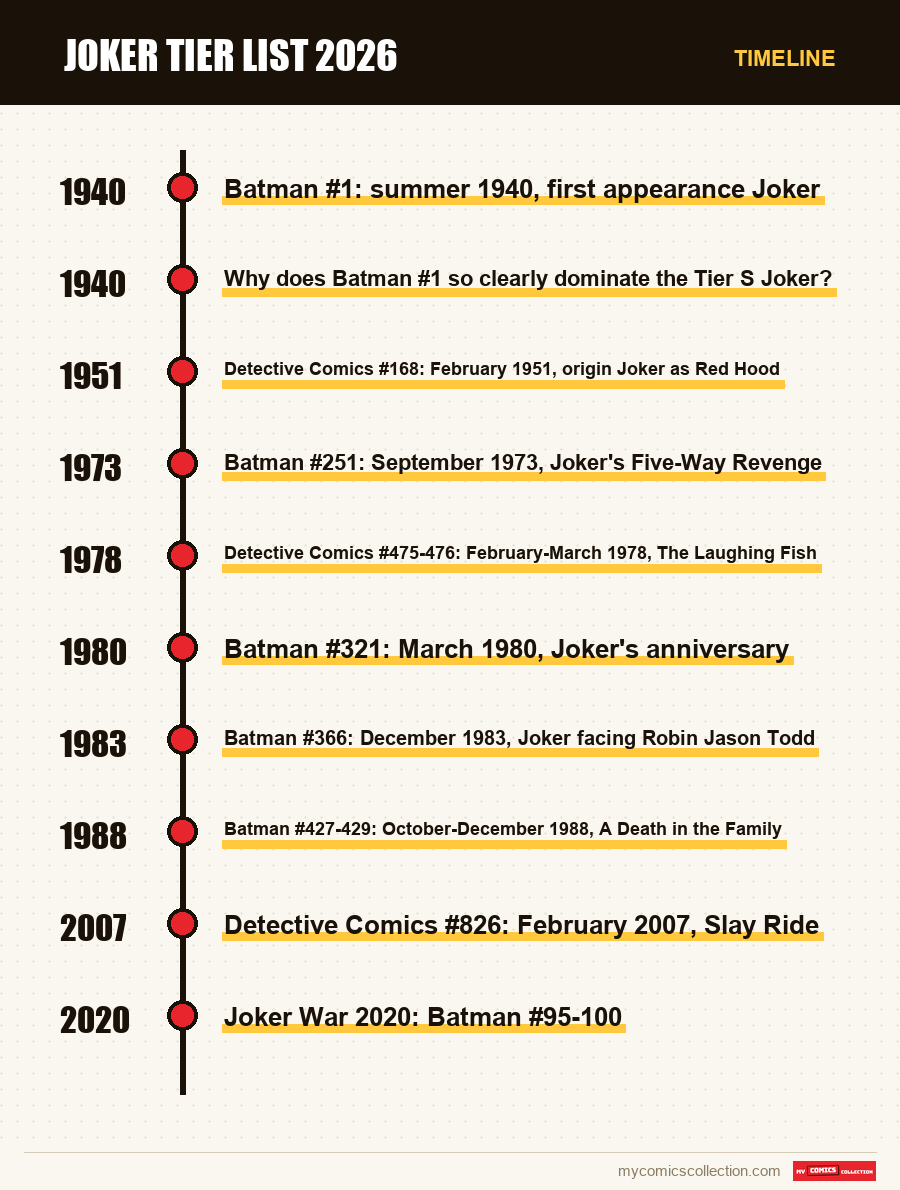
La tier list Joker 2026 prioritizes Clown Prince of Crime keys by historical value, liquidity and rating resilience. The blue-chip Tier S brings together four unassailable parts: Batman #1 (summer 1940, first Joker appearance by Bob Kane, Jerry Robinson and Bill Finger), Detective Comics #168 (February 1951, origin retcon Joker as Red Hood), Batman #251 (September 1973, Joker's Five-Way Revenge by Dennis O'Neil and Neal Adams, Modern Joker), and Batman: The Killing Joke (1988, one-shot Alan Moore and Brian Bolland with crippled Barbara Gordon). Tier A includes Batman #321 (March 1980, Joker anniversary), Batman #366 (December 1983, debut Robin Jason Todd opposite Joker), Batman #427-429 (October-December 1988, A Death in the Family by Jim Starlin and Jim Aparo), and the 1st Catwoman in Batman #1. Tiers B and C cover sleepers and post-MCU spec DCU 2026-2028.
La tier list Joker 2026 ranks keys from the largest villain DC by expected yield, observed rarity and 36-month rating resilience. The method does not consist of stacking first appearances by date: a serious tier ranking crosses four dimensions, historical value (a cult comic always sells, regardless of the DCU cycle), market liquidity (how many monthly CGC sales on eBay and Heritage), spec adaptation potential (the James Gunn 2025-2030 DCU reboot opens a new post-Joaquin Phoenix Joker cycle Joker 1 and 2) and the ratio of raw entry price / CGC rating. The four pieces of Tier S alone concentrate more than 80% of the historical value of the character in collection, a significantly more concentrated ratio than for Batman, Superman or Wonder Woman, because the Joker is one of the rare DC villains whose first appearance is also that of a major title (Batman #1 also contains the first appearance of Catwoman).
This article dissects each tier with precise dates, original creators, May 2026 price ranges observed on eBay and Heritage Auctions, and purchasing strategies by budget (500, 2,000, 10,000, 50,000 and 200,000 euros). Joker is one of the most trapped DC characters on the market Golden Age: Priority Batman #1 vs. Detective Comics #27 (first Batman, May 1939, without Joker), the multiple reprints and facsimile editions of The Killing Joke 1988 (first print, second print, first hardcover Deluxe, facsimile 2008, facsimile 2018 30th anniversary), confusion Batman #251 Adams cover vs Adams reprint, or the differential rarity Detective #168 origin Red Hood deserve a dedicated traps section. The 2026-2030 tracker indicates likely resale windows and arcs to anticipate for the long-term spec under the new DCU.
Joker tier list methodology: how to classify a Golden Age DC key issue?
A tier list comics Joker is not a subjective fan opinion, it is an analytical grid applicable to any serious collection, in particular on a character who covers 86 years of editorial history (1940-2026). The S, A, B, C classification used here is based on four weighted and measurable criteria. First criterion, historical value. A key issue which marks the first appearance of a character who has become iconic enters Tier S by default. Batman #1 (summer 1940) falls into this category without possible debate: it is not only the first Joker appearance, but also the first Catwoman appearance, and the first Batman solo title, making it one of the three or four most historically dense comics of DC's golden age, alongside Action Comics #1 (1938, Superman) and Detective Comics #27 (1939, Batman).
Second criterion, liquidity observed over 12 rolling months. The Heritage and eBay market publishes between 2 and 8 CGC sales each quarter for Batman #1 (absolute rarity requires low frequency but maximum visibility), compared to 8 to 15 monthly sales for Batman: The Killing Joke 1988. This liquidity conditions the ease of resale: a Tier S Golden Age like Batman #1 requires a minimum resale horizon of 12 to 24 months, while a modern Tier S like The Killing Joke sells in a few weeks on eBay.
Third criterion, resilience in the face of spec cycles. A Tier S comic maintains its rating even if an adaptation is postponed or disappointing. Batman #1 changed little in relative rating between 2015 and 2020 (disappointing post-Suicide Squad 2016 and Justice League 2017 cycle), then progressed strongly with the DCU reboot James Gunn announced in 2023 and the Joker Joaquin Phoenix 2019-2024. A Tier C, on the other hand, can drop by 60 to 80% in 6 months if the adaptation disappoints or is canceled. Fourth criterion, the raw entry price / high CGC rating ratio. For the Golden Age Joker, the CGC vs raw ratio is extreme: a Batman #1 CGC 9.0 is worth $2.2 million (Heritage 2021 record), while an incomplete or badly damaged example can fetch $8,000-$15,000. The raw / CGC grid is therefore not applicable in Golden Age, where each copy is a unique case.
The weighting retained for this Joker 2026 tier list attributes 45% to historical value (weight slightly above average, justified by the historical depth of the character), 20% to liquidity, 20% to resilience and 15% to the entry ratio. With this grid, the four pieces of Tier S obtain a score higher than 88/100. Tier A is between 72 and 87. Tier B between 56 and 71. Tier C, more speculative, oscillates between 40 and 55. This hierarchy is revised each year based on documented sales over 12 rolling months and official DC Studios announcements. To understand the general methodology applied to other DC characters, see the Batman 2026 tier list et the Harley Quinn tier list 2026, particularly complementary.
The tier list does not exempt you from reading the key issues Joker complete nor a comparative analysis of the major arcs like Joker story in comics. It serves as a prioritization tool: where to start a Joker collection with 500, 2,000, 10,000, 50,000 or 200,000 euros? The answer changes radically depending on the preferred tier, risk tolerance and hold horizon (3 years, 7 years, 15 years, 25 years). The following sections provide the exact numbers to arbitrate each tier with consistent allocation discipline.
Tier S. The four unassailable Joker blue-chips
Le Tier S Joker brings together the four comics whose absence in a serious collection of the character is prohibitive. These coins concentrate historical value, dominate the secondary market in terms of liquidity, and withstand speculative cycles over decades. Buying these four issues, in any grade that suits the budget, forms the heritage foundation of a Joker collection.
Batman #1: summer 1940, first appearance Joker (Bob Kane, Jerry Robinson, Bill Finger)
Batman #1, dated summer 1940 (cover date with mention "Spring 1940" on some sources, but the market consensus retains "summer 1940" and the date of sale April 1940), created by Bob Kane (official credit), Jerry Robinson (visual creator of the Joker according to modern historical research) and Bill Finger (screenplay, narrative creator of the Joker according to the same research), contains the first appearance of the Joker on the cover and the first appearance of Catwoman in the same edition. The issue is the first solo Batman title following initial appearances in Detective Comics from #27 (May 1939). The historical density of Batman #1 is probably the highest in Golden Age DC after Action Comics #1 (Superman, 1938). The estimated print run is 200,000 to 300,000 copies, with an extremely low survival rate in high condition: fewer than 100 CGC 7.0+ copies are documented to date.
Rating May 2026: CGC 9.4 between $2,100,000 and $2,800,000 (the Heritage Auctions record from January 2021 set $2.22 million for a CGC 9.4 white pages, and the rating has increased since then). CGC 9.0 between $1,200,000 and $1,600,000. CGC 8.0 between $480,000 and $720,000. CGC 6.0 between $180,000 and $280,000. CGC 4.0 between $65,000 and $95,000. CGC 2.0 between $25,000 and $40,000. Incomplete or restored copies between 8,000 and 30,000 dollars depending on condition. The rating tripled between 2015 and 2021 and stagnated slightly in 2026 after the record peak. For a full analysis of the record prices, see Batman #1 1940 value. It is the absolute cardinal piece of any Joker collection, and its purchase is not discussed if the budget allows it.
Detective Comics #168: February 1951, origin Joker as Red Hood
Detective Comics #168, dated February 1951, story by Bill Finger and drawn by Lew Schwartz and Win Mortimer, contains the story "The Man Behind the Red Hood!" which first establishes the Joker's origin as the criminal formerly known as Red Hood, transformed after falling into a vat of acid at Monarch Playing Card Company. This origin will be taken up and canonized by Alan Moore in Batman: The Killing Joke in 1988, which makes Detective #168 the character's most historically significant origin retcon. Before 1951, the Joker had no official origin. The number is also crucial in the context of Batman: Under the Red Hood 2005 and the eponymous 2010 animated film, which reused the name Red Hood for the resurrected Jason Todd.
Rating May 2026: CGC 9.0 between $95,000 and $145,000. CGC 8.0 between $38,000 and $58,000. CGC 6.5 between $14,000 and $22,000. CGC 5.0 between $6,500 and $10,000. CGC 3.0 between $2,800 and $4,200. CGC 1.8 between $1,200 and $1,800. Raw VG between 1,200 and 2,000 euros. Raw GD between 600 and 950 euros. The rating doubled between 2018 and 2024 with the buzz of Red Hood Jason Todd in several animated and live action adaptations, and the repeated mention of the Red Hood in the DCU James Gunn. Central Tier S position for anyone investing more than 5,000 euros in a Joker collection, but remains out of budget for collectors starting at 500-2,000 euros.
Batman #251: September 1973, Joker's Five-Way Revenge (O'Neil and Adams, Modern Joker)
Batman #251, dated September 1973, written by Dennis O'Neil and drawn by Neal Adams, contains the story "Joker's Five-Way Revenge" which marks the Joker's return as a ruthless killer after the camp years of the 1960s. Before this issue, the Joker had become a comic character under the influence of the 1966 Batman TV show with Cesar Romero. O'Neil and Adams reimagine the character as a psychopathic, murderous criminal, laying the narrative foundation for the entire modern Joker. This reinvention will be extended by the runs Steve Englehart, Frank Miller, Alan Moore and all the post-1973 Joker writers. Neal Adams' iconic cover, showing an evil Joker with a creepy smile, is probably the most reproduced and iconic Bronze Age Batman cover in DC history.
Rating May 2026: CGC 9.8 between $4,200 and $6,200. CGC 9.6 between $1,400 and $2,200. CGC 9.4 between 580 and 880 dollars. CGC 9.0 between 240 and 380 dollars. CGC 8.0 between 110 and 170 dollars. CGC 6.0 between 45 and 70 dollars. Raw NM between 180 and 280 euros. Raw VF between 65 and 100 euros. Raw VG between 28 and 45 euros. The CGC 9.8 / raw NM ratio exceeds 18, making it one of the best grading levers in Tier S Joker. The Adams cover is also available in reprints from the 2000s and 2010s (DC Millennium Editions, facsimile 2023), with a very lower rating (raw NM 5-12 euros for reprints), not to be confused. To understand the context of the Bronze Age Batman, see Batman story in comics.
Batman: The Killing Joke: 1988, Alan Moore and Brian Bolland (Barbara Gordon paralysis)
Batman: The Killing Joke, published in March 1988 in one-shot prestige format, written by Alan Moore and drawn by Brian Bolland, is probably the most influential and most cited Joker comic in modern history. The one-shot features the Joker's first complete canonical origin (before he was Joker, he was a failed comedian named Jack), reuses the Red Hood origin from Detective #168 1951, and marks the traumatic event of Barbara Gordon's (Batgirl) paralysis by gunshot, a transformation that would lead her to become Oracle in the following years. Alan Moore's non-linear storytelling and Brian Bolland's photographic art set a new standard for Prestige Edition DC. The one-shot was reprinted more than 40 times between 1988 and 2026, with variations in color and format that merit separate analysis.
Rating May 2026: CGC 9.8 between 380 and 580 dollars (first print 1988). CGC 9.6 between 140 and 220 dollars. CGC 9.4 between 65 and 100 dollars. CGC 9.0 between 30 and 45 dollars. Raw NM between 25 and 45 euros (first print). Raw VF between 10 and 18 euros. The CGC 9.8 / raw NM ratio is exceptional (around 12), among the most relevant in Tier S Joker for grading. The rating doubled between 2018 and 2024 with the buzz Joker Joaquin Phoenix 2019 and Joker 2 Folie à Deux 2024, and stagnated slightly in 2026. Tier S position central and affordable for any collection budget 500 euros and more. For the print detection method (first, second, third, hardcover deluxe 2008, facsimile 2018), see Batman Killing Joke value et key issues Killing Joke.
Tier A: Joker secondary essentials
Le Tier A Joker brings together comics that immediately follow Tier S in importance, without reaching absolute blue-chip status. These four pieces are important for a coherent collection of the character and often offer a better entry price / upside potential ratio than the Tier S already historicized and widely recognized by the market.
Batman #1-1st Catwoman (same issue as 1st Joker)
The special place of Batman #1 (summer 1940) in this tier list deserves an analytical duplication: the number is Tier S for the 1st Joker, and Tier A separately for the 1st Catwoman, who appears in the same edition. This historical double density explains why Batman #1 is one of the most expensive comics of the Golden Age after Action Comics #1 and Detective Comics #27. For collectors who invest in Batman #1, Catwoman value adds to Joker value in the odds calculation, justifying a 15-25% premium over comparable Golden Age odds without this multiple density. The initial print run remains estimated at 200,000-300,000 copies, with survival in high condition extremely low.
For allocation strategy, it is important to understand that purchasing a Batman #1 simultaneously counts Tier S Joker and Tier S Catwoman, making it a particularly efficient investment for those who collect both characters. The cover of #1 shows Batman and Robin on rooftops, with no Joker or Catwoman visible, which may mislead non-specialist buyers. For a complete analysis of the multiple first appearance mechanic, see Harley Quinn story in comics, where the same problem arises for Batman Adventures #12 (1993, first Harley Quinn appearance AND first Joker animated series crossover).
Batman #321: March 1980, Joker's anniversary
Batman #321, dated March 1980, story by Len Wein and drawn by Walt Simonson (cover by José Luis García-López and Dick Giordano), contains the story "Dreadful Birthday, Dear Joker!" which marks the Joker's birthday party and includes an iconic cover by García-López showing the Joker cutting a cake. The García-López/Giordano cover is one of the most recognizable Bronze Age Batmans and has been widely reused in merchandising, reissue covers, and modern references. The issue is crucial to the narrative: it marks the establishment of the Joker as a recurring character in the post-O'Neil/Adams Len Wein run, and foreshadows the Joker resurgence of the 1980s.
Rating May 2026: CGC 9.8 between 580 and 880 dollars. CGC 9.6 between 220 and 340 dollars. CGC 9.4 between 95 and 145 dollars. CGC 9.0 between 45 and 70 dollars. Raw NM between 35 and 55 euros. Raw VF between 14 and 22 euros. The CGC 9.8 / raw NM ratio is around 16, which justifies the grading for the pristine copies. The iconic cover justifies the Tier A position, despite the relative narrative discretion of the interior story. Long hold position preferred to short term spec. The issue deserves its place in any complete Bronze Age Batman/Joker collection.
Batman #366: December 1983, Joker facing Robin Jason Todd
Batman #366, dated December 1983, written by Doug Moench and drawn by Don Newton (cover Ed Hannigan), contains the first appearance of Jason Todd in his Robin costume facing the Joker. Before this issue, Jason Todd had existed for Batman #357 (March 1983) as an orphan taken in by Bruce Wayne, but #366 officially marks his introduction as Robin in a direct confrontation with the Joker, foreshadowing the traumatic events of A Death in the Family 1988. The issue is crucial to understanding the narrative dynamic that will lead Jason Todd to become Red Hood two decades later. The Hannigan cover shows Robin (Jason Todd) facing off against the Joker in an iconic set-up.
Rating May 2026: CGC 9.8 between 320 and 480 dollars. CGC 9.6 between 120 and 180 dollars. CGC 9.4 between 55 and 85 dollars. CGC 9.0 between 25 and 40 dollars. Raw NM between 22 and 35 euros. Raw VF between 10 and 16 euros. The CGC 9.8 / raw NM ratio exceeds 14, which justifies grading on high condition examples. The rating increased from 80 to 120% between 2018 and 2024 with the Red Hood buzz and the integration of Jason Todd in Titans live action then the DCU James Gunn. Solid Tier A position with residual potential if a live action or animated Red Hood adaptation is confirmed by 2027-2028. For the full Jason Todd background, see Jason Todd story in comics.
Batman #427-429: October-December 1988, A Death in the Family (Jim Starlin and Jim Aparo)
Batman #427-429, dated October, November and December 1988, storyboarded by Jim Starlin and drawn by Jim Aparo (inker Mike DeCarlo), constitute the arc A Death in the Family in which the Joker kills Robin (Jason Todd) after readers cast a 1-cent telephone vote to decide his fate. The arc is one of the most notable events in modern DC history and one of the only instances where the death of a major character was decided by reader poll (5,343 votes for death to 5,271 against, of the 10,614 votes cast). #428 contains the actual death of Jason Todd by the Joker, in Ethiopia, by crowbar then explosion. #429 contains the immediate aftermath and Batman's investigation. The resurrection of Jason Todd as Red Hood in 2005 will directly reuse the events of this arc.
Rating May 2026 (by number). Batman #427 CGC 9.8 between 180 and 280 dollars, CGC 9.6 between 70 and 110 dollars, raw NM between 15 and 25 euros. Batman #428 CGC 9.8 between 380 and 580 dollars (the Jason Todd death episode commands a premium), CGC 9.6 between 140 and 220 dollars, raw NM between 28 and 45 euros. Batman #429 CGC 9.8 between 140 and 220 dollars, CGC 9.6 between 55 and 85 dollars, raw NM between 12 and 20 euros. The rating tripled between 2015 and 2024 with multiple mentions of Red Hood Jason Todd in Titans , Gotham Knights video games, and waiting for DCU. Priority Tier A position for the entire arc. For the full arc analysis, see Batman Death in the Family value.
Tier B: Joker sleepers and underrated bows
Le Tier B Joker brings together the sleepers, that is to say the issues which deserve the attention of informed collectors but whose value the general market has not yet fully recognized. These pieces often present the most relevant price/potential ratios at 24-36 months, with downside risk limited by objective rarity or narrative centrality.
Detective Comics #475-476: February-March 1978, The Laughing Fish (Englehart, Rogers, Austin)
Detective Comics #475-476, dated February and March 1978, story by Steve Englehart and drawn by Marshall Rogers with inking Terry Austin, contain the arc The Laughing Fish in which the Joker attempts to patent dead fish by giving them his signature smile. The arc is one of the most emblematic of the Joker bronze age, and was directly adapted into an episode of Batman: The Animated Series 1992 (with some modifications). The Rogers cover for #475, showing the Joker with smiling fish, is one of the most iconic Joker covers ever published. The Englehart/Rogers/Austin short run on Detective Comics (#471-476) is considered one of the most influential Batman runs of all time, despite its brevity.
Rating May 2026 (by number). Detective Comics #475 CGC 9.8 between 1,200 and 1,800 dollars, CGC 9.6 between 480 and 720 dollars, CGC 9.4 between 200 and 300 dollars, raw NM between 95 and 145 euros. Detective Comics #476 CGC 9.8 between 580 and 880 dollars, CGC 9.6 between 220 and 340 dollars, raw NM between 45 and 70 euros. The rating increased by 100 to 150% between 2018 and 2024 with the gradual awareness of the historical importance of the Englehart/Rogers run. Priority Tier B position for Bronze Age collectors, with downside risk very limited by objective rarity and narrative centrality.
Batman #251 reprint Adams cover: later editions
The Neal Adams cover of Batman #251 (September 1973) was reused in several subsequent editions: DC Millennium Edition: Batman #251 (2001), Greatest Joker Stories Ever Told (1988 and reissues), and several facsimile editions in the years 2010-2020. These reprints share the same iconic cover with the original but at a very different price (raw NM 5-15 euros, CGC 9.8 60-150 dollars). The confusion between original and reprint is one of the most common pitfalls of the Joker Bronze Age market. The distinction is made on the cover price (20 cents for the 1973 original, $2.50 and more for the reprints) and the mention DC Millennium Edition on the cover of the 2001 reprint.
This sleeper Tier B subcategory specifically concerns the DC Millennium Edition #251 (2001), which faithfully reproduces the contents of the original with a Millennium logo band at the top of the cover. The rating doubled between 2020 and 2024 and remains underestimated by the general market. Rating May 2026: CGC 9.8 between 120 and 180 dollars, raw NM between 18 and 30 euros. Long hold position preferred to short term spec. The Millennium Edition is also an excellent substitute for collectors who want the Adams cover without the cost of the Bronze Age original.
Detective Comics #826: February 2007, Slay Ride (Paul Dini)
Detective Comics #826, dated February 2007, written by Paul Dini and drawn by Don Kramer, contains the story "Slay Ride" in which the Joker takes Robin (Tim Drake) hostage on Christmas Eve. The story is considered one of the most relevant Joker stories of the 21st century, for its narrative concision (only one outcome) and its psychological tension. Paul Dini, creator of Batman: The Animated Series and co-creator of Harley Quinn, is the modern Joker writer most recognized for successfully balancing humor and menace. The number is part of the Dini run on Detective Comics (#821-851, 2006-2009), considered one of the most consistent Detective runs of the 2000s.
Rating May 2026: CGC 9.8 between 140 and 220 dollars. CGC 9.6 between 55 and 85 dollars. Raw NM between 18 and 30 euros. Raw VF between 8 and 14 euros. The rating increased by 60 to 100% between 2020 and 2024 without any specific buzz, a classic signal of a sleeper being revalued. Long hold position preferred to short term spec. The issue is also a great entry point for collectors who want to read a modern Joker without getting into the long, complex arcs typical Joker War or Death of the Family.
Joker War 2020: Batman #95-100 (James Tynion IV)
The bow Joker War , published in Batman #95-100 between July and December 2020, written by James Tynion IV and drawn primarily by Jorge Jiménez, marks one of the most ambitious Joker arcs of the 2020s. The Joker seizes the Wayne fortunes and takes control of Gotham for several weeks. The arc also introduces the character Punchline, Joker's sidekick who will be central to the post-2020 Joker mythology. The cover of #100 (December 2020) is one of the most iconic modern Batman covers and has been released in multiple variations. The Tynion IV run on Batman (#86-117, 2020-2022) is considered one of the most consistent modern Batman runs.
Rating May 2026 (selection). Batman #89 (first Punchline teaser) CGC 9.8 between 180 and 280 dollars, raw NM between 28 and 45 euros. Batman #92 (first full Punchline cover) CGC 9.8 between 240 and 360 dollars, raw NM between 35 and 55 euros. Batman #95 (first issue Joker War) CGC 9.8 between 95 and 145 dollars, raw NM between 18 and 28 euros. Batman #100 (final Joker War) CGC 9.8 between 140 and 210 dollars, raw NM between 22 and 35 euros. Tier B position with Punchline emphasis for the long-term spec: if a live action Punchline adaptation is confirmed in the James Gunn DCU, the corresponding key issues could increase by 50 to 120% over 24 months.
Tier C: Spec 2026-2028 and DCU reboot James Gunn
Le Tier C Joker brings together high-risk speculative bets, the odds of which mainly depend on cinema or TV announcements not yet confirmed. These pieces should not exceed 5-10% of a Joker collection budget, but can outperform if the right catalyst arrives. Three speculative axes dominate in 2026.
DCU reboot effect James Gunn 2025-2030 and Joker fallout
The DCU reboot announced by James Gunn and Peter Safran in January 2023 began its deployment in 2025 with Superman by James Gunn. The plan includes several phases through 2030, with Batman integration planned in The Brave and the Bold (Andy Muschietti film, date unconfirmed late 2027 or 2028) and a DCU Joker whose casting has not been announced in 2026. Independently of the DCU Joker, the Joaquin Phoenix Joker (Elseworlds, outside DCU) continues to influence the market with Joker: Folie à Deux 2024. The 2026 spec is to anticipate the Joker DCU casting and the arcs that could be adapted in The Brave and the Bold.
Tier C spec parts to watch out for: Joker Vol 2 #1 (March 2021, James Tynion IV) which marks the return of the Joker in a solo series, raw NM 12-22 euros, negligible downside risk. Joker Year One In Batman & The Joker: The Deadly Duo 2022-2023, raw NM 8-15 euros, low cost spec with moderate potential. Three Jokers (Geoff Johns 2020) raw NM 18-35 euros the complete set (3 issues), long-term spec with limited downside risk. The upside potential over 24 months is estimated between 40 and 100% if The Brave and the Bold announces confirmed Joker casting and an arc inspired by one of these series. To identify arcs adaptable to the DCU, see spec keys 2027 Marvel DC movies series.
Independent Joker and Black Label DC 2026
Since 2018, DC Black Label has been publishing Joker series independent of the main continuity (DC Universe), with an adult target and greater creative freedom. These series include Batman: Three Jokers (2020, Geoff Johns and Jason Fabok), Joker / Harley: Criminal Sanity (2019, Kami Garcia), Joker: Killer Smile (2019, Jeff Lemire), and several others. The Black Label market is underpriced on average, because the majority of Joker collectors focus on the main continuity and neglect these titles. This habit creates opportunities for arbitration on certain issues which have influenced modern live action (notably Joker Joaquin Phoenix 2019 which is partially inspired by several Black Label).
Tier C Black Label spec parts to watch out for: Batman: Damned #1 (October 2018, Brian Azzarello and Lee Bermejo) with controversial Nightwing/Joker cover, raw NM 25-45 euros. Joker / Harley: Criminal Sanity #1 (October 2019) raw NM 12-22 euros. Joker: Killer Smile #1 (October 2019) raw NM 10-18 euros. The 24-month upside potential is estimated between 30 and 80% in the event of a Black Label adaptation announcement by DCU James Gunn. Satellite spec position to be diversified across 5-8 different pieces to limit downside risk.
Modern 1:25 and 1:50 variants Joker 2024-2026
The 1:25, 1:50 and 1:100 incentive variants on the Joker 2024-2026 series constitute a third Tier C spec axis. DC systematically publishes several variants by number for the major arcs: 1:25 ratio variants (one copy for 25 orders), 1:50 variants, 1:100 variants, plus virgin variants and acetate covers on key pieces. These variants sell for between 80 and 600 euros upon release depending on the ratio, with a price trajectory depending on the arc and the artist. The downside risk remains high: a variant that does not make an impact can fall by 70% in 18 months if the arc disappoints.
Rule of thumb Tier C 2026: do not exceed 100-300 euros per individual spec bet, diversify across 5-8 different coins, set a resale threshold at +100% gross. For a spec portfolio discipline and hold method, see investment strategy update 2027. Tier C is a satellite compartment: it complements but never replaces a solid Tier S and A base. The specific rule for the Joker is that the historical stability of the character (the only DC villain continuously published since 1940) makes Joker spec bets less volatile than on other more recent characters.
Collecting this series?
Track what you own, what you are missing and what your collection is worth. 7 day trial.
Start my trial →Purchasing strategy by budget: 500, 2,000, 10,000, 50,000 and 200,000 euros
La Joker purchasing strategy depends directly on the available budget and the hold horizon. Five budget profiles are rational for 2026, each with an optimal mix of thirds and consistent allocation discipline. The Joker is distinguished from other characters by the need for a high window to access Tier S Golden Age (Batman #1 remains out of reach under 25,000 euros).
Budget 500 euros: Joker beginner collection
At 500 euros, the objective is heritage access without grading and without Tier S Golden Age. Suggested allowance: 30 euros for Batman: The Killing Joke 1988 raw NM (the accessible Tier S coin), 100 euros for Batman #251 raw VF (modern Joker O'Neil/Adams in equivalent grade CGC 7.0-8.0), 25 euros for Batman #428 raw NM (died Jason Todd), 35 euros for Batman #321 raw NM (anniversary), 30 euros for Detective Comics #826 raw NM (Slay Ride Dini), 50 euros for Batman #95-100 raw NM (complete Joker War), 80 euros for 8-10 key issues Bronze Age and secondary moderns, 150 euros reserve for opportunities. This allowance covers the modern Joker major bows without grading, at an accessible budget. For a complete method of DC input, see DC comics for beginners guide.
Budget 2,000 euros: Joker intermediate collection
At 2,000 euros, the introduction of grading on modern key parts becomes relevant, but the Tier S Golden Age remains inaccessible. Suggested allowance: 380 euros for Batman: The Killing Joke CGC 9.8 first print (the affordable Tier S part in high condition), 580 euros for Batman #251 CGC 9.4 (modern Joker in investment grade), 380 euros for Batman #428 CGC 9.8 (dead Jason Todd), 220 euros for Batman #321 CGC 9.6 (anniversary), 95 euros for Batman #366 raw NM (1st Robin Jason Todd facing Joker), 100 euros for Detective Comics #475 raw VF (Laughing Fish sleeper), 245 euros for 8-10 sleepers Tier B and C raw NM. This allocation builds a serious collector's collection with grading accents on key modern narrative pieces.
Budget 10,000 euros: Joker investor collection
At 10,000 euros, Tier S Golden Age remains inaccessible (Detective Comics #168 starts at 1,200 euros in very low grade and quickly reaches several tens of thousands), but a modern museum-quality collection becomes possible. Suggested allowance: 2,000 euros for Detective Comics #168 CGC 1.8-3.0 (the cardinal Tier S part accessible in low grade), 1,400 euros for Batman #251 CGC 9.6 (high condition modern Joker), 580 euros for Batman: The Killing Joke CGC 9.8, 580 euros for Batman #428 CGC 9.8, 1,200 euros for Detective Comics #475 CGC 9.6, 880 euros for Batman #321 CGC 9.8, 480 euros for Batman #366 CGC 9.6, 1,200 euros for Tier A and B raw NM diversified collection, 1,680 euros reserve for opportunities. The portfolio combines investment (Tier S grading authenticated) and a complete modern narrative collection. Hold target for 7-10 years with rebalancing every 24 months.
Budget 50,000 euros: Joker heritage collection
At 50,000 euros, the purchase of a Detective Comics #168 in collector grade becomes possible, but Batman #1 remains out of budget. Suggested allocation: 22,000 euros for Detective Comics #168 CGC 5.0-6.5 (the cardinal Golden Age coin in investment grade), 6,200 euros for Batman #251 CGC 9.8 (Modern Pristine Joker), 2,200 euros for Batman: The Killing Joke CGC 9.8 plus alternative prints, 1,800 euros for Detective Comics #475-476 CGC 9.6-9.8, 2,800 euros for complete collection A Death in the Family #427-429 CGC 9.8, 4,800 euros for complete Tier A collection in CGC 9.6-9.8, 6,000 euros for 15-20 Tier B and C sleepers diversified in CGC, 4,200 euros cash reserve for opportunities. For the logistical management of this level of collection, see comics manager complete guide.
Budget 200,000 euros: Joker museum collection
At 200,000 euros, the purchase of a Batman #1 in moderate grade becomes possible and constitutes the main objective. Suggested allocation: 95,000 euros for Batman #1 CGC 4.5-5.5 (the absolute cardinal piece Joker Golden Age), 38,000 euros for Detective Comics #168 CGC 8.0 (original Red Hood high condition), 14,000 euros for Detective Comics #475 CGC 9.8, 8,000 euros for Batman #251 CGC 9.8 plus #321 CGC 9.8, 6,000 euros for complete collection A Death in the Family CGC 9.8, 4,500 euros for Batman: The Killing Joke CGC 9.8 plus all major prints, 12,000 euros for complete Tier A and B collection in CGC 9.6-9.8, 22,500 euros cash reserve for Heritage opportunities and upgrades. At this level, the collection becomes a heritage asset transferable over several generations, with a target hold of 15-25 years.
Cautious method. Whatever the budget bracket, do not exceed 65% of the envelope on a single Tier S part, unless the explicit objective is to acquire a Batman #1 in high condition grade. If Detective Comics #168 or Batman #1 monopolizes a budget, the collection loses its narrative coherence and its resilience in the face of cycles. Diversification between Tier S, A and B remains the key to a balanced Joker collection that is resilient to spec cycles.
Joker Traps: Batman #1 vs Detective #27, multiple prints Killing Joke, restored Golden Age
Five technical pitfalls characterize the Joker market and cause the most costly mistakes among beginning and intermediate collectors. Identifying them conditions the quality of any Tier S and A investment. The Joker is one of the most trapped characters on the DC market due to the historical depth of the catalog (1940-2026), the proliferation of prints on modern titles, and the concentration of counterfeits on high-value Golden Age titles.
Trap 1: Batman #1 vs Detective Comics #27 priority
The most common strategic trap concerns arbitrage Batman #1 (summer 1940, 1st Joker, 1st Catwoman) vs Detective Comics #27 (May 1939, 1st Batman). Both coins are absolute Golden Age DC Tier S, but the investment per equivalent grade differs significantly. Detective Comics #27 CGC 5.5 is worth around $750,000 in 2026, compared to $280,000 for Batman #1 CGC 5.5 (ratio 2.7 in favor of Detective #27). For a Joker collector, the question is: do you need a Batman #1 moderate grade or Detective #27 very low grade? The answer depends on the purpose: priority Joker collection = Batman #1, general Batman collection = Detective #27. The two comics are not interchangeable. For the full strategy, see Batman #1 1940 value.
The secondary risk is to confuse Batman #1 (summer 1940, DC Comics, Joker and Catwoman) with Batman #1 from other later series: Batman: The Dark Knight Returns #1 (1986, Frank Miller, which is also sometimes listed as "Batman #1" in error), Batman: Year One start in Batman #404 (1987), Batman Vol 2 #1 (2011, New 52 Scott Snyder), Batman Vol 3 #1 (2016, Rebirth Tom King), Batman Vol 4 #1 (2023, Chip Zdarsky). Verification is mandatory: cover date, cover price (10 cents for 1940, and more for modern Vols), DC Comics mention, presence of Joker in the content.
Trap 2: multiple prints Killing Joke 1988
Batman: The Killing Joke has been reprinted more than 40 times between 1988 and 2026, with variations that merit separate analysis. The first print 1988 (original cover Brian Bolland) is the most sought after: squareback cover with ISBN, price 3.50 dollars (USA) or £1.95 (UK). The second, third and fourth prints 1988-1990 reproduce the same cover but with the mention "Second Printing" and no longer in cover or indicia. The 2008 Deluxe Edition hardcover (re-colored by Brian Bolland himself) changes certain colors (notably the final flashback scene, now in color instead of black and white). The 2018 30th anniversary facsimile reproduces the 1988 first print identically but with a "Facsimile Edition" strip on the cover.
Differential rating 2026: first print 1988 CGC 9.8 between 380 and 580 dollars, raw NM between 25 and 45 euros. Second print 1988 CGC 9.8 between 120 and 180 dollars, raw NM between 8 and 14 euros. Third print 1989 CGC 9.8 between 80 and 130 dollars, raw NM between 6 and 10 euros. Hardcover 2008 Deluxe Edition CGC 9.8 between 95 and 145 dollars, raw NM between 18 and 30 euros. Facsimile 2018 raw NM between 8 and 14 euros, CGC 9.8 between 60 and 95 dollars. Verification is mandatory: mention printing on cover or indicia, cover price ($3.50 for first 1988 vs. higher Modern Age price), "Facsimile Edition" or "Deluxe Edition" strip. For the complete method of differentiation, see key issues Killing Joke.
Trap 3: restored CGC Golden Age copies without detection
THE Batman #1, Detective Comics #27 and Detective Comics #168, due to their high rating, are prime targets for fraudulent restores. Restoration involves recoloring the cover, reattaching detached pages, restoring the spine, or retouching the colors to increase the visual grade. CGC systematically identifies the restoration, which appears on the slab with the purple label "Restored" and a modified grade (e.g. "Restored 5.0 Extensive") rather than blue label "Universal". A restored example is typically worth 30 to 50% of a Universal example of equivalent grade. In the raw market, detection is complex and requires professional expertise (UV lighting, microscopic observation, edge and whiteness verification). Buying raw above 5,000 euros without expertise is very risky.
The simple rule: any purchase Batman #1, Detective #27 or Detective #168 above 5,000 euros must be in CGC blue label confirmed Universal. Heritage Auctions sales routinely document Universal or Restored status, allowing for quick verification via the HA Archives database. For the eBay market, caution is required: avoid any seller without documented CGC history, require high-resolution photos of the slab including the full label, and cross-check with the CGC Census database (population by grade and status).
Trap 4: Detective Comics #168 reprints and Red Hood confusion
Detective Comics #168 (February 1951) was the subject of several reprints in the "Greatest Joker Stories" and "DC Archives" collections, as well as in facsimile editions. These reprints reproduce the content of the original but at a very different price (raw NM 8-15 euros for standard reprints, 80-150 dollars CGC 9.8 for facsimile). Confusion with the Golden Age original is rare but expensive: a CGC 5.0 original is worth $6,500-10,000, compared to $60-95 for a CGC 9.8 facsimile. The distinction is made on the cover price (10 cents for 1951, and more for reprints), the mention "Facsimile Edition" on recent reprints, and the quality of the paper (yellowed newsprint for the original, modern white paper for the reprints).
The secondary risk concerns the narrative confusion between the Red Hood Joker (Detective #168, 1951) and the Red Hood Jason Todd (Batman: Under the Red Hood, 2005, and eponymous animated film 2010). Both characters use the name "Red Hood" but are distinct: the 1951 Red Hood is the pre-Joker origin of the criminal turned Joker, the 2005 Red Hood is Jason Todd resurrected after his death in A Death in the Family 1988. For the complete cartography, see Jason Todd story in comics. Narrative confusion can lead to buying Batman #635 (February 2005, first modern Red Hood Jason Todd) thinking of purchasing a Joker piece, which is a categorization error.
Trap 5: facsimile editions Batman #251 and Bronze Age reprints
DC has published several facsimile editions of Batman #251 (the iconic Neal Adams cover) in the 2010s and 2020s: DC Millennium Edition: Batman #251 (2001), DC Facsimile Edition: Batman #251 (2018), and several collected editions in the volumes "Greatest Joker Stories" or "Batman by Neal Adams". These reprints carry a "Facsimile Edition" or "Millennium Edition" label on the cover, and a modern cover price ($2.50 and up), but unscrupulous sellers sometimes present them as originals in blurry listings or low-resolution photos. Verification is immediate on the cover price (20 cents for 1973, more than 2 dollars for reprints) and the facsimile/Millennium mention. The facsimile/Millennium price remains modest (15 to 30 euros raw NM, 80 to 150 dollars CGC 9.8), without any connection with the original. The trap only arises in the event of a misleading listing.
Monitoring 2026-2030: resale windows and cycles to anticipate
Le long-term follow-up Joker over 2026-2030 must integrate several probable catalysts. DC Studios has not confirmed a firm date for the DCU Joker (who could appear in The Brave and the Bold or in a Max series), but internal projections point to 2027 or 2028 for the Batman introduction into the DCU. This window constitutes the probable speculative peak for Tier S Jokers, with a potential increase estimated between 15 and 30% on Golden Age blue-chips (already very high odds but possible margin) and between 40 and 100% on Tier A and B linked to secondary characters (Jason Todd, Punchline, Red Hood).
Indicative calendar 2026-2030. Year 2026: residual effect Joker: Folie à Deux 2024 still partially active, optimal purchasing window on Tier B and C before DCU rise. Year 2027: if firm announcement of Joker DCU casting and title The Brave and the Bold, start of the major speculative cycle, purchasing window gradually closing on Tier S and A. Year 2028: probable speculative peak around the release of the film The Brave and the Bold or the Joker DCU introduction, optimal resale window on Tier S (15-30% above 2026), Tier A (40-80%) and B (50-100%). Year 2029: post-peak digestion, rating stabilized or slightly decreasing, waiting for the next catalyst. Year 2030: new possible cycle with Joker spin-off or dedicated Max series.
The empirical rule observed on major DC key issues over 15 years: 55% of the pre-film increase occurs in the 12 months preceding the release, 30% at the release, 15% in the following 6 months. Beyond that, partial descent of 15 to 25% before stabilization. For Tier S Jokers, the 2028 peak should represent a partial resale opportunity, particularly on parts purchased in 2022-2024 at prices that are still reasonable. The optimal resale window extends from May to December 2028 according to this cycle. For an updated market analysis, see comics investment update 2027 strategy pillar.
Daily monitoring of Tier S ratings requires a tracking tool. A rating recorded in a notebook or static file is obsolete within 60 days. A Comics Manager that keeps grade-level estimates current provides the necessary refreshment to manage a 36-60 month hold strategy, with price alerts set on eBay rather than in the app. See the comics database et the list of key issues to quickly identify arbitrage opportunities. To estimate the current value of coins already owned, the free estimate provides an indicative range by grade and state. Monthly monitoring of Heritage and eBay sales remains the basis for any purchase or resale decision on Tier S Joker. For Batman/Joker/Harley crossover collectors, see the Batman 2026 tier list, the Harley Quinn tier list 2026 et key issues Court of Owls.
FAQ: Joker 2026 Tier List
Why does Batman #1 (1940) so clearly dominate the Tier S Joker?
Because this is the character's first full appearance on the cover, by her original creators Bob Kane, Jerry Robinson and Bill Finger, and the same edition also contains the first appearance of Catwoman. No other comic can claim the status of first issue Joker. The historical density of Batman #1 automatically places it at the top of Tier S, but its extreme rating (CGC 9.4 at $2.2 million Heritage 2021 record) makes it inaccessible to 99% of collectors. The liquidity of the market (2 to 8 quarterly CGC sales) confirms its position as an absolute museum piece. It is the central pivot of any heritage Joker collection exceeding 100,000 euros, but remains out of budget for beginner profiles at 500-10,000 euros.
Does Detective Comics #168 really deserve Tier S at $95,000 in CGC 9.0?
Yes, and this is precisely what makes the Tier S Golden Age coin accessible to investor collectors. The entry price/historical value ratio is exceptional compared to Batman #1: for around 5% of the price of a Batman #1 in equivalent grade, we access the canonical origin Joker in Red Hood (reused by Alan Moore in Killing Joke 1988 and adapted in Under the Red Hood 2005 and 2010). This is the first logical Tier S Golden Age acquisition for a heritage budget (10,000-50,000 euros). Beyond CGC 9.0, #168 remains accessible up to CGC 3.0 under $4,200, making it the most affordable Golden Age coin in Tier S Joker. The rating doubled between 2018 and 2024 and presents a residual margin of improvement for 2026-2030.
Should we favor the O'Neil/Adams run or the Killing Joke to enter the modern Joker collection?
The O'Neil/Adams run (Batman #251 and other appearances 1971-1974) remains the absolute reference for understanding the modern Joker: it is the Bronze Age reinvention that lays the narrative foundations for the entire post-1973 Joker. Without this run, the camp Joker of the 1960s would have remained the dominant version. Alan Moore and Brian Bolland's 1988 Killing Joke is the most influential modern play, but it is a continuation of the O'Neil/Adams work. For a coherent chronological reading, starting with Batman #251 (1973) then Detective #475-476 (1978, Laughing Fish Englehart/Rogers) then Killing Joke (1988) is the logical order. For immediate oriented reading, Killing Joke alone remains sufficient as a modern entry. The two runs are complementary and important to any serious collection.
Killing Joke first print vs reprints: what to prioritize in 2026?
The 1988 first print remains the historical reference piece, essential to any serious Joker collection. The 2008 Deluxe Edition hardcover (with Brian Bolland re-coloring) is an interesting narrative complement to understanding Bolland's modified artistic vision, but remains a reprint. The 2018 30th anniversary facsimile is a budget option for collectors who want the object without the cost of the first print (raw NM 8-14 euros vs 25-45 euros for the first print). At equivalent rating in CGC grade 9.8, the first print always represents the optimal heritage position. The optimal sequence is: first print first, hardcover Deluxe 2008 then if budget available, facsimile 2018 as a reading object with no heritage value.
Should we favor raw or CGC for a Joker 2026 collection?
The rule depends on the tier and Golden Age vs Modern. For Tier S Joker Golden Age (Batman #1, Detective #168), CGC grading is non-negotiable at any level of investment: counterfeits, undeclared restorations and trimming make the raw too risky above 1,000 euros. For Tier S Bronze Age (Batman #251), the CGC grading is justified from CGC 9.4 where the raw price / CGC price ratio exceeds 8. For Tier S Modern (Killing Joke), the CGC grading is justified from CGC 9.6. For Tier A, CGC grading is profitable on coins over 100 euros. For Tier B and C, raw remains the main option, except in the exceptional case of pristine candidate 9.8. For the CGC submission method from France, see the dedicated guide in the Joker cluster.