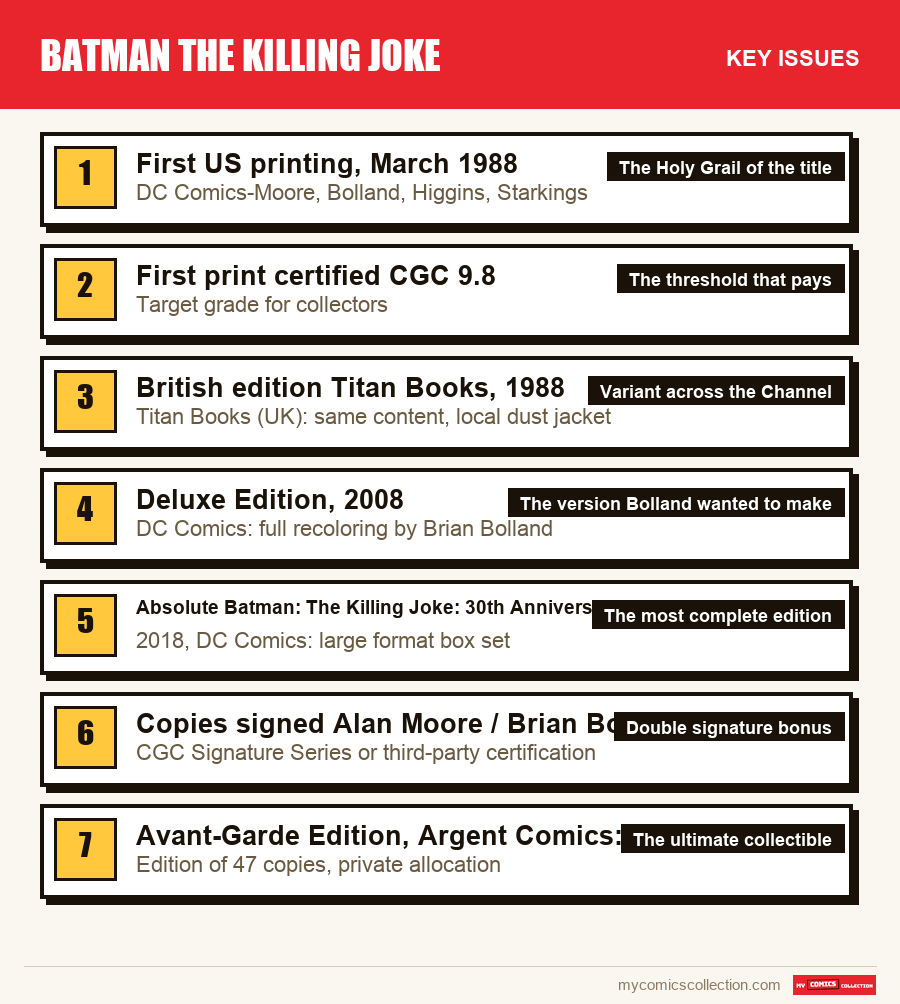
Published in March 1988 by DC Comics, Batman: The Killing Joke by Alan Moore and Brian Bolland is not a series but a one-shot in prestige format (square spine, hardcover). There are therefore no “key numbers” in the classic sense: they are the editions and printings which make the value: first US printing with embossed neon green logo ($50 to $250 depending on condition, $150 to $250 in CGC 9.8), Deluxe edition recolored by Bolland in 2008, Absolute 30th Anniversary box set from 2018, signed copies in CGC Signature Series, and since 2026 the ultra-limited “Avant-Garde” version from Argent Comics printed at 47 copies.
There are dozens of comics that claim to have marked the history of the genre, but very few have truly redefined a character as profoundly as Batman: The Killing Joke. In fifty-two pages, Alan Moore and Brian Bolland delivered in 1988 what remains, almost forty years later, the reference reading on the Joker: to the point that almost all of the film and television adaptations of the clown prince of crime, from Tim Burton to Christopher Nolan, bear its mark.
For a collector, this graphic novel poses a particular problem: it is not a numbered series with “first appearances” to track down, but a unique object published and republished in increasingly elaborate forms for almost forty years. Understanding which editions have real collectible value, and which are simple commercial reprints of no speculative interest, requires knowing the precise editorial history of the title.
This article details the editions and prints that really matter to a collector of Killing Joke, how to distinguish a first printing from a late reprint, the real effect of the 2016 animated adaptation on the rating, and the pitfalls to avoid when purchasing.
Killing Joke, a one-shot that changed superhero comics
Batman: The Killing Joke appeared in March 1988 by DC Comics, written by Alan Moore, drawn by Brian Bolland, colored by John Higgins and lettered by Richard Starkings. It is a one-shot in the so-called “prestige” format: square bound spine, thick hardback cover, 52 pages, sold for US$3.50 / CAN$4.75 at launch. This format, then recent at DC, gave the book an appearance closer to a graphic novel than a simple stapled comic book: an editorial choice which accompanied the stated ambition of the story. The story is based on a simple and terrible idea: the Joker, escaped from Arkham, wants to prove that anyone can descend into madness after “one bad day”. To demonstrate this on Commissioner Jim Gordon, he shoots his daughter Barbara:Batgirl: in the entrance to her apartment, paralyzing her, before kidnapping and psychologically torturing Gordon in an abandoned funfair. At the same time, flashbacks tell a possible origin of the Joker: a failed actor, whose pregnant wife was accidentally killed, pushed into a desperate heist which goes wrong and ends up in a vat of chemical waste. Moore has always claimed the deliberate vagueness of this origin, preferring that it remain "multiple choice" rather than definitive: an ambiguity which infuses until the final scene, where Batman and the Joker share a laugh in the rain, the exact meaning of which continues to divide readers almost forty years later.
The book won the Eisner Award for Best Graphic Novel in 1989 and even made the World's Best Sellers list. New York Times in May 2009: extremely rare commercial longevity for a comic more than twenty years old at the time. It also had a lasting influence on DC continuity: the paralysis of Barbara Gordon, never canceled in the decades that followed, gave birth to her identity as Oracle, one of the most significant character reconstructions of the post-Crisis era. Alan Moore himself has been surprisingly critical of his own work in interviews, saying that the book "doesn't say anything very interesting": a stance that has never diminished the work's cult status among readers and collectors.
Unlike a monthly run where we clearly distinguish a key number 1 from an uninteresting number 47, the value of Killing Joke is built print by print and edition by edition. It is this precise genealogy that must be mastered to intelligently collect this title.
First US printing, March 1988
The first American edition can be recognized by its “Batman: The Killing Joke” logo embossed in neon lime green on the cover: a distinctive sign used only on this very first press run. Subsequent prints featured other shades of the same logo (pink, yellow, orange, blue, crimson) over successive reissues from 1988-1990, which allows serious sellers to precisely date a copy with the naked eye. The original prestige format, glued square spine and flexible cardboard, makes these copies particularly fragile: the spine cracks and wrinkles from the first, somewhat abrupt opening, and the corners of the hardcover cover crush easily, which explains why high grades are proportionally rarer to find than on a classic stapled comic of the same edition.
First print certified CGC 9.8
The overall circulation of the title was significant: it is not a rare comic in itself, it is regularly found in raw sales on specialized platforms. Rarity therefore depends on the condition more than on the existence of the copy: as with many modern comics with a large circulation, it is the CGC grade 9.8 which marks the real jump in value, the gap between a 9.6 and a 9.8 being clearly more marked than between a 9.0 and a 9.6. To explore this logic of grade thresholds in more depth and know where to invest your certification budget, our comparison CGC 9 versus 9.8 details precisely where the value march is located on this type of large-volume drawdown.
British edition Titan Books, 1988
DC was not the only one to publish the book in 1988: Titan Books released a British edition the same year, also recognizable by its neon green embossed lettering on the first print. Above all, there is a much rarer variant of this English print, with the title embossed in pink instead of the usual green or yellow of subsequent printings: a detail that only keen collectors of the UK edition actively seek out, with most French or American buyers focusing on the original DC print.
Deluxe Edition, 2008
Twenty years after the original release, DC released a hardcover Deluxe Edition where Brian Bolland completely recolored his own drawing, with the help of Photoshop retouching work on some of the faces. The result is a clear departure from John Higgins' saturated palette: flashbacks switch to black and white, and only one touch of red or pink remains per panel until the Red Hood's helmet is revealed, creating a visual guiding effect that the artist deemed more faithful to his initial intention. The volume additionally includes a foreword by Bolland, a gallery of sketches and a bonus story, with an introduction by Tim Sale. This edition remains the reference for those who want to read the book as its own designer would have liked to see it published in 1988.
Absolute Batman: The Killing Joke: 30th Anniversary Edition
Published for the thirty years of the book, this Absolute edition in oversized format (approximately 286 pages, in illustrated cardboard box) is the only one to bring together in the same volume the original coloring of John Higgins and the recoloring of Bolland from 2008, supplemented by the story Batman: Black and White #4, the full script by Alan Moore and a previously unpublished selection of Batman/Joker sketches by Bolland. The cover of the box set features a profile version of the cult illustration of the Joker with the camera. More compact than most DC Absolute Editions, which often exceed 500 pages, it remains a reference object for comparing the two colorimetric biases side by side without having to own two separate books.
Copies signed Alan Moore / Brian Bolland
Alan Moore has virtually ceased all public signing for many years, which makes first edition copies bearing his authenticated signature particularly sought after: especially when they are accompanied by that of Brian Bolland, or even John Higgins. A first edition copy signed by Moore and Bolland, for example, was followed at auction for around $276, a price level that illustrates the premium that these double signatures add over an equivalent unsigned copy in condition. Third-party certification (CGC Signature Series or equivalent) remains essential to secure authenticity, with the value of the derived product being almost entirely tied to the guarantee that the signature is not a reproduction or forgery.
Avant-Garde Edition, Argent Comics: 2026
Announced in 2026, this ultra-limited edition developed by Argent Comics pushes the concept of collector's item very far: presented as the first comic ever printed in giclée (a high-resolution inkjet printing process usually reserved for art prints), it is hand-bound in a case shaped like a vintage camera: finely machined aluminum with a pearl finish, black leather grip, removable anodized aluminum lens held in place by magnets, directly echoing the camera of the Joker on Bolland's original cover. The set comes in a cognac calfskin case lined with purple plush, stamped with the DC logo and an engraved Joker quote, with a surprise opening compartment that releases a replica of the character's iconic playing card, and a shoulder strap to match the Joker's Hawaiian shirt. The content brings together the two colorings (Higgins and Bolland), a foreword and a signature of Brian Bolland on each copy. Only 47 copies will be produced, accessible only through a private allocation process upon registration: a format that shifts scarcity from the period print to that of the numbered contemporary art edition.
Collecting this series?
Track what you own, what you are missing and what your collection is worth. 7 day trial.
Start my trial →The impact of adaptations on the rating
Unlike many comics whose popularity skyrockets when a film is announced, Killing Joke experienced a different trajectory: the book was already cult long before its first direct adaptation. The animated film Batman: The Killing Joke released in 2016, produced by Warner Bros. Animation, directed by Sam Liu and written by Brian Azzarello, with the voices of Kevin Conroy, Mark Hamill, Tara Strong and Ray Wise: that is to say a good part of the original cast of Batman: The Animated Series from the 1990s, a strong marketing argument for early fans. It is the very first Batman film, and the very first Warner Bros. film. Animation, rated R by the MPAA, a classification officially justified by “gory images and disturbing content”.
The film had a very limited event release in theaters (two nights only), grossing approximately $4.4 million worldwide: a score that made it, at the time, one of the highest-grossing R-rated animated films ever released in theaters relative to its release format. The critical reception, however, was mixed, largely due to a long new prologue added to flesh out the original story considered too short for a feature-length format: this prologue introduces a sexual relationship between Batman and Batgirl which sparked considerable controversy upon its presentation at San Diego Comic-Con, with some fans accusing the creative team of betraying the spirit of Barbara Gordon's character.
For a collector, this controversy had a paradoxical effect: it considerably revived media interest in the original 1988 comic, pushing many readers to (re)discover the source to judge for themselves the liberties taken by the film: a classic phenomenon where the adaptation, even if criticized, acts as a gateway to the original material. It was during this period that the Deluxe edition of 2008 and, two years later, the Absolute 30th Anniversary of 2018 experienced renewed visibility in bookstores, without this fundamentally upsetting the rating of the first printing 1988, whose large circulation mechanically limits the potential for a speculative surge compared to a first appearance key with a limited edition.
Buying guide
- Check the color of the embossed logo on the cover before any purchase presented as “first printing”: only the neon green corresponds to the very first passage in the US press in 1988; the other shades (pink, yellow, orange, blue, crimson) indicate later, less sought-after reprints.
- Systematically inspect the glued square back before purchasing a raw copy: the prestige format cracks and creases easily when opened, and a crack in the spine drops the potential grade much faster than on a classic stapled comic.
- Do not confuse DC 1988 edition and Titan Books UK edition: both exist with a neon green logo on their own respective first printing, but their value and relative rarity differ depending on the target market.
- For a limited certification budget, aim for CGC 9.8 rather than a 9.4 or 9.6: on this high circulation title, this is the only level where the grade premium clearly exceeds the cost of certification: see our comparison CGC 9 versus 9.8 for detailed logic.
- Require third-party authentication for any signed copies: Alan Moore very rarely signs in public, which makes the market for forgeries or unverified signatures particularly active on this specific title.
- For the Deluxe and Absolute editions, choose an original sealed copy. if the objective is collection rather than reading: these publisher's prints, some of which are now out of print, increase in value especially in new, unopened condition.
- Keep an accurate inventory of your editions: first print, Deluxe, Absolute, signed: rather than relying on your memory: the collection management application allows you to centralize print runs, grades and provenance for this type of title with multiple variants.