
Batgirl debuted in January 1967 in Detective Comics #359 , created by Carmine Infantino and Gardner Fox at DC Comics. The mantle runs from Barbara Gordon, daughter of Gotham's police commissioner, to Cassandra Cain (Batgirl from 2000 to 2006), then Stephanie Brown (2009-2011), with Barbara Gordon donning the costume again in 2011 during the New 52 reboot. This guide traces her origin , her full biography , the series timeline , the key issues to know and the major arcs worth collecting.
Batgirl has belonged to the core Bat-Family for fifty-five years. The character's 1967 creation answered a dual mandate from DC and the TV production of Batman with Adam West: ABC wanted a recurring heroine who could steady the ratings for a third season. Yvonne Craig played the role on screen the same year Carmine Infantino drew the page version. Since then, the character has carried three principal identities, headlined three solo series and shaped the identity of Oracle, one of the most distinctive figures in DC's 1990s catalog. The Bat-Family today counts more than a dozen active members, and Batgirl remains one of the three most frequently revived identities in miniseries since 2010.
This article traces Batgirl's editorial origins, the biography of Barbara Gordon and her successors, the timeline of solo series from 2000 to today, the top 10 key issues for collectors and the major arcs that anchor the mythology. For a detailed ranking of the issues to target first, see our guide to Batgirl key issues, a companion piece to this historical overview.
Batgirl biography
Batgirl is a DC Comics character created by Carmine Infantino and Gardner Fox. Her first appearance comes in Detective Comics #359 in January 1967. The character occupies a pivotal place between the mythology of Batman and the autonomy of the Bat-Family: Barbara Gordon is at once the daughter of Commissioner James Gordon and an ally of the Dark Knight, making her one of the few members of the inner circle who is neither an orphan nor a direct protégé of Bruce Wayne.
Batgirl character profile
- Real name: Barbara Gordon (primarily), Cassandra Cain, Stephanie Brown
- First appearance : Detective Comics #359 (January 1967)
- Creators: Carmine Infantino, Gardner Fox
- Publisher: DC Comics
- Affiliations: Bat-Family, Birds of Prey, Justice League
- Status: Heroine
Origins of the character
Batgirl's creation grew out of a dual mandate in 1966. The Batman TV production was looking for a female character who could revive its ratings. DC Comics, for its part, wanted to introduce a heroine capable of reaching a female readership then almost entirely absent from its superhero lineup. Gardner Fox wrote the script and Carmine Infantino designed the costume. Barbara Gordon first appears on her way to a masquerade ball at Wayne Manor, before stepping in against Killer Moth. The in-universe origin presents her as a graduate librarian, a judo champion and the daughter of Commissioner Gordon. The purple-and-yellow costume derives directly from Batman's silhouette, to which Infantino adds a shorter cape and an identical utility belt. Success was immediate: Batgirl joined the regular lineup of Detective Comics as early as 1967 and earned her own back-up stories in Batman Family starting in 1975.
Powers and abilities
- Martial arts: mastery of judo, jiu-jitsu and close combat, training rounded out by Batman in Barbara Gordon's case
- Computer genius: as Oracle, Barbara Gordon becomes the Justice League's chief intelligence source
- Detective work: crime-scene analysis, deduction, an eidetic memory attributed to Barbara Gordon since Suicide Squad #23 (1989)
- Bat-gadgets: batarangs, grappling hook, utility belt, gear tailored to each identity
- Driving and infiltration: motorcycle skill, urban parkour, silent infiltration: traits heightened in Cassandra Cain, raised as a living weapon by David Cain
Costume and visual identity
The original 1967 costume reworks Batman's codes in purple and yellow: short cape, pointed cowl, identical utility belt. Cassandra Cain upends that grammar in 2000 with an all-black costume, a mask stitched over the mouth and white lenses, designed by Damion Scott. Stephanie Brown returns in 2009 to a purple-and-black palette with yellow accents. The 2011 New 52 reboot reintroduces Barbara Gordon in a streamlined black-and-yellow costume, redesigned in 2014 by Babs Tarr in a more colorful version with a biker jacket and riding goggles, conceived for the Burnside arc.
Batgirl series timeline
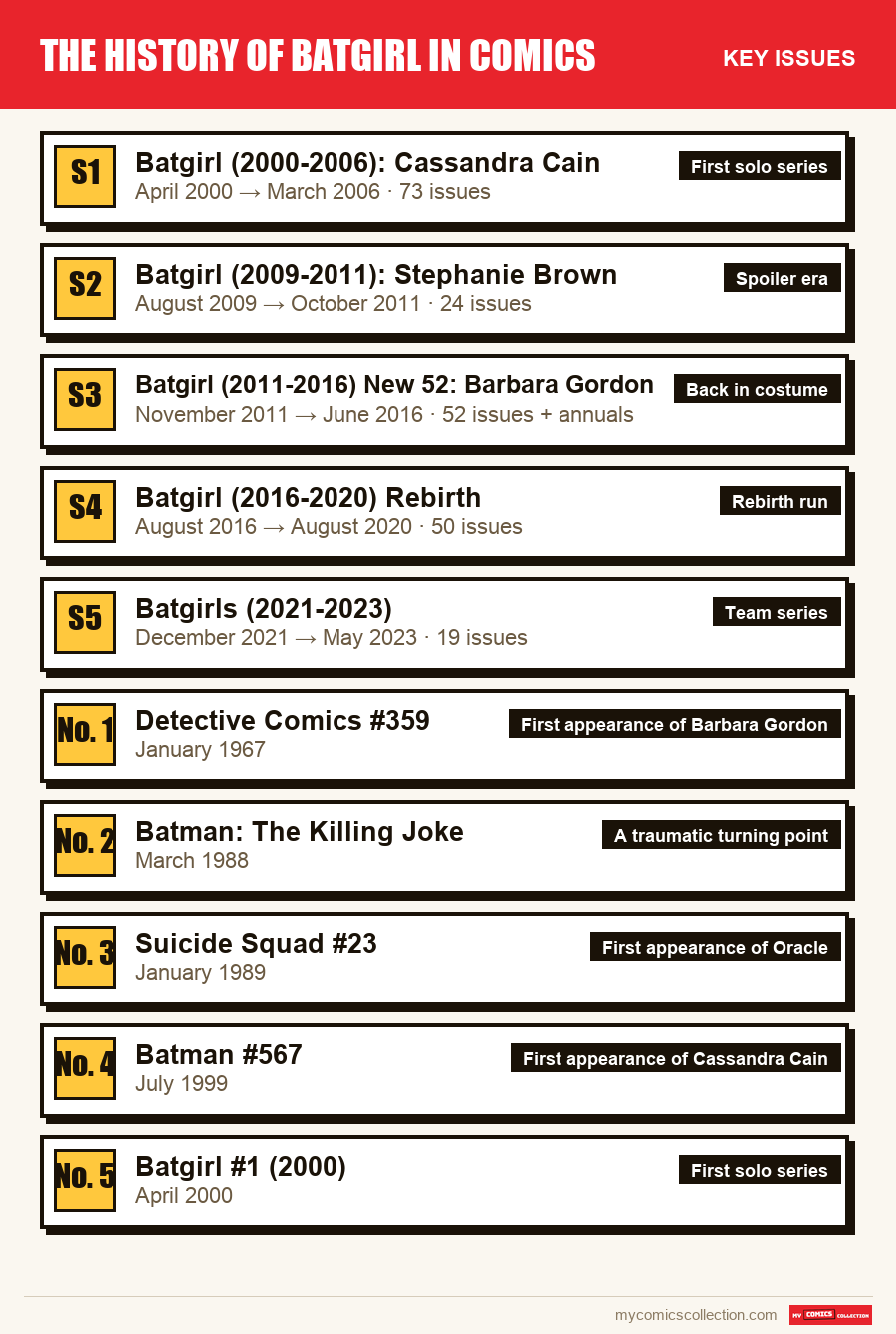
Batgirl's editorial journey unfolds in three phases: appearances in Detective Comics and Batman Family (1967-1988), the Oracle era following The Killing Joke (1988-2011), and three successive solo series starting in 2000.
Batgirl (2000-2006): Cassandra Cain
The first ongoing series to carry the Batgirl name. Written by Kelley Puckett and later Andersen Gabrych, drawn most notably by Damion Scott. Cassandra Cain, daughter of the assassin David Cain, struggles to communicate through words but reads body language like a native tongue. The series is one of the rare DC titles to headline an Asian heroine.
Batgirl (2009-2011): Stephanie Brown
Bryan Q. Miller writes a lighter series blending college humor and action. Stephanie Brown, a former Spoiler and short-lived Robin, inherits the costume with the blessing of Barbara Gordon (then Oracle). A critically acclaimed run, cut short by the New 52 reboot.
Batgirl (2011-2016) New 52: Barbara Gordon
Gail Simone takes up Barbara Gordon mid-recovery after her time in a wheelchair. The series pivots in 2014 toward the Burnside arc (Cameron Stewart, Brenden Fletcher, Babs Tarr), a major aesthetic reset that revives sales and ripples into pop culture.
Batgirl (2016-2020) Rebirth
Hope Larson and then Mairghread Scott write a series centered on Barbara in Burnside, split between civilian life and Birds of Prey missions. The run wraps in 2020 ahead of DC's editorial reshuffles.
Batgirls (2021-2023)
Becky Cloonan and Michael W. Conrad bring together Barbara Gordon (as a field Oracle), Cassandra Cain and Stephanie Brown under one banner. Art by Jorge Corona. The series formalizes the coexistence of all three identities in current continuity.
Collecting this series?
Track what you own, what you are missing and what your collection is worth. 7 day trial.
Start my trial →Top 10 Batgirl key issues
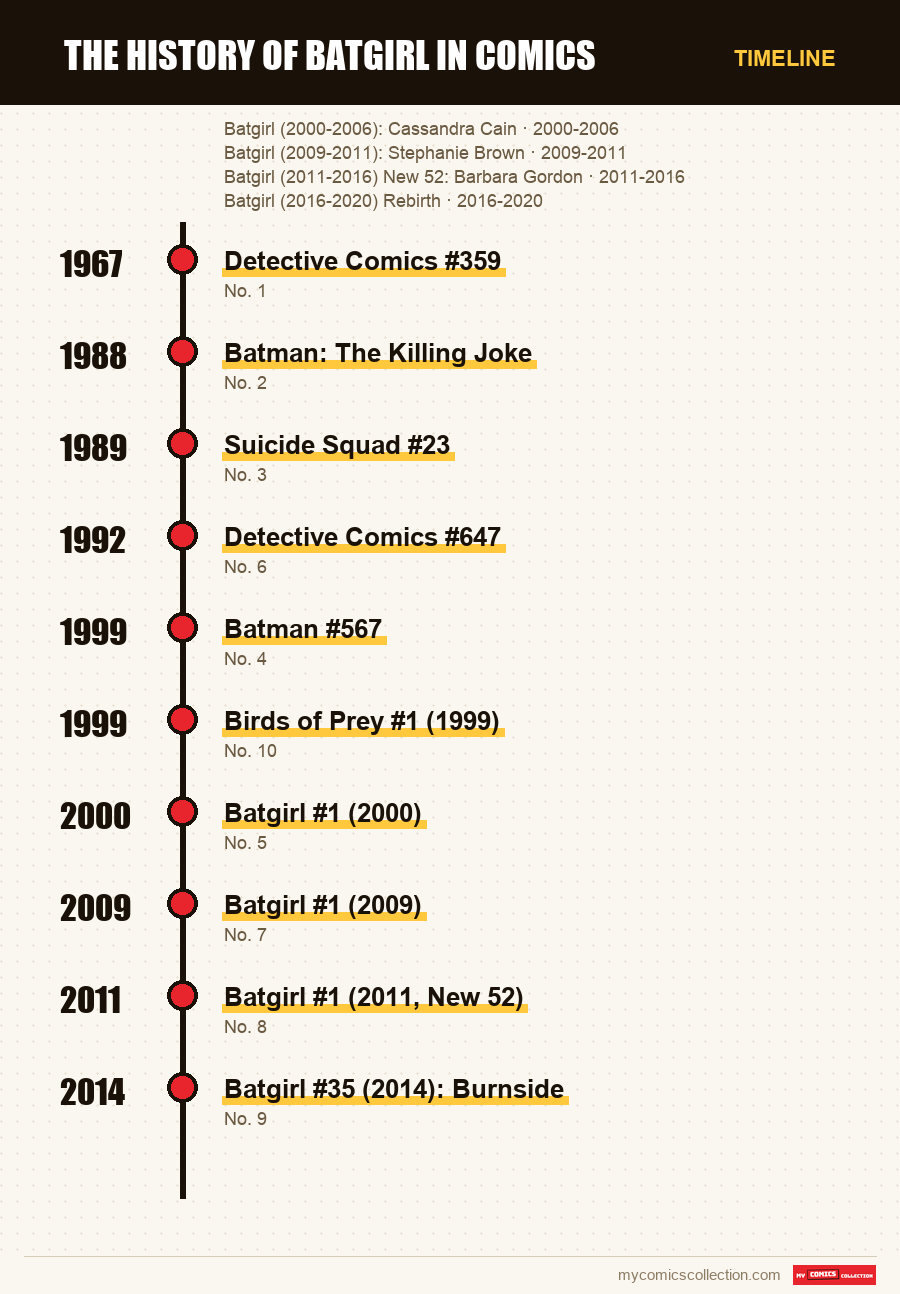
This top 10 targets the foundational issues for a Batgirl collection, complementing the detailed ranking available in Batgirl key issues. The values noted are indicative and vary with CGC grade and market dynamics.
Detective Comics #359
First appearance of Batgirl / Barbara Gordon, by Gardner Fox and Carmine Infantino. A key Silver Age issue, sought after for its scarcity in high grade and its historical weight. Value on a steady climb since the live-action adaptations were confirmed.
Batman: The Killing Joke
A one-shot by Alan Moore and Brian Bolland. The Joker shoots Barbara Gordon and paralyzes her. A pivotal event that leads to the creation of Oracle. Multiple printings: prioritize the first printing (March 1988).
Suicide Squad #23
Barbara Gordon reappears as Oracle, written by John Ostrander and Kim Yale. A key issue sought after since the character was confirmed for television. Standard print run, decent availability in mid grade.
Batman #567
First appearance of Cassandra Cain within the No Man's Land arc. The issue is followed by Legends of the Dark Knight #120, in which she takes on the Batgirl costume. Demand has been strong since 2020.
Batgirl #1 (2000)
Launch of the first ongoing Batgirl series, by Kelley Puckett and Damion Scott. Cassandra Cain headlines. A key issue for collectors of first appearances and complete runs.
Detective Comics #647
First appearance of Stephanie Brown as Spoiler, before she takes on the Batgirl costume in 2009. The issue is written by Chuck Dixon. Demand has climbed since DC announced projects spotlighting the character.
Batgirl #1 (2009)
Stephanie Brown officially takes on the Batgirl costume, written by Bryan Q. Miller. Launch of the second solo series. Standard print run, an affordable market for rounding out a themed collection.
Batgirl #1 (2011, New 52)
New 52 reboot, with Gail Simone at the helm. Barbara Gordon sheds the Oracle identity to take the costume back. A founding issue of the third ongoing series. Value varies, with a recent uptick tied to DC announcements.
Batgirl #35 (2014): Burnside
First issue of the Burnside arc by Cameron Stewart, Brenden Fletcher and Babs Tarr. A major aesthetic reset: biker jacket, purple palette, pop sensibility. Value holds up well among modern collectors.
Birds of Prey #1 (1999)
Launch of the ongoing Birds of Prey series by Chuck Dixon, a team led by Oracle (Barbara Gordon) and Black Canary. A foundational issue for the Oracle mythology. Value varies, with demand rising since the 2020 film adaptation.
Major arcs and cult runs
The Killing Joke (1988, Alan Moore / Brian Bolland) remains the absolute turning point: a single one-shot that takes Batgirl out of circulation and gives rise to Oracle. No Man's Land (1999, collective story) introduces Cassandra Cain in a quarantined, post-earthquake Gotham: the perfect testing ground for a mute heroine. Batgirl: Year One (Beatty/Dixon/Lopez, 2003) rebuilds Barbara Gordon's origin across nine chapters, a recommended entry-point read. The Black Mirror (Scott Snyder, 2011) precedes Barbara's return in costume and sets the dark tone of the New 52 run. Burnside (Stewart/Fletcher/Tarr, 2014-2015) visually reinvents the character and sparks a wave of imitators across mainstream publishing. The Gail Simone Birds of Prey run (2003-2007) builds the definitive version of the Oracle / Black Canary duo, an essential reference for understanding the 2000s. On the Cassandra Cain side, the first Batgirl series (2000-2006, Puckett/Scott) serves as a structuring saga: 73 issues unfold a complete redemption arc.
Adaptations and cultural impact
Yvonne Craig played Batgirl in the third season of the Batman TV series (1967-1968), a cult appearance that fixed the character's image in pop culture. Alicia Silverstone took the role in Batman & Robin (1997). The animated Batman: The Animated Series (1992-1995) and its spin-off The New Batman Adventures cemented Barbara Gordon's place in the broader mythology. Batman: The Killing Joke was adapted into an animated film in 2016. Birds of Prey moved to live-action on The WB as early as 2002. More recently, Leslie Grace was set to play Barbara Gordon in a Batgirl film produced by DC in 2022, a project canceled in post-production by Warner Bros. Discovery: an event that paradoxically revived demand for first appearances and triggered a measurable rise in values for Detective Comics #359 and Batman #567 starting in the summer of 2022.
Build your Batgirl collection methodically
Catalog the Batgirl series in one click, identify your missing key issues, track their estimated value from current eBay listings. 7-day free trial.
🚀 Start your 7-day free trial