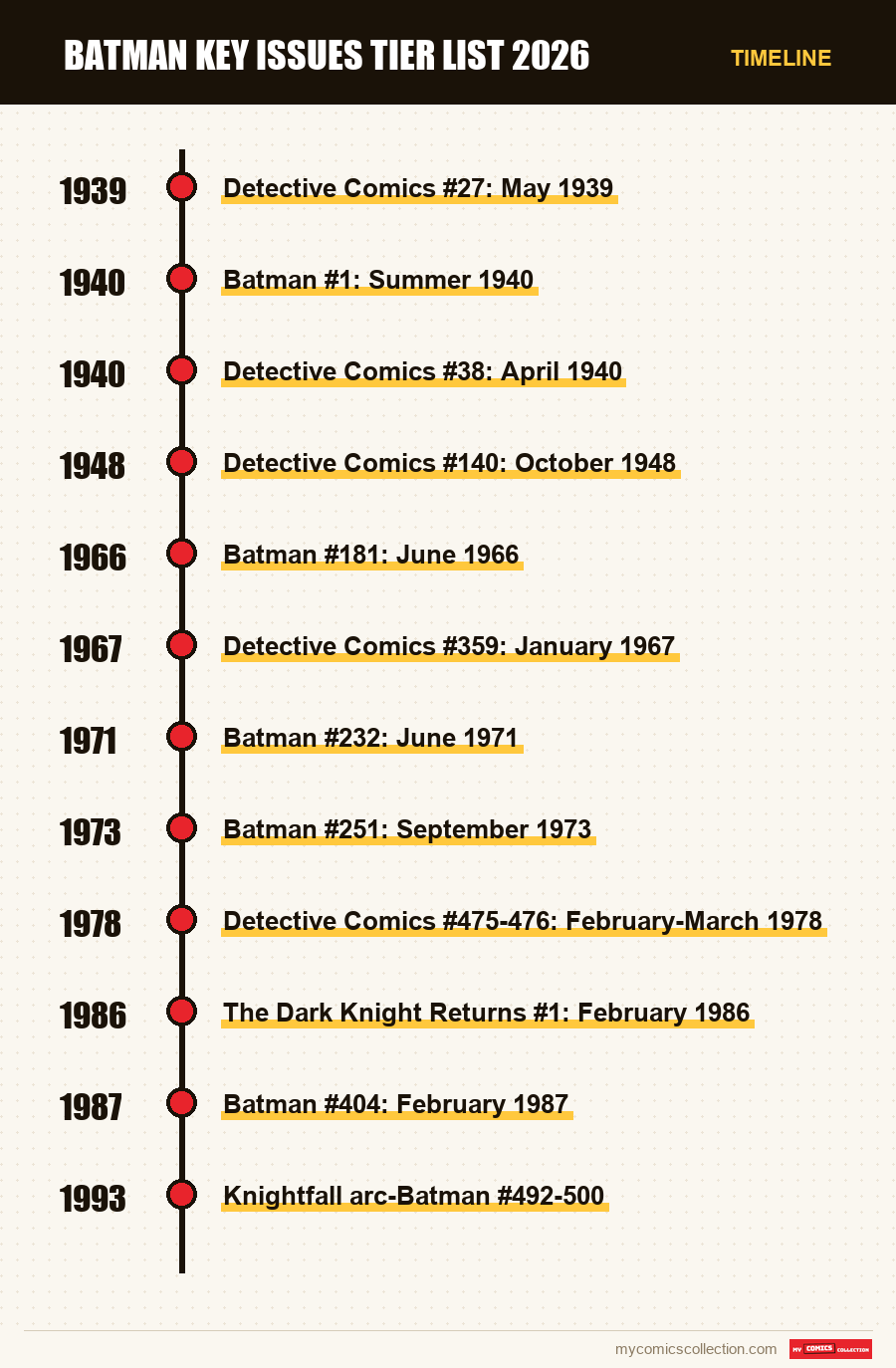
The 2026 tier list of key Batman issues ranks the issues by valuation potential: Tier S blue-chip (Detective Comics #27 May 1939 1st Batman Bob Kane/Bill Finger, Batman #1 Summer 1940 1st Joker + Catwoman Bob Kane/Jerry Robinson, Detective Comics #38 April 1940 1st Robin Dick Grayson Bob Kane/Bill Finger, Detective Comics #140 October 1948 1st Riddler Bill Finger/Dick Sprang): central assets at 8,000-2 €500,000 depending on grade. Tier A (Batman #181 June 1966 1st Poison Ivy, Detective Comics #359 January 1967 1st Batgirl Barbara Gordon, Batman #232 June 1971 1st Ra's al Ghul Denny O'Neil/Neal Adams, Batman #251 September 1973 Joker's Five-Way Revenge). Tier B sleepers (Detective Comics #475-476 1978 Laughing Fish Englehart/Rogers, DKR #1 February 1986 Frank Miller, Batman #404 February 1987 Year One Miller/Mazzucchelli, Knightfall arc 1993, The Killing Joke 1988 Moore/Bolland). Tier C speculative bets 2026-2027 (Brave & Bold 2026 James Gunn DCU, reintroduction Damian Wayne).
Building a solid Batman collection in 2026 requires a rigorous method: the catalog covers eighty-seven years of continuous publication (1939-2026), several hundred structuring issues and a price dispersion that goes from a few tens of euros for the Modern Age arcs to several millions for Detective Comics #27 in high grade. Without clear prioritization, the French-speaking collector disperses his budget on secondary issues while blue-chips continue to appreciate out of reach.
Ce guide tier list Batman 2026 classifies the major key issues into four tiers (S, A, B, C) according to three weighted criteria: narrative historical importance, market performance over five rolling years, and probability of DCU James Gunn catalyst in the 2026-2030 window. Each issue is documented with exact date, creative team and price range by CGC grade. Objective: to allow the French-speaking collector to build a budgeted purchasing strategy, without wasting a euro on the classic traps of the Batman catalog (facsimile editions confused with originals, Famous First Edition reprints, overpriced post-1990 runs).
Batman 2026 tier list methodology
A useful tier list doesn't just line up numbers in order of price: it prioritizes based on a coherent investment and collection thesis. For Batman in 2026, three methodological axes structure the ranking.
Tier S/A/B/C classification criteria
- Narrative historical significance (40%): first appearances of structuring characters (Batman himself, his extended family Robin/Batgirl/Nightwing, his gallery of villains Joker/Catwoman/Riddler/Poison Ivy/Ra's al Ghul), canonical arcs cited by academic criticism, founding retcons.
- Market performance 5 years (35%): CGC price trend documented on GoCollect, Heritage Auctions and ComicConnect between 2021 and 2026. An issue that has doubled and then plateaued is not equivalent to an issue that progresses linearly.
- DCU catalyst probability 2026-2030 (25%): proximity of the character with the James Gunn / Peter Safran announcements at DC Studios, presence in confirmed HBO Max projects (The Penguin, Lanterns), traction of verifiable rumors on The Cosmic Circus and The Hollywood Reporter.
Definition of third parties
- Tier S: blue-chip: Golden Age central numbers, globally recognized value, no risk of historical downgrading. These are the absolute defensive assets of the collection. If you could only own four Batman issues, these would be them.
- Tier A: fundamentals: historically critical issues with solid performance but without the absolute status of Tier S. Make up the backbone of a serious Silver Age / Bronze Age collection.
- Tier B: sleepers with conviction: numbers undervalued in view of their significance, with catalyst identified at 12-36 months or canonical Modern Age status in consolidation. Moderate risk, documented re-rating potential.
- Tier C: speculative bets: numbers with a strong thesis but dependent on uncertain future events (DCU, unconfirmed casting). Limited budget allocation recommended.
Voluntary out-of-scope
This tier list does not classify secondary annuals from the 1960s-1980s, major DC event crossovers (Crisis on Infinite Earths, Final Crisis) unless directly influenced by Batman, nor modern post-2015 variants which have lost their lasting speculative premium. The market for DC facsimile editions (Detective #27 facsimile 2022, Batman #1 facsimile 2014) is treated separately in the pitfalls section, because confusion with the originals constitutes a major risk for the French-speaking collector.
Tier S: the central Batman blue-chips
Four issues absolutely dominate the Batman catalog and constitute the defensive core of any serious collection. They combine absolute high-grade rarity, indisputable historical significance and maximum liquidity on the major Heritage Auctions and ComicConnect auction markets. These four titles alone represent the foundations of the entire Batman universe.
Detective Comics #27: May 1939 (Bob Kane / Bill Finger)
The absolute founding number. Published by DC Comics in May 1939, Detective Comics #27 introduces "The Bat-Man" on six pages by Bob Kane for drawing and Bill Finger for screenplay (initially uncredited, official recognition obtained in 2015). The story The Case of the Chemical Syndicate features Bruce Wayne, his costumed alter-ego, and Commissioner Gordon. It is one of the three most valuable issues in the entire global comics market, alongside Action Comics #1 and Detective Comics #1.
- CGC 8.0: public sales 2023-2026 between €1,800,000 and €2,500,000. Census CGC 8.0+ less than 10 known copies.
- CGC 6.0: €650,000 to €950,000. Institutional entry point for ultra-high heritage collectors.
- CGC 4.0: €280,000 to €420,000.
- CGC 2.0: €110,000 to €165,000.
- CGC 1.0: €55,000 to €85,000. The minimum acceptable to preserve historic blue-chip status.
5-year trend: +180% between 2021 and 2026 in CGC 4.0, with a post-pandemic acceleration which has never reversed. No documented market correction greater than 10% on 36-month rolling windows since 2014. The issue is more liquid than one might think: Heritage Auctions has recorded a high-grade public sale every quarter since 2019.
Batman #1: Summer 1940 (Bob Kane / Jerry Robinson / Bill Finger)
The Joker/Catwoman double birth. Published in spring-summer 1940 by DC Comics, Batman #1 inaugurates the solo series dedicated to the character and simultaneously introduces two of the most iconic antagonists in all of world pop culture: The Joker (creation attributed to Jerry Robinson, with contributions from Bob Kane and Bill Finger) and The Cat (renamed Catwoman in subsequent issues). This concentration of first major appearances in the same issue is without parallel in the history of comics.
- CGC 9.0: €1,800,000 to €2,800,000. Census 9.0+ less than 5 known copies.
- CGC 7.0: €480,000 to €720,000.
- CGC 6.0: €280,000 to €420,000.
- CGC 4.0: €120,000 to €180,000.
- CGC 2.0: €48,000 to €75,000.
5-year trend: +220% in CGC 6.0, with continued acceleration driven by the Joker resonance (Joaquin Phoenix 2019, Joker: Folie à Deux 2024) and the Catwoman project in development. For a complete analysis of the female character, see story of Catwoman in comics as well as the complete joker story.
Detective Comics #38: April 1940 (Bob Kane / Bill Finger)
First appearance of Robin. Published April 1940 by DC Comics, Detective Comics #38 introduces Dick Grayson, the circus orphan adopted by Bruce Wayne, who becomes the very first teenage sidekick in American comics history. The concept of the young costumed partner would later be copied by Captain America/Bucky, Green Arrow/Speedy and dozens of other franchises. Robin remains the founding archetype.
- CGC 9.0: €380,000 to €580,000. Census 9.0+ extremely limited.
- CGC 7.0: €110,000 to €165,000.
- CGC 6.0: €65,000 to €95,000.
- CGC 4.0: €28,000 to €42,000. Recommended entry point for a serious Tier S collection.
- CGC 2.0: €11,000 to €17,000.
5-year trend: +145% in CGC 4.0. Potential catalyst: any DCU James Gunn project integrating Dick Grayson (Brave and the Bold announced 2026) would significantly increase the rating. The historical progression remains more predictable than that of Avengers from the same decade.
Detective Comics #140: October 1948 (Bill Finger / Dick Sprang)
First appearance of the Riddler. Published October 1948 by DC Comics, Detective Comics #140 introduced Edward Nigma aka The Riddler, written by Bill Finger and drawn by Dick Sprang. The character has experienced several major resurgences: Frank Gorshin adaptation in the 1966 television series, Jim Carrey in Batman Forever (1995), and especially Paul Dano in The Batman (Matt Reeves, 2022) which propelled the rating to record levels.
- CGC 9.0: €280,000 to €420,000. Census 9.0 extremely rare.
- CGC 7.0: €75,000 to €115,000.
- CGC 6.0: €42,000 to €65,000.
- CGC 4.0: €18,000 to €28,000.
- CGC 2.0: €7,500 to €12,000.
5-year trend: +320% in CGC 4.0 between 2021 and 2026, boosted by The Batman 2022. The sequel The Batman Part II announced for 2027 could support a new upward wave if Paul Dano takes over the role. The issue remains in the tactical buying zone for Tier S collectors with institutional budgets.
Tier A: Batman Silver/Bronze Age fundamentals
Tier A brings together the issues that form the backbone of a serious Batman collection beyond the Golden Age. They combine documented narrative importance and continued market performance, without reaching the status of absolute monument of Tier S. The budgetary weighting rule suggests that they represent 35 to 45% of the total allocation of the Silver/Bronze Age oriented collector, which constitutes the most accessible segment for the majority of French speakers.
Batman #181: June 1966 (Robert Kanigher / Sheldon Moldoff)
First appearance of Poison Ivy. Published June 1966 by DC Comics, Batman #181 introduced Pamela Isley aka Poison Ivy, written by Robert Kanigher and drawn by Sheldon Moldoff (ghosting for Bob Kane). The character's modern resonance exploded with the Harley Quinn animated series (HBO Max 2019-2024) which established the Harley/Ivy relationship as a narrative pillar, propelling demand for Batman #181 and related keys.
- CGC 9.4: €18,000 to €28,000.
- GCC 9.2: €9,500 to €14,000.
- CGC 9.0: €5,200 to €7,800.
- CGC 8.5: €3,200 to €4,800.
- CGC 7.5: €1,600 to €2,400.
- CGC 6.0: €850 to €1,300.
Be careful with the glued central pinup: the version without the detached poster is worth less, and the market strictly distinguishes the "complete with pin-up" copies from the others. 5-year trend: +260% in CGC 9.0. Recommended number crossed with the story of Harley Quinn in comics to understand the commercial dynamics of the Harley/Ivy duo.
Detective Comics #359: January 1967 (Gardner Fox / Carmine Infantino)
First appearance of Batgirl Barbara Gordon. Published January 1967 by DC Comics, Detective Comics #359 introduces Commissioner Gordon's daughter in her purple and yellow costume, written by Gardner Fox and drawn by Carmine Infantino (then DC art director). Barbara Gordon became central beyond Batgirl with her retcon in Oracle (Suicide Squad #23 1989) then her post-Flashpoint Batgirl return, and remains one of the most exploited female characters in the extended DCU.
- CGC 9.6: €14,000 to €21,000.
- CGC 9.4: €6,500 to €9,500.
- GCC 9.2: €3,200 to €4,800.
- CGC 9.0: €1,800 to €2,700.
- CGC 8.5: €1,100 to €1,650.
- CGC 7.0: €480 to €720.
The Batgirl film canceled in 2022 by Warner Bros (Leslie Grace) has temporarily frozen the rating. A revival of the character in the DCU James Gunn would immediately restart the dynamic. 5-year trend: +180% in CGC 9.2.
Batman #232: June 1971 (Denny O'Neil / Neal Adams)
First appearance of Ra's al Ghul. Published June 1971 by DC Comics, Batman #232 introduces Ra's al Ghul (Head of the Demon), immortal patriarch of a global society of assassins, written by Denny O'Neil and drawn by Neal Adams. The character is central in the Christopher Nolan trilogy (Liam Neeson in Batman Begins 2005 and The Dark Knight Rises 2012) and in Arrow season 3 (Matt Nable, 2014-2015). His daughter Talia al Ghul is the mother of Damian Wayne, which anchors Ra's at the heart of the Bat-Family dynasty.
- CGC 9.8: €28,000 to €42,000. Census 9.8 less than 30 known copies.
- CGC 9.6: €6,500 to €9,800.
- CGC 9.4: €2,200 to €3,300.
- GCC 9.2: €1,100 to €1,650.
- CGC 9.0: €650 to €950.
- CGC 8.5: €380 to €580.
5-year trend: +210% in CGC 9.4. The number remains a Bronze Age cornerstone recommended by all spec analyses, because the reintroduction of Damian Wayne into the DCU would necessarily involve Talia and Ra's al Ghul. See the key issues Court of Owls to understand other modern antagonistic dynamics.
Batman #251: September 1973 (Denny O'Neil / Neal Adams)
Joker's Five-Way Revenge. Published September 1973 by DC Comics, Batman #251 marks the return of the Joker after four years of editorial absence (the character no longer appeared in the post-Comics Code 1954 grid). O'Neil and Adams reinvent him as a psychopathic killer, definitively abandoning the good-natured clown version of the 1960s. The number is considered the founding act of the modern Joker, archetype of all subsequent adaptations (Heath Ledger, Joaquin Phoenix).
- CGC 9.8: €38,000 to €58,000. Census 9.8 limited to approximately 15 copies.
- CGC 9.6: €9,500 to €14,500.
- CGC 9.4: €3,800 to €5,700.
- GCC 9.2: €1,800 to €2,700.
- CGC 9.0: €1,050 to €1,600.
- CGC 8.5: €580 to €880.
5-year trend: +290% in CGC 9.4. This is the Bronze Age sleeper turned cornerstone, to be preferred in grade matching with Batman #232 in a complete Tier A collection. The iconic cover by Neal Adams (Joker Grimacing Playing Card) is one of the most reproduced in DC history.
Tier B: Batman Modern Age conviction sleepers
Tier B is the favorite playground of informed collectors. The numbers are accessible there, their assessment thesis documented, and the potential/risk ratio favorable. They typically represent 25-35% of a diversified Batman allocation. The specificity Batman: The Modern Age (1985-1995) concentrates globally recognized canonical arcs which have not yet reached their full speculative potential.
Detective Comics #475-476: February-March 1978 (Steve Englehart / Marshall Rogers)
The Laughing Fish. Published February-March 1978 by DC Comics, Detective Comics #475 and #476 contain the Laughing Fish arc written by Steve Englehart and drawn by Marshall Rogers (inker Terry Austin). This arc is universally cited as the most relevant Joker short story ever published, a direct source of inspiration for Batman: The Animated Series (eponymous episode 1993) and for the narrative design of The Dark Knight (Christopher Nolan, 2008). The diptych is undervalued in view of its canonical importance.
- #475 CGC 9.8: €4,800 to €7,200.
- #475 CGC 9.6: €1,400 to €2,100.
- #475 CGC 9.4: €580 to €870.
- #476 CGC 9.8: €2,200 to €3,300.
- #476 CGC 9.6: €680 to €1,020.
- Pair 9.6 matching: €2,400 to €3,600.
Buying the grade matching pair maximizes future resale liquidity. 5-year trend: +180% in CGC 9.6 for #475. This is the late Bronze Age sleeper par excellence, to be integrated as soon as a purchase window presents itself under €2,000 in CGC 9.6.
The Dark Knight Returns #1: February 1986 (Frank Miller)
DKR #1, the founding act of the Modern Age. Published February 1986 by DC Comics in the prestige square-bound format, The Dark Knight Returns #1 is written and drawn by Frank Miller (inking Klaus Janson, colors Lynn Varley). The work redefines Batman as a retired veteran returning to a dystopian Gotham, and more broadly redefines what a comic book can be in terms of narrative maturity. It is one of the two works, with Watchmen #1 (September 1986), which mark the transition to adulthood of the medium.
- CGC 9.8 White Pages: €1,200 to €1,800.
- CGC 9.8 OW/W Pages: €850 to €1,250.
- CGC 9.6: €280 to €420.
- CGC 9.4: €130 to €195.
- GCC 9.2: €75 to €115.
- 1st Print Newsstand 9.8: 35-50% premium on direct edition.
5-year trend: +145% in CGC 9.8. 9.8 White Pages remains the sweet spot with a strictly controlled census. Beware of multiple reprints (second, third and fourth printings 1986, hardcover 1986, trade paperback) which are confused with the first print in non-rigorous eBay ads.
Batman #404: February 1987 (Frank Miller / David Mazzucchelli)
Year One #1. Published February 1987 by DC Comics, Batman #404 inaugurates the Year One arc over four issues (#404-407, February-May 1987), written by Frank Miller and drawn by David Mazzucchelli (Richmond Lewis colors). The arc redefines the origin of Bruce Wayne post-Crisis on Infinite Earths, and remains the canonical version exploited by all subsequent cinema adaptations (Batman Begins 2005, The Batman 2022 in its Year One aesthetic treatment).
- #404 CGC 9.8: €380 to €580.
- #404 CGC 9.6: €110 to €165.
- #404 CGC 9.4: €55 to €85.
- #404 Newsstand 9.8: €580 to €870 (50-60% premium).
- Complete set #404-407 CGC 9.8: €1,200 to €1,800.
5-year trend: +210% in CGC 9.8 newsstand. The issue remains underpriced in mid-grade for French-speaking collectors with a modest monthly budget: see our accumulation strategy in the DC comics guide to get started. The major pitfall: the numerous Year One reprints (trade paperback 1988, deluxe edition 2005, absolute edition 2017) are frequently confused with the first print issue.
Batman: The Killing Joke: 1988 (Alan Moore / Brian Bolland)
The Joker origin according to Moore. Published in 1988 by DC Comics in the prestige one-shot format, Batman: The Killing Joke is written by Alan Moore and drawn by Brian Bolland (original colors John Higgins, final recoloring Bolland 2008). The work offers the "possible origin story" of the Joker while mutilating Barbara Gordon (paralysis which will lead to the Oracle retcon). It is one of the most cited and studied works in the modern Batman catalog.
- 1stPrint 9.8: €480 to €720.
- 1stPrint 9.6: €140 to €210.
- 1st Print 9.4: €65 to €95.
- 2nd Print: discount 70-80% vs first print.
- Hardcover Deluxe 2008 9.8: €150 to €230.
5-year trend: +135% in first print 9.8. First print identification: no mention of "Second Printing" on the indicia page, cover without promotional banner. The Killing Joke is mentioned in all canonical analyzes alongside DKR as the birth certificate of Modern Batman.
Knightfall arc-Batman #492-500 (May 1993-October 1993)
Bane breaks Batman. The Knightfall saga runs from Batman #492 (May 1993) to #500 (October 1993), with Doug Moench, Chuck Dixon and Alan Grant writing the script. Batman #497 (July 1993) contains the seminal moment: Bane (introduced in Batman: Vengeance of Bane #1 January 1993) breaks Bruce Wayne's spine. The storyline fueled The Dark Knight Rises (Nolan 2012) and remains the most widely distributed modern Batman arc in France via Urban Comics reissues.
- Vengeance of Bane #1 CGC 9.8: €850 to €1,300. This is Bane's true first appearance.
- Vengeance of Bane #1 CGC 9.6: €280 to €420.
- Batman #497 CGC 9.8: €220 to €330.
- Batman #500 Die-cut Cover CGC 9.8: €180 to €270.
- Complete set #492-500 CGC 9.6: €1,200 to €1,800.
The real sleeper of the saga is Vengeance of Bane #1, first official appearance of Bane, underrated for two decades before his 2018-2024 explosion (+450% in CGC 9.8). This dynamic shows that Modern Age sleepers can double as soon as an MCU/DCU signal emerges.
Collecting this series?
Track what you own, what you are missing and what your collection is worth. 7 day trial.
Start my trial →Tier C: speculative bets 2026-2027
Tier C concentrates bets with a strong thesis but high uncertainty. Recommended budget allocation: 10-20% of the total Batman budget. Buying multiple copies of the same issue is sometimes relevant here if conviction is high and the entry price low (under €50 in raw NM).
Brave & Bold 2026: DCU project James Gunn
James Gunn and Peter Safran confirmed The Brave and the Bold project for Chapter One DCU in January 2023. The film will feature Batman and Damian Wayne, his dynastic version. The official reintroduction of Damian Wayne (first prototype Batman: Son of the Demon graphic novel 1987, first canonical appearance Batman #655 September 2006 by Grant Morrison and Andy Kubert) would trigger an immediate revaluation of the associated issues.
- Batman #655 CGC 9.8: €220 to €330.
- Batman #655 CGC 9.6: €75 to €115.
- Batman #655 Newsstand 9.8: premium 60-80%.
- Batman #666 CGC 9.8: €320 to €480 (Damian future Batman).
- Batman: Son of the Demon hardcover: €180 to €270 in VF.
Potential catalyst: any official Brave and the Bold teaser confirming Damian casting would draw x2-x3 odds in 12 months. Risk: DCU calendar shift until 2027-2028, or major recasting. To follow the arbitrations, consult the investment strategy analysis 2027.
Reintroduction Damian Wayne and the Bat-Family ecosystem
Beyond Damian, the arrival of the DCU could revalue other first Bat-Family appearances that are still underrated:
- New Teen Titans #44 (1984): Dick Grayson officially becomes Nightwing.
- Batman #357 (March 1983): first cameo appearance Jason Todd (Robin II).
- Batman: Streets of Gotham #4: first Hush recent status.
- Detective Comics #647 (August 1992): first Stephanie Brown (Spoiler).
- Batman #408 (June 1987): Jason Todd post-Crisis revised origin.
These sleepers are available for under €200 in CGC 9.8 and offer favorable asymmetry. For the exhaustive list of 2027 bets, see the spec keys 2027 Marvel/DC films and series.
Joker spinoff projects 2026-2028
The Penguin HBO Max series (September 2024) demonstrated that the Bat-Family spinoffs can sustainably carry the associated keys. Any Catwoman, Riddler or Two-Face project announced in 2026 would trigger a similar dynamic on the associated keys. To follow the Joker dynamic beyond just Tier S, cross with the tier list Joker 2026. For other Bat-Family antagonists, see also the Harley Quinn tier list 2026 and the tier list Catwoman 2026.
Batman collector budget allocation strategy
A tier list only has value when operationalized by a budgetary strategy. The Batman specificity: the gap between Tier S Golden Age (Detective Comics #27) and the rest of the catalog is so structural that the budgetary profiles differ radically from a comparable Marvel franchise. Here are four typical profiles adjusted to the 2026 market.
Budget €10,000: the founding Silver/Bronze Age collection
- Batman #232 CGC 9.0 (€750): Ra's al Ghul, Tier A anchor.
- Batman #251 CGC 9.0 (€1,200): Joker’s Five-Way Revenge.
- Detective Comics #359 CGC 8.5 (€1,300): Batgirl Barbara Gordon.
- Batman #181 CGC 8.0 (€1,100): Poison Ivy with pin-up.
- DKR #1 CGC 9.8 OW/W (950 €): founding act Modern Age.
- Batman #404 Year One Newsstand 9.8 (€680): Year One first print premium.
- Detective Comics #475 CGC 9.6 (€1,800): Laughing Fish #1.
- Vengeance of Bane #1 CGC 9.6 (€350): consolidated Bane sleeper.
- Reserve €1,870: window opportunities + targeted Tier C (Batman #655 raw, Killing Joke).
This allocation builds a representative base of four ages (Silver-Bronze-Copper-Modern) while keeping a tactical reserve for DCU announcements. It deliberately avoids Tier S Golden Age (inaccessible under €50,000) while covering all of the first appearances of structuring villains.
Budget €50,000: the balanced institutional collection
Suggested allocation: 40% Tier S, 35% Tier A, 15% Tier B, 10% Tier C.
- Detective Comics #38 CGC 4.0 (€32,000): Robin Golden Age cornerstone.
- Detective Comics #140 CGC 4.0 (€22,000): Riddler Tier S accessible.
- Batman #232 CGC 9.6 (€8,000): Ra's al Ghul high rank.
- Batman #251 CGC 9.6 (€12,000): Definitive Joker Bronze.
- Batman #181 CGC 9.2 (€10,000): Poison Ivy high grade.
- DKR #1 CGC 9.8 White (€1,500): Modern Age standard.
- Reserve €4,500: Tier B Knightfall, Killing Joke, opportunities.
This level allows access to Tier S Golden Age via Detective #38 and #140, the two most accessible issues of the founding quartet. Detective Comics #27 and Batman #1 remain out of reach at this budget.
Budget €250,000 and more: Detective Comics #27 and blue-chip portfolio
At this level, the top priority is acquiring Detective Comics #27, the absolute seminal issue. Buy a Detective #27 CGC 2.0 (€130,000) rather than multiply the Silver Age numbers in mid-grade. Resale liquidity takes precedence over diversification: a single Detective #27 kept for 10 years will almost always outperform a portfolio of 30 Bronze Age numbers accumulated at the same amount.
- Detective Comics #27 CGC 2.0 (€130,000): absolute cornerstone.
- Batman #1 CGC 4.0 (€140,000): Joker + Catwoman.
- Detective #38 CGC 6.0 (€75,000): Robin high grade.
- Detective #140 CGC 6.0 (€55,000): Riddler institutional.
- Tier A/B balance: maximum selectivity, grade matching required.
For continuous arbitration, cross-reference with the broad context of comics DC universe and the investment strategy analysis 2027.
Budget €5,000: the opportunistic Modern Age strategy
For constrained budgets, the Modern Age Batman segment offers an excellent importance/price ratio:
- DKR #1 CGC 9.8 OW/W (€950).
- Batman #404 Year One CGC 9.8 newsstand (€680).
- Complete Year One Set #404-407 CGC 9.6 (€480).
- Killing Joke 1st Print 9.8 (€580).
- Vengeance of Bane #1 CGC 9.8 (€1,050).
- Batman #497 CGC 9.8 (€250).
- Batman #655 (1st Damian) CGC 9.8 (€280).
- Reserve €730: opportunities, run completion.
Classic pitfalls to avoid in the Batman franchise
The Batman collection has specific pitfalls that can erode a well-planned budget. Four families of risks dominate and affect beginner French speakers as well as intermediate collectors.
Detective Comics #27 facsimile, reprints and unauthenticated copies
Detective Comics #27 has been the subject of multiple reprints over the decades: Famous First Edition Treasury (F-4, October-November 1974), Detective Comics #627 (March 1991) reproducing the cover, Millennium Edition (June 2000), and especially Detective Comics #27 Facsimile Edition published 2022 by DC Comics. The 2022 facsimile reproduces the original page for page with discreet mention "Facsimile Edition" on the inside cover. The price difference between the original Detective Comics #27 (€100,000+) and the facsimile (€5-15) creates a strong incentive for scams.
- Buy CGC slabbed exclusively for any acquisition over €1,000 on Golden Age numbers.
- Check the CGC serial number on the official register to confirm the exact year of certification.
- Refuse any “raw original” purchase without third-party authentication for Golden Age, even if offered at a low price.
- The Famous First Edition Treasury from 1974 measures 25.4 × 35.5 cm (treasury format), while the original measures 17.8 × 26 cm. Obvious dimensional difference in hand.
Year One: confusion between first print issue and trade reprints
Batman: Year One has seen an exceptional number of reprints: trade paperback 1988, deluxe edition 1988, hardcover collected 2005, Absolute Edition 2017, multiple French printings Urban Comics 2012-2024. The first print of the single issue Batman #404 (February 1987) is easily confused with these collections by non-expert sellers.
- Batman #404 first print is barcoded direct edition or newsstand UPC, never ISBN.
- The pagination of the single issue is 22 narrative pages + period advertisements (Twinkies, NES games).
- Trade paperbacks must bear an ISBN on the back cover and exclude period advertisements.
- The newsstand commands a premium of 50-60% over live, to be verified visually by the presence of the UPC barcode (vs. square direct edition).
Overvalued modern variants post-2015
The post-2015 variant covers on Detective Comics and Batman (1:25, 1:50, 1:100, retailer exclusives) have massively lost their speculative premium. 80% of variants purchased for €200-500 in 2021 are now selling for €30-80. Avoid variant ratios as a main strategy and favor pre-2000 live newsstand coverage for their documented authentic rarity.
Premium for secondary first appearances
The speculative market has sometimes inflated the first appearances of tertiary characters on simple DCU rumors that have never been confirmed. Distinguish reliable sources (The Cosmic Circus, The Hollywood Reporter, Variety) from unverified Twitter and TikTok feeds. The recurring pattern: a character is rumored for a DCU project, his first appearance doubles in a few weeks, then corrects by 60-80% when the rumor is not confirmed within 12 months. Major discipline.
Batman Portfolio Tracker 2026-2030
A tier list is not static. DCU catalysts James Gunn, changes in editorial management at DC Comics, and macro-economic cycles in the collecting market cause the rankings to evolve year after year. This is the recommended review method for a diversified Batman portfolio.
Quarterly review cycle
- Q1: previous year report: Heritage Auctions and ComicConnect sales, calculation of progression by issue and by grade. Recalibration of budgetary weighting.
- Q2: analysis of San Diego Comic-Con announcements (July) and DC Studios confirmations. Updated Tier C targets based on DCU confirmations.
- Q3: monitoring of HBO Max releases and price impact observed D+30, D+90, D+180 on the associated keys.
- Q4: end-of-year tax arbitrage, opportunistic sales of positions that have achieved their objectives.
Re-classification indicators
Three signals can justify moving a Tier C number to Tier B, or Tier B to Tier A:
- Official DC Studios casting announcement on the issue's central character.
- Reduction of the CGC 9.8 census below a structural threshold (typically 80 copies in public circulation for Modern Age, 30 for Bronze Age, 15 for Silver Age).
- Price progression greater than 100% over 18 rolling months with maintenance over 24 months.
Operational monitoring tools
To manage a diversified Batman portfolio over 50-200 issues, manual tools (Excel, Google Sheets) quickly reach their limits. Dedicated applications like Comics Manager keep daily-updated eBay estimates in one place, to read alongside the CGC census and the DCU announcements calendar. See the complete guide Comics Manager for initial setup and free estimate for individual arbitrations. For comparisons to other DC franchises, see DC comics guide to get started.
Horizon 2027-2030: areas to monitor
Five major theses will probably structure the following decade on the Batman franchise:
- The Brave and the Bold film (target 2027): reintroduction Damian Wayne triggering revaluation Batman #655 and Bat-Family keys.
- The Batman Part II (October 2027 announced): Riddler sequel (Detective Comics #140) and possible new villains (Hush, Mister Freeze).
- Joker spinoffs post-Folie à Deux: opportunity or correction depending on receipt 2024-2025.
- Court of Owls DCU integration: first appearance Batman #2 (vol 2, December 2011) already on the rise, see dedicated analysis.
- HBO Max Penguin Season 2: raise secondary Penguin keys.
For collectors wishing to actively track the global market, the overview of referenced comics and the index of key issues comics provide a systematic entry point. For the Batman franchise specifically, the Batman character archive centralizes resources, and the panorama Batman Key Issues details specific editions and variants.
Batman 2026 tier list FAQ
Detective Comics #27 (May 1939, Bob Kane / Bill Finger) remains the absolute seminal issue, Batman's first appearance. If the institutional budget allows it (CGC 2.0 minimum at €110,000+), this is the priority acquisition. For more modest budgets, Batman #1 (summer 1940) or Detective Comics #38 (April 1940, first Robin) constitute Tier S alternatives with entry points at €28,000 in CGC 4.0.
Three indicators are decisive. First, the 2022 facsimile bears the discreet mention “Facsimile Edition” on the index page and interior card. Second, modern paper (bright white) differs from the original yellowed pulp paper. Finally, the modern barcode on the reverse is absent on the 1939 original. For any acquisition over €1,000, require CGC slabbed with verifiable serial number on the official register.
Detective Comics #359 (January 1967, first Batgirl Barbara Gordon) offers a better importance/price ratio in 2026 than Batman #181 (June 1966, first Poison Ivy). The 9.0 Detective #359 at €1,800-2,700 remains more accessible than Batman #181 in equivalent grade. Barbara Gordon is also more exposed to DCU announcements (potential Batgirl recasting) than Poison Ivy, which mainly depends on the Harley Quinn animated timing.
The two are complementary and not substitutable. DKR #1 (February 1986) is more emblematic but the market is saturated with CGC 9.8 (census 600+). Batman #404 (February 1987, Year One #1) in newsstand 9.8 remains rarer and underpriced at €580-870. For a single budget under €1,000, choose Batman #404 newsstand. For €1,500 and more, buying both in matching grade maximizes the consistency of the Modern Age collection.
For Detective Comics #27 and Batman #1: CGC 4.0 minimum is the institutional liquidity threshold, below which resale requires negotiated discounts. For Detective Comics #38 and #140: CGC 6.0 offers the most relevant preservation/institutional price ratio. For Silver Age issues like Batman #181 or Detective #359: aim for CGC 9.0-9.4. For Bronze Ages like Batman #232 and #251: CGC 9.4-9.6 are the sweet spots, with 9.8 frequently overselling the documented census rarity.
Related articles
- Batman key numbers: detailed overview
- Joker tier list key issues 2026
- Catwoman tier list key issues 2026
- Harley Quinn tier list key issues 2026
- Spec keys 2027 Marvel/DC films and series
Do you own Batman comics? Estimate the value of your collection for free to know their current rating.