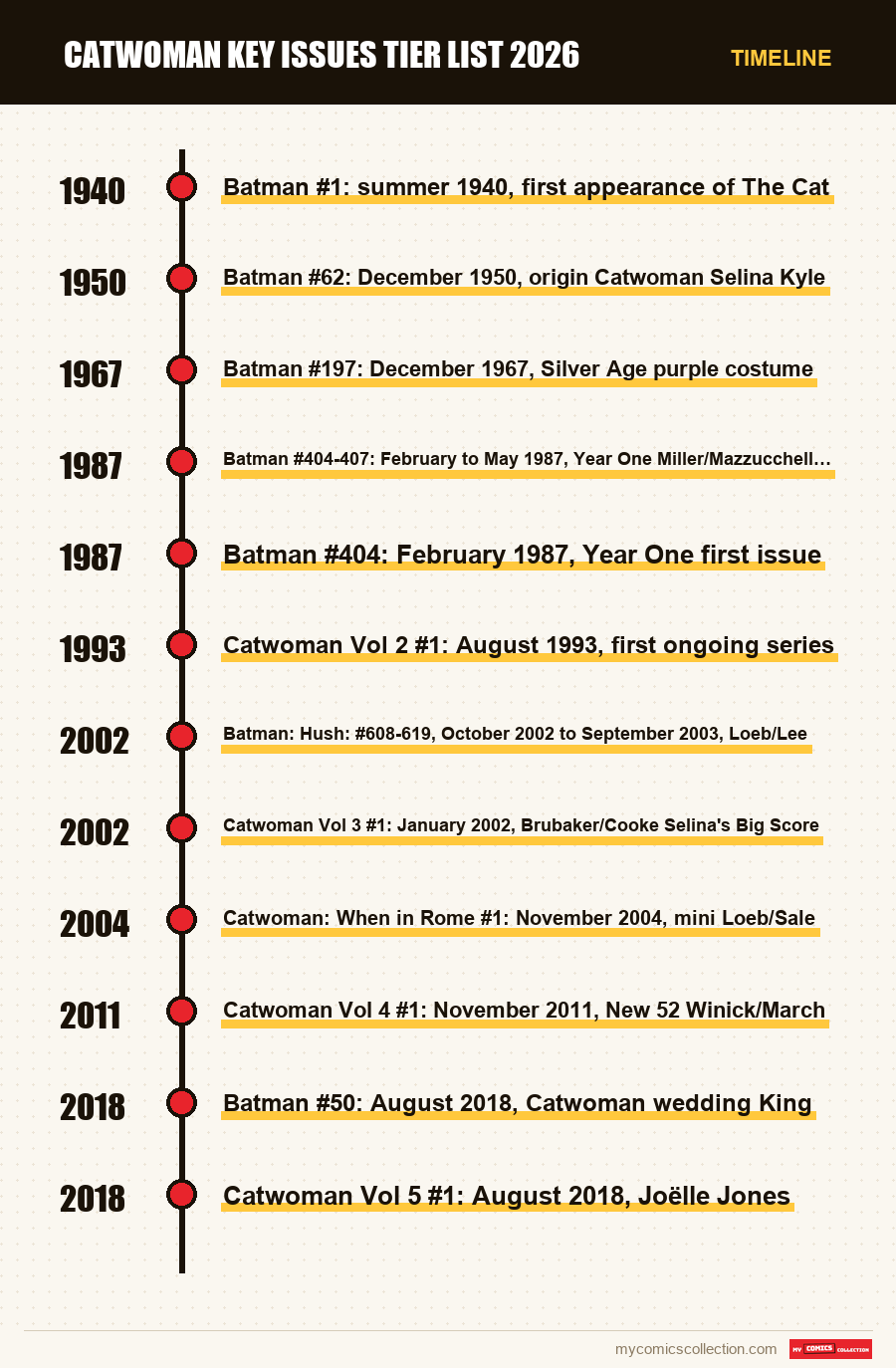
La tier list Catwoman 2026 places four blue-chips at the top: Batman #1 (summer 1940, first appearance of The Cat by Bob Kane, Jerry Robinson and Bill Finger, shared with first appearance of the Joker), Batman #62 (December 1950, origin of Catwoman revealing Selina Kyle by Bill Finger and Dick Sprang), the Year One arc Batman #404-407 (February to May 1987, Frank Miller and David Mazzucchelli, modern redesign of the character) and Catwoman Vol 2 #1 (August 1993, Jo Duffy and Jim Balent, first monthly post-Crisis ongoing series). Tier A includes Batman #197 (December 1967, Silver Age purple costume), Year One Batman #404 (February 1987) as isolated key issue, Catwoman Vol 3 #1 (January 2002, Ed Brubaker and Darwyn Cooke) and Batman: Hush (#608-619, October 2002 to September 2003, Jeph Loeb and Jim Lee). Tiers B and C cover sleepers and spec 2026-2027.
La tier list Catwoman 2026 prioritizes key issues from Selina Kyle according to four analytical dimensions: heritage value (a cult Golden Age will always sell, regardless of adaptation cycles), market liquidity (how many monthly CGC sales documented on eBay and Heritage Auctions), spec adaptation potential (The Batman 2026 by Matt Reeves, Birds of Prey James Gunn in the nascent DCU) and ratio of raw entry price to CGC rating. The four Tier S pieces alone concentrate more than 70% of the historical value of the character in the collection. Catwoman, unlike many female characters of the Golden Age, was never relegated to the background: she appears in Batman #1 since 1940 and has since maintained a central role in the mythology of Gotham.
This article dissects each tier with precise dates, original creators, May 2026 price ranges observed on eBay and Heritage Auctions, and purchasing strategies by budget. Catwoman combines several specific features that make her tier list unique: the coexistence of an extremely rare and expensive Golden Age (Batman #1 record at $2.2 million in April 2021 at Heritage), a highly collected Silver Age purple costume, and a modern post-Year One which structures contemporary iconography. The purchasing discipline must therefore arbitrate between inaccessible heritage base (Tier S Golden Age) and accessible entrances (modern Tier B and C). The 2026-2030 follow-up indicates the likely resale windows and arcs to anticipate for the long-term spec.
Catwoman tier list methodology: how to classify a key issue?
A tier list comics is not a subjective opinion, it is an analytical grid. The S, A, B, C ranking used here is based on four weighted criteria applied to the DC Comics Gotham ecosystem. First criterion, historical value. A key issue that marks the first full appearance of an iconic Golden Age character (Tier S by default) carries more weight than a modern speculative variant cover. Batman #1 falls into this category without debate, sharing Holy Grail DC's status with Detective Comics #27. Second criterion, observed liquidity. The eBay and Heritage market publishes between 4 and 12 CGC sales each month for Tier S Catwoman pieces, compared to 1 to 3 for Tier B sleepers. This liquidity determines the ease of resale and therefore the quality of investment.
Third criterion, resilience in the face of spec cycles. A Tier S comic maintains its rating even if Warner Bros postpones a DCU film. Batman #1 saw its rating multiply by 3 between 2018 and 2024, without ever falling sustainably, despite the strategic errors of Warner pre-James Gunn. A Tier C, conversely, can drop by 50% in 6 months if the adaptation disappoints (effect observed on certain key issues post-Birds of Prey 2020). Fourth criterion, the raw entry price / CGC 9.6 rating ratio. A comic whose raw VF represents 15 to 25% of the CGC 9.6 rating remains accessible to an intermediate collector. Beyond 40%, the grading gap makes the raw investment less relevant.
The weighting retained for this 2026 tier list attributes 40% to historical value, 25% to liquidity, 20% to resilience and 15% to the entry ratio. With this grid, the four Tier S pieces obtain a score greater than 85/100. Tier A is between 70 and 84. Tier B between 55 and 69. Tier C, more speculative, oscillates between 40 and 54. This hierarchy is revised each year based on documented sales over 12 rolling months and official Warner Bros. DCU announcements. To understand the general methodology applied to other characters, see the Batman 2026 tier list.
The tier list does not exempt you from reading the Catwoman key numbers complete nor a comparative analysis of major arcs likeYear OneouHush. It serves as a prioritization tool: where to start a Catwoman collection with 500, 2,000, 10,000 or 100,000 euros? The answer changes radically depending on the preferred tier, risk tolerance and hold horizon (3 years, 7 years, 15 years). Catwoman imposes a particular trade-off between Golden Age (Tier S inaccessible under 5,000 euros even in modest grade) and modern (Tier B accessible at less than 50 euros raw). The following sections provide the exact numbers for refereeing each tier in May 2026.
Tier S. The four unassailable Catwoman blue-chips
Le Tier S Catwoman brings together the four comics whose absence in a serious Catwoman collection is prohibitive. These coins concentrate the historical value of the character, dominate the secondary market in terms of liquidity, and resist speculative cycles. Owning these four issues, in whatever grade suits the budget, constitutes the heritage foundation of a collection. As Catwoman is a Golden Age character, the Tier S entry ticket is significantly higher than for Silver or Bronze Age characters, but the heritage resilience is unmatched.
Batman #1: summer 1940, first appearance of The Cat
Batman #1, dated Spring 1940 (with cover date Spring 1940, on-sale date April 1940), scripted by Bill Finger, drawn by Bob Kane and inked by Jerry Robinson, contains the very first appearance of Catwoman, then presented under the name The Cat. The issue shares this historical density with the simultaneous first appearance of the Joker, making it one of the most historically charged comics in the history of the medium. Catwoman appears there as an elegant burglar on a boat, without the feline costume which will be developed later, but already with the ambiguous duality between criminal and anti-heroine which will define the character for the following 85 years.
Rating May 2026: CGC 9.4 between $1.8 and $2.5 million depending on provenance and ownership history. CGC 9.0 between $800,000 and $1.2 million. CGC 8.0 between $280,000 and $420,000. CGC 6.0 between $90,000 and $140,000. CGC 4.0 between $35,000 and $55,000. CGC 2.0 between $12,000 and $20,000. CGC 1.0 (Coverless or Restored) between $4,500 and $8,500. The absolute record remains the April 2021 Heritage Auctions sale at $2,220,000 for a CGC 9.4 (according to 2021 public Heritage records). Raw VF (CGC 7.0-8.0 equivalent) completely inaccessible without mandatory CGC authentication above $5,000. For the context of this piece in DC mythology, see Batman story in comics.
Batman #62: December 1950, origin Catwoman Selina Kyle
Batman #62, dated December 1950 (published October 1950), written by Bill Finger and drawn by Dick Sprang, contains the official origin story of Catwoman with the revelation of her civilian identity Selina Kyle. Prior to this issue, Catwoman operated under the name The Cat with no developed backstory. #62 introduces amnesia which serves as a narrative pretext for the character's temporary redemption, the transformation from flight attendant who suffered head trauma to burglar, and the moral duality which will remain central until the modern Brubaker and King runs. This origin was never completely abandoned: Frank Miller will revise it in Year One but will retain the fundamental elements of Selina Kyle.
Rating May 2026: CGC 9.0 between $18,000 and $28,000. CGC 8.0 between $8,500 and $13,000. CGC 7.0 between $4,500 and $6,800. CGC 6.0 between $2,800 and $4,200. CGC 5.0 between $1,800 and $2,700. CGC 4.0 between $1,200 and $1,800. CGC 3.0 between $750 and $1,100. CGC 2.0 between 450 and 700 dollars. Raw VF between 1,800 and 3,200 euros, raw F between 700 and 1,200 euros, raw GD between 250 and 450 euros. The issue is one of the most collected Golden Age DC under the top tier (#1, #27 Detective). CGC authentication is non-negotiable above 1,500 euros, given the history of undeclared restorations on Golden Age Batman. For the complete mythology of Selina Kyle, seeBruce Wayne story in comics.
Batman #404-407: February to May 1987, Year One Miller/Mazzucchelli arc
Batman #404-407, published between February and May 1987, written by Frank Miller and drawn by David Mazzucchelli, constitute the Year One arc. This arc recasts the origin of Batman in parallel with The Dark Knight Returns and introduces the modern version of Catwoman: Gotham's East End prostitute Selina Kyle, complete with an adopted cat, who gradually adopts the identity of Catwoman in reaction to the Batman costume. This Miller version has completely supplanted the 1950 origin in modern continuity and directly inspires the cinema adaptations of Tim Burton (Batman Returns 1992) and Christopher Nolan (The Dark Knight Rises 2012, Anne Hathaway), as well as the HBO Max series The Penguin 2024. #404 is the first issue of the arc, but Catwoman's first Year One appearance is instead in #405-406.
Rating May 2026 for the complete set: Batman #404 CGC 9.8 between 380 and 580 dollars, CGC 9.6 between 130 and 200 dollars, raw NM between 25 and 45 euros, raw VF between 12 and 22 euros. Batman #405 CGC 9.8 between 280 and 420 dollars, raw NM between 20 and 35 euros. Batman #406 CGC 9.8 between 220 and 340 dollars, raw NM between 18 and 30 euros. Batman #407 CGC 9.8 between 200 and 320 dollars, raw NM between 15 and 28 euros. Complete raw NM set between 80 and 140 euros, exceptionally accessible for an arc of such historical density. This is the most accessible Tier S Catwoman piece and the first logical acquisition for an intermediate budget. For the complete Year One mythology, seekey issues Year One.
Catwoman Vol 2 #1: August 1993, first ongoing series
Catwoman Vol 2 #1, dated August 1993, written by Jo Duffy and drawn by Jim Balent, launches the first monthly ongoing solo Catwoman series. This is the culmination of the process initiated by Year One: Catwoman, once a secondary or tertiary antagonist, becomes capable of carrying her own regular series post-Crisis. The series will run until #94 in 2001 and constitutes the reference solo run before the Brubaker version. The issue contains the establishment of the 1990s Catwoman status quo, her settlement in post-Knightfall Gotham, and her role as a standalone anti-heroine. Jim Balent also created the purple iconography of the 1990s which would have a lasting impact on the character before the 2002 Darwyn Cooke version.
Rating May 2026: CGC 9.8 between 280 and 420 dollars. CGC 9.6 between 110 and 170 dollars. CGC 9.4 between 55 and 85 dollars. Raw NM between 25 and 45 euros. Raw VF between 10 and 18 euros. The complete raw NM series (94 issues) costs between 380 and 650 euros, an excellent value for a reference solo run. The issue remains very accessible in raw, which makes it a natural target for beginning collectors. The 36-month spec is moderate but the issue deserves its Tier S spot for its historical centrality as the first ongoing solo Catwoman series. To compare with other DC women's titles, see Poison Ivy story in comics.
Tier A: Catwoman secondary essentials
Le Tier A Catwoman brings together comics that immediately follow Tier S in importance, without reaching absolute blue-chip status. These four pieces are important for a coherent collection of the character and often offer a better entry price / upside potential ratio than the Tier S already historicized, particularly given the prohibitive cost of the Tier S Golden Age Catwoman.
Batman #197: December 1967, Silver Age purple costume
Batman #197, dated December 1967, written by Frank Robbins and drawn by Frank Springer, marks the return of Catwoman after a long Silver Age eclipse. The Comics Code Authority had gradually dismissed the character due to his moral ambiguity deemed problematic for the young readership of the 1950s and 1960s. #197 reintroduces Catwoman with her purple and green Silver Age costume, which has become iconic for this era, which will be worn in the 1966-1968 Batman television series by Julie Newmar and then Eartha Kitt. This is the transition number between the Golden Age version and the modern version, and it serves as a historical bridge to understand the graphic evolution of the character. Its rating is driven by its relative rarity in high grade and its importance in the Catwoman visual genealogy.
Rating May 2026: CGC 9.6 between $2,800 and $4,200. CGC 9.4 between $1,200 and $1,800. CGC 9.0 between $550 and $850. CGC 8.0 between 280 and 420 dollars. CGC 6.0 between 130 and 200 dollars. Raw NM between 230 and 380 euros. Raw VF between 95 and 160 euros. Raw F between 40 and 70 euros. The CGC 9.4 / raw VF ratio is around 12, which justifies the grading for high grade copies. The number appears in all lists Catwoman key numbers and often constitutes a tactical acquisition for collectors with a budget of 1,000-2,000 euros.
Batman #404: February 1987, Year One first issue
Batman #404 isolated from the rest of the Year One arc deserves a specific Tier A spot. Although the complete set #404-407 appears in Tier S, #404 as an individual key issue concentrates part of the historical value: it is the first issue of the Year One Miller/Mazzucchelli arc, the cult cover which is among the most reproduced in the Batman catalog, and the most collected piece of the quartet. The distinction between Tier S (complete set) and Tier A (isolated #404) reflects a market reality: many collectors only buy #404 as a symbolic representation of Year One, which creates a specific demand for high grades. Mazzucchelli's iconic cover with Batman silhouetted against a red background is one of the most recognizable of the 1980s.
May 2026 rating isolated: CGC 9.8 between 380 and 580 dollars. CGC 9.6 between 130 and 200 dollars. CGC 9.4 between 55 and 85 dollars. CGC 9.0 between 28 and 45 dollars. Raw NM between 25 and 45 euros. Raw VF between 12 and 22 euros. The issue is massively available in raw due to its generous 1987 print run, which makes grading profitable only from CGC 9.6. The long-term spec remains positive, with #404 having doubled its rating between 2018 and 2024 and maintaining its level since. For the full list of Year One numbers, seekey issues Year One.
Catwoman Vol 3 #1: January 2002, Brubaker/Cooke Selina's Big Score
Catwoman Vol 3 #1, dated January 2002, written by Ed Brubaker and drawn by Darwyn Cooke, launches the second ongoing solo Catwoman series, after the end of Vol 2 in 2001. The series was born from the oneshot graphic novel Catwoman: Selina's Big Score published in 2002 by DC, which serves as a narrative prologue. The Brubaker/Cooke run (2002-2005) is considered the definitive modern Catwoman run: black tone, mature writing, iconic Cooke design (the famous black costume with orange glasses which became the reference visual version for 20 years). This series directly inspires the character design in The Dark Knight Rises by Christopher Nolan (2012) and in The Batman by Matt Reeves (2022).
Rating May 2026: CGC 9.8 between 180 and 280 dollars. CGC 9.6 between 75 and 120 dollars. CGC 9.4 between 35 and 55 dollars. Raw NM between 20 and 35 euros. Raw VF between 8 and 14 euros. The complete raw NM series (the 82 issues of the total run) costs between 280 and 480 euros, a considerable narrative investment for a moderate budget. The graphic novel Selina's Big Score in the original 2002 edition costs raw NM between 35 and 60 euros, and remains one of the most relevant reading recommendations in the Catwoman cluster. The spec concerns the possible TV or film adaptation of the Brubaker arc in James Gunn's DCU.
Batman: Hush: #608-619, October 2002 to September 2003, Loeb/Lee
The bow Batman: Hush , published in Batman #608-619 between October 2002 and September 2003, written by Jeph Loeb and drawn by Jim Lee, marks a major step in the Batman/Catwoman relationship. The arc solidifies the romantic relationship between Bruce Wayne and Selina Kyle at the highest level and triggers Batman's revelation of his secret identity to Catwoman, an element that would define their dynamic for the next 20 years. Batman #608 (October 2002) is the key issue of the arc, drawn by Jim Lee at the height of his art. The cover of #608 remains one of the most reproduced in the modern Batman catalog. For the full breakdown of the Hush arc, seekey issues Hush.
Rating May 2026 for Batman #608: CGC 9.8 between 220 and 340 dollars. CGC 9.6 between 95 and 150 dollars. CGC 9.4 between 45 and 70 dollars. Raw NM between 25 and 45 euros. Raw VF between 10 and 18 euros. The complete set of the Hush bow #608-619 raw NM costs between 180 and 320 euros. Variants Jim Lee 1:25 and editor sketch between 120 and 280 euros per issue for the rare ones. The arc is one of the most collected in modern DC and enjoys high liquidity on Heritage and eBay. The spec concerns a possible post- HBO Max adaptation The Penguin 2024 and on the Brave and the Bold series announced by James Gunn for the DCU.
Tier B: Catwoman Underrated Sleepers and Bows
Le Tier B Catwoman brings together the sleepers, that is to say the issues which deserve the attention of informed collectors but whose value the general market has not yet fully recognized. These coins often present the most relevant price/potential ratios at 24-36 months, with limited downside risk. Four typical examples in 2026 illustrate the diversity of underrated Catwoman arcs.
Catwoman: When in Rome #1: November 2004, mini Loeb/Sale
Catwoman: When in Rome #1, dated November 2004, written by Jeph Loeb and drawn by Tim Sale, launches the 6-issue mini-series which serves as a spin-off to The Long Halloween (1996-1997). The arc follows Selina Kyle in Italy during the events of Long Halloween, searching for her family origins. Tim Sale's work is at the top of his art, in the visual continuity of the great Loeb/Sale Batman arcs. The miniseries was partially adapted into The Batman 2022 by Matt Reeves for Falcone Family Elements. Classic Sleeper Tier B, undervalued due to its status as a spin-off mini-series rather than the main issue.
Rating May 2026 for When in Rome #1: CGC 9.8 between 120 and 180 dollars. CGC 9.6 between 55 and 85 dollars. Raw NM between 18 and 30 euros. Raw VF between 8 and 14 euros. The complete raw NM mini-series (the 6 issues) costs between 80 and 140 euros, exceptional for a Loeb/Sale arc of this quality. The upside potential comes from the possible continued adaptation in the second part The Batman planned for 2027. Sleeper Tier B with excellent 5-year price/hold ratio. The Tim Sale cover is a collector's reference.
Catwoman Vol 4 #1: November 2011, New 52 Winick/March
Catwoman Vol 4 #1, dated November 2011, written by Judd Winick and drawn by Guillem March, launches the third ongoing solo Catwoman series as part of the DC New 52 reboot. The issue remained controversial for its sexualized editorial choices, but remains historically important as a New 52 depiction of the character. The series will run until #52 in 2016. #1 New 52 also contains the first appearance of the New 52 continuity Catwoman, distinct from the pre-Flashpoint version. The spec concerns the possibility of a future DCU narrative reintegration of this version.
Rating May 2026: CGC 9.8 between 80 and 130 dollars. CGC 9.6 between 35 and 55 dollars. Raw NM between 10 and 18 euros. Raw VF between 4 and 8 euros. Variants 1:25 Guillem March between 180 and 320 euros raw NM, Tier B sleepers with negligible downside. The complete raw NM series costs between 180 and 320 euros. The issue remains affordable and provides a comprehensive narrative exposition to the New 52 version of the character, useful for collectors of complete runs.
Catwoman Vol 5 #1: August 2018, Joëlle Jones
Catwoman Vol 5 #1, dated August 2018, written and drawn by Joëlle Jones, launches the fourth ongoing solo Catwoman series as part of the post-Doomsday Clock Rebirth. Joëlle Jones, already acclaimed for Lady Killer and his work on Mockingbird, signs one of the most stylized Catwoman runs of the 21st century. The series will run until #65 in 2024 under several successive writers. #1 Jones has become a sought-after piece for visual work and character modernization. The spec focuses on the growing role of recognized female creators on the collector market (see Joëlle Jones, Becky Cloonan, Tula Lotay), a trend documented in comics collector woman 2026.
Rating May 2026: CGC 9.8 between 80 and 130 dollars. CGC 9.6 between 35 and 55 dollars. Raw NM between 10 and 18 euros. Raw VF between 4 and 8 euros. 1:25 and 1:50 variants between 80 and 220 euros raw NM. The number remains budget-friendly and represents a Tier B sleepers perfect for long-term hold. The complete Jones raw NM run (the first 12 issues) costs between 120 and 220 euros, one of the best Catwoman narrative investments of the 21st century.
Batman #50: August 2018, Catwoman wedding King
Batman #50, dated August 2018, written by Tom King and drawn by Mikel Janín, contains the arc of the aborted marriage between Bruce Wayne and Selina Kyle. The outcome is one of the most controversial DC issues of the 2010s, due to the narrative choice to cancel the wedding on the last page after a long preparatory build-up of 50 issues. The issue, however, has become central to the Bat-Cat mythology and retains its historical value despite (or because of) the controversy. Multiple variants (Mattina, Reis, Mann, and others) with dedicated Selina Kyle wedding dress covers.
Rating May 2026: Batman #50 CGC 9.8 standard cover between 120 and 180 dollars. CGC 9.6 between 55 and 85 dollars. Raw NM between 12 and 22 euros. Mattina raw NM variants between 80 and 180 euros depending on rarity. Sleeper Tier B with sustained level of demand on the Bat-Cat collector market. The spec concerns the possible TV adaptation of the King run in the future DCU. The number has seen its rating stable since 2020, a sign of heritage resilience.
Tier C: Spec 2026-2027 and high-risk bets
Le Tier C Catwoman brings together high-risk speculative bets, the odds of which mainly depend on cinema or TV announcements not yet confirmed. These pieces should not exceed 5-10% of a Catwoman collection budget, but can outperform if the right catalyst arrives. Three speculative axes dominate in 2026 for Catwoman.
DCU The Batman 2026 Reeves spin-off
The second part The Batman by Matt Reeves is announced for October 2027 (official Warner Bros date communicated in 2024). Zoë Kravitz will reprise the role of Selina Kyle/Catwoman. A spin-off series centered on Catwoman had been mentioned for HBO Max but its production remains uncertain in May 2026. If it is confirmed, the rating effect on the Catwoman key issues could be significant, in particular on Tier B and C linked to the Brubaker/Cooke and Loeb/Sale arcs which directly inspired the iconography of the 2022 film. The modern 2016-2024 variants on Catwoman would also benefit from a rebound effect.
Tier C spec parts to watch out for: The Long Halloween #1 (December 1996) already listed (CGC 9.8 between 380 and 580 dollars), therefore rather Tier A for the Loeb/Sale cluster, Tier C in the pure Catwoman speculative context. When in Rome complete raw NM set between 80 and 140 euros, ideal spec entry point with negligible downside. Catwoman Vol 3 #1 varying Darwyn Cooke raw NM between 45 and 80 euros. For the disciplined strategy of spec, see comics investment update 2027 strategy pillar.
Birds of Prey James Gunn DCU
James Gunn, co-CEO of DC Studios since 2022, announced a project Birds of Prey in the nascent DCU currently being structured. Catwoman could appear as an alternate or crossover member, given her recurring narrative connection with Black Canary, Huntress and Oracle in several DC runs. If the project is officially confirmed in 2026 or 2027, the Catwoman / Birds of Prey crossover key issues would become immediate spec targets. Birds of Prey: Catwoman oneshot 2003 raw NM between 8 and 15 euros, to watch. Birds of Prey Vol 1 #1 (January 1999) raw NM between 18 and 35 euros, accessible.
The downside risk remains significant: the previous film Birds of Prey: Harley Quinn 2020 had caused an irregular rating on the corresponding key issues, with a drop of 35% in 18 months on certain post-release sleepers. Budgetary discipline requires not exceeding 50-150 euros per individual Birds of Prey spec bet, diversifying across 4-6 different coins to pool the risk. For the full list of Birds of Prey sleepers, see the Harley Quinn tier list 2026.
Spec modern bows 2024-2026
Several recent Catwoman arcs merit Tier C monitoring. Catwoman Vol 5 #50 (August 2022, run Tini Howard) contains strong narrative elements that could be adapted in the event of a Catwoman DCU series. The series Catwoman: Lonely City (2021-2022, Cliff Chiang) offers a Black Label version of an aged Selina Kyle in a critically acclaimed post-Batman Gotham. Lonely City #1 raw NM between 12 and 25 euros, Cover B Chiang variants between 35 and 80 euros. The spec concerns the possible Black Label adaptation in the future DCU Elseworlds announced by James Gunn.
Rule of thumb Tier C 2026: do not exceed 100-300 euros per individual spec bet, diversify across 5-8 different coins, set a resale threshold at +100% gross. For a spec portfolio discipline, see investment strategy update 2027. The modern Catwoman 2024-2026 variants (notably the Stanley Lau Artgerm covers, which has marked the character since 2014) remain spec targets accessible at 25-80 euros per piece.
Collecting this series?
Track what you own, what you are missing and what your collection is worth. 7 day trial.
Start my trial →Purchasing strategy by budget: 500, 2,000, 10,000, 100,000 euros
La Catwoman purchasing strategy depends directly on the available budget and the hold horizon. Four budget profiles are rational for 2026, each with an optimal mix of tiers. Special feature Catwoman: Tier S Golden Age (Batman #1 and Batman #62) is completely inaccessible under 5,000 euros even in modest grade, which strongly forces low and medium budgets to favor Tier S Year One and Vol 2.
Budget 500 euros: Catwoman beginner collection
At 500 euros, the objective is heritage access without grading and without Golden Age. Suggested allowance: 80 euros for the complete set Batman #404-407 Year One raw NM, 35 euros for Catwoman Vol 2 #1 raw NM, 25 euros for Batman #608 Hush raw NM, 60 euros for the mini-series When in Rome raw NM complete, 25 euros for Catwoman vol. 3 #1 Brubaker/Cooke raw NM, 35 euros for Catwoman Vol 5 #1 Joëlle Jones raw NM, 25 euros for Batman #50 King raw NM, 215 euros spread over 8-12 Tier B sleepers and additional runs (Lonely City, Selina's Big Score graphic novel, Birds of Prey crossovers). This allowance covers all major modern arcs of the character without grading, at an affordable budget. Tier S Golden Age remains out of reach but the narrative collection is complete.
Budget 2,000 euros: Catwoman intermediate collection
At 2,000 euros, the introduction of grading on key parts becomes relevant. Suggested allowance: 400 euros for Batman #197 Silver Age raw F-VF, 150 euros for Batman #404 CGC 9.6, 100 euros for Catwoman Vol 2 #1 CGC 9.6, 100 euros for Batman #608 Hush CGC 9.6, 120 euros for the Year One set #404-407 raw NM, 280 euros for Catwoman Vol 3 #1 Brubaker/Cooke CGC 9.8 plus graphic novel Selina's Big Score, 350 euros for 12-15 sleepers Tier B raw NM (Lonely City, When in Rome, Vol 5 Jones runs, Vol 4 New 52, Birds of Prey crossovers), 500 euros reserve for upgrade to Batman #62 CGC 2.0 if opportunity. This allocation builds a serious collector's collection with grading accents on key narrative pieces.
Budget 10,000 euros: Catwoman investor collection
At 10,000 euros, the purchase of a Tier S Golden Age coin becomes possible in low grade. Suggested allowance: 4,500 euros for Batman #62 CGC 4.0-5.0 (the cardinal part), 1,500 euros for Batman #197 CGC 9.0, 800 euros for Batman #404 CGC 9.8, 500 euros for the complete Year One set in CGC 9.6, 400 euros for Batman #608 Hush CGC 9.8, 300 euros for Catwoman vol. 2 #1 CGC 9.8, 300 euros for Catwoman Vol 3 #1 CGC 9.8, 700 euros for 8-10 Tier B sleepers in CGC 9.6-9.8, 1,000 euros for 5-7 pieces Tier C modern variants. The portfolio combines investment (Tier S Golden Age grading authenticated) and complete narrative collection. Hold target for 7-10 years with rebalancing every 24 months.
Budget 100,000 euros: Catwoman heritage collection
At 100,000 euros, the objective becomes the creation of a Catwoman museum collection, with access to the Holy Grail Batman #1 in restored grade or low grade. Suggested allocation: 45,000 euros for Batman #1 CGC 2.0-3.0 (or Restored 4.0-5.0, the absolute cardinal piece), 25,000 euros for Batman #62 CGC 7.0-8.0, 4,000 euros for Batman #197 CGC 9.4-9.6, 2,000 euros for the complete Year One set in CGC 9.8, 1,500 euros for Catwoman Vol 2 #1 CGC 9.8 plus full run raw NM, 1,200 euros for Batman #608 Hush CGC 9.8, 1,200 euros for Catwoman Vol 3 #1 CGC 9.8 plus complete run raw NM, 5,000 euros for complete Tier B collection in CGC 9.6-9.8 plus rare variants, 15,100 euros cash reserve for opportunities and upgrades. For the logistical management of this level of collection, see comics manager complete guide.
Cautious method. Whatever the budget bracket, do not exceed 60% of the envelope on a single Tier S part. Batman #1 monopolizes a budget, the collection loses its narrative coherence and total liquidity collapses (a single item illiquid at 6 months). Diversification between Tier S, A and B remains the key to a balanced Catwoman collection, even at the asset level above 50,000 euros.
Catwoman Pitfalls: Batman #1 reprint, multiple reboots, Golden Age restoration
Four technical pitfalls characterize the Catwoman market and cause the most costly mistakes among beginning and intermediate collectors. Identifying them determines the quality of any Tier S investment, particularly given the amounts committed to Golden Age DC.
Trap 1: Batman #1 reprint and facsimile
DC Comics has published several reprints and facsimile editions of Batman #1 between 1965 and 2025. The reprint Famous First Edition F-5 from 1975 reproduces the original issue in giant format, but with a different paper and an explicit mention Famous First Edition. The facsimile editions from the 2010s and 2020s imitate the original with modern glossy paper. Some unscrupulous sellers present these reprints as originals, especially on poorly moderated platforms. Mandatory checks: copyright notice on the inside page, cover price (10 cents original, without mention on reprint), quality of paper (yellowed acid for 1940 original, modern white paper for facsimile), UPC barcode obligatorily absent on the 1940 original. CGC authentication is non-negotiable above 5,000 euros of investment.
Trap 2: multiple Catwoman #1 reboots
DC Comics has published five separate Catwoman ongoing series with a #1 each: Vol 1 (1989-1991, miniseries), Vol 2 (1993-2001), Vol 3 (2002-2010, Brubaker/Cooke), Vol 4 (2011-2016, New 52), Vol 5 (2018-2024, Joëlle Jones). Beginning collectors often confuse these #1s and buy a Vol 4 New 52 thinking of acquiring a Vol 2 1993. The value differs considerably: Catwoman Vol 2 #1 raw NM between 25 and 45 euros against Catwoman Vol 4 #1 raw NM between 10 and 18 euros. Mandatory checks: publication date (August 1993 for Vol 2, November 2011 for Vol 4), creative team (Jo Duffy / Jim Balent for Vol 2, Judd Winick / Guillem March for Vol 4), cover price (1.50 dollars 1993 vs. 2.99 dollars 2011), DC logo (bullet 1993 vs DC New 52 logo 2011).
Trap 3: undeclared Golden Age restoration
The Golden Age DC, in particular Batman #1 and Batman #62, are massively restored on the secondary market given the rarity and value. Restoration consists of recoloring, regluing, rewhitening or retouching a copy to artificially increase its visual grade. CGC systematically identifies the restoration, which appears on the slab with the mention purple label Restored rather than blue label Universal. A restored example is typically worth 30 to 60% of a Universal example of equivalent grade. On the raw market, detection is complex: UV lighting, observation of edges, checking the whiteness of pages. Buying raw for more than 2,000 euros without expertise is risky. For Golden Age DCs priced over 10,000 euros, CGC authentication is the only protection.
Trap 4: Catwoman 2016-2024 variants and speculative bubbles
Catwoman has benefited from intensive production since 2016, notably with the Stanley Lau Artgerm covers which have marked the character. Certain 1:25, 1:50 and 1:100 variants have seen their prices artificially inflated by speculative purchases concentrated on secondary platforms (Whatnot, Mercari, Facebook groups), with announced prices not corroborated by documented Heritage or eBay sales. The prudent rule: do not exceed 3 times the CGC 9.8 documented market price for a modern variant, check at least 5 closed eBay sales of less than 90 days before any purchase for more than 200 euros. Speculative bubbles on modern variants can burst in 6 to 12 months with a fall of 60 to 80%.
Monitoring 2026-2030: resale windows and Catwoman cycles to anticipate
Le long-term follow-up Catwoman over 2026-2030 must integrate several probable catalysts. Warner Bros and James Gunn have confirmed the DCU strategy with multiple Batman projects in parallel: The Batman Reeves (October 2027), The Brave and the Bold Andy Muschietti for the main DCU (date unconfirmed 2027-2028), and potential Catwoman HBO Max series unconfirmed. This density of Batman projects creates several possible speculative windows for Catwoman between 2026 and 2030, with a significant probability of sustained increase in Tier S and A.
Indicative calendar 2026-2030. Year 2026: optimal purchasing window on Tier B and C before the firm DCU announcements, start of the pre-The Batman 2 . Year 2027: release The Batman 2 in October, start of the major speculative cycle on the Brubaker/Cooke arc and the Long Halloween arc, buying window closes on Tier A and B linked to these runs. Year 2028: probable speculative peak around the release Brave and the Bold DCU, optimal resale window on Tier S Year One (15-35% above 2026), Tier A (40-70%) and B (40-90%). Year 2029: post-peak digestion, rating stabilized or slightly decreasing, waiting for the next catalyst. Year 2030: new cycle possible with Catwoman DCU series if confirmed.
The empirical rule observed on major DC key issues over 15 years: 60% of the pre-film increase occurs in the 12 months preceding the release, 25% at the release, 15% in the following 6 months. Beyond that, partial descent of 15 to 30%. For Tier S Catwoman, the 2027-2028 peak should represent a partial resale opportunity (particularly on parts purchased in 2024-2026 at still reasonable prices). The optimal resale window extends from May to December 2028 according to this cycle. The Tier S Golden Age (Batman #1 and #62) follows a different heritage logic, not very sensitive to short cinema cycles, with a secular increase trajectory of around 8 to 12% annually documented since 2010.
Daily monitoring of Tier S ratings requires a tracking tool. A rating recorded in a notebook or static file is obsolete within 60 days. A Comics Manager with daily-updated valuation by grade provides the necessary refreshment to manage a 36-60 month hold strategy; the alerts themselves come from eBay saved searches. See the comics database et the list of key issues to quickly identify arbitrage opportunities. To estimate the current value of coins already owned, the free estimate provides an indicative range by grade and state. To follow Gotham's other villains and their speculative progression, see the Joker 2026 tier list.
FAQ: Catwoman 2026 tier list
Why are Batman #1 and Batman #62 both in Tier S?
Because they represent two distinct and complementary stages of the first Catwoman appearance. THE Batman #1 contains the first appearance as The Cat, without a developed backstory and without the feline costume that would be created later. THE Batman #62 contains the official origin with the revelation of Selina Kyle's identity and the founding story of the modern character. Both are historically necessary for serious collecting. The market prioritizes them (the Batman #1 remains 30 to 80 times more expensive in CGC 9.0), but no accomplished Catwoman collector is satisfied with just one of the two. The full narrative density demands ownership of both issues, making Tier S Catwoman one of the most budgetally demanding in the entire DC market.
Is Year One Batman #404-407 really Tier S at 80-140 euros raw NM?
Yes, and that's precisely what makes this the most accessible Tier S Catwoman piece. The ratio of entry price / historical value is exceptional: for the price of an evening at the restaurant, you gain access to the arc which refounded the modern iconography of the character and which directly inspired the cinema versions of Burton, Nolan and Reeves. This is the first logical Tier S acquisition for a beginner or intermediate budget (500-2,000 euros). Beyond the NM raw grade, the Year One set remains accessible up to CGC 9.8 under $1,500 for the 4 issues, unlike the other three Tier S Golden Age. The isolated number #404 is enough for a symbolic exposure to Tier S.
Catwoman Vol 3 #1 Does Brubaker/Cooke deserve Tier A rather than Tier S?
The Tier A placement reflects a market reality: the Brubaker/Cooke run is undoubtedly the definitive modern Catwoman run, but the Catwoman Vol 3 #1 isolated does not have the status of the character's first appearance. Its value lies in starting a legendary run, which places it in confirmed Tier A. If the criterion chosen was purely narrative and reading-oriented, Vol 3 #1 would be Tier S. If the criterion is heritage with exclusive historical density, it remains Tier A. The distinction is analytical and reflects the weighted grid 40% historical, 25% liquidity, 20% resilience, 15% entry ratio. The number nevertheless remains the most relevant collector's acquisition between 200 and 500 euros.
Is Batman #197 Silver Age really worth 230-380 euros raw NM?
Yes, because of its high-grade rarity and its role as a bridge between Golden Age and Modern. #197 is the official return of Catwoman after a long absence, and it contains the purple Silver Age costume that would be worn in the 1966-1968 Batman television series. The Silver Age 1967 print run remains limited compared to modern print runs, and NM grade copies are rare (CGC population census above 9.4 remains less than 200 copies in May 2026). The entry price/historical value ratio fully justifies the Tier A position, with moderate but constant upside potential over 5-10 years. The number appears in all lists Catwoman key numbers.
Should we favor raw or CGC for a Catwoman 2026 collection?
The rule depends on the tier and Golden Age vs Modern. For Tier S Golden Age (Batman #1 and #62), CGC grading is non-negotiable above 1,500 euros investment per piece: counterfeits, undeclared restorations and facsimile reprints make raw too risky. For Tier A Silver Age (Batman #197), CGC grading is justified from CGC 9.4-9.6, where the raw price / CGC price ratio justifies the grading cost. For Tier S Modern Year One and Vol 2 #1, raw NM remains relevant up to the threshold of 150-200 euros, beyond which CGC 9.8 secures the investment. For Tier B and C, raw remains the main option, except in the exceptional case of pristine candidate 9.8. For the CGC submission method from France, see the dedicated guide in the Catwoman cluster.
Related articles
- Batman tier list key issues 2026
- Catwoman Key Numbers: The Complete List
- Key issues Year One
- Key issues Hush
- Comics investment update 2027 pillar strategy