The 2026 tier list of key Harley Quinn issues ranks the numbers by valuation potential: Tier S blue-chip (Batman Adventures #September 12, 1993 Kelley Puckett/Mike Parobeck, 1st appearance Harley Quinn comics; Batman: Mad Love 1994 prestige one-shot Paul Dini/Bruce Timm official origin; Harley Quinn Vol 1 #1 December 2000 Karl Kesel/Terry Dodson first ongoing series; Detective Comics #8 June 31, 2007 1st Bombshells follows): central assets to €350-18,000 depending on grade. Tier A (Batman Adventures Annual #1 1994, Harley Quinn Vol 2 #1 February 2014 New 52 relaunch Conner/Palmiotti/Hardin, Batman: Harley Quinn #1 1999 prestige DCU canon, Batman Adventures #28 January 1995). Tier B solid sleepers (Suicide Squad Vol 4 #1 November 2011 New 52, Birds of Prey Vol 3 #1 November 2011, Harley Quinn 25th Anniversary Special 2017, Harley Quinn Vol 4 #1 February 2016). Tier C speculative bets 2026-2027 (HBO Harley Quinn Animated season 5, DCU James Gunn Birds of Prey).
Building a solid Harley Quinn collection in 2026 requires a method: without rigorous prioritization of numbers, the collector scatters his budget on decorative modern variants while historic blue-chips continue to climb out of reach. Harley Quinn is one of the rare characters whose development trajectory has broken records over the decade 2014-2024, driven by the transition from the second-hand status of the Joker to that of an autonomous cultural icon. The tier list is the discipline tool that separates must-have from nice-to-have, defensive investment from calculated bet, purchasing urgency from opportunistic patience.
Ce guide tier list Harley Quinn 2026 classifies major key issues into four tiers (S, A, B, C) according to three weighted criteria: narrative historical importance, market performance over five rolling years, and probability of DCU/HBO catalyst in the 2026-2030 window. Each issue is documented with exact date, creative team and price range by CGC grade. Objective: to allow the French-speaking collector to build a budgeted purchasing strategy, without wasting a euro on the classic traps of the Harley Quinn catalog: false reprints of Batman Adventures #12, confusion between 1st/2nd/3rd/4th printings, multiple relaunches #1 of the Harley Quinn series of which only two really count.
Harley Quinn 2026 tier list methodology
A useful tier list doesn't just line up numbers in order of price: it prioritizes based on a coherent investment and collection thesis. For Harley Quinn in 2026, three methodological axes structure the classification, calibrated on the specificity of a character born outside of comics (Batman: The Animated Series, September 1992) and naturalized late in the main DC continuity.
Tier S/A/B/C classification criteria
- Narrative historical significance (40%): first appearances in comics, canonical events (Mad Love as official origin, post-2000 mainstream integration, New 52 relaunch), structuring runs cited by critics. For Harley, the singularity lies in the diversity of the firsts: 1st comics app (BA #12), 1st origin (Mad Love), 1st ongoing (Vol 1 #1), 1st Bombshells design (Detective #831).
- Market performance 5 years (35%): CGC price trend documented on GoCollect, Heritage Auctions, ComicConnect between 2021 and 2026. Batman Adventures #12 1st print in CGC 9.8 exploded to records €12,000-18,000 during the big Heritage 2024 sales.
- Probability of DCU/HBO catalyst 2026-2030 (25%): Birds of Prey James Gunn projects, season 5 Harley Quinn Animated HBO Max, Margot Robbie rumors DCU revival, long-term media traction post-Suicide Squad and The Suicide Squad.
Definition of third parties
- Tier S: blue-chip: central numbers, globally recognized value, no risk of historical downgrading. These are the defensive assets of the collection. If you could only own four Harley Quinns, these would be them.
- Tier A: fundamentals: historically critical issues with solid performance but without the absolute status of Tier S. Make up the backbone of a serious collection.
- Tier B: sleepers with conviction: numbers undervalued in view of their significance, with catalyst identified at 12-36 months. Moderate risk, documented re-rating potential.
- Tier C: speculative bets: numbers with a strong thesis but dependent on uncertain future events. Limited budget allocation recommended.
Voluntary out-of-scope
This tier list does not classify modern post-2016 variants without a confirmed limited edition, secondary files (advertising cameos prior to BA #12 that are regularly contested), nor OGN graphic novels without an identified key issue. For the parallel market of Batman Adventures #12 reprints and the critical distinction 1st print / 2nd-3rd-4th printings, the guide dedicated to the four printings of Batman Adventures #12 constitutes obligatory prior reading before any raw purchase over €200.
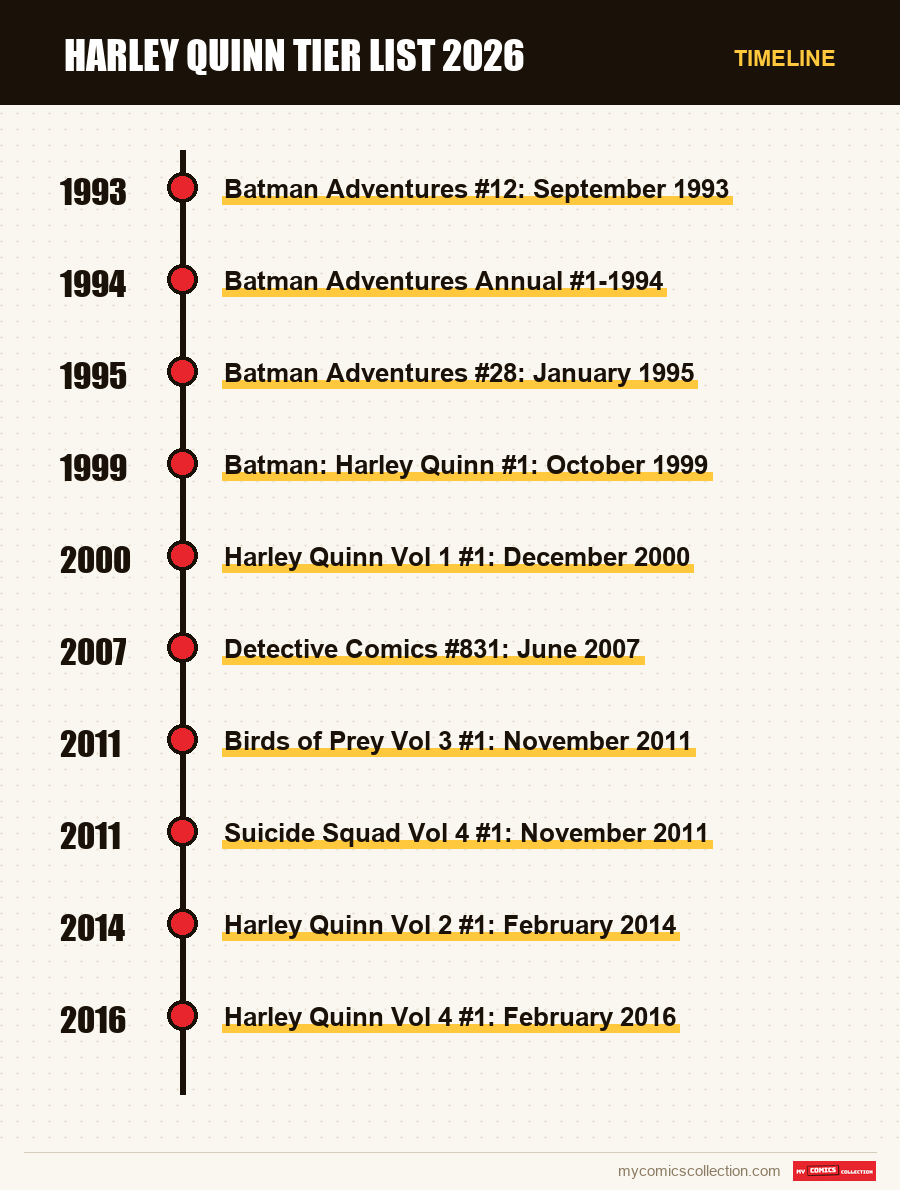
Tier S: the central Harley Quinn blue-chips
Four issues absolutely dominate the Harley Quinn catalog and constitute the defensive core of any serious collection. They combine proven rarity in high grade, indisputable historical importance and maximum liquidity on major auction markets. Harley particularity: three of these four issues focus on the decade 1993-2007, with a clear generational jump towards modern relaunches.
Batman Adventures #12: September 1993 (Kelley Puckett / Mike Parobeck / Rick Burchett)
The absolute cornerstone. Published by DC Comics in September 1993, written by Kelley Puckett, drawn by Mike Parobeck (inker Rick Burchett), Batman Adventures #12 marks the first appearance of Harley Quinn in a comic book. The character had already existed since September 1992 in Batman: The Animated Series (episode "Joker's Favor", Bruce Timm and Paul Dini), but this issue inaugurates his official entry into comics continuity: first in the Animated tie-in label, then gradually absorbed into the main DC universe from the 2000s. To understand why this late induction creates the historical singularity, see the complete story of Harley Quinn in comics.
- CGC 9.8 1st print: public sales 2024-2026 between €8,500 and €15,500. Record Heritage 2024 at €16,800 on an exceptional newsstand copy. Census CGC 9.8 1st print less than 1,800 copies.
- CGC 9.6 1st print: €3,200 to €5,500. Relative sweet spot to enter the title.
- CGC 9.4 1st print: €1,600 to €2,600.
- CGC 9.2 1st print: €900 to €1,500.
- CGC 9.0 1st print: €550 to €850. The minimum acceptable to preserve blue-chip status.
- CGC 8.0 1st print: €280 to €420. Acceptable for heritage collections, steep discount on resale.
5-year trend: +340% between 2021 and 2026 in CGC 9.8 1st print, with an acceleration post-Birds of Prey (2020) and The Suicide Squad (2021) never really reversed. No correction greater than 18% on the 24-month sliding windows since 2018. Absolute criticism: never buy raw above €600 without slabbed CGC authentication, the market for 2nd, 3rd and 4th printings sold for 1st prints remains massive. For the precise distinction method (price rating on the back, book ratio marker, visual clues), the dedicated guide is imperative.
Batman: Mad Love: February 1994 (Paul Dini / Bruce Timm)
The official origin. Published February 1994 in the prestige one-shot format (squarebound, 64 pages, light hardcover), Batman: Mad Love written by Paul Dini and drawn by Bruce Timm: the two original creators of the character in Batman: The Animated Series: establishes the canonical backstory of Harleen Quinzel: brilliant psychiatrist at Arkham Asylum, seduced and then manipulated by the Joker to the point of falling into crime. This issue won the 1994 Eisner Award for Best One-Shot, institutionally validating Harley as a character worthy of serious narrative treatment. It will be adapted almost entirely as an episode of The New Batman Adventures (1999) then cited as the template for the Birds of Prey plot (2020).
- CGC 9.8: €1,800 to €3,200. Census CGC 9.8 higher than BA #12 (higher initial circulation), but structurally strong demand.
- CGC 9.6: €700 to €1,100.
- CGC 9.4: €380 to €580.
- GCC 9.2: €220 to €340.
- CGC 9.0: €140 to €210.
- Raw VF/NM: €60 to €120 depending on condition. Entry point for reading collection.
5-year trend: +210% in CGC 9.8 between 2021 and 2026. The issue benefits from a double effect: prestige in physical format (hobby collectors of object-sized comics) and academic recognition. Any Harley Quinn biopic or Dini/Timm Animated Universe anthology project would give an immediate boost. Cross reference recommended with complete story of the Joker in comics to understand the initial Harley-Joker narrative dependence.
Harley Quinn Vol 1 #1: December 2000 (Karl Kesel / Terry Dodson)
The first ongoing solo series. Published December 2000, written by Karl Kesel and drawn by Terry Dodson (inker Rachel Dodson), Harley Quinn Vol 1 #1 launches the first regular series dedicated to the character in the main DC continuity (post-No Man's Land where Harley makes her canonical entry into the Earth-Prime universe). The series of 38 issues + Annuals (2000-2004) will be the testing ground for a character who proves his ability to carry a solo title without the crutch of the Joker. Without this first ongoing, the commercial rebound Vol 2 (New 52) would never have existed.
- CGC 9.8: €380 to €620.
- CGC 9.6: €150 to €240.
- CGC 9.4: €75 to €115.
- GCC 9.2: €45 to €75.
- Raw VF/NM: €20 to €35.
5-year trend: +130% in CGC 9.8 between 2021 and 2026, +85% in CGC 9.6. Most accessible Tier S entry point. Relative sleeper until the general public market has fully integrated the historical importance of Vol 1 compared to Vol 2 New 52. To watch specifically: the newsstand variant is rare (DC having largely switched to direct edition at the end of 1999) and can command a premium of 40-80% over the direct edition.
Detective Comics #831: June 2007 (Paul Dini / Don Kramer)
First appearance of the Bombshells costume. Published June 2007, scripted by Paul Dini (return of the original creator) and drawn by Don Kramer, Detective Comics #831 visually inaugurates Harley's “Bombshells” design: vintage retro-pin-up costume which will become one of the character's emblematic silhouettes, available in variant covers, collector's statues and massive merchandising. The Bombshells design, later theorized by Ant Lucia for the DC Comics Bombshells line (2013-2017), builds directly on this first canonical occurrence.
- CGC 9.8: €280 to €460.
- CGC 9.6: €110 to €180.
- CGC 9.4: €55 to €85.
- Raw VF/NM: €15 to €30.
5-year trend: +95% in CGC 9.8. Sleeper Tier S to conviction. The Bombshells rating mechanically follows the DC Collectibles editions, and the exhibition of the Bombshells line in French collections (notably Eaglemoss DC Superhero Collection) maintains continued demand. Preferred position for content budget looking for Tier S without going for the 1st major apps.
Tier A: Harley Quinn fundamentals
Four numbers make up the second circle. They are not absolutely major, but no serious Harley Quinn collection can sustainably do without them. They represent the historical bridge between the birth of Animated (1993-1994) and mainstream recognition (post-2014).
Batman Adventures Annual #1-1994
First appearance of the extrapolated origin. Published in 1994, this first annual of the Batman Adventures series contains a complementary story of the Harley Quinn origin by Paul Dini and Ronnie del Carmen. It prefigures Mad Love (six months later) by laying the psychological foundations for Harleen Quinzel. Often overlooked by beginning collectors, this is a Tier A must-have for anyone wanting a coherent chronological set.
- CGC 9.8: €380 to €580.
- CGC 9.6: €160 to €240.
- CGC 9.4: €80 to €120.
- Raw VF/NM: €18 to €32.
5-year trend: +160% in CGC 9.8. The census rarity (annual less distributed than the regular title) begins to be felt above CGC 9.6.
Harley Quinn Vol 2 #1: February 2014 (Amanda Conner / Jimmy Palmiotti / Chad Hardin)
The commercial relaunch that changes everything. Published February 2014 as part of the New 52 DC, co-written by Amanda Conner and Jimmy Palmiotti, drawn by Chad Hardin (cover Amanda Conner), Harley Quinn Vol 2 #1 marks the character's transition from niche fan-favorite status to that of a mainstream icon with strong commercial potential. The series will reach more than 30 issues per month in DC sell-through for three years, triggering compulsive variant covers, widespread cross-title appearances and cinema integration Suicide Squad (2016).
- CGC 9.8 cover A regular: €110 to €170.
- CGC 9.8 variant Bruce Timm: €380 to €580. The most sought after variant of the lot.
- CGC 9.8 variant Madame Tussauds: €240 to €360.
- CGC 9.6 cover A regular: €45 to €70.
- Raw VF/NM cover A: €10 to €20.
5-year trend: +95% cover A in CGC 9.8, +180% Bruce Timm variant. Recommended strategy: prioritize the Bruce Timm variant for the long-term premium collection, with the regular cover A remaining a commodity entry point. Reference to cross with the tier list Joker key issues 2026 to understand the Joker/Harley halo effect on 2014-2024 valuations.
Batman: Harley Quinn #1: October 1999 (Paul Dini / Yvel Guichet)
The prestige DCU canonization one-shot. Published October 1999, written by Paul Dini and drawn by Yvel Guichet, Batman: Harley Quinn #1 marks Harley Quinn's official entry into the main DC continuity (Earth-Prime), not the Animated tie-in label. The issue precedes by a few months the No Man's Land run which will definitively anchor Harley in the mainstream universe. Without this canonization, Vol 1 ongoing from December 2000 would not have had a narrative basis.
- CGC 9.8: €320 to €480.
- CGC 9.6: €130 to €200.
- CGC 9.4: €65 to €95.
- Raw VF/NM: €15 to €28.
5-year trend: +175% in CGC 9.8. High conviction Tier A sleeper. The market is beginning to recognize the critical distinction between “1st app comics” (BA #12, Animated label) and “1st app DCU mainstream” (Batman: Harley Quinn #1), creating a dual pole of lasting demand.
Batman Adventures #28: January 1995
First significant post-Mad Love solo cameo. Published January 1995, Batman Adventures #28 features Harley Quinn in a central post-Mad Love role, cementing the character's status beyond mere gimmick. The issue remains relatively accessible and offers an excellent importance/price ratio for a coherent chronological collection.
- CGC 9.8: €220 to €340.
- CGC 9.6: €90 to €140.
- CGC 9.4: €45 to €70.
- Raw VF/NM: €12 to €22.
5-year trend: +110% in CGC 9.8.
Tier B: Harley Quinn sleepers to conviction
Four numbers make up the sleeper segment. Moderate risk, catalyst identified at 12-36 months, re-rating potential documented. The Tier B Harley characteristic: high exposure to HBO Max and DCU James Gunn 2026-2028 announcements.
Suicide Squad Vol 4 #1: November 2011 (Adam Glass / Federico Dallocchio)
The central New 52 role that precedes the competing MCU adaptation. Published November 2011 as part of the New 52 DC reboot, Suicide Squad Vol 4 #1 by Adam Glass revives the dynamic Task Force
- CGC 9.8: €95 to €150.
- CGC 9.6: €38 to €60.
- Raw VF/NM: €8 to €15.
5-year trend: +75% in CGC 9.8. To go further on this series, see the key issues Suicide Squad.
Birds of Prey Vol 3 #1: November 2011 (Duane Swierczynski / Jesus Saiz)
The relaunch Birds of Prey New 52. Published November 2011, written by Duane Swierczynski, drawn by Jesus Saiz, Birds of Prey Vol 3 #1 reintegrates Harley Quinn into the Birds of Prey ecosystem which will then be massively amplified by the film Birds of Prey (2020). The narrative connection with Poison Ivy (see full story Poison Ivy) constitutes a lasting asset.
- CGC 9.8: €75 to €120.
- CGC 9.6: €30 to €48.
- Raw VF/NM: €6 to €12.
5-year trend: +85% in CGC 9.8. Main catalyst: Birds of Prey DCU James Gunn 2027 project confirmed announcement.
Harley Quinn 25th Anniversary Special: September 2017
Anthology celebrating 25 years. Published September 2017, the 25th Anniversary Special brings together Paul Dini, Bruce Timm, Amanda Conner, Jimmy Palmiotti and others for a commemorative anthology. In addition to the nostalgic content, the issue contains several limited variant covers (notably Frank Cho ratio variant) which constitute sleepers in their own right.
- CGC 9.8 cover A: €65 to €100.
- CGC 9.8 variant Frank Cho: €180 to €280.
- Raw VF/NM cover A: €8 to €15.
5-year trend: +60% cover A in CGC 9.8.
Harley Quinn Vol 4 #1: February 2016 (Amanda Conner / Jimmy Palmiotti / John Timms)
Relaunch Rebirth. Published February 2016 as part of the DC Rebirth, Vol 4 #1 maintains the Conner/Palmiotti creative team and capitalizes on the Suicide Squad momentum (cinema release August 2016). Sleeper with historical catalyst: the combined effect of Rebirth + film has brought the rating to a plateau which has not yet really taken off.
- CGC 9.8: €60 to €95.
- CGC 9.6: €25 to €40.
- Raw VF/NM: €6 to €12.
5-year trend: +55% in CGC 9.8.
Collecting this series?
Track what you own, what you are missing and what your collection is worth. 7 day trial.
Start my trial →Tier C: speculative bets 2026-2027
Tier of calibrated speculation. Recommended budget allocation: maximum 10-15% of the total Harley Quinn budget. Tier C positions must be taken on numbers whose thesis is based on an identifiable future event, with explicit acceptance of the risk of non-realization.
Harley Quinn Animated season 5 (HBO Max): window 2026-2027
The Harley Quinn Animated HBO Max series (Justin Halpern, Patrick Schumacker, Dean Lorey, launched 2019) is approaching its season 5. Any official confirmation will re-trigger a speculative wave on the following issues, to be acquired preventively:
- Harley Quinn Vol 4 #16 (October 2017): iconic Amanda Conner cover often featured in promos. CGC 9.8 currently €35-55.
- DC Comics Bombshells #1 (August 2015): alternate entry point on the Bombshells design. CGC 9.8 currently €90-140.
- Harleen #1 (September 2019) Stjepan Sejic: Black Label prestige reinterpretation, already documented 2025 spec keys. CGC 9.8 currently €70-110.
Birds of Prey DCU James Gunn: 2027 window
James Gunn has confirmed Birds of Prey among the priority DCU phase 2 projects. Any confirmation of casting or release date will trigger an increase:
- Birds of Prey #1 Vol 1 (January 1999) Chuck Dixon / Greg Land: first canonical team appearance. CGC 9.8 currently €380-580.
- Birds of Prey: Black Canary/Oracle (1996) one-shot: origin of the team. CGC 9.8 currently €220-340.
For the overall spec keys strategy, see the guide spec keys 2027 Marvel/DC films and series which covers Harley transversely with the other DC poles.
Allocation strategy by budget
The most relevant tier list is useless without a disciplined allocation plan. Three budgetary profiles structure the 2026 recommendations, calibrated on the European secondary market (Heritage Auctions, ComicConnect, premium French-speaking platforms).
Budget €500-1,500: Tier A and Tier B premium focus
With this budget, the priority is Tier A consolidation complemented by a high-end Tier B. The target: Batman: Harley Quinn #1 (1999) in CGC 9.6 (€130-200), Harley Quinn Vol 2 #1 variant Bruce Timm in CGC 9.6-9.8 (€200-580), Batman Adventures Annual #1 in CGC 9.6 (€160-240). No Tier S position at this level (except Mad Love in CGC 9.4 at €380-580 as a milestone). The risk here is dispersion on too many modern variants: concentrating on 3-4 identified positions.
Budget €1,500-5,000: progressive Tier S entry
Pivotal budget: start building up Tier S exposure on accessible positions. Target: Mad Love CGC 9.6-9.8 (€700-3,200), Harley Quinn Vol 1 #1 CGC 9.8 (€380-620), Detective Comics #831 CGC 9.8 (€280-460), complete with Batman Adventures Annual #1 CGC 9.8 (€380-580). Batman Adventures #12 still remains difficult unless you aim for CGC 9.0 (€550-850): acceptable for a long-term defensive position with an understanding of the resale potential capped below CGC 9.2.
Budget €5,000-15,000: full Tier S exhibition
Institutional budget serious collector. Target: Batman Adventures #12 1st print CGC 9.4-9.6 (€1,600-5,500), Mad Love CGC 9.8 (€1,800-3,200), Harley Quinn Vol 1 #1 CGC 9.8 + identified variants, Detective Comics #831 CGC 9.8. Complete with full Tier A exposure and 2-3 Tier B sleepers positions. At this level, geographic diversification of purchasing platforms (Heritage US, ComicConnect, premium European sellers) becomes critical to avoid localized premiums. See the investment guide comics update 2027 for the diversified allocation methodology.
Budget over €15,000: Tier S premium and trophy pieces
Beyond €15,000, the target is Batman Adventures #12 1st print CGC 9.8 (€8,500-15,500) as a trophy position, supplemented by the most relevant Tier S grades on Mad Love (CGC 9.8), Vol 1 #1 (CGC 9.8 + newsstand variants) and Detective #831 (CGC 9.8). At this level, pre-purchase due diligence requires real-time CGC census verification and support from an independent third-party expert. For the female collector looking to structure her portfolio around Harley Quinn as a central asset, the women's collector's guide 2026 covers the specific strategy.
Pitfalls to avoid in the Harley Quinn catalog
The Harley Quinn catalog concentrates some of the most expensive traps in the DC universe. Three families of recurring errors deserve maximum vigilance.
Trap 1: confusion Batman Adventures #12 1st print / 2nd-3rd-4th prints
Batman Adventures #12 had four printings between 1993 and 1994. Only the 1st print really counts for value: 2nd print (May 1994), 3rd print (October 1994) and 4th print (1995) cost between €20 and €80 in CGC 9.8, compared to €8,500-15,500 for the 1st print. The distinction goes through:
- Price rating on the back: 1st print indicates “$1.25 US / $1.50 CAN” with specific mention “DEC 93” and identifiable bar code.
- Internal textual notice (copyright page): 1st printing bears no mention of “second printing” or later, which appears explicitly on reprints.
- Print quality index: 2nd-4th prints use slightly more yellowish paper and less precise color alignment.
The absolute safety rule: for any purchase over €200, require CGC slab with explicit mention “1st printing” on the label. THE guide identification of the four printings details the complete methodology.
Trap 2: the multiplication of Harley Quinn #1 reboot
Five different issues are labeled "Harley Quinn #1" in DC continuity:
- Harley Quinn Vol 1 #1 (December 2000): Tier S, founder. The only one that matters historically.
- Harley Quinn Vol 2 #1 (February 2014): Tier A, New 52 commercial relaunch.
- Harley Quinn Vol 3 #1 (December 2013 issue zero): frequent confusion with #1 Vol 2.
- Harley Quinn Vol 4 #1 (February 2016): Tier B, Rebirth.
- Harley Quinn Vol 5 #1 (March 2021): of no collector relevance except confirmed limited edition variants.
Many raw sellers on eBay and non-specialized French-speaking platforms list these numbers interchangeably as “1st issue Harley Quinn”. Cross-verification of date + publisher + creative team required before any raw purchase.
Trap 3: Harley Quinn Vol 2-4 variants without limited edition
The 2014-2020 period produced several hundred Harley Quinn variant covers. The vast majority have no lasting value: unlimited print runs, massive distribution in stores, purely decorative demand. Only confirmed ratio variants (1:25, 1:50, 1:100, 1:200) with census rarity documented on GoCollect deserve a collection position. Systematically refuse any proposal for a modern variant above €50 without explicit ratio verification.
Trap 4: fake “1st apps” before BA #12
Periodically, sellers claim that Batman Animated advertising cameos from before September 1993 constitute 1st app Harley Quinn comics. None of these proposals have been ratified by the Overstreet, CGC or GoCollect standards. The 1st canonical comics app remains Batman Adventures #September 12, 1993, without exception. Refuse any bonus on this pretext.
Harley Quinn Market Tracker 2026-2030
The tier list discipline only makes sense if the collector remains connected to market catalysts and signals. Four monitoring projects will structure the next 36-48 months.
Project 1: DCU James Gunn and Birds of Prey 2027
James Gunn and Peter Safran have confirmed the development of a Birds of Prey DCU project in the 2026-2028 window. Any official title filing, casting announcement or first trailer will automatically trigger a Tier S and Tier A revaluation. Monitoring: The Hollywood Reporter, Variety, DC Studios official accounts.
Project 2: HBO Max Harley Quinn Animated season 5
The Justin Halpern animated series reaches its season 5 with HBO Max confirmation. Renewal season 6 or spin-off film would impact the rating of the issues referenced by the series, in particular Vol 4 and Vol 5. Monitoring: official HBO Max announcements, Animation Magazine and Cartoon Brew blogs.
Project 3: premium auction market
Heritage Auctions Comics & Comic Art Signature Auctions quarterly remain the reference barometer for the blue-chips Batman Adventures #12 and Mad Love. Any record sale (beyond €18,000 on BA #12 CGC 9.8 1st print) triggers an immediate repricing across the entire tier S. Monitoring: Heritage HA.com, ComicConnect public results, GoCollect alerts.
Project 4: DC Black Label and prestige projects
The DC Black Label prestige format projects (Harleen Sejic 2019, White Knight Murphy 2017-2020 where Harley plays a central role) have validated a premium production format that translates into solid CGC 9.8 ratings. All new confirmed Black Label Harley will create a new Tier B sleepers position to integrate.
Horizon 2027-2030: areas to monitor
Four major theses will probably structure the following decade on the Harley Quinn franchise:
- Margot Robbie DCU cover: either resumption of the role, or official recasting, which will repolarize the Suicide Squad and Birds of Prey market.
- Harley/Poison Ivy as a hot couple: the queer relationship canonized since 2017 continues to expand the collector demand base; any centered film or series project would trigger a revaluation.
- Saturation variant covers: risk of market fatigue on modern variants; possible consolidation in premium Tier S to the detriment of low-conviction Tier C.
- Extensive animated adaptations: beyond the HBO Max series, DC Universe Animated Original Movies or anthologies could regenerate demand for the Bruce Timm/Paul Dini numbers.
For collectors wishing to actively track the global market, the overview of referenced comics and the index of key issues comics provide a systematic entry point. For the Harley Quinn franchise specifically, the Harley Quinn character archive centralizes resources. For tier lists of related characters, see tier list Batman et tier list Catwoman.
FAQ tier list Harley Quinn 2026
Batman Adventures #12 (September 1993, Kelley Puckett/Mike Parobeck) in 1st print remains the absolute foundational issue. If the budget only allows one Tier S acquisition, this is it, ideally in CGC 9.0 minimum (€550-850) to preserve blue-chip status and resale liquidity. Batman: Mad Love (1994, Dini/Timm) is the second central choice if the budget allows it, ideally in CGC 9.6-9.8.
Mad Love in CGC 9.8 (€1,800-3,200) offers a better budgetary entry point than Batman Adventures #12 1st print CGC 9.4 (€1,600-2,600) with lower authentication risk (Mad Love lacks the complexity of four printings). For a first Tier S purchase, Mad Love maximizes the safety/prestige ratio. Batman Adventures #12 remains the absolute number but requires increased vigilance on the 1st print distinction.
Three critical clues: the internal copyright notice (1st print does not carry any “second/third/fourth printing” notice unlike explicit reprints), the cover barcode which differs between prints, and the printing quality (whiter paper, precise color alignment on 1st print). Security rule: for any purchase over €200, require CGC slab with explicit mention “1st printing” on the label. The dedicated identification guide details the complete methodology.
Only confirmed ratio variants with documented census rarity deserve a position. Harley Quinn Vol 2 #1 variant Bruce Timm (CGC 9.8 at €380-580) remains the strongest bet thanks to the premium of the creative name. Unlimited non-ratio variants have little lasting potential. Refuse any modern variant proposal above €50 without explicit ratio verification (1:25, 1:50, 1:100 or 1:200).
For Batman Adventures #12 1st print: CGC 9.2 minimum is the institutional liquidity threshold, ideally CGC 9.4 or higher. Below (CGC 8.0-9.0), resale remains possible but with a significant negotiated discount. For Mad Love and Vol 1 #1: CGC 9.6-9.8 are the sweet spots, with 9.8 rarely outperforming the census rarity. For Detective Comics #831 and post-2007 issues: CGC 9.8 is the operational threshold, with 9.6 already significantly discounted.
Related articles
- Batman Adventures #12: identification guide 1st-4th prints
- Complete story of Harley Quinn in comics
- Joker tier list: key issues 2026
- Catwoman tier list: key issues 2026
- Comics investment update 2027 pillar strategy
Do you own any Harley Quinn comics? Estimate the value of your collection for free to know their current rating.