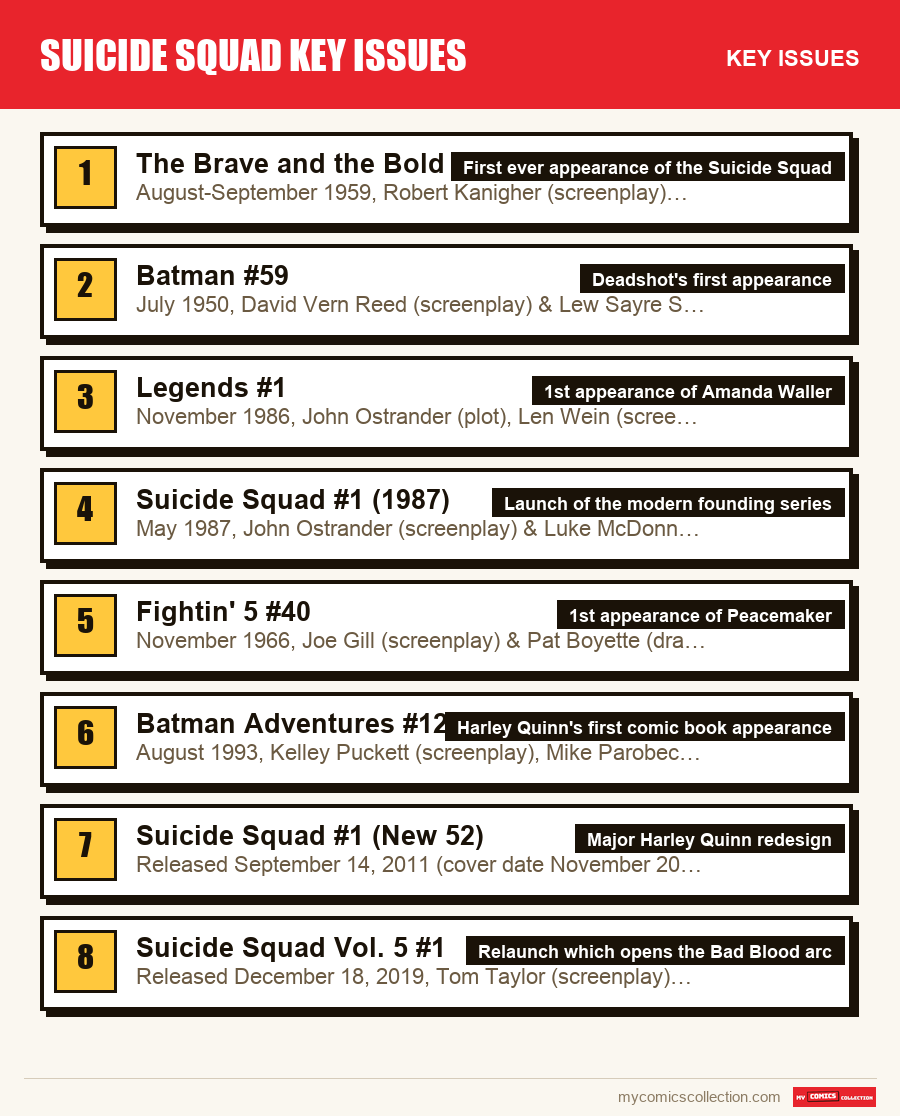
The Suicide Squad's essential key issues cover nearly seven decades of publishing history: The Brave and the Bold #25 (1959) which invented the concept of Task Force Peacemaker at Charlton Comics, Batman Adventures #12 (1993) which gave Harley Quinn her very first appearance in a comic book, then Suicide Squad #1 New 52 (2011) and Suicide Squad Vol. 5 #1 (2019) which redesign the team for recent generations of readers.
Few teams in the DC Universe have such a storied editorial history as the Suicide Squad. Unlike Justice League or the X-Men, whose continuity remains relatively linear, Task Force X has been reinvented three times by different creative teams, each time with an almost entirely new cast. This particularity complicates the collector's task: there is not a single “Suicide Squad #1” which would achieve consensus, but several first issues, each marking a major editorial break and each sought after for different reasons.
What makes this body of comics particularly interesting from a rating point of view is the way in which the screen adaptations have reshuffled the cards in just a few years. Characters who remained in the shadows for decades, like Peacemaker, became objects of intense speculation as soon as a casting was announced, while others, like Amanda Waller or Deadshot, saw their popularity stabilize over time thanks to a constant presence in comics and derivative products.
This guide lists the issues that really matter to a serious collector, with verifiable information on creators, release dates and market data publicly available, with no invented value where no reliable data exists.
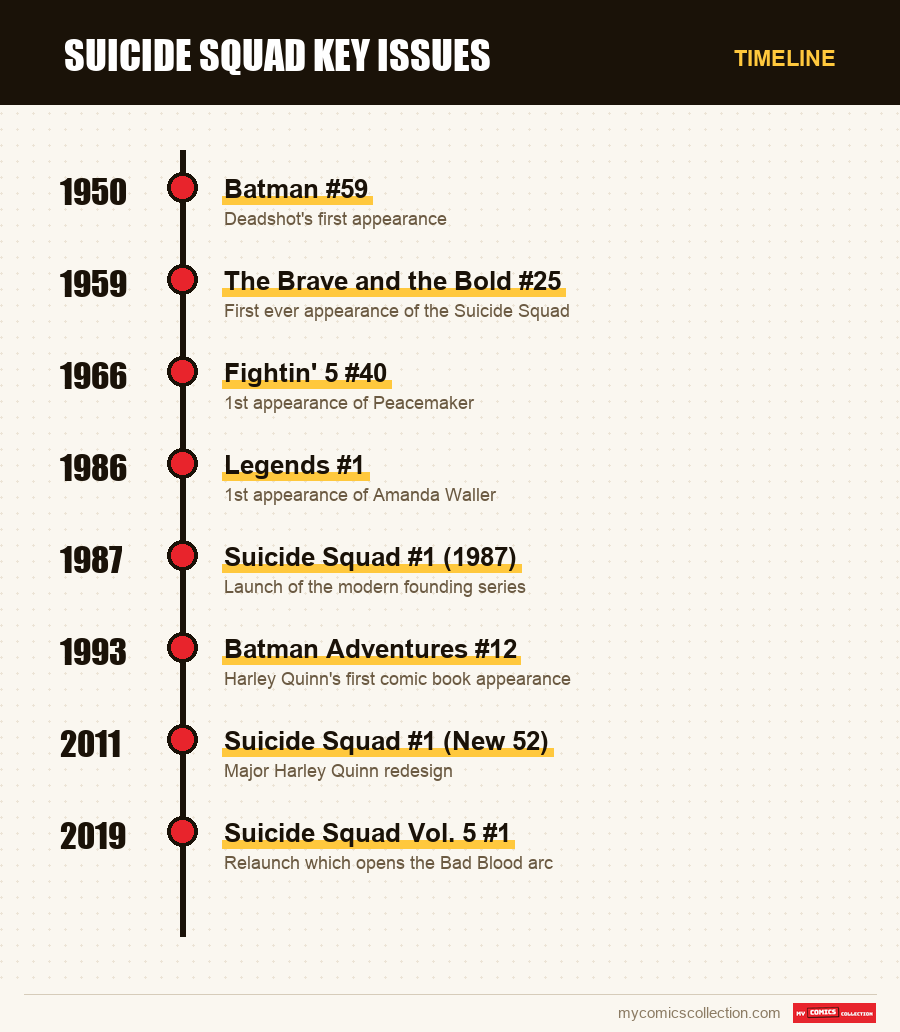
From Task Force X to black ops: the editorial history of the Suicide Squad
The concept that gave birth to the Suicide Squad was born in 1959, in The Brave and the Bold #25, from the pen of Robert Kanigher and the pencil of Ross Andru. At that time, it was not yet a team of supervillains pardoned in exchange for high-risk missions: the original group, nicknamed Task Force This original version disappeared after a few publications, but the name and concept of "suicide mission" remained in a corner of DC's editorial memory for almost three decades.
It was in 1986, in the event mini-series Legends, that the foundations of the Suicide Squad as we know it today were laid. The character of Amanda Waller, a ruthless bureaucrat running a secret prison program, makes her very first appearance. This mini-series, plotted by John Ostrander and written by Len Wein with drawings by John Byrne, serves as a springboard for three regular series, including a new version of Suicide Squad. The central idea then radically changes in nature: it is no longer volunteer agents but convicted criminals who make up the team, each negotiating a reduction in sentence in exchange for missions where death is a probability assumed from the briefing.
The launch of the Suicide Squad series in May 1987, written by John Ostrander with Luke McDonnell on the drawings, made this proposition a reality. It is this comic that permanently establishes Deadshot, until then a secondary character in the Batman universe appearing almost forty years earlier, as a pillar of the team. Ostrander also develops Amanda Waller in depth and introduces several recruits who will become familiar to regular readers. The series would last 66 issues until 1992, a rare longevity for a title built on the premise that its characters could die at any time.
The following decades will see the team redistributed several times: the New 52 relaunch of 2011 reinvents Harley Quinn visually and thematically, the Rebirth period then Tom Taylor's series from the end of 2019 further modernizes the tone, until the addition of Peacemaker in the editorial continuity following James Gunn's film. Each of these stages produced an opening number which is now the subject of a specific demand on the collecting market.
The Brave and the Bold #25
This issue literally invents the concept of Task Force X, almost thirty years before the version popularized by John Ostrander. The original team, composed of Rick Flag Jr., Karin Grace, Dr. Hugh Evans and Jess Bright, has no superpowers: they are soldiers and scientists sent to the front of supernatural catastrophes in the story "The Three Waves of Doom". Historically, this title is therefore the absolute founding stone of the entire franchise, making it a Silver Age sought after by collectors of DC fundamentals as much as by fans of the modern Squad.
Batman #59
In the story "The Man Who Replaced Batman", a masked sniper named Deadshot challenges the Dark Knight for the title of vigilante of Gotham, before switching to the criminal side. This Golden Age comic is today one of the most difficult books to find in high grade: the CGC census only has a little over 80 unrestored copies for all grades combined, which makes it a significantly rarer item than most DC supervillain debuts from the 1950s. Deadshot will remain a secondary character for almost forty years before becoming the central figure of Ostrander's Suicide Squad.
Legends #1
This six-issue event miniseries serves as a launch pad for three regular DC series, including the modern Suicide Squad. Amanda Waller appears for the first time as the bureaucrat who will build the prison program Task Force X as we know it today, alongside a large cast including Darkseid, Flash and Captain Marvel/Shazam. For any collector looking for the origin of the character rather than the team, Legends #1 is the issue to own, more so than #3, which is often confused with it, since Waller already appears there and #3 only develops his establishment of the team.
Suicide Squad #1 (1987)
It was this number that established the formula that would define the Suicide Squad for the following decades: convicted criminals, led by Amanda Waller, sent on a mission risking their lives in exchange for a reduced sentence. Deadshot occupies the cover and becomes the de facto face of the team. The issue also introduces several lesser-known recruits like Briscoe, Jihad, Ravan and Jaculi. Sold for $0.75 upon release, this comic remains the absolute reference for anyone who wants to own the birth certificate of the Suicide Squad as it inspired the films.
Fightin' 5 #40
Long considered a minor curiosity from the Silver Age of Charlton Comics, this issue features Christopher Smith, aka Peacemaker, as a pacifist willing to do anything to impose peace by force. The character will remain confined to secondary roles and confidential mini-series for more than fifty years. Its selection by James Gunn for the film The Suicide Squad (2021), then its incarnation by John Cena in the HBO Max series that bears his name, has completely reversed the perception of this comic previously neglected by Silver Age collectors.
Batman Adventures #12
Harley Quinn was created for Batman: The Animated Series before existing on paper: this issue, adapted from the animated series, is the very first comic book where the character appears, in the story “Batgirl: Day One”. Published both on newsstands and through direct channels, the newsstand copy is significantly rarer than the direct market version and trades at a significant premium at high grades. This issue peaked in value during the release of 2016's Suicide Squad, where Harley first appeared in cinema, before a market correction in the following years.
Suicide Squad #1 (New 52)
This New 52 relaunch marks a radical visual break for Harley Quinn: her classic jester suit disappears in favor of a corset and hot pants look, her skin becomes white and her hair is divided into blue and red locks, in an aesthetic clearly inspired by the Batman: Arkham video games. It is also the first appearance of this reformed team alongside King Shark and Deadshot in the New 52 continuity. The issue sparked notable editorial controversy upon its release regarding the portrayal of the character, which reinforced its cultural notoriety well beyond the circle of collectors alone.
Suicide Squad Vol. 5 #1
This issue inaugurates the run of Tom Taylor and Bruno Redondo, praised by critics for its sharper tone and its management of the roster, with the “Bad Blood” arc which redistributes the team's cards. This period directly prepares the editorial ground in which Peacemaker will then be integrated into Task Force X, echoing its arrival in cinema two years later. It's a sought-after entry point for readers who want to understand the version of the team closest, tonally, to the one popularized by James Gunn.
Collecting this series?
Track what you own, what you are missing and what your collection is worth. 7 day trial.
Start my trial →The impact of adaptations on the rating
Few DC franchises illustrate the effect of adaptations on the collectible market as clearly as Suicide Squad. The Peacemaker case is the most spectacular example: between December 2019 and November 2020, a CGC 9.2 copy of Fightin' 5 #40 went from $515 to $4,250, an increase of 725% in less than a year, based solely on casting announcements and then confirmation of the HBO Max series. This movement can also be explained by the objective rarity of the comic: the CGC has only identified 56 copies to date, a paltry volume compared to the massive print runs of the better-known Silver Age comics.
The 2016 film Suicide Squad had a comparable, if less extreme, effect on Batman Adventures #12. Harley Quinn's first comic book appearance saw its rating rise significantly in the run-up to and at the time of the film's release, before a gradual decline in the following years as supply stabilized and demand shifted to other appearances of the character. It's a classic pattern of the modern comic book market: a peak correlated with cinematic news, followed by consolidation around a more durable floor value, driven by the intrinsic popularity of the character rather than by one-off speculation.
James Gunn's The Suicide Squad (2021), despite a disappointing box office performance with $167.4 million in worldwide revenue for a budget of $185 million, remained the most streamed DC content on HBO Max at the time of its release. His influence was especially felt on the editorial repositioning of secondary characters like Peacemaker, integrated into the team's continuity in the comics precisely because Gunn had chosen him for the film. This feedback phenomenon, where an adaptation permanently modifies the composition of the team on paper, is specific to the Suicide Squad and makes certain recent issues interesting to watch over the long term rather than in the short term.
For a collector, the practical lesson of these cycles is twofold: on the one hand, the strongest window of increase is generally between the announcement of the casting and the actual release of the film or series, which means that waiting until the release to buy often means paying the peak. On the other hand, the gap in value between two close ranks can become considerable once a character explodes in popularity: understand the difference between a CGC grade 9 and a 9.8 then becomes decisive before any purchase, in particular on modern books with a large circulation like the New 52 Suicide Squad #1, where the grade premium can represent the majority of the price difference between two copies.
Buying guide
- Clearly distinguish the four launches of the series: Legends #1 (1986, origin of Amanda Waller), Suicide Squad #1 (1987, seminal series), Suicide Squad #1 New 52 (2011, Harley redesign) and Suicide Squad Vol. 5 #1 (2019, Taylor/Redondo era) are four different issues with four distinct collector profiles; do not confuse them when making a purchase.
- On Batman #59, always check the restoration: given its rarity as a Golden Age (barely more than 80 unrestored copies identified), restored or retouched copies circulate and trade significantly less expensive; Always require a CGC slab marked “Universal” rather than “Restored” if you are aiming for maximum collectible value.
- On Batman Adventures #12, choose the newsstand version (newsstand) if your budget allows it: it is structurally rarer than the direct market version and retains its value better over the long term, particularly in CGC 9.6 and 9.8.
- Don't pay the post-announcement spike on characters being popularized: the Peacemaker case shows that an eight-fold increase in value can occur in less than a year; watch for casting and series renewal announcements rather than buying after an already widely publicized release.
- For The Brave and the Bold #25, bet on the grade rather than the number of copies: it is a Silver Age whose original mintage remains correct, but where the price gap between medium grades and high grades (CGC 9.0 and beyond) is disproportionate, as shown by the gap between $9,300 in 9.0 and $25,000 in 9.2.
- Keep an accurate inventory of your collection rather than relying on your memory, especially if you accumulate several versions of Suicide Squad #1 over the relaunches; a collection management application allows you to follow the grade, the date of purchase and the evolution of the rating of each copy without risk of error.
- Beware of misidentified New 52 variants: Suicide Squad #1 from 2011 exists in several printings and covers, and only the first printing with the correctly identified number constitutes the true key number for the Harley Quinn redesign.