Mike Mignola (born September 16, 1960 in Berkeley, California) is an American author-cartoonist who trained at Marvel then DC in the 1980s, before creating Hellboy in 1993 for Dark Horse Comics. His first public appearance of the character appears in the fanzine convention San Diego Comic-Con Comics #2 (August 1993, confidential edition of around 1500 copies), followed by the founding mini-series Hellboy: Seed of Destruction (March-June 1994). Since then, Mignola has built an entire shared universe (B.P.R.D., Abe Sapien, Lobster Johnson, Baltimore) and remains active in 2026, with new Hellboy publications announced this very year.
There are few comic book authors whose name alone is enough to identify a graphic style. Mike Mignola is one of them: his black solids, his angular silhouettes inspired by German expressionism and pulp illustration of the 1930s have shaped the visual identity of one of the most recognizable characters of modern American comics, Hellboy. But before becoming this singular creator associated with a single hero, Mignola went through fifteen years of production for the two largest superhero publishers in the country, where he refined a narrative and graphic know-how that would irrigate all of his subsequent work.
For a collector, understanding Mignola's journey changes the way he approaches his collection. We are not looking for the same numbers depending on whether we are interested in the studio artist of the Marvel/DC years, the founding writer-artist of Hellboy, or the architect of an extended universe at Dark Horse who, forty years after his debut, continues to produce new titles. This article retraces this trajectory step by step, relying solely on verifiable editorial facts: publication dates, editors, collaborators and documented print runs.
We will also see how the film adaptations have influenced the perception of the character on the collectible market, and we will end with a practical guide to guide purchases according to the desired collection profile.
From Marvel and DC studios to the founding of Dark Horse Comics: Mignola's editorial context
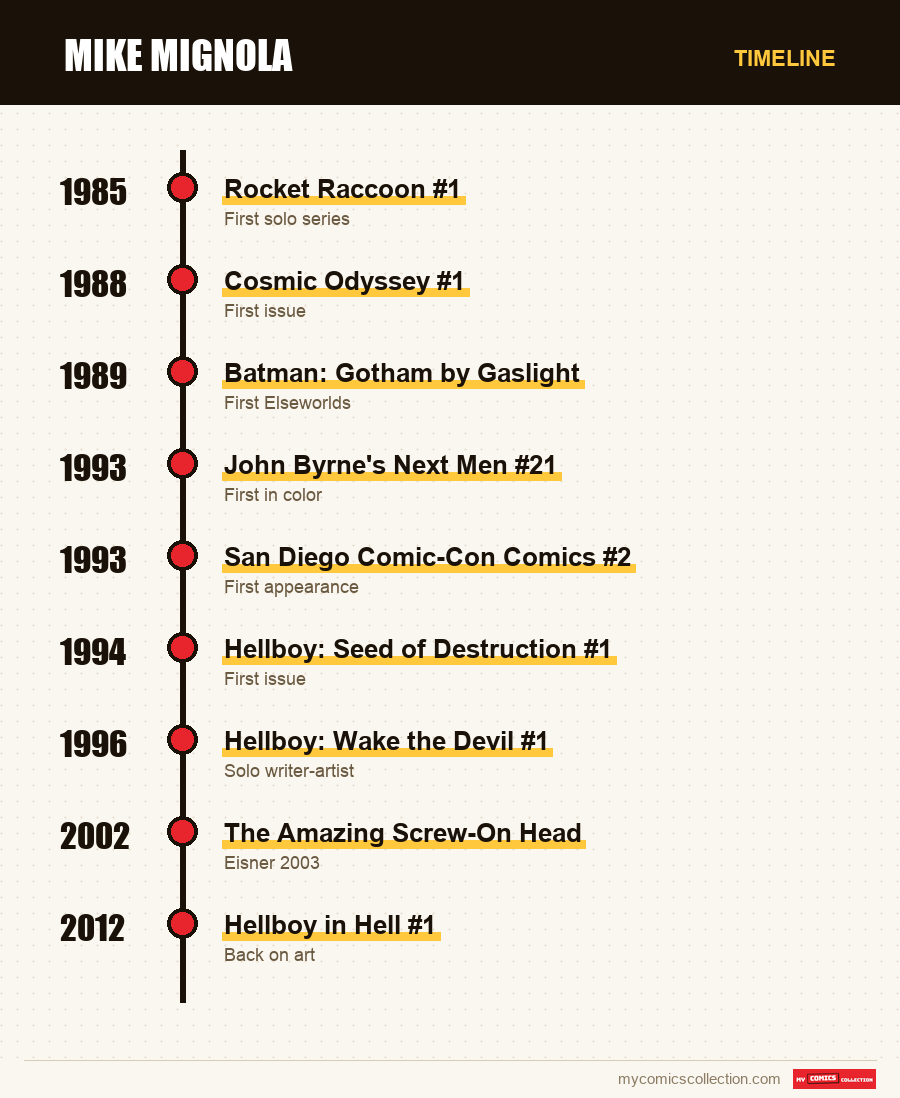
Mike Mignola's editorial history begins far from Hellboy. A graduate in illustration from the California College of Arts and Crafts (now California College of the Arts) in 1982, he joined Marvel Comics in 1983, where he worked first as an inker then as a designer on series like Daredevil and Power Man and Iron Fist, before moving on to more ambitious titles like The Incredible Hulk and Alpha Flight. This training period is essential: it is there that Mignola learns to work on the line, within the tight deadlines of monthly superhero production, while gradually developing a personal graphic vocabulary which will soon contrast with the dominant Marvel style of the time.
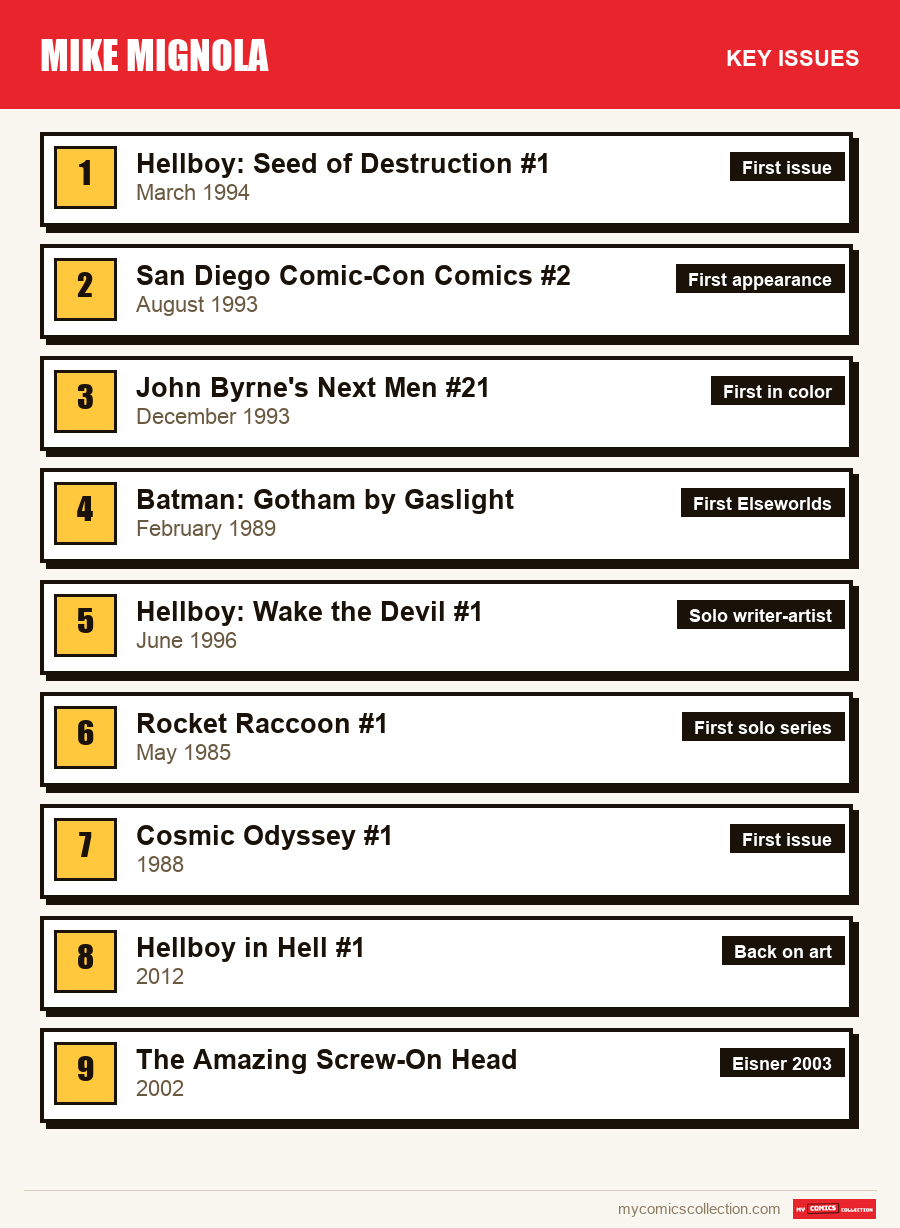
1985 marks a pivotal stage with the mini-series Rocket Raccoon at Marvel, written by Bill Mantlo and drawn by Mignola. This character, now known worldwide thanks to the films Guardians of the Galaxy, remained a niche curiosity at the time, but the series allowed Mignola to express himself in a more offbeat tone, between adventure and fable, far from strictly heroic codes. This is a milestone often overlooked in the author's biography, even though it already foreshadows his taste for adventure stories tinged with fantasy.
In 1988, change of publisher: Mignola joined DC Comics for Cosmic Odyssey, a four-issue miniseries written by Jim Starlin, which brings the Justice League together around a cosmic threat involving the New Gods. The project confirms Mignola's ability to design massive architectures and serious atmospheres, a register that he would later find in his own creations. The following year, in 1989, he collaborated with screenwriter Brian Augustyn on Batman: Gotham by Gaslight, a one-shot setting Batman in a Victorian Gotham confronted by Jack the Ripper. Published on February 10, 1989 at a cover price of $3.95 for 52 pages, this story is today considered the very first "Elseworlds" story from DC Comics, the editorial line that would go on to explore alternate versions of DC heroes for decades. Mignola's gothic style, his dramatic lighting and his science of silhouettes find an ideal field of expression there, already announcing the aesthetic that he will deploy with Hellboy a few years later.
The extra-comic collaborations that shaped the Mignola style
Even before the birth of Hellboy, Mignola also worked outside of the monthly comics circuit. In 1992, he participated as an illustrator in the film Bram Stoker's Dracula by Francis Ford Coppola, an experience that confronts him with cinematic gothic aesthetics and production design. This foray into the seventh art will continue well after the creation of Hellboy: Mignola will be production director on the Disney animated feature film Atlantis, the Lost Empire (2001), then conceptual artist on Blade II (2002, directed by Guillermo del Toro, who would become his collaborator for the Hellboy adaptations) and on Rebel (Brave) from Pixar. This back and forth between comics and cinema partly explains why his graphic universe subsequently proved so naturally adaptable to the screen.
1993-1994: the birth of Hellboy, from confidential fanzine to founding mini-series
The exact genealogy of Hellboy's first appearance is more complex than is often realized, and is of direct interest to key comic book collectors. The very first image of a prototype version of the character (gray skin, stumps of horns, stone forearm already present) appears on the cover of the Italian fanzine Dime Press #4 in May 1993. But the first complete comic book story, a four-page black and white story, appeared in San Diego Comic-Con Comics #2, published by Dark Horse Comics in August 1993. This promotional booklet, available only at the San Diego convention booth or through a limited mail order offer, had a confidential print run estimated at around 1,500 copies: making it today one of the rarest key comics associated with a character that has become cult, well beyond the usual rarity of simple convention exclusives.
Hellboy's first appearance in a nationally distributed, color comic came a few months later, in December 1993, in John Byrne's Next Men #21. It is this same collaboration with John Byrne which led, the following spring, to the true founding mini-series: Hellboy: Seed of Destruction, published in four monthly issues by Dark Horse Comics between March and June 1994. The story was co-written by Mignola and Byrne, drawn and designed by Mignola, colored by Mark Chiarello, and lettered by Pat Brosseau; Each issue also features a four-part companion story, "Who are Monkeyman and O'Brien?", written and drawn by Arthur Adams. The opening pitch, a team of paranormal investigators and American commandos interrupting a Nazi occult ritual in 1944 that summons a young demon, lays out in a handful of pages the entire mythology that would develop over more than twenty years of publication.
This distinction between San Diego Comic-Con Comics #2 (the very first appearance, extremely rare and confidential) and Seed of Destruction #1 (the official launch of the mini-series which made the character known to the general public, with a much wider national distribution) is fundamental for any collector. These are two "first appearances" in a different sense: the first in the strict sense of the publication, the second in the sense of the mini-series which really built the commercial notoriety of the character and which remains, as such, the issue most sought after by readers discovering the series a posteriori.
Building a shared universe: B.P.R.D., Abe Sapien, Lobster Johnson and spin-off series
Unlike many comic book creators who are content with a single title, Mignola methodically built, over the 1990s and 2000s, a true shared universe around Hellboy at Dark Horse. Members of the paranormal agency that recruits Hellboy: the Bureau for Paranormal Research and Defense, or B.P.R.D. obtained their own spin-off series, where Mignola retained a role as screenwriter or co-writer while gradually entrusting the drawing to artists like Guy Davis then Duncan Fegredo. Abe Sapien, the telepathic fish-man founding member of the B.P.R.D., and Lobster Johnson, a pulp vigilante from the 1930s operating in the same historical universe, also receive their own mini-series and one-shots. Later, Mignola developed entirely new but graphically similar franchises, such as Baltimore (co-written with Christopher Golden) and Joe Golem: Occult Detective, as well as the occasional and offbeat series The Amazing Screw-On Head (2002), which even got an animated pilot adaptation for the Sci-Fi Channel.
This editorial policy has a direct consequence for collectors: the price and heritage interest of a Mignola issue are not limited to the parent series. The first issues of B.P.R.D. or the one-shots Lobster Johnson written by Mignola himself, in particular those where he also provides part of the drawing or the covers, constitute milestones sought by collectors who follow the entire work rather than just the title character.
Critical recognition: Eisner Awards and induction into the Hall of Fame
Mignola's legitimacy in the world of comics is not based solely on the commercial success of Hellboy: it is also validated by the profession itself via the Eisner Awards, considered the most prestigious awards in the sector in the United States. From 1995, the first year following the publication of Seed of Destruction, the bound album of the story won the prize for best reissued graphic album. Mignola and his collaborators will then receive several other Eisners over the decades, including that of best screenwriter-cartoonist for short stories like Hellboy: Almost Colossus , THE Hellboy Christmas Special or the Hellboy Jr. Halloween Special, the prize for best short story in 2003 for "The Magician and the Snake", or that for best one-shot in 2018 for Hellboy: Krampusnacht. In 2024, the culmination of this recognition, Mignola was inducted into the Eisner Hall of Fame, in the "Voters' Choice" category voted on by industry professionals: a distinction reserved for creators judged to have had a lasting impact on the medium.
On the documentary level, the year 2022 sees the release of Mike Mignola: Drawing Monsters, a feature-length documentary that traces his creative journey through interviews with major industry figures, including Guillermo del Toro and Neil Gaiman: two longtime collaborators and admirers of his work.
The impact of adaptations on the rating
As with many comic book characters that have become audiovisual franchises, collector attention to Mignola's comics has closely followed the timeline of film adaptations. The first film, Hellboy (2004), directed and co-written by Guillermo del Toro with Ron Perlman in the title role, grossed approximately $99.8 million worldwide for a budget of $60 to $66 million, enough success to launch a franchise. The sequel, Hellboy II: The Golden Army (2008), still directed by del Toro and co-written with Mignola himself, did better with around $168 million in worldwide receipts on a budget of $85 million, driven by a domestic opening of $34.5 million. A third part, which should have brought together del Toro, Perlman and Selma Blair again, was in development for several years before being officially abandoned in 2017 for lack of financing: an episode which has long fueled fan nostalgia around this unfinished trilogy.
In 2019, the franchise was rebooted with a new cast: David Harbor (revealed in the meantime by the series Stranger Things) reprises the role under the direction of Neil Marshall. This reboot, however, did not meet with the same response, with approximately $55.1 million in worldwide revenue for a production budget of $50 million, and a significantly colder critical reception than del Toro's films. A new attempt arrives in 2024 with Hellboy: The Crooked Man, directed by Brian Taylor from a screenplay co-written by Mignola himself and Christopher Golden, adapted from the 2008 comic of the same name, with Jack Kesy in the lead role. The film, released directly to video on demand on October 8, 2024, remains a significantly lower-budget production and only makes around $1.3 million in limited theatrical receipts.
For a collector, this checkered cinematic history has a clear lesson: these are the founding comics signed by Mignola himself -San Diego Comic-Con Comics #2 , Seed of Destruction, and to a lesser extent the runs that he personally wrote and/or drew on B.P.R.D. or Hellboy in Hell: which concentrate lasting heritage interest, independently of the surges in popularity linked to the release or failure of a film. Comics adapted for cinema in 2008 (like The Crooked Man, initially published in 2008 before its adaptation fifteen years later) clearly illustrate that the printed source continues to be rediscovered long after its original publication, with each new audiovisual exploitation.
Collecting this series?
Track what you own, what you are missing and what your collection is worth. 7 day trial.
Start my trial →Where is Mike Mignola today? Editorial news for 2025-2026
Unlike many creators who completely delegate their franchises after several decades, Mignola remains an active author on his own mythology in 2025 and 2026. The recent calendar is particularly busy: Hellboy and the B.P.R.D.: Professor Harvey is Gone published by Dark Horse on August 27, 2025; a new series co-written with Bruce Zick, drawn by the latter and set in 1880s England around the Whittier family, is launched on October 22, 2025. Apart from the Hellboy universe itself, Mignola is also developing the "Lands Unknown" universe with the graphic novel Uri Tupka and the Gods, due at Dark Horse in February 2026, which he writes and draws himself.
The most immediate news at the time of writing concerns Giant Robot Hellboy Returns #1, released July 22, 2026: a two-part miniseries that reunites Mignola with artist Duncan Fegredo and colorist Dave Stewart, both historical collaborators on the major Hellboy arcs of the 2000s. Later in the year, Hellboy in Hell: Nothing but Blood, a two-issue micro-series associating Mignola with French artist Cyrille Pomès, is due to appear on October 7, 2026. This ongoing editorial activity reminds us that, for a collector, the Mignola corpus is not frozen in the 1990s: each new mini-series written or drawn personally by the author constitutes an additional entry point, and sometimes a future key issue if it introduces a character or a significant narrative arc.
Buying guide
Building a coherent collection around Mike Mignola requires distinguishing several layers of rarity and editorial significance. Here are the points to be aware of before purchasing:
- Distinguish between the two "first appearances" of Hellboy. San Diego Comic-Con Comics #2 (1993) is the very first publication of the character, with an extremely limited print run of close to 1500 copies and a restricted distribution at the San Diego convention; Hellboy: Seed of Destruction #1 (1994) was the miniseries that commercially launched the character nationally. The two have different key status: don't confuse mintage rarity with historical importance to the franchise.
- Systematically check the drawing and scenario credit. Not all of Mignola's work is drawn by him: on derivative series like B.P.R.D., he often remains the screenwriter or co-writer while other artists (Guy Davis, Duncan Fegredo) provide the drawing. An issue entirely written AND drawn by Mignola generally has a greater heritage value than an issue where he only appears in the storyline.
- Consider pre-Hellboy works as career milestones in their own right. Rocket Raccoon (1985), Cosmic Odyssey (1988) and Batman: Gotham by Gaslight (1989, DC's first official Elseworlds) document the formation of the Mignola style and is of interest to collectors who follow his entire career rather than just the Dark Horse segment.
- Be wary of reprints ("facsimile edition"). Dark Horse has reissued in facsimile historical issues like Seed of Destruction #1 on the occasion of anniversaries: these reissues include the original cover and content but have neither the rarity nor the collectible value of the original 1994 edition. Always check the edition notice on the title page or barcode.
- Favor authentication by a recognized grading company for older prints. For a number as confidential as San Diego Comic-Con Comics #2, a CGC certification or equivalent greatly reduces the risk of acquiring a misidentified or unknowingly restored copy, given the low number of copies in circulation.
- Follow editorial news to spot future keys. Mignola still being active in 2026 on new titles (Giant Robot Hellboy Returns , Hellboy in Hell: Nothing but Blood , Uri Tupka and the Gods), the first issues of these recent series are available at the sale price on newsstands and deserve to be followed before a possible subsequent increase in value.
To organize the monitoring of these different layers of collection (historical keys, derived series, new releases for 2026) many collectors now rely on dedicated digital tools rather than simple spreadsheets. OUR collection management application allows you to precisely catalog each issue, its condition and its origin, series after series.
The key issues to know
Hellboy: Seed of Destruction #1
Hellboy's first miniseries, four issues published from March to June 1994 by Dark Horse. Conceived and drawn by Mike Mignola, with John Byrne on script, it lays out the mythology of the demon taken in in 1944 and of the B.P.R.D. It is the commercial launch of the character and of Mignola's personal work.
San Diego Comic-Con Comics #2
The four-page black-and-white story "Mike Mignola's Hellboy" is the character's first full story. This Dark Horse promotional comic, tied to the San Diego convention, had a limited print run. A rarity not to be confused with the 1994 launch.
John Byrne's Next Men #21
Hellboy's first appearance in a nationally distributed comic, and his first in color, billed as a crossover with John Byrne's series. This collaboration led a few months later to Seed of Destruction. A milestone between the convention comic and the miniseries.
Batman: Gotham by Gaslight
A 52-page one-shot written by Brian Augustyn and drawn by Mike Mignola: Batman faces Jack the Ripper in a Victorian Gotham. The story retroactively became the first official publication of DC's Elseworlds line. Mignola's gothic look already foreshadows Hellboy.
Hellboy: Wake the Devil #1
For Hellboy's second miniseries, five issues long, Mike Mignola handles both writing and art on his own. A B.P.R.D. mission takes the hero to Romania on the trail of a vampire. The work earned him the 1997 Eisner for Best Writer/Artist.
Rocket Raccoon #1
The character's first miniseries, four issues written by Bill Mantlo and drawn by Mike Mignola, inked by Al Gordon. Its tone of adventure and fable stood out at Marvel at the time. A milestone of Mignola's formative years, reread in light of the character's later success.
Cosmic Odyssey #1
The first of four books in the miniseries written by Jim Starlin and drawn by Mike Mignola for DC. The Justice League and the New Gods face a cosmic threat. Mignola asserts his taste for massive architecture and grave atmospheres.
Hellboy in Hell #1
Mike Mignola returns as Hellboy's regular artist for the final act of the saga. The hero, now dead, wakes up at the gates of Hell, where Edward Grey is waiting. An issue closely followed by collectors who favor pages both written and drawn by Mignola himself.
The Amazing Screw-On Head
A one-shot written and drawn by Mike Mignola at Dark Horse, outside the Hellboy universe, about a hero reduced to a head that screws onto different bodies. It won the 2003 Eisner for Best Humor Publication. The title also led to an animated pilot.