
Hellboy (2004) Guillermo del Toro , with Ron Perlman, adapts the comic book of Mike Mignola (Dark Horse, 1994). The film remains faithful to the demon with the big heart, the B.P.R.D. and the occult universe, while developing its own plot. Here is the detailed comparison, film versus comics.
Adaptation of a cult occult horror comic, Hellboy brings to the screen the red demon who becomes a paranormal investigator. It draws from the gothic universe of Mike Mignola. Source-by-source decryption.
As in each article in this series, only verified information (creators, distribution, dates, publishers) is stated; the comparative analysis is ours, without reproducing dialogue or protected images.
Title : Hellboy (2004)
Director: Guillermo del Toro
Actors: Ron Perlman (Hellboy), Selma Blair (Liz Sherman), Doug Jones (Abe Sapien)
Exit : April 2004
Studio: Columbia Pictures
Seed of Destruction (1994): Mike Mignola, at Dark Horse
A demon: invoked by the Nazis, raised good
The B.P.R.D.: the paranormal office
An occult universe: mythology and folklore
- Hellboy, demon with a big heart, with a hand of stone.
- Its origin: invoked by the Nazis, bred by Bruttenholm.
- Le B.P.R.D. and his agents (Abe Sapien, Liz).
- The universe occult mixing folklore and mythology.
- Rasputin and the Ogdru Jahad.
- La romance Hellboy-Liz is amped up.
- The agent John Myers is created for the film.
- The tone mixes humor and del Toro action.
- The plot condenses several elements from the comics.
- Abe Sapien is developed differently.
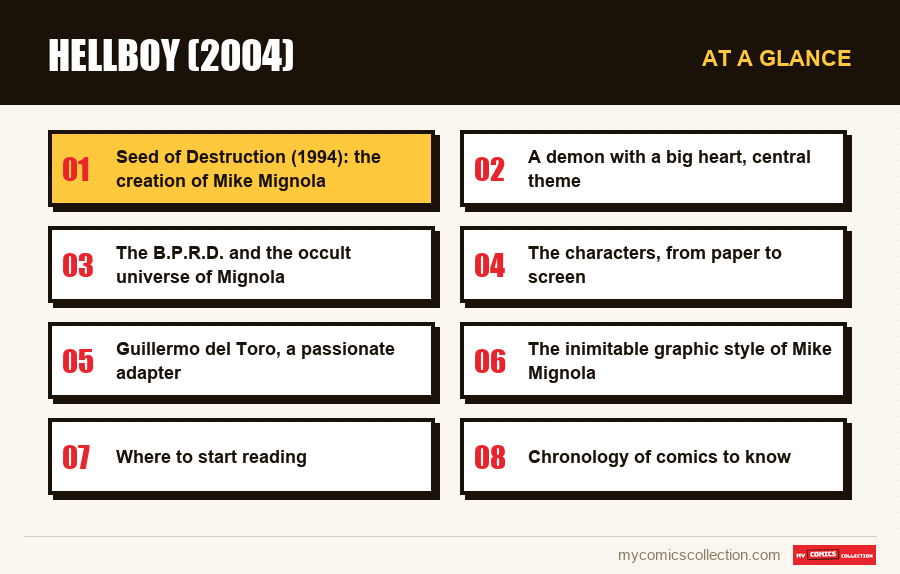
Seed of Destruction (1994): the creation of Mike Mignola
Hellboy adapts the comic book created by Mike Mignola, whose first major miniseries, Seed of Destruction, was published in 1994 by Dark Horse Comics (the character having appeared briefly as early as 1993). A cult work of occult horror, Hellboy features a demon summoned to Earth by Nazi occultists at the end of the Second World War, but collected and raised by the Allies, notably Professor Bruttenholm. Having become a good being despite his infernal origins, Hellboy works for the B.P.R.D. (Bureau for Paranormal Research and Defense), investigating supernatural phenomena. Recognizable by his red skin, his filed horns and his enormous stone “Right Hand of Destiny”, he embodies a gruff but deeply human anti-hero. Mignola deploys a unique graphic style and a rich universe mixing folklore, mythology and occultism.
Guillermo del Toro's film is recognized for its faithfulness to the spirit and aesthetic of Mignola. Ron Perlman plays a faithful Hellboy: gruff, sarcastic, lover of cigars and cats, but with a big heart. The film retains its origin (invoked by the Nazis, raised by Bruttenholm), the B.P.R.D., his colleagues Abe Sapien and Liz Sherman, as well as the antagonists Rasputin and the Ogdru Jahad. This fidelity to the characters and the occult universe, as well as to the gothic atmosphere of the comics, makes the film a respectful adaptation. Del Toro, an admirer of the work, adds his own visual sensitivity and develops a plot that condenses and rearranges elements from the comics.
A demon with a big heart, central theme
What makes Hellboy rich is the contrast between his origins and his nature. Born a demon, destined according to the prophecy to cause the apocalypse, he nevertheless chooses good, refusing the destiny that people want to impose on him. This theme (free will triumphing over fate, the choice of one's own identity against one's supposed nature) is at the heart of the character. Hellboy embodies the idea that one is not condemned by one's origins, and that a being born of evil can become a hero through one's actions. This deep dimension, mixed with his gruff humor and his humanity, makes Hellboy an endearing and complex character, far from classic superheroes.
The film fully captures this dimension. Del Toro's Hellboy is torn between his demonic origins and his desire to be good, confronted by Rasputin who seeks to awaken his apocalyptic nature. The film explores this inner struggle, making Hellboy's choice (refusing his destiny, breaking his horns in refusal) the emotional heart of the story. This fidelity to the central theme of the comic strip, served by Ron Perlman's interpretation, gives the film its depth. For the reader, it illustrates what sets Hellboy apart: an anti-hero whose struggle is not just against monsters, but against his own nature. The film invites you to discover Mignola's comic strips, where this theme of free will and chosen identity is developed with remarkable richness and melancholy, through adventures anchored in folklore and myth.
The B.P.R.D. and the occult universe of Mignola
The film deploys the occult universe of Hellboy, one of the great riches of comics. The B.P.R.D., a secret agency responsible for investigating the paranormal, brings together atypical agents: Hellboy the demon, Abe Sapien the amphibious and telepathic fish-man, Liz Sherman the pyrokineticist. This universe draws heavily on folklore, mythology, occultism and history, mixing occult Nazis, ancient gods, legendary creatures and black magic. Mike Mignola has built a dense and coherent mythology, where each story explores a part of the supernatural, from European folklore to the Great Old Ones of Lovecraftian inspiration. This richness makes the Hellboy universe one of the most original in modern comics.
The film recreates this universe with the visual talent of Guillermo del Toro, himself passionate about monsters and fantasy. It features the B.P.R.D., its agents, the creatures and the gothic atmosphere of the comics, served by careful effects and designs. The confrontation with Rasputin and the Ogdru Jahad, apocalyptic entities of Lovecraftian inspiration, is faithful to Mignola's mythology. The film, however, condenses this abundant universe for the purposes of a feature film, developing certain elements and simplifying others. For the reader, it is a gateway to comics, whose occult universe is much larger and more developed. It invites you to explore the numerous stories of Hellboy and B.P.R.D., where Mignola deploys a mythology of rare richness and originality, mixing horror, folklore and dark poetry in an inimitable graphic universe.
Collecting this series?
Track what you own, what you are missing and what your collection is worth. 7 day trial.
Start my trial →The characters, from paper to screen
- Hellboy: The demon with a big heart, faithful to Mignola's comic strip.
- Abe Sapien: The telepathic fishman from B.P.R.D.
- Liz Sherman: The pyrokineticist, whose romance with Hellboy is amplified.
- Professor Bruttenholm: Hellboy's adoptive father.
- Rasputin: The antagonistic occultist, faithful to the comics.
Guillermo del Toro, a passionate adapter
The success of Hellboy owes a lot to Guillermo del Toro, a filmmaker passionate about monsters, fantasy and comics. A long-time admirer of Mike Mignola's work, del Toro took on the project with true devotion, seeking to honor the spirit and aesthetic of the comic strip. His sensitivity for creatures, gothic and stories mixing horror and emotion made him the ideal director to adapt Hellboy. This adequacy between Mignola's universe and del Toro's vision explains the success of the film, which captures the melancholy, humor and dark beauty of the comic strip. The collaboration between the author and the filmmaker, sharing the same passion for the fantastic, guaranteed respect for the original material.
This involvement of a passionate director illustrates the importance of the affinity between a filmmaker and the work he adapts. Del Toro didn't just transpose Hellboy: he captured its soul, infusing it with his own visual poetry while respecting Mignola. This type of collaboration, where the adapter is a true admirer of the source, often produces the most successful adaptations. For the reader, del Toro's film is a celebration of the Hellboy universe, faithful to its spirit while bearing the filmmaker's signature. He reminds us that the best adaptations are born from an encounter between a work and an artist who understands and loves it. Hellboy invites you to discover the comics of Mike Mignola, whose richness inspired one of the most visionary filmmakers of contemporary fantasy, in a fruitful dialogue between comics and cinema.
The inimitable graphic style of Mike Mignola
Beyond the character and the universe, what makes Hellboy unique in comics is Mike Mignola's graphic style. Recognizable among all, his line is characterized by vast areas of black, massive shadows, refined compositions and a dramatic use of emptiness and light. This gothic and expressionist aesthetic creates a unique atmosphere, both eerie and poetic, perfectly suited to Hellboy's horror and folklore tales. Mignola has developed a visual language that favors suggestion over excess, atmosphere over overload of details, making each plate an evocative composition. This style profoundly influenced modern comics and made Mignola an immediately identifiable line artist.
Guillermo del Toro's film seeks to honor this aesthetic through its artistic direction, contrasting lighting and gothic atmosphere. If cinema cannot reproduce Mignola's trait exactly, del Toro captures its spirit: the dark beauty, the mixture of horror and melancholy, the atmosphere of a macabre tale. This fidelity to the visual atmosphere of the comic strip contributes to the success of the film. For the reader, Mignola's style is inseparable from the Hellboy experience, an essential component of the work. He reminds us that comics are a visual art where the graphic style carries as much meaning as the story itself. Discovering Hellboy in comics means immersing yourself in Mignola's inimitable graphic universe, each page of which is a work of atmosphere, a thousand miles from the conventions of the traditional superhero comic.
Where to start reading
To discover Hellboy, Seed of Destruction (1994) by Mike Mignola presents his origin and his first great adventure. “Wake the Devil” and “The Right Hand of Doom” develop the universe and the character. The collections, available in French, reveal the unique atmosphere of Mignola. This journey reveals an occult universe of remarkable richness.
Chronology of comics to know
- 1993: First appearance of Hellboy in a Dark Horse publication.
- 1994: Seed of Destruction: Mike Mignola's first major miniseries.
- 1996+: The following stories develop the universe of B.P.R.D.
Collection side: what numbers to aim for after the film
Hellboy points to keys to independent comics. Hellboy: Seed of Destruction #1 (1994, first major miniseries) is the key sought after by collectors, marking the character's true debut. Early appearances in Dark Horse publications from 1993 are particularly prized and rare. The collections are accessible targets for readers. These numbers cover various budgets. As always, condition and gradation determine value; relying on real recent sales is strongly recommended.
Its place in the saga and for the collector
Hellboy will remain as a faithful and inspired adaptation of a cult occult horror comic, driven by the passion of Guillermo del Toro. For the collector, it highlighted Seed of Destruction, key to the work of Mike Mignola at Dark Horse. It illustrates the success of an adaptation led by an admiring filmmaker. Beyond the film, Mignola's comic book remains a major work of fantasy, to be discovered in its entirety. Hellboy reminds us that a demon can become a hero through his choices, and that independent comics contain worlds of exceptional richness and originality.
The verdict: a faithful and inspired adaptation
- Loyalty: Hellboy, his origin, his nature as a big-hearted anti-hero, the B.P.R.D., Abe Sapien, Liz, Rasputin and the occult universe come from comics.
- Freedoms: the Hellboy-Liz romance amplified, the agent John Myers created for the film, the tone mixing humor and action, the plot condensed, Abe Sapien developed differently.
- Collectible numbers: Hellboy: Seed of Destruction #1 (1994, Dark Horse).
Hellboy adapts Mike Mignola's occult horror comic, bringing to the screen the big-hearted demon B.P.R.D. Faithful to the character, his origin, his colleagues and the Gothic universe while developing its own plot, the film benefits from the passion of Guillermo del Toro. For both the reader and the collector, it is an invitation to discover Seed of Destruction.
Frequently asked questions
From the comic created by Mike Mignola, whose first major mini-series, Seed of Destruction, was published in 1994 by Dark Horse Comics (the character appearing in 1993). Hellboy is a demon summoned by the Nazis but raised good, a paranormal investigator. The film adapts it faithfully.
He was summoned to Earth by Nazi occultists at the end of World War II, then collected and raised by the Allies, notably Professor Bruttenholm. Having become good despite his infernal origins, he works for the B.P.R.D. The film faithfully reproduces this origin.
The Bureau for Paranormal Research and Defense, a secret agency charged with investigating the supernatural. It brings together atypical agents: Hellboy the demon, Abe Sapien the telepathic fishman and Liz Sherman the pyrokineticist. The film faithfully recreates this occult universe.
Yes, in spirit and aesthetics. Guillermo del Toro, admirer of Mignola, retains the character, his origin, the B.P.R.D., his colleagues and the Gothic universe. It does, however, amp up the Hellboy-Liz romance, create Agent John Myers, and condense the plot for the cinematic format.
Hellboy: Seed of Destruction #1 (1994, first major miniseries) is the sought-after key, marking the character's true debut. Early appearances in Dark Horse publications from 1993 are particularly prized and rare.
Does the film make you want to collect? Estimate the value for free of your issues (Hellboy: Seed of Destruction #1…) with our tool based on current eBay listings.