Hellboy was born in 1993 under the pencil of Mike Mignola, before the founding mini-series Hellboy: Seed of Destruction officially launches the franchise at Dark Horse Comics in March 1994. Three decades later, this red demon of Bureau for Paranormal Research and Defense has given birth to an editorial universe of more than 70 volumes (Hellboy, B.P.R.D., Abe Sapien, Lobster Johnson, Witchfinder), four feature films, two animated films, a video game and several Eisner and Harvey Awards: while remaining, a rare occurrence in the industry, the exclusive property of its creator.
There are few examples, in the recent history of American comics, of a character who has constructed a mythology as coherent and as personal as Hellboy. Where most major superhero franchises are the product of decades of writers and artists succeeding each other on the same property owned by a publisher, Hellboy remains, from the first stroke of the pencil to today, the work of a single man: Mike Mignola. This editorial peculiarity is not an anecdotal detail: it directly explains why the Hellboy universe has such a recognizable graphic and narrative identity, and why its editorial history reads almost like a novel in its own right.
This guide retraces the complete story of Hellboy in comics: its genesis at Dark Horse, the methodical construction of its extended universe, the changes of artistic hands which marked the series, the rewards obtained, and the effect of audiovisual adaptations on the perception of the character. For a precise inventory of numbers to own and their documented rarity, our article dedicated to Hellboy key issues remains the complementary reference to this historical story: here, the angle is that of how and of Why this franchise built itself the way it did.
Mike Mignola and the birth of a creator-owned character
Before Hellboy, Mike Mignola had already spent more than a decade as a designer at Marvel and DC Comics, where he worked notably on Cosmic Odyssey with Jim Starlin or Gotham by Gaslight, one of Batman's very first "Elseworlds" stories. It is this studio experience that forges his very particular style: massive black areas, angular silhouettes inspired by German expressionism and European Gothic, an economy of line inherited as much from Jack Kirby as from old engravings. Mignola sketched the first ideas for the character in the late 1980s, but it was his arrival at Dark Horse Comics in 1993 which made the project possible.
The choice of Dark Horse is not trivial. At that time, the publisher founded by Mike Richardson established itself as the main focus of the movement creator-owned: this wave which, in the wake of the creation of Image Comics the same year, allows authors to retain full rights to their creations rather than ceding them to a publisher, as is the rule at Marvel and DC. Hellboy is born directly from this dynamic: Mignola remains the owner of the character from the first to the last day, a situation which has never changed in more than thirty years, and which contrasts radically with the status of figures like Spider-Man or Batman, perpetual property of their respective publishers.
This freedom has a direct consequence on the editorial structure of the franchise: there has never been a forced editorial reboot, a “new continuity” imposed by a corporate restructuring, nor a multiplication of parallel titles decided by a committee. Each expansion of the Hellboy universe, and there will be many, responds to a narrative logic desired by Mignola himself, which gives the whole thing a rare coherence in the industry.
1993: the first traces of a red demon
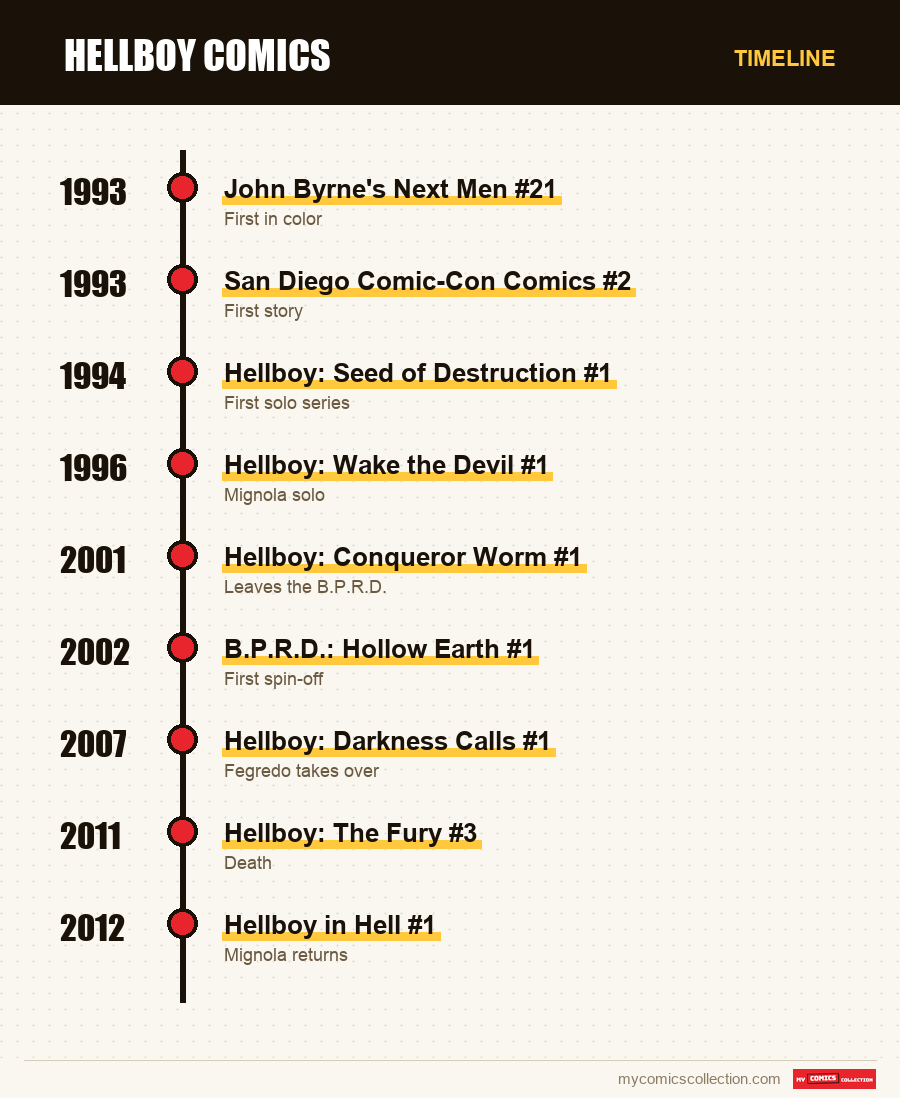
Hellboy's very first public appearance is not in a series that bears his name. The character first appears in a full story: four pages in black and white, co-written with John Byrne - In San Diego Comic-Con Comics #2, distributed free of charge during the 1993 edition of the California show. This small promotional booklet, printed in around 1,500 copies according to generally accepted market estimates, serves as a business card before the real launch of the character.
This editorial gestation period of 1993 is also the one in which a fanzine entitled Dime Press #4, sometimes cited as predating the SDCC issue in the strict chronology of very first appearances in print. This overlap of “firsts” (Italian fanzine, trade show giveaway, color appearance in Next Men #21 in December 1993) has become, over time, one of the most debated topics in Hellboy collecting. We do not detail here the precise classification of these milestones nor their respective market values: this is the subject of our article on Hellboy key issues, which specifically addresses this issue from a collecting perspective. What is important for the editorial history of the character is that 1993 is the year of gestation, and that 1994 is that of the real commercial launch.
Seed of Destruction: the seminal 1994 miniseries
Hellboy: Seed of Destruction appeared in four monthly issues, from March to June 1994, by Dark Horse Comics. Mignola provided the drawing and concept, while the screenplay was co-written with John Byrne: a collaboration which can be explained by Mignola's relative inexperience as a screenwriter at the time, he who mainly came from drawing. This mini-series presents in a single story the essential mythology that will structure the entire franchise: the origin of Hellboy, invoked in 1944 by Nazi occultists as part of the Ragna Rok project led by Grigori Rasputin (yes, this Rasputin, reinvented as an occult figure), his adoption by the allied forces, his integration into the very young Bureau for Paranormal Research and Defense, and his confrontation with Anung Un Rama, the prophecy which designates him as the Beast of the Apocalypse.
It is in Seed of Destruction that the very particular tone of the series crystallizes: a mixture of Lovecraftian horror, European folklore (Slavic creatures, Celtic legends, medieval witchcraft), and a deadpan humor carried by the main character: a jaded, cigar-smoking paranormal investigator, more interested in the rapid resolution of the problem than in the metaphysics which surrounds it. This tension between the cosmic scale of the stakes and the casualness of the hero will become the narrative signature of the entire franchise.
The critical success was almost immediate: the mini-series earned Mignola his first Eisner Award from 1995, in the best screenwriter-cartoonist category, as well as the prize for best album reissued in bound format. This is the starting point of a long history of institutional recognition for the character: a fairly rare trajectory for a title published outside of the two major historical publishers.
Wake the Devil and a Complete Author's Claim
The second major miniseries, Hellboy: Wake the Devil, published in 1996, marks a decisive turning point: it is the first time that Mignola wrote the entire screenplay alone, without a collaborator. The story delves deeper into the Nazi-occult side of the Hellboy mythology (return of von Klempt and the witch Hecate, confrontation with the resurrection attempts of Rasputin's fiancée) while refining the graphic style which will become the absolute reference for the character: more contrasted panels, more daring layout, even more advanced narrative economy.
This shift is not only stylistic, it is structural: from Wake the Devil, Hellboy ceases to be a collaboration between a designer and a seasoned screenwriter to become Mignola's fully personal voice. The miniseries earned him a second Eisner Award in 1997, confirming that the 1995 recognition was no fluke. Between 1998 and 2003, an uninterrupted series of awards followed: for Almost Colossus , THE Hellboy Christmas Special and Junior Halloween Special , the mini-series Conqueror Worm , the humorous one-shot The Amazing Screw-On Head, the short story “The Magician and the Snake”, and the collection The Art of Hellboy: which permanently established Hellboy as one of the most awarded works of its generation, alongside the Harvey Awards won for best artist in 1995, 1996 and 2000.
The expansion of the universe: from the solo character to the editorial franchise
The next turning point in Hellboy's story comes at the end of the arc Conqueror Worm, when the character officially leaves the B.P.R.D. in the continuity of the series. This seemingly innocuous script choice has a major editorial consequence: it frees up the space necessary for the Office to become the subject of its own series. Then born B.P.R.D., which now follows Hellboy's former colleagues (Liz Sherman, Abe Sapien, Kate Corrigan) in their own paranormal investigations, without the original title character.
This editorial gesture inaugurates what readers and the editor will soon call the Hellboy Universe (or “Mignolaverse”), an architecture of titles linked together but readable largely independently:
- B.P.R.D.: the Office without Hellboy, which has become the backbone of the universe in terms of publication volume, with dozens of arcs spread over nearly twenty years.
- Abe Sapien: the solo adventures of the telepathic fish-man, from the mini-series The Drowning, then in a collection of dedicated collections.
- Lobster Johnson: a pulp vigilante from the 1930s whose legacy irrigates the mythology of the Bureau, mixing thriller noir and fantasy.
- Witchfinder: the Victorian investigations of Sir Edward Grey, set in the past of the universe and illuminating the occult origins of the entire edifice.
- Frankenstein Underground and other one-off miniseries that further flesh out the backdrop.
Today, this entire universe represents more than seventy bound volumes: a corpus of unusual magnitude for a franchise entirely controlled by its original creator, and which explains why Hellboy occupies a special place in the publishing landscape: neither superhero in the classic sense, nor comic from a confidential author, but something in between, carried by an internal continuity of remarkable rigor.
The passing of the artistic baton: Duncan Fegredo
One of the most significant chapters in Hellboy's editorial history involves a change that few readers expected: Mignola ceasing, for the first time, to draw the parent series himself. From the miniseries Hellboy: Darkness Calls, he is the British designer Duncan Fegredo who takes over the pencil, with Mignola retaining writing and overall artistic supervision. Fegredo will provide art for the main series from 2007 to 2011, on Darkness Calls , the short story The Mole, the eight-issue miniseries The Wild Hunt , Then The Storm and the Fury in three issues: the latter closing the great narrative arc begun years earlier around the apocalyptic destiny of the character.
This handover is a rare test of confidence in the story of a creator-owned character: Mignola deliberately chooses to share his drawing to preserve his ability to continue writing the story at a sustainable pace, while maintaining total creative control over the direction of the series. The critically acclaimed result proved that Hellboy's visual identity could survive a change in artist without losing its soul: a lesson that would influence the way the entire Hellboy universe was drawn later, with artists like Guy Davis on B.P.R.D. or Sebastián Fiumara on several late mini-series.
Hellboy in Hell: Mignola takes up the pencil for the conclusion
After Fegredo's departure, Mignola personally took over the drawing of the parent series for its final chapter: Hellboy in Hell, launched in 2012. This ten-issue series, entirely written and drawn by the character's creator, takes place after the "death" of Hellboy at the end of The Storm and the Fury and follows his journey into Hell itself: a dreamlike, fragmented story, closer to graphic poetry than to classic adventure comics, which closes the narrative loop opened twenty years earlier.
Mignola publicly announces the conclusion of the series for its tenth and final issue, published in 2016. This choice marks a strong editorial milestone: Hellboy, as the main character of a regular series, stops there, by the explicit wish of its creator, who then indicates that he wants to devote himself more to painting and slow down his drawing pace. This is not a commercial stoppage imposed by declining sales, but an assumed author's choice: consistent with the creator-owned logic which has governed the entire history of the character since 1993. The extended universe continues: B.P.R.D. and the satellite series continued their course in the following years, and Mignola himself would occasionally return to the drawing board for one-shots and short stories, like Hellboy: Krampusnacht with Adam Hughes, winner of an Eisner Award in 2018.
Collecting this series?
Track what you own, what you are missing and what your collection is worth. 7 day trial.
Start my trial →The impact of adaptations on the rating
As with the majority of comic book characters with a strong visual identity, audiovisual adaptations played a considerable role in exposing Hellboy to the general public: with very uneven commercial results depending on the era.
The first feature film, Hellboy (2004), directed by Guillermo del Toro with Ron Perlman in the title role, remains the version which made the character known well beyond comic book readers. The film grossed approximately $99.8 million at the worldwide box office for a production budget of between $60 and $66 million: a decent result without being triumphant, but enough to justify a sequel. Hellboy II: The Golden Army was released in 2008, still directed by del Toro with Perlman, and confirmed the visual and creature-centered dimension of the universe; it remains to this day the most profitable part of the franchise at the box office.
The cinematic journey then becomes complicated. In 2019, a reboot by Neil Marshall, with David Harbor in the title role, attempts to relaunch the franchise on a more violent and darker register, but the film disappoints critics and audiences, with a domestic result of around 21 million dollars for a budget of 50 million. Then, in 2024, Hellboy: The Crooked Man, carried by Jack Kesy and adapted from one of the comic book arcs most appreciated by readers, chooses a direct release on video on demand in the United States rather than traditional theatrical release, for a very reduced budget; the film received mixed to negative critical reception, praised for its faithfulness to the horrific tone of the comic book but criticized for its production limitations.
Beyond live-action cinema, the Hellboy universe has also developed in animation, with TV films Sword of Storms (2006) and Blood and Iron (2007), as well as in video games with Hellboy: Web of Wyrd, released in 2023 on consoles and PC, developed in close collaboration with Mignola to faithfully respect its characteristic graphic style.
For the collector, the mechanism is well identified: each release or announcement of adaptation revives media attention on the character, and this attention is almost systematically transferred to the very first issues and the first appearances, the offer of which is by nature fixed. A trade show giveaway printed in 1,500 copies in 1993 cannot see its stock increase, whatever the success of a film released thirty years later: this is why peaks in demand almost always concentrate on the same historical numbers rather than being diluted across the entire production. That said, the very uneven reception of recent adaptations (2019 and especially 2024) also reminds us that a disappointing film does not boost the rating in the same way as a critically acclaimed film: the adaptation effect is neither automatic nor uniform, and the solidity of a key issue Hellboy relies first of all on its documented editorial importance, as detailed in our article on the franchise key numbers.
Buying Guide: Understanding the History Before Collecting
Knowing the editorial history of Hellboy is not a purely academic exercise: it is a practical prerequisite for intelligently collecting this franchise, whose structure differs greatly from classic Marvel or DC series.
- Distinguish between the parent series and the extended universe. A number of Hellboy itself does not have the same historical significance as a number of B.P.R.D. , of Abe Sapien or Witchfinder: these satellite series are important for continuity, but the founding milestones (Seed of Destruction, Wake the Devil, Conqueror Worm, Darkness Calls, Hellboy in Hell) remain the essential chronological reference points.
- Mark designer changes as milestones. The passage from Mignola to Fegredo on Darkness Calls in 2007, then the return of Mignola on Hellboy in Hell in 2012, mark identifiable artistic breaks which also structure the symbolic value of certain issues for collectors attentive to the history of the series.
- Do not confuse original edition and reissues. Dark Horse has multiplied formats over the decades: original monthly comic books, Hellboy Library Editions bound, facsimile reprints for anniversaries (like the 30th anniversary of Seed of Destruction). Only the original publication carries the collection value linked to the first publication.
- Keep in mind the release context of each title. An issue published after major critical success (Eisner Award, acclaimed adaptation) often circulates more widely than an issue released in a more discreet period of the franchise: a factor which indirectly influences raw market availability.
- See the additional key issues story. For an analysis focused on the values, circulations and CGC populations of the most sought-after issues (SDCC Comics #2, Dime Press #4, Next Men #21, Seed of Destruction #1), refer to our guide dedicated to Hellboy key issues, which extends this article from a strictly collection angle.
Before any purchase, check the real rating of a number with our free estimator based on current eBay listings, and catalog your acquisitions with the collection management application to precisely follow the evolution of your Hellboy collection over time, series by series.
Key issues to know
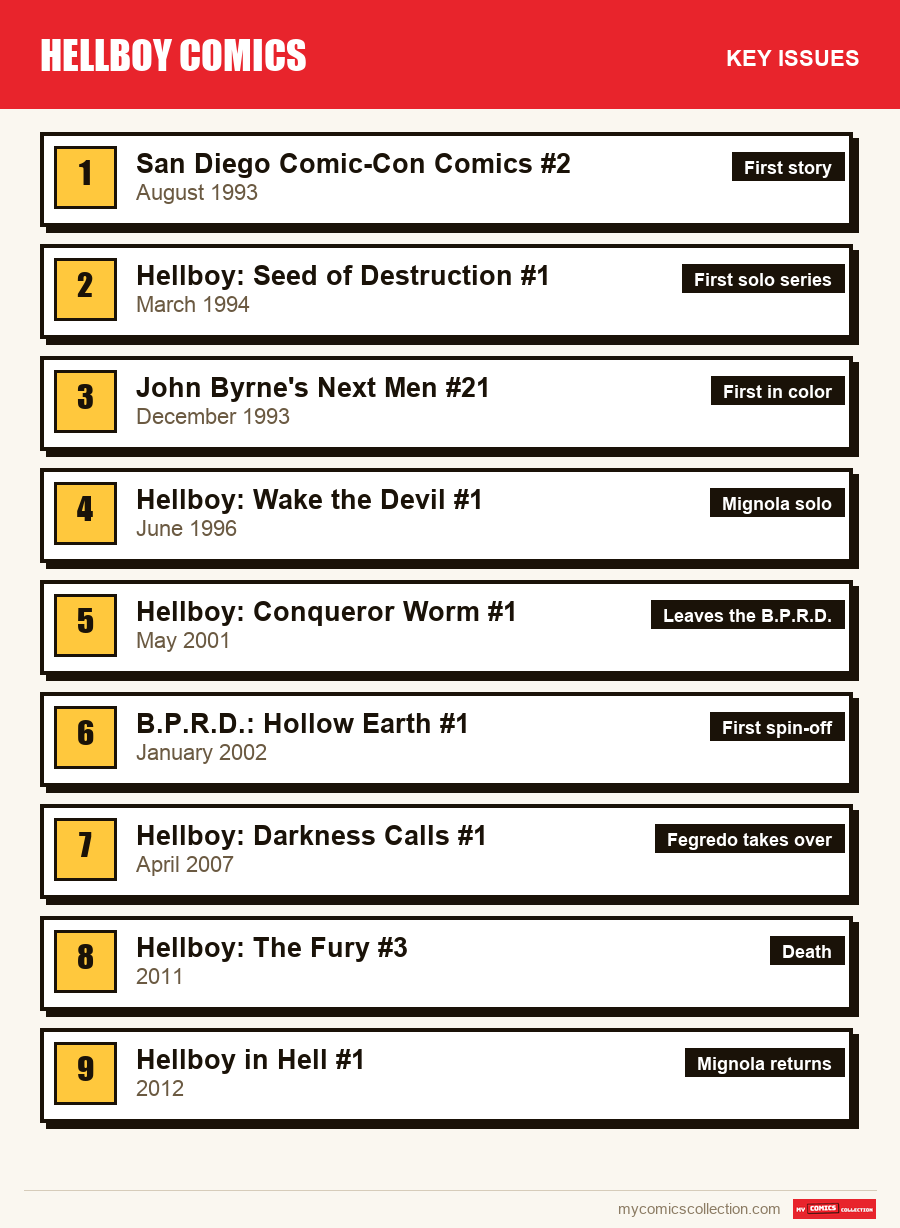
San Diego Comic-Con Comics #2
This Dark Horse promotional comic handed out at the San Diego convention contains Hellboy's first story: four black-and-white pages by Mike Mignola. Printed in small numbers, it is the character's first published narrative.
Hellboy: Seed of Destruction #1
The first miniseries bearing the character's name, conceived and drawn by Mike Mignola and scripted with John Byrne. It recounts Hellboy's summoning in 1944 during a Nazi ritual led by Rasputin and lays down the franchise's whole mythology.
John Byrne's Next Men #21
Hellboy appears for the first time in a nationally distributed regular series, and for the first time in color. Mignola draws the pages featuring the character himself, marketed as a crossover.
Hellboy: Wake the Devil #1
The first miniseries Mike Mignola writes alone, in five issues. Hellboy travels to Romania on a vampire's trail and faces the Nazi occult legacy of Ragna Rok once more. The series earns Mignola an Eisner Award in 1997.
Hellboy: Conqueror Worm #1
With help from the ghost of Lobster Johnson, Hellboy stops the Conqueror Worm from reaching Earth. At the end of this miniseries he resigns from the Bureau, paving the way for the B.P.R.D. series. It won the 2002 Eisner Award for best limited series.
B.P.R.D.: Hollow Earth #1
The first miniseries devoted to the Bureau without Hellboy, focused on Abe Sapien, Liz Sherman and their colleagues. It launches the extended universe that will become, by volume, the backbone of the franchise.
Hellboy: Darkness Calls #1
For the first time, Mike Mignola hands the art of the main series to another artist, Duncan Fegredo, while keeping the writing. In England, Hellboy refuses to become king of the witches and ends up in Baba Yaga's realm.
Hellboy: The Fury #3
The conclusion of the trilogy drawn by Duncan Fegredo: Hellboy battles Nimue, transformed into a dragon, amid a storm ravaging England. The fight ends with the character's death, the starting point of his story in Hell.
Hellboy in Hell #1
Mike Mignola returns to drawing the final chapter of the main series himself, following Hellboy into the Abyss after his death. This series, concluded with its tenth issue in 2016, closes the character's journey as his creator intended.