The key numbers of Hellboy do not follow the usual logic of major Marvel or DC franchises: created by Mike Mignola and published by Dark Horse Comics, the character has a unique editorial history with several “first appearances” . The Italian fanzine Dime Press #4 (1993) and the San Diego Comic-Con Comics #2 (1993) compete for the title of true first, before the first appearance in color in Next Men #21 and the first solo miniseries Hellboy: Seed of Destruction #1 (1994).
Few modern characters have a history of first appearance as rich and disputed as Hellboy . Created by Mike Mignola in the early 1990s, the red demon of Bureau for Paranormal Research and Defense (B.P.R.D.) is one of the rare heroes creator-owned to have achieved the status of cultural icon, supported by several films and an instantly recognizable graphic identity. For the collector, this creates a special situation: Hellboy key issues derive their value not from half a century of continuity, but from tiny prints and a extreme rarity on the very first issues.
This guide lists the Hellboy key issues to know, with their exact editorial context, what makes them important, the effect of adaptations on the market and a practical buying guide: because on Hellboy more than elsewhere, distinguishing the collector legend from factual reality is essential.
Hellboy in comics history
Mike Mignola, after a decade spent drawing for Marvel and DC: we owe him in particular Cosmic Odyssey and Gotham by Gaslight:, imagines Hellboy at the end of the 1980s before bringing him to life in 1993. The character was born in a specific historical context: the explosion of the movement creator-owned and the rise of Dark Horse Comics, publisher where authors retain the rights to their creations. Unlike Spider-Man or Batman, perpetual property of their publisher, Hellboy belongs to Mignola: a decisive choice which shaped the entire trajectory of the franchise: total narrative freedom, graphic coherence, and an extended universe (B.P.R.D., Abe Sapien, Lobster Johnson, Witchfinder) controlled by a single creator.
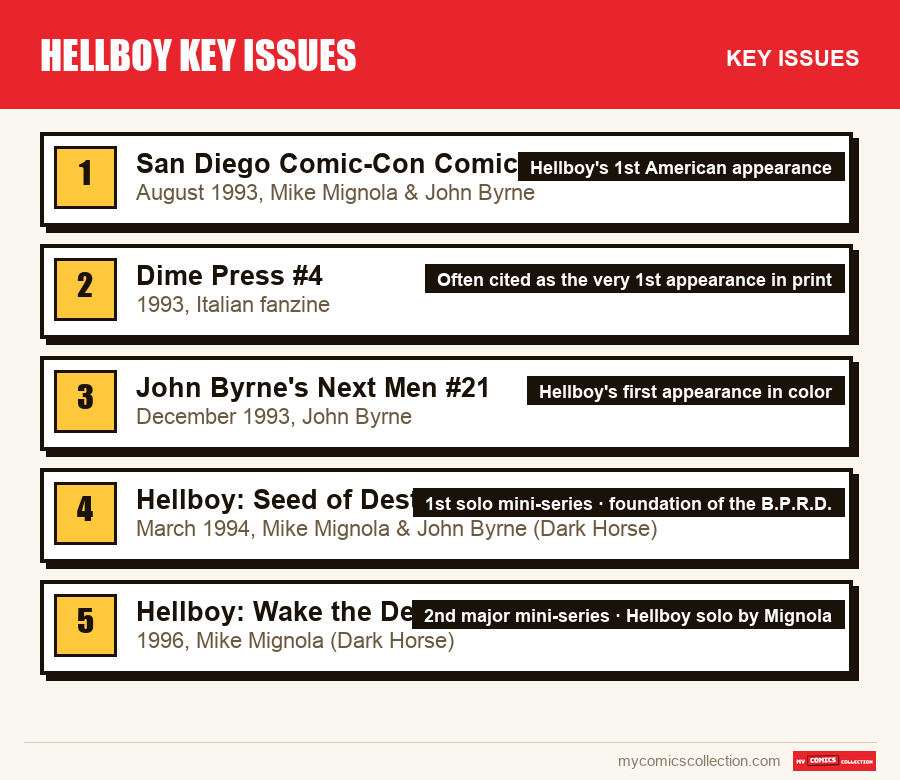
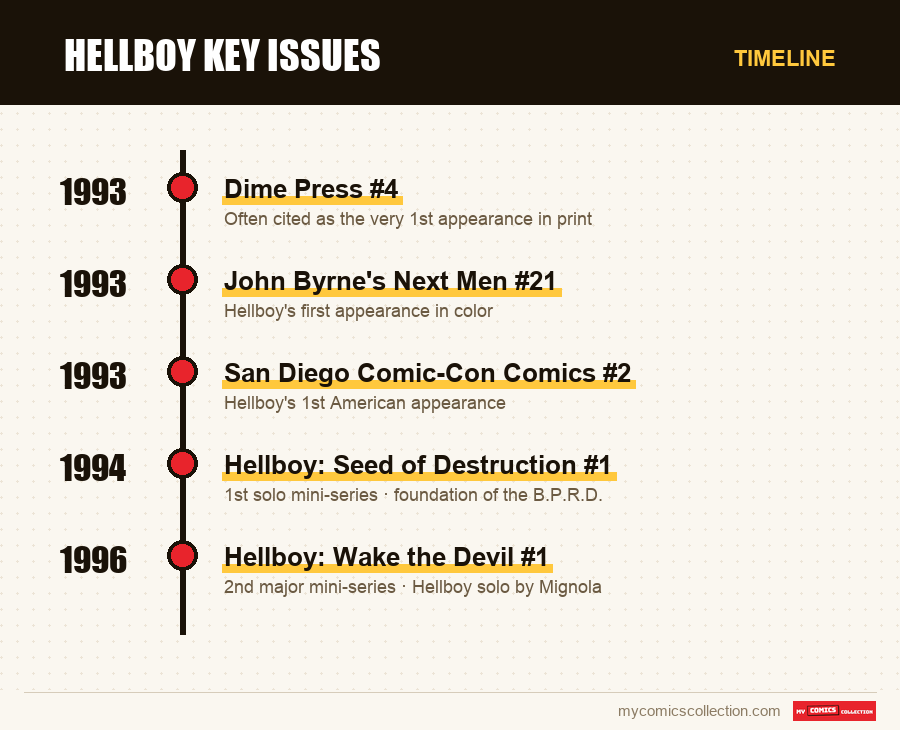
The exact timeline of Hellboy's first appearances is one of the most debated in modern comic collecting:
- John Byrne's Next Men #14-15 (1993): first sketches and mentions of the character in John Byrne's series at Dark Horse
- Dime Press #4 (1993): Italian fanzine, often cited as the very first appearance in print from Hellboy, with a tiny print run
- San Diego Comic-Con Comics #2 (August 1993): the first American appearance, a 4-page black and white story, distributed free at SDCC
- John Byrne's Next Men #21 (December 1993): the first appearance in color of the character
- Hellboy: Seed of Destruction #1 (March 1994): the launch of the first solo miniseries, written with John Byrne, who establishes the universe of B.P.R.D.
This plurality of “firsts” is exactly what makes Hellboy fascinating, and tricky, for the collector. Each corresponds to a different milestone (first printed trace, first American publication, first color, first series), and their value differs radically. To organize your numbers and track their rating by grade, the tool My Comics Collection Collection Tracker allows each edition and variant to be cataloged separately.
Hellboy key numbers
Here are the franchise's essential numbers Hellboy, classified by historical importance. The values shown are based on actual market data; when no reliable rating is publicly available, we instead indicate the documented rarity (mintage, CGC population) rather than an invented figure.
San Diego Comic-Con Comics #2
San Diego Comic-Con Comics #2 is the number that the majority of the American market recognizes as the first appearance of Hellboy . It contains a story of 4 pages in black and white , co-written with John Byrne, distributed free of charge during San Diego Comic-Con 1993. Its circulation is estimated at approximately 1,500 copies: a paltry figure which explains its persistent rarity. Because it was a giveaway folded and handled at a show, high grade copies are particularly sought after: in the CGC census, the vast majority of certified copies are in 9.4 and above, but every copy counts. This is the “general public” Hellboy key issue par excellence, the one around which the character's reference rating is built.
Dime Press #4
Dime Press #4 is the wild card of any serious Hellboy collection. This Italian fanzine of 1993 is frequently presented as the true first appearance in print of the character, predating SDCC Comics #2. Her extremely limited edition (of the order of a thousand copies, the vast majority remaining in Italy) makes it one of the most difficult Hellboy issues to find in the world, especially certified. For the “completionist” collector, it is the ultimate piece, but also the most tricky, because authenticated copies rarely go on public sale. Its value is measured primarily by its documented rarity rather than by a regular market quotation, and its authentication requires particular vigilance.
John Byrne's Next Men #21
Published in the series Next Men of John Byrne at Dark Horse, the number #21 mark it first appearance in color of Hellboy: an important distinction for collectors seeking the character as we know him visually. Unlike the two previous issues, Next Men #21 was a classic commercial publication, available on newsstands and in stores: the print runs are therefore much higher, which makes it significantly more accessible. This is often the first "real" Hellboy key a collector adds to their collection, before tackling the SDCC and Dime Press rarities. An excellent value for money to start with.
Hellboy: Seed of Destruction #1
Hellboy: Seed of Destruction #1 is the founding issue of the Hellboy universe as it exists today. This four-part mini-series, drawn by Mignola and scripted with John Byrne, establishes the gothic tone, the occult atmosphere and the mythology of the B.P.R.D. which will define the entire franchise. It's the ideal narrative entry point and one of the most important key issues collected: as of September 30, 2025, the CGC Population Report recorded 1,087 certified copies. Being a mainstream publication from 1994, it remains accessible in raw state, making it the easiest Hellboy key to get started with: while still being historically major.
Hellboy: Wake the Devil #1
After Seed of Destruction , Wake the Devil is the mini-series where Mike Mignola takes sole control of the script, definitively asserting his authorial voice. THE #1 marks a turning point: it is the moment when the Hellboy universe ceases to be a collaboration to become the personal and coherent work which will earn Mignola his cult status. Less rare than the very first appearances, this issue remains a milestone appreciated by collectors who want to document the evolution of the series beyond its sole origin. Its rating largely follows the general interest in the franchise, revived with each adaptation.
Collecting this series?
Track what you own, what you are missing and what your collection is worth. 7 day trial.
Start my trial →The impact of adaptations on the Hellboy rating
As with most comic book characters, film adaptations played a central role in Hellboy's visibility and collectors' interest in its key issues. The franchise has had several appearances on screen:
- Hellboy (2004), directed by Guillermo del Toro with Ron Perlman in the title role: the film that introduced the character to the general public.
- Hellboy II: The Golden Army (2008), again by del Toro and Perlman, which confirms the visual and poetic dimension of the universe.
- Hellboy (2019), a reboot directed by Neil Marshall with David Harbor.
- Hellboy: The Crooked Man (2024), adaptation of one of the arcs most appreciated by readers.
The mechanism is well known to collectors: with each announcement or adaptation release, attention is focused on the first appearances and founding numbers, which increases demand for print runs that are limited in nature. On Hellboy, this effect is amplified by the structural scarcity of the very first issues: unlike a Marvel comic from the 1960s printed in hundreds of thousands of copies, a trade show giveaway or a fanzine cannot see its supply increase. When demand rises, it concentrates on a quasi-fixed stock. This is why savvy collectors monitor adaptation announcements as market signals, while keeping in mind that a peak in media interest is no guarantee of lasting value: the strength of a key issue relies above all on its actual editorial importance and documented rarity.
Buying Guide: How to Collect Hellboy
Collecting Hellboy requires a different approach than classic franchises. Here are the essential points before buying:
- Identify precisely which “first” you are purchasing. SDCC Comics #2 (1st US), Dime Press #4 (claimed 1st in print), and Next Men #21 (1st in color) are not interchangeable. Always check the exact title, year and publisher of the issue offered.
- Favor certification over rarities. On a trade show giveaway or a fanzine with a very low circulation, a grade CGC provides two guarantees: authenticity (essential given the risk of reproductions) and an objective scale of value. For mainstream issues like Seed of Destruction #1, a raw copy in good condition may be sufficient.
- Monitor the status specific to giveaways. SDCC Comics #2 having been distributed free of charge and often folded, high grades are rare: the difference in value between a handled copy and an almost new copy is considerable.
- Start with Seed of Destruction #1. Historically major, widely available and affordable, it's the best entry point before chasing SDCC and Dime Press rarities.
- Document your collection. Each edition, variant and grade has its own value trajectory: rigorous monitoring allows you to know precisely what you hold and how its rating evolves.
Before any purchase, check the real rating of a number and its grade with our free estimator based on current eBay listings, and catalog your acquisitions with the collection management application to follow the evolution of their value over time.