Image Comics is, in 2026, the third American comics publisher behind Marvel and DC, and the first in the world “creator-owned”. Founded in February 1992 by seven star cartoonists (Todd McFarlane, Jim Lee, Rob Liefeld, Erik Larsen, Marc Silvestri, Jim Valentino, Whilce Portacio), the house redefined the rules of the sector by guaranteeing authors ownership of their characters. This pillar guide covers the 1992 foundations, the ten historic flagship series (Spawn, Savage Dragon, WildC.A.T.s, Witchblade, Walking Dead, Saga, Invincible, Monstress, Sex Criminals, Paper Girls), the creator-owned renaissance since 2003, the Top Cow and Skybound pillars, the thirty-year retrospective in 2022, the TPB vs single issue debate, the 2026 spec calls, the collector strategy by budget and the VF sources (Delcourt, Bliss Comics, Urban). To properly catalog your Image universe, use My Comics Collection from the first acquisition.
Univers Image Comics: the pillar collector's guide FR 2026
For a French collector who wants to escape the usual Marvel/DC corridor, the Image Comics universe is probably the most exciting area to explore in 2026. The house founded in February 1992 by seven cartoonists who left to slam the door of Marvel has experienced three successive lives: the speculative fury of the 90s driven by Spawn , WildC.A.T.s , Savage Dragon , Witchblade and the Top Cow galaxy; the crossing of the desert from 1996 to 2002 when the market collapsed; then the creative renaissance from January 2003 when Robert Kirkman published the first issue of Invincible , followed by The Walking Dead in October. From this second breath are born Saga by Brian K. Vaughan in March 2012, Monstress by Marjorie Liu in 2015, East of West by Jonathan Hickman and a whole generation of authors who came to Image to seek what neither Marvel nor DC offered them: editorial freedom and ownership of their works.
This pillar guide is aimed at the French-speaking collector who wants to build a structured overall vision of the Image universe in 2026. You will find a precise chronology, the ten series which define the house, the essential modern runs, the analysis of the two studios which make the editorial fortune of the house today (Top Cow around Marc Silvestri, Skybound around Robert Kirkman), a retrospective of the thirty years celebrated in 2022, the decisive debate TPB versus single issue, the spec calls which are shaking up the market in 2026 and the gradual collector strategy by budget.
Image Comics is not just a publisher, it is a business model that has transformed the industry. To understand this universe is to understand why The Walking Dead has become the most profitable multimedia franchise of the 21st century for an independent comic, why Saga wins the Eisner Awards year after year, why Invincible relaunched the superhero genre on television via the Prime Video animated series launched in 2021. It also means understanding the pitfalls of a house without unified continuity, without a predictable schedule, and where a series can end abruptly as did Walking Dead at number 193 in July 2019. This guide gives you the complete map of the territory.
Image Comics 1992: the founding by the seven cartoonists
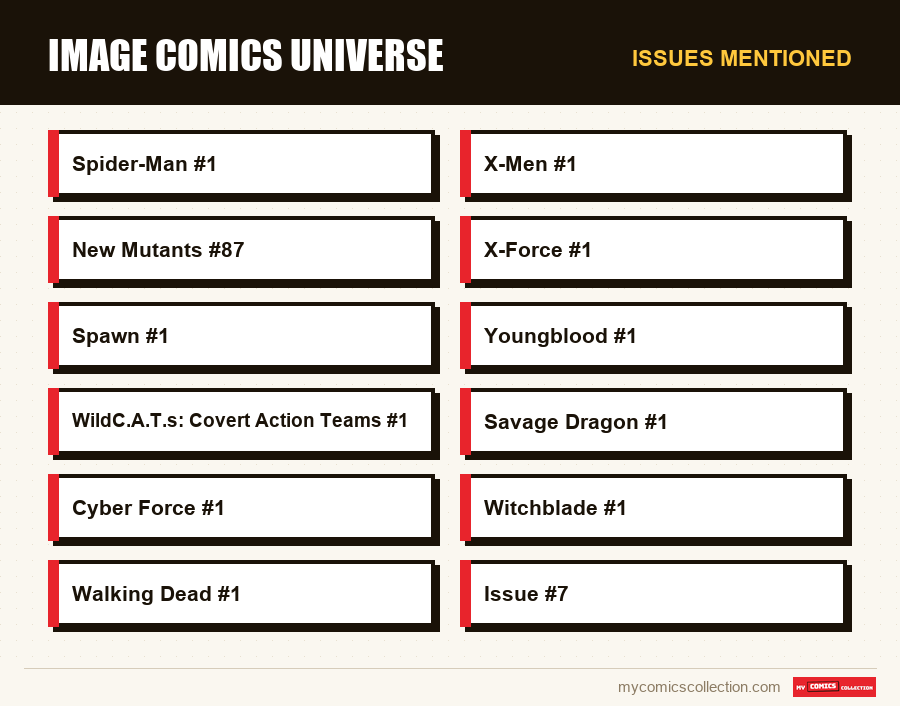
February 1, 1992 marks the birth of Image Comics. Seven artists, then at the peak of their sales at Marvel, simultaneously announced their departure to found an independent publishing house. This collective decision, taken in the weeks preceding the summer San Diego Comic-Con, constitutes the most important editorial earthquake in the American market since the creation of Marvel in 1961 by Stan Lee and Jack Kirby. The seven founders are: Todd McFarlane (author of sales records on Spider-Man #1 launched in August 1990, which sold more than 2.5 million copies), Jim Lee (architect of the run X-Men #1 of October 1991, best-selling comic of all time with more than 8.1 million copies sold, all variants combined), Rob Liefeld (creator of Cable, Deadpool and Domino on New Mutants #87 then X-Force #1 from August 1991), Erik Larsen (then on Amazing Spider-Man where he succeeds McFarlane), Marc Silvestri (coming out of a notable run on Wolverine and Uncanny X-Men ), Jim Valentino (on Guardians of the Galaxy volume 1) and Whilce Portacio (on Uncanny X-Men alongside Jim Lee).
The revolutionary rule of intellectual property
Image's founding rule was unprecedented at the time in the American industry: each author retains complete intellectual property of their creations. At Marvel or DC, the creator of a character historically did not receive any derivative rights. The figures of Spider-Man, Wolverine, Batman, Superman belong to the publishers, not to their authors. Stan Lee himself, despite his public role at Marvel, never received significant royalties from Marvel films until the end of his life. This structural injustice motivates the departure of the seven. At Image, each studio operates in total autonomy: Todd McFarlane Productions carries Spawn, WildStorm Productions carries the Jim Lee Galaxy (WildC.A.T.s , Stormwatch , Gen 13), Extreme Studios carries Liefeld (Youngblood , Bloodstrike), Highbrow Entertainment carries Larsen (Savage Dragon), Top Cow Productions carries Silvestri (Cyber Force , later Witchblade , Darkness), Shadowline carries Valentino, Wetworks Studios carries Portacio. The Image Central Editor is only a distribution and marketing facilitator.
The first titles of 1992: massive commercial success
The first Image issues came out in the spring and summer of 1992. Spawn #1 by Todd McFarlane was released in May 1992 and sold more than 1.7 million copies, an absolute record for an independent publisher at the time. Youngblood #1 by Rob Liefeld, released in April 1992, also exceeded one million copies. WildC.A.T.s: Covert Action Teams #1 by Jim Lee was released in August 1992 with a circulation of over 1.1 million. Savage Dragon #1 by Larsen, Cyber Force #1 of Silvestri, ShadowHawk of Valentino followed in the following months with sales in the hundreds of thousands each. On a strictly commercial level, the adventure was an immediate triumph. The specialist press speaks of a revolution. In its first year, Image achieved the status of third American publisher in terms of market share, displacing established houses like Dark Horse, Valiant and Malibu.
The setback of 1996: the speculative bubble burst
But this first period of Image is fragile. The editorial quality is uneven: chronic publication delays at Liefeld and Wildstorm Studios, botched scenarios on certain titles, drawings sometimes sacrificed to the urgency of deadlines. Above all, in 1995-1997 the American comics market was going through its worst speculative crisis since the creation of modern comics. The printing of variant covers, promotional polybags and commercial gimmicks artificially inflated sales for five years. When the bubble burst, distributors closed, comic shops disappeared by the thousands, and half of the Image catalog collapsed with them. Spawn and Savage Dragon survive (Larsen writes and draws alone Savage Dragon since number 1, unique industrial performance). But Image seems doomed to be nothing more than a footnote in the industry's publishing history. For chronological details of this troubled period, consult our thirty-year history of Image Comics.
Top 10 historical Image series by editorial importance
To understand the Image universe in 2026, you need to know the ten series that define the house over thirty-four years of existence. This list is not a classification by literary quality but by editorial, commercial and cultural weight in the Image ecosystem. She deliberately mixes classics from the 90s and post-2003 revivals to give a panoramic vision of the house.
The pillars of the founding age (1992-2002)
1. Spawn (1992 - ongoing). Todd McFarlane's flagship series exceeds 360 issues in early 2026. Character of Albert "Al" Simmons, murdered former CIA agent turned Hellspawn in the service of the forces of hell, Spawn is the historic commercial face of Image. The series has had its downturns (the arcs of the 2000s are contested), but it remains one of the two titles launched in 1992 still published continuously. The multimedia franchise includes a 1997 film starring Michael Jai White, an HBO animated series from 1997 to 1999, and a movie sequel announced several times by McFarlane since 2015. For a 2026 collector, the essential run begins with issues 1 to 100 (1992-2000) then the relaunch Spawn: Resurrection from 2017 under the writing of McFarlane.
2. Savage Dragon (1992 - ongoing). Erik Larsen writes, draws and inks alone all the issues since the first, a unique industrial performance in the history of American comics. The series exceeds 270 issues at the start of 2026. Uninhibited action, anarchic tone, direct legacy of the golden age of independent superheroes of the 80s. For a beginner, the first compendium Savage Dragon Archives volume 1 covers the first fifty issues and is enough to understand the spirit. For a collector of runs, the complete Larsen is a lifelong project.
3. WildC.A.T.s: Covert Action Teams (1992-1998, multiple relaunches). Created by Jim Lee, the series founded the WildStorm galaxy which was bought by DC Comics in 1999. WildStorm then became an internal DC studio but retained its editorial consistency until 2010. The WildC.A.T.s returned occasionally to DC in 2022. For a strict Image collector, only issues 1 to 50 published under the Image label (1992-1998) count. The Jim Lee variants are the most sought after on the market in the 90s, some reaching 200 to 400 euros in CGC 9.8.
4. Witchblade (1995-2015, 2017 relaunch). Joint creation by Marc Silvestri, David Wohl and Brian Haberlin at Top Cow Productions. The series follows Sara Pezzini, a New York police inspector who inherits an ancestral gauntlet. The franchise spawned a TV movie in 2000, two Japanese animated series (the 2006 TBS series), a regular crossover with Darkness . Witchblade is, with Spawn, one of the two Image characters most exploited in multimedia before Walking Dead. For a collector, issues 1-25 by Silvestri and Michael Turner are the most sought after; Witchblade #1 in Turner variation sells for 80 to 150 euros in high quality.
Modern renaissances (2003-2026)
5. The Walking Dead (2003-2019). 193 issues, 32 classic TPBs, 16 hardcovers, 8 giant compendiums covering the entire book. Robert Kirkman and Tony Moore launched the black and white series in October 2003 with an initial print run of approximately 7,250 copies. Charlie Adlard replaces Moore from number 7 and remains in the drawing until the end. The series exploded from 2010 with the AMC adaptation, and ended abruptly at number 193 in July 2019, Kirkman having decided to end the story without notice to prevent it from stretching out indefinitely. For the differences between the multiple prints of Walking Dead #1, check out our guide Walking Dead #1 prints differences which details the six successive draws from 2003 to 2010 and their respective odds.
6. Saga (2012 - ongoing). Brian K. Vaughan and Fiona Staples launch the series on March 14, 2012. Space opera, family tale, political satire, meditation on parenthood and war: Saga is all of this at once. She has won a series of Hugo Awards and Eisner Awards. A three-year editorial break occurs between July 2018 and January 2022 (the Vaughan/Staples couple announcing they need to recharge). In the 1st quarter of 2026, Saga has approximately seventy-five issues published and remains the most followed ongoing series in the Image catalog. Eleven TPB are available, the compendium volume 1 covers the first nine volumes (numbers 1 to 54).
7. Invincible (2003-2018). Robert Kirkman and Cory Walker launched the series on January 22, 2003. Mark Grayson, an American high school student whose father is Earth's greatest superhero, discovers his own powers. Issue #7 turns the tables with a now-legendary twist that transforms the series into one of the most subversive works in the superhero genre. Invincible runs from January 2003 to February 2018 over 144 issues and a definitive ending, a rare performance in an industry accustomed to perpetual relaunches. The Amazon Prime Video animated adaptation launched in 2021 and its third season broadcast in 2025 have revived interest in TPBs and compendiums. The complete collection exists in three complete compendiums of approximately 1,500 pages each.
8. Monstress (2015 - ongoing). Marjorie Liu and Sana Takeda launched the series in November 2015. Adult fantasy set in an alternative world inspired by early 20th century Asia, Monstress won three consecutive Hugo Awards for best graphic novel in 2017, 2018 and 2019. At the start of 2026, more than fifty issues have been published, nine TPBs are available. Sana Takeda's drawing combines Art Nouveau and Asian imagery with a decorative precision that makes Monstress one of the most beautiful graphic series published in fifteen years. For a demanding collector in terms of objects, hardcovers Monstress Book One and Book Two are the reference.
9. Sex Criminals (2013-2020). Matt Fraction and Chip Zdarsky sign a bank robbery romantic comedy with an improbable pitch: a couple who discover that their orgasms stop time decide to use this power to rob banks. Eisner Award in 2014, series ended in 2020 over 30 issues published in 6 TPB. Short, accessible format, ideal for a beginner who wants to test the Image non-superheroes offer.
10. Paper Girls (2015-2019). Brian K. Vaughan and Cliff Chiang create a science fiction story that follows four newspaper delivery girls propelled through time. 30 issues, 6 TPB, 1 complete compendium. The series is complete and self-conclusive, adapted into a Prime Video series in 2022 (cancelled after one season). For a beginner looking for a short format, it is the most accessible entry point into the Vaughan universe.
Top 10 modern essential runs from the Image ecosystem
Beyond the star series, the Image universe of 2026 owes a lot to a second layer of author runs published since around 2010, which have consolidated the house's reputation as the main creator-owned publisher on the market. Here are the ten modern runs to know for a serious collector.
1. East of West (2013-2019) by Jonathan Hickman and Nick Dragotta. 45 issues, 10 TPB, 5 hardcovers. Post-apocalyptic Western in an alternate America where the Horsemen of the Apocalypse are physical entities. Dense, demanding series, rewarded with a controlled ending. Count 100 to 130 euros for the complete TPB collection.
2. Nailbiter (2014-2018) by Joshua Williamson and Mike Henderson. 30 issues, 6 TPB. Horrifying thriller set in a small Oregon town that produced sixteen famous serial killers. Quick read, complete format, ideal for a collector who wants to diversify beyond superheroes and fantasy.
3. Black Science (2013-2019) by Rick Remender and Matteo Scalera. 43 issues, 9 TPB. Multi-dimensional science fiction where a scientist lost in the multiverse tries to protect his family. Remender is one of Image's most prolific authors, also Deadly Class and Low.
4. Deadly Class (2014 - hiatus 2025) by Rick Remender and Wes Craig. More than 55 issues published. Teenagers trained in the art of murder in a secret school in the 80s. Syfy adaptation in 2019 (canceled after one season). Series still formally in progress but on hiatus since 2024.
5. Descender / Ascender (2015-2021) by Jeff Lemire and Dustin Nguyen. 32 + 18 numbers. Science fiction then fantasy saga in two connected series, drawn in watercolor by Nguyen. One of the greatest visual successes of the decade at Image.
6. The Wicked + The Divine (2014-2019) by Kieron Gillen and Jamie McKelvie. 45 numbers + specials. Every 90 years, twelve deities represent themselves as young pop stars for two years before dying. Meditation on celebrity, youth and artistic creation. Complete series on 9 TPB.
7. Gideon Falls (2018-2020) by Jeff Lemire and Andrea Sorrentino. 27 issues, 6 TPB. Psychological horror about a black barn that appears and disappears. Eisner Award for best cartoonist in 2020 for Sorrentino.
8. Something is Killing the Children (2019 - ongoing, originally BOOM! Studios). Important note for a collector: the series is published by BOOM! Studios, not by Image. But it is part of the same creator-owned movement and its author James Tynion IV has since launched at Image The Department of Truth, an essential conspiracy series in 2026.
9. The Department of Truth (2020 - ongoing) by James Tynion IV and Martin Simmonds. 30+ issues in early 2026. Global conspiracy where conspiracy theories become real if enough people believe them. One of the most discussed series in the recent Image ecosystem.
10. Geiger / Geiger volume 2 (2021 - ongoing) by Geoff Johns and Gary Frank. Geoff Johns, DC historical screenwriter (Green Lantern , The Flash , Doomsday Clock), launches its own creator-owned franchise at Image with Gary Frank. This is the political signal that the very big names in the mainstream now consider Image as the natural terrain for their personal projects.
The creator-owned renaissance since 2003: why Image dominates the segment
Between 1999 and 2004, Image underwent a profound transformation. Jim Valentino takes over as editorial director and opens the house to creator-owned projects that no longer have anything to do with the muscular superheroes of the origins. This openness is the key to everything that follows. The house becomes the refuge for authors who want to keep their rights, regardless of the genre: science fiction, horror, romance, thriller, fantasy, slice of life, autobiographical memoirs. It is this repositioning that prepares the renaissance of the 2000s and Image's current status as the leading American independent publisher.
Why authors are coming to Image in 2026
Three structural reasons explain Image's domination of the creator-owned segment. First reason: intellectual property. An author who publishes with Image retains 100% of the rights to his creations, whereas Marvel and DC continue to operate on work-for-hire contracts for their historical characters. This means that if Saga is made into a movie tomorrow, Brian K. Vaughan and Fiona Staples receive most of the royalties. If Invincible was adapted into an Amazon series, Kirkman receives the rights via Skybound Entertainment. This asymmetry has become impossible to ignore for an established author.
Second reason: editorial flexibility. At Image, the rhythm is dictated by the author. No imposed monthly calendar, no shared continuity to respect, no marketing directives that constrain the story. If Vaughan and Staples decide to take a three-year break from Saga, they do it. If Kirkman decides to finish Walking Dead at number 193 overnight, he does. This creative freedom is impossible at Marvel or DC.
Third reason: the format adapted to reading in TPB and in compendium. Image publishes its series in a “serial graphic novel” logic which naturally lends itself to collection in bound volumes. Where Marvel and DC remain attached to the model of the monthly single issue as the main support, Image designs its series from the start to live in TPB. This is why series like Saga or Walking Dead find their readers over ten or fifteen years, well after their initial publication, which is rarely the case for mainstream comics.
Top Cow and the Marc Silvestri galaxy: a sub-universe Essential image
Top Cow Productions, the studio founded by Marc Silvestri in 1992, deserves a separate focus in any Image panorama. Unlike Wildstorm Studios (integrated into DC in 1999) or Extreme Studios (dissolved in the 2000s), Top Cow remained active under the Image label for thirty-three years and continues to publish in 2026 under the editorial direction of Matt Hawkins.
Witchblade and The Darkness: the two flagship franchises
Witchblade, launched in 1995 by Silvestri, David Wohl, Brian Haberlin and Michael Turner, tells the story of Sara Pezzini, a New York police detective who inherits an ancient gauntlet that has chosen its wearers for millennia. The series runs from 1995 to 2015 over 185 issues, with a relaunch in 2017. Darkness, launched in 1996 by Garth Ennis, Marc Silvestri and David Wohl, tells the story of Jackie Estacado, a mafia hitman who inherits an ancestral power linked to primordial darkness. The two series regularly cross paths in crossovers (Witchblade/Darkness is a classic of the 2000s) and have each undergone an adaptation: Witchblade in a TBS TV series in 2001, then in Japanese anime in 2006; Darkness in console video games in 2007 and 2012.
Why Top Cow remains a niche investment in 2026
For a French collector in 2026, Top Cow presents a particular profile. The catalog is less rated than modern creator-owned hits (Saga , Walking Dead) but there is a solid fan market, particularly around Michael Turner covers which remain sought after in CGC. Witchblade #1 in the first edition sells for 40 to 80 euros in TBE, certain Turner variant covers reaching 200 to 400 euros in CGC 9.8. The integral TPBs Witchblade Compendium have become rare and can be found between 60 and 90 euros each on the secondary market. To accurately estimate the value of your Top Cow lot, use our tool free estimate, which draws on current eBay listings.
Skybound and Robert Kirkman: the empire built on Walking Dead
Skybound Entertainment, founded in 2010 by Robert Kirkman and David Alpert, now constitutes the second major sub-ecosystem of Image Comics. Initially thought of as an editorial unit dedicated to Kirkman and his personal projects, Skybound has become a true multimedia studio that produces comics, TV series, video games and podcasts. Skybound publishes its comics under the Image label with distinct visual branding (the Skybound logo appears on the cover alongside the Image logo).
The essential Skybound series
Four major franchises structure the Skybound catalog in 2026. The Walking Dead (2003-2019, completed), of course, whose multimedia rights have generated an extended television universe: the original AMC series from 2010 to 2022 over 11 seasons, Fear the Walking Dead from 2015 to 2023, The Walking Dead: Dead City , Daryl Dixon , The Ones Who Live in 2023-2024. Invincible (2003-2018, completed), carried by the Prime Video animated series launched in 2021 and whose third season was broadcast in 2025. Outcast (2014-2021, completed), story of exorcisms in the American Bible Belt, adapted into a Cinemax series in 2016. Fire Power (2020 - completed 2023), martial arts and magic.
Kirkman 2026: what to expect from the next project?
In 2026, the great unknown Skybound concerns the next project from Robert Kirkman himself. The author announced in an interview at the beginning of 2025 that he was working on a new creator-owned series whose release is expected in 2026. Rumors suggest a post-apocalyptic science fiction story different from Walking Dead. For speculative collectors, this is the most closely watched Image event of the 2026 calendar: a first Kirkman issue could re-trigger a pre-order dynamic equivalent to that of Invincible #1 or Walking Dead #1 at the time. For financial issues, consult our analysis on modern comics: investing 2020-2026 which details the patterns of post-Walking Dead speculation.
Collecting this series?
Track what you own, what you are missing and what your collection is worth. 7 day trial.
Start my trial →Image Comics, thirty years in 2022: the retrospective and the lessons
The year 2022 marks the thirtieth anniversary of Image Comics. The publisher publishes several commemorative works, including Image Comics: The Road to Independence which goes behind the scenes of thirty years, and organizes an anniversary panel at San Diego Comic-Con in July 2022 bringing together five of the seven founders (Whilce Portacio and Marc Silvestri being represented). This anniversary is an opportunity to take stock of how far we have come.
Key figures from the first thirty years
In thirty years, Image Comics has published more than 12,000 issues of all titles, launched more than 600 different series (ongoing and completed), generated more than 35 confirmed audiovisual adaptations (films, TV series, animations, video games). The house went from a publisher perceived as speculative in the 90s to a creative reference publisher in the years 2010-2020. No more major creator-owned project announcements are made without Image being cited as a natural candidate. The Eisner Awards and Hugo Awards 2010-2025 are dominated by Image series (Saga , Monstress , The Wicked + The Divine , Paper Girls).
The admitted failures of the founders
The 2022 panel was also an opportunity for the founders to publicly acknowledge the failures. McFarlane admitted that chronic release delays on Spawn in the 2000s lost readers. Liefeld admitted that his '90s screenplays lacked depth. Jim Lee acknowledged that the sale of WildStorm to DC in 1999 was a financial compromise that he partially regrets. This retrospective honesty is rare in an industry accustomed to promotional speeches. It nourishes the current image of a peaceful, structured house, where editorial quality has replaced marketing as a priority.
TPB format vs single issue: the decisive question for a collector Image
The debate between single issue and TPB is more structuring at Image than at any other publisher. For an Image 2026 collector, this choice determines the budget, the storage space, the speed of discovery and the long-term development strategy.
The single issue Image: the traditional experience
The single issue (stapled monthly issue) is the historic format for the American market. Each Image issue costs between $3.99 and $5.99 in the United States (4 to 6 euros when imported into France via independent comic shops). For Image, single issues have a particular appeal: they often include editorials from the author (the letter columns of Saga or Walking Dead are an integral part of reading and have never been included in TPB), sometimes readers' letters with comments, and unpublished variant covers which are never included in the collection. The single issue is also the only format that allows you to experience a series in real time, release by release, with the community of readers in parallel.
The major disadvantage of the single issue for an Image collector is the cumulative cost. If you want to catch up on a finished series like The Walking Dead, buying the 193 issues one by one in new TBE will cost you two to three times the price of equivalent compendiums, not to mention the time spent hunting for missing issues. For current series like Saga or Monstress, the single issue only makes sense if you're reading in real time. For the optimized purchasing strategy, consult our guide buy Walking Dead cheap which details the best sectors in France and Europe.
The TPB Image: the collector’s king format
The TPB (Trade Paperback) generally brings together six to twelve issues in a paperback volume, sold between 12 and 25 dollars depending on the pagination. This is the ideal format for an Image collector in 2026. Advantages: price per comic divided by two or three compared to the single issue, permanent availability (Image reprints its bestsellers regularly), ease of storage in the library, more immersive reading over six consecutive chapters, covers designed as bookish objects. For Walking Dead, for example, the 32 classic TPBs allow comfortable reading of the complete set for a total budget of around 540 euros (16 to 18 euros for a new TPB). For the same integral, the 8 giant compendiums cost around 220 to 250 euros.
The Image compendium: the economical archiving format
The compendium is a particularity Image popularized by Walking Dead. It brings together 24 to 48 issues in a single large format paperback volume, sold between 35 and 70 euros each. Economically, it's unbeatable to catch up on a finished series. The eight compendiums Walking Dead at around 30 euros each covers the 4,008 pages of the complete book for 240 euros total. The three compendiums Invincible at 60 euros each (180 euros total) cover the 144 numbers compared to 450 euros in classic TPB. The disadvantage of the compendium is ergonomic: they are blocks of 1,200 to 1,500 pages, heavy, difficult to read in transport. Our advice for a 2026 collector: compendium for archiving and first reading, single issue or TPB for series that you really want to own in detail.
Spec calls Image 2026: the bets of the speculative collector
The speculative Image comics market is more volatile than that of Marvel or DC. The first appearances of independent series can see their ratings multiply by five or ten over a weekend if an audiovisual adaptation is announced. These are the spec calls that are shaking up the Image market in the first half of 2026.
The Saga sequel: announcement effect and anticipation
The Vaughan/Staples couple confirmed in an interview in November 2025 that Saga was entering its final arc, planned for 25 to 30 issues to definitively conclude the story of Alana, Marko and Hazel. This announcement has already increased demand on Saga #1 first edition, which goes from 60 to 90 euros in TBE at the start of 2025 to 90 to 140 euros at the start of 2026 for the same states. For details of current speculations, consult our regular analysis on the Walking Dead valuation which details the patterns applicable to Saga by analogy.
The next creator-owned Kirkman
As mentioned above, Robert Kirkman's next creator-owned project expected in 2026 is the most closely watched Speculative Image event on the calendar. If history repeats itself, the first issue could experience pre-order dynamics equivalent to Walking Dead #1 or Invincible #1. For the key issues of Walking Dead historical stories (Negan #100, Carl #50, Tyreese), the same mechanics could apply to a future Kirkman 2026 if the series meets its audience. Our prudent advice: wait for the first three issues and their actual sales before any speculative investment.
Image 2024-2026 variants underrated
For an informed speculative collector, the Image 2024-2026 variants published in small editions (1 in 25, 1 in 50, 1 in 100) constitute a hunting ground. Several variant covers of Department of Truth , Geiger , Local Man , The Six Fingers saw their rating double or triple during the year. The risk is real: without audiovisual adaptation or an exceptional author's run, these variants can also stagnate. For the complete overview of speculative variants, consult our guide on Walking Dead variants which details the methodologies applicable to the entire Image ecosystem.
Image collector strategy by budget: the 2026 method
Four budgetary profiles structure the Image collector approach in 2026. This segmentation, validated by feedback from French-speaking members of the ecosystem comics Image to start, makes it possible to build a coherent trajectory over three to five years.
Discovery profile: 40 to 60 euros per month
For a monthly budget of 40 to 60 euros, the objective is to discover the Image universe by favoring TPBs and compendiums of completed series. Recommended six-month plan: month 1, compendium Walking Dead volume 1 (30 euros) + first TPB Saga (15 euros). Month 2, compendium Walking Dead volume 2 + TPB Saga volume 2. Months 3-4, first compendium Invincible (60 euros). Months 5-6, TPB Sex Criminals volume 1 + TPB Paper Girls volume 1. After six months, you have covered four flagship series for around 280 euros total. This is the optimal trajectory for understanding Image without breaking the bank.
Active profile: 80 to 120 euros per month
For a monthly budget of 80 to 120 euros, you can combine TPB catch-up and single tracking from current series. Recommended plan: 60 euros per month for catch-up (compendium or archive TPB), 30 euros for single issues of the month (Saga , Monstress , Department of Truth , Geiger), 10 to 30 euros of variance for variants or cross-overs. At this rate, you build a solid Image collection of 150 to 200 volumes in two years.
Collector profile: 150 euros and more per month
Beyond 150 euros per month, you enter into a logic of investment and qualitative archiving. Purchase of luxury hardcovers (Saga Compendium , Monstress Book One , Walking Dead Omnibus), speculative variants 1 out of 50, first editions in CGC for old key issues (Walking Dead #1 first print in CGC 9.8 at 2,500 euros, Invincible #1 first print in CGC 9.8 at 800 to 1,200 euros). At this point, using a cataloging tool becomes useful: My Comics Collection allows valuation to be monitored, updated daily.
Investor profile: 300 euros and more per month
Beyond 300 euros per month, you are in the process of building an Image comics portfolio with the ambition of valuation over 5-10 years. Focus on key issues (Walking Dead #1 to 50, Invincible #1 to 50, Saga #1 to 25), rare variants, international VF editions in first print from Delcourt or Urban. Regular comparison with comparables Heritage Auctions and ComicConnect. For the issues and the method, see our comparison Marvel vs DC vs Collectible Image which details the particularities of the Image market.
VF sources in 2026: Delcourt, Bliss Comics, Urban
The VF Image offering in 2026 is split between several publishers, each having rights to different portions of the catalog. For a French-speaking collector, understanding this distribution is essential to avoid making duplicates and to optimize your purchases.
Delcourt: the home of Walking Dead
Delcourt has published The Walking Dead in French since 2007, in its Contrebande collection: 33 softcover volumes released up to January 2020, each reprinting six US issues up to volume 31, then a hardcover Prestige edition in 16 volumes of two volumes each. The match between French volumes and original US issues is detailed in our guide to The Walking Dead in French.
Bliss Comics: the Image creator-owned specialist
Bliss Comics, founded in 2010, has established itself as the French publisher of reference for the modern creator-owned Image catalog. The house publishes in French several flagship Image series which did not find buyers elsewhere: Spawn Origins in full, Witchblade in complete editions, several Top Cow special editions. To understand the Bliss catalog and its editorial approach, consult our guide Bliss Comics French publisher's guide which details the publication choices and the 2026 calendar.
Delcourt and Urban: the other series
Delcourt published historically Invincible in VF in the years 2005-2015 in more than 25 volumes. The series is no longer systematically available new in 2026, which poses a real problem for a French-speaking collector who discovers Invincible after the Prime Video series. Urban Comics occasionally publishes certain Image series in French, notably Saga the first volumes of which are available. For a complete overview of the VF editions available in 2026 and second-hand search strategies, our comics page centralizes recommendations updated monthly.
FAQ: the five essential questions about the Image universe in 2026
Is Image Comics really the third American publisher in 2026?
Yes, and the gap with Marvel and DC remains structural. In American market share measured by Diamond Comic Distributors and Lunar Distribution, Marvel weighs approximately 38 to 42%, DC approximately 22 to 28%, and Image approximately 8 to 12% depending on the month and major releases. No independent publisher approaches this level: Dark Horse, BOOM! Studios, IDW, Dynamite, Boom!, Oni Press each oscillate between 1 and 4%. Image benefits from a cumulative catalog effect (Walking Dead , Saga , Spawn) and modern creator-owned dynamics (Department of Truth , Geiger, Kirkman projects 2026). The position of third publisher seems assured for the decade 2026-2036 unless there is major consolidation in the sector.
Which Image series brings the most value to a French collector in 2026?
Strictly in terms of 10-year valuation, The Walking Dead #1 first print October 2003 remains the safest Image value, with a rating multiplied by 50 to 100 since 2010. Invincible #1 first print January 2003 follows with a rating multiplied by 20 to 40 since 2015. Saga #1 first print March 2012 has seen its rating multiply by 10 to 15 since 2015. For a 2026 collector, the most promising bets are recent key issues (Department of Truth #1, Geiger #1, Local Man #1) which can capture a dynamic of audiovisual adaptation in the 3 to 5 years to come. Diversification between classics and moderns remains the most relevant strategy.
How do I choose between Bliss Comics and Delcourt for my Image VF collection?
The distribution is clear in 2026: Delcourt for The Walking Dead (volume 1 to volume 33), Bliss Comics for the modern creator-owned catalog (Spawn Origins, certain Top Cow series, independent specials). If you collect both universes, you will necessarily have both publishers in your library. For other series (Invincible , Saga , Monstress), the VF offer is more fragmented and requires a case-by-case hunt, sometimes on the second-hand market. Our advice: favor the VF for classics available in full, and accept the original version for recent or untranslated series.
Should we buy the Image single issues in 2026 or wait for the TPB?
It depends on your relationship with reading. For a passionate reader who wants to follow Saga , Monstress or new Kirkman releases in real time, the single issue is the only format that allows it. For a collector who wants to build a coherent library over 5 to 10 years, the TPB is unbeatable in cost, storage comfort and readability. Our 2026 recommendation: single issue for 2 or 3 series that you really love, TPB for everything else. The compendium is reserved for the economic catch-up of completed series (Walking Dead , Invincible , Sex Criminals , Paper Girls).
Which Image series to watch for audiovisual adaptations 2026-2028?
Several Image series have active options or announcements. Monstress by Marjorie Liu and Sana Takeda has been in development at 20th Television since 2018 (status uncertain but active option in 2026). The Department of Truth by James Tynion IV was optioned by Showtime in 2021 (status uncertain in 2026). East of West was optioned by AMC in 2014 (option expired then re-optioned several times). Deadly Class was adapted on Syfy in 2019 and canceled. Invincible season 4 is expected 2026-2027 on Prime Video. For speculative variants linked to these adaptations, our monitoring Calendar Image Independent Comics is updated monthly.