The Walking Dead is a comic series created by Robert Kirkman (screenplay) and Tony Moore (initial drawing), published by Image Comics from October 2003 (first number: TWD #1 ). From the #7 (April 2004), Charlie Adlard replaces Tony Moore in drawing and stays until the end. The series matters 193 numbers in total, divided into 32 trading volumes and 4 compendiums . Publication ended on July 3, 2019 with the #193, a surprise 72-page finale issue that no one saw coming. THE TWD #1 in CGC 9.8 is being negotiated today between $3,000 and $5,000, far from the historic record of more than $10,000 reached in 2013-2014 at the peak of the TV series.
Launched in 2003 to almost general indifference, The Walking Dead became in less than a decade the best-selling independent series in the history of American comics. Where Marvel and DC have dominated the superhero market since the 1940s, Robert Kirkman proved that a black-and-white title, without spandex or superpowers, could compete with the industry's biggest draws. At the height of its popularity, between 2012 and 2015, the series sold over 300,000 copies per issue: a figure that even some Marvel or DC titles struggle to reach.
This phenomenal success is based on a simple narrative promise but radically different from anything that existed in the zombie genre: no guaranteed happy ending, no untouchable character, and the certainty that any survivor could die at any time. Kirkman has often described The Walking Dead like the zombie movie that never ends: where Night of the Living Dead by Romero ends after 90 minutes, TWD explores what happens After: the months, the years, the decades of survival, reconstruction and human conflict that make the undead almost secondary.
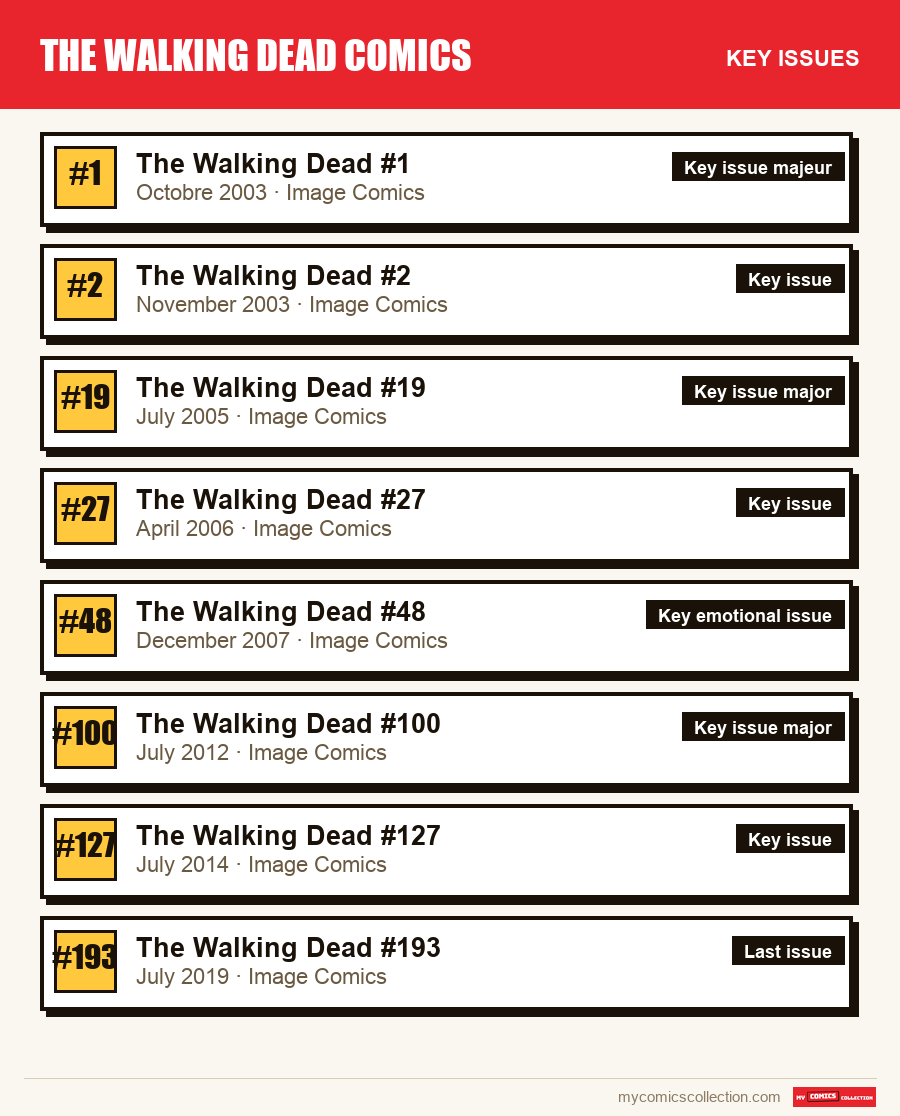
This guide traces the editorial birth of the series, gives the complete chronological list of story arcs over 193 issues, explains the artistic transition between Tony Moore and Charlie Adlard, analyzes the impact of the TV series on the back issue market, identifies the key issues to know to build a structured collection, and returns to the surprise ending which stunned the industry in July 2019.
The birth of The Walking Dead: Kirkman's pitch to Image Comics (2002-2003)
In 2002, Robert Kirkman is a young 24-year-old screenwriter from Lexington (Kentucky) who has already published a few little-noticed independent titles: Battle Pope (2001) at Funk-O-Tron and Tech Jacket (2002) at Image Comics. His ambition is to create a long-running zombie series that explores human survival far beyond the classic horror film. The problem: Image Comics, at the time, was reluctant to publish a black-and-white horror series in a market dominated by superheroes.
Kirkman publicly admitted to lied during his pitch to convince Image. He claimed that TWD's zombies would have an extraterrestrial origin: a science fiction element that he said would reassure the publisher. This alien revelation obviously never came. Kirkman confessed to this ruse in the bonus pages of TWD #50, claiming that the idea of a sci-fi origin was a pure marketing ploy. The publisher accepted the project, and the first issue came out in October 2003.
For drawing, Kirkman is recruiting Tony Moore, a childhood friend from Lexington with whom he had previously collaborated on Battle Pope. Moore brings an expressive, semi-realistic line, with dense inking which gives the zombies an impressive level of organic detail. The inker Cliff Rathburn completes the team and will remain until the last issue: the only member of the original artistic team to have made it through all 193 issues.
The Walking Dead #1 (October 2003): a discreet launch
The first number, drawn approximately 7,200 copies, sells modestly. The plot opens with Rick Grimes, a deputy sheriff in a small Georgia town, who wakes up from a hospital coma to find a world ravaged by the undead. The tribute to 28 Days Later (Danny Boyle, 2002) is assumed. Rick goes looking for his wife Lori and his son Carl, guided by a survivor named Morgan Jones. The issue ends on the road to Atlanta.
Today, TWD #1 is one of the most sought after independent comics of the 21st century. The extremely low initial print run combined with the subsequent explosion in popularity created a natural scarcity. A copy CGC 9.8 oscillates between $3,000 and $5,000 in 2025-2026, after reaching peaks beyond 10,000 dollars between 2013 and 2015, during the peak of the AMC television series.
Complete timeline of story arcs (2003-2019)
The Walking Dead se découpe en 32 arcs narratifs corresponding to the 32 trade paperback volumes published by Image Comics. Each volume contains 6 issues. Here is the exhaustive list in chronological order:
Volume 1 (Days Gone Bye (#1-#6, octobre 2003) mars 2004)
The founding arc. Rick wakes up from a coma, finds his family at a survivors' camp near Atlanta run by Shane Walsh, his former partner. The Rick-Lori-Shane triangle sets up the first major interpersonal conflict of the series. Shane dies #6, shot by Carl: a radical narrative choice that sets the tone: no one is safe in TWD.
Volume 2 (Miles Behind Us (#7-#12, April) September 2004)
The group leaves Atlanta and seeks permanent refuge. Introduction of Hershel Greene et de sa ferme, de Maggie Greene et de Glenn, future emblematic couple. It is also the first arc drawn by Charlie Adlard, who replaces Tony Moore from #7 . The group discovers the prison in the final pages: the central setting for subsequent arcs.
Volume 3 (Safety Behind Bars (#13-#18, janvier) juin 2005)
The group moves into the prison and meets the inmates who survive there. Introduction of Tyreese , Axel , Dexter and Andrew. The arc explores the theme of forced cohabitation and tensions between "free" survivors and former prisoners. Internal violence within the group begins to rival the zombie threat.
Volume 4 (The Heart's Desire (#19-#24, juillet) décembre 2005)
Introduction de Michonne dans le #19: one of the major key issues of the series. Armed with her katana and accompanied by two chained zombies, Michonne immediately becomes a pivotal character. THE #19 is also the first appearance du Gouverneur (Philip Blake), the first major human antagonist of TWD, who leads the fortified community of Woodbury.
Volume 5 (The Best Defense (#25-#30, janvier) juin 2006)
Rick, Glenn and Michonne scout towards Woodbury and are captured by the Gouverneur. The torture scenes that follow: notably against Michonne and the mutilation of Rick (loss of his right hand in the #28): are among the most brutal in the series and have marked the history of independent comics. The arc definitively establishes TWD as an uncompromising adult narrative.
Volume 6 (This Sorrowful Life (#31-#36, juillet) décembre 2006)
Michonne takes revenge on the Governor in scenes of extreme violence. The group escapes Woodbury and returns to the prison. The Governor prepares his final assault. Introduction of new internal tensions: Rick sinks into paranoia and begins his famous monologues on the phone with his dead wife: a psychological thread that will recur throughout the series.
Volume 7 (The Calm Before (#37-#42, janvier) juin 2007)
Deceptive lull. Life is organized in the prison. Lori gives birth to Judith. The arc explores couple dynamics and attempts at normalcy in the apocalypse. But the Governor assembles an army of Woodbury fighters to destroy the prison.
Volume 8 (Made to Suffer (#43-#48, juillet) décembre 2007)
The Governor's assault on the prison. The most devastating arc of TWD's early years. Lori et Judith meurent dans le #48: a shock for readers who thought the protagonist's wife and baby were untouchable. The Governor is finally killed by his own soldiers, sickened by the violence. The prison falls. Rick and Carl flee, alone, broken. THE #48 is a major emotional issue and marks the end of the "prison" era of TWD.
Volumes 9-11: Here We Remain, What We Become, Fear the Hunters (#49-#66, 2008-2009)
Rick and Carl wander alone after the prison falls, then gradually rebuild the group. Introduction of Abraham Ford , Eugene Porter and Rosita Espinosa: the trio who claim to know the cause of the epidemic and are heading to Washington. Eugene's revelation menti on the existence of a cure hits the group hard. The bow Fear the Hunters confronts survivors with cannibales qui mutilent Dale: Rick responds with violence that questions the boundary between survival and savagery.
Volumes 12-13: Life Among Them, Too Far Gone (#67-#78, 2009-2010)
The group arrives at the Zone de sécurité d'Alexandria, a fortified community led by Douglas Monroe. For the first time since the prison, the survivors find a semblance of civilization: houses, running water, electricity. Rick gradually takes political control of the community, executing Pete Anderson, a violent surgeon: an act that establishes him as an authoritarian but effective leader.
Volume 14 (No Way Out (#79-#84, juillet) décembre 2010)
A massive horde of zombies invades Alexandria. One of the most intense arcs of the series. Carl is seriously injured: a bullet tears off part of his face and right eye in the #83. Rick galvanizes the residents to push back the horde in a desperate collective fight. The arc redefines the relationship between Rick and the community: he becomes the undisputed leader of Alexandria.
Volumes 15-16. We Find Ourselves, A Larger World (#85-#96, 2011)
Reconstruction after the invasion. Rick builds a network between communities. Introduction of Paul "Jesus" Monroe , émissaire de Hilltop , dirigée par Gregory. The horizon of TWD broadens: the story moves from an isolated group to a network of emerging societies. But Hilltop pays tribute to a group called the Sauveurs, led by a man whose name is on everyone's lips: Negan.
Volume 17 (Something to Fear (#97-#102, janvier) juin 2012)
Negan made its entry into the #100: one of the most important issues in the entire series. Armed with Lucille, sa batte de baseball enroulée de barbelés, Negan exécute Glenn in front of Maggie and the rest of the group. Glenn's death in #100, depicted with graphic brutality unprecedented for TWD, sends shockwaves through the industry. TEA TWD #100 was drawn to more than 380 000 exemplaires with numerous variant covers, an all-time record for Image Comics.
Volumes 18-19: What Comes After, March to War (#103-#114, 2012-2013)
Rick temporarily submits to Negan to protect Alexandria, while secretly planning a rebellion. Introduction of Royaume , a community led by Ezekiel, who walks with a tame tiger named Shiva. The three-way Alexandria-Hilltop-Kingdom alliance forms in the shadows, preparing for all-out war against the Saviors.
Volume 20 (All Out War Part 1 (#115-#120, juillet) décembre 2013)
War breaks out. The allied communities launch their offensive against the Sanctuaire, the base of the Saviors. Pitched battles, ambushes, betrayals. Negan uses biological weapons: weapons coated with zombie viscera to infect opposing fighters. The arc, published bimonthly, is the first event of this magnitude in the history of TWD.
Volume 21 (All Out War Part 2 (#121-#126, janvier) avril 2014)
Conclusion of the war. Rick slits Negan's throat but chooses to let him live: a decision that divides the characters and readers. Rick locks Negan in an underground cell in Alexandria, arguing that civilization must do better than retaliation. This moral choice is the major philosophical turning point of the series: Rick goes from survivor to builder.
Volume 22 (A New Beginning (#127-#132, juillet) décembre 2014)
Un saut temporel de deux ans between #126 and #127: a daring narrative bet. The network of communities has grown. Trade routes connect Alexandria, Hilltop, the Kingdom and a new community, Oceanside. De nouveaux characters apparaissent : Magna , Yumiko , Connie. But at the end of the arc, a new threat arises: zombies who parlent.
Volume 23 (Whispers into Screams (#133-#138, janvier) juin 2015)
Révélation des Chuchoteurs (Whisperers): a group of survivors who wear zombie skin masks to move among the hordes. Led by Alpha, a cold and merciless woman, the Whisperers reject all forms of civilization and live like nomadic animals. Alpha is accompanied by Beta, a silent and violent colossus.
Volume 24 (Life and Death (#139-#144, juillet) décembre 2015)
Alpha draws a boundary with Rick's communities by planting heads on pikes: an iconic scene from #144. Among the decapitated victims: Rosita and Ezekiel. Alpha's brutality establishes the Whisperers as the most terrifying antagonists since the Governor.
Volumes 25-26: No Turning Back, Call to Arms (#145-#156, 2016)
Tensions between communities over how to respond to the Whisperers. Negan s'échappe from his cell, joins the Whisperers and gains Alpha's trust. But in a major twist, Negan décapite Alpha dans le #156 and brings his head to Rick as proof of loyalty. This gesture definitely complicates Negan's character: enemy who has become an unlikely ally.
Volumes 27-28. The Whisperer War, A Certain Doom (#157-#168, 2017)
The final war against the Whisperers. Beta, who became leader after Alpha's death, launches a massive horde of zombies against the communities. Andrea, Rick's companion, is bitten during the fights and dies in the #167: a devastating moment for Rick and the readers. Beta is killed, the horde dispersed, but the victory tastes bitter: Rick must rebuild once again, this time without the woman who helped him keep his humanity.
Volumes 29-31: Lines We Cross, New World Order, The Rotten Core (#169-#186, 2018-2019)
Introduction de la Commonwealth, a community of fifty thousand people who have reconstituted a quasi-functional society with government, army, social classes and justice. Led by Pamela Milton, the Commonwealth represents the culmination of the dream of civilization, but also its authoritarian excesses. Rick attempts to reform society from within rather than overthrow it, while Mercer, leader of the guard, becomes a potential ally. The arc questions the tension between security and freedom in a post-apocalyptic society.
Volume 32: Rest in Peace (#187-#193, juillet 2019)
The final arc. Rick is assassiné dans le #192 by Sebastian Milton, Pamela's son, who shoots her while she sleeps. Rick reanimates as a zombie and is shot by Carl. The last exit, the #193, takes a time jump of several decades and shows a world in reconstruction where Carl, an adult, tells the story of his father to his daughter.
Tony Moore vs Charlie Adlard: the artistic transition
Tony Moore drew the first six issues of TWD (#1-#6) as well as the covers until #24. His detailed, expressive style, with richly textured inking, defined the initial visual identity of the series. Moore's zombies are organic, visceral, almost tactile in their decomposition. Its covers remain among the most collected in the series.
À partir du #7 (avril 2004), Charlie Adlard takes over the interior design. His style is purer, more cinematic, with inking in flat black areas which favors atmosphere and composition over anatomical detail. The transition was controversial at the time: some readers missed Moore's organic realism. In hindsight, Adlard's style proved a perfect fit for the monthly publishing pace and increasingly dark tone of the series.
Kirkman and Moore's relationship deteriorated over the years. In 2012, Moore sued Kirkman over unpaid royalties from the series and its adaptations. The matter was settled amicably in 2012 for an undisclosed amount. Despite this dispute, Tony Moore remains officially credited as co-creator of The Walking Dead, and his work on the first six issues is considered fundamental to the series' identity.
Charlie Adlard, for his part, drew 186 issues consécutifs (#7-#193) without any notable interruption: a feat of consistency in the comics industry. Its inking, completed by the grays of Cliff Rathburn, gave TWD its recognizable atmosphere: dramatic contrasts, chiaroscuro compositions, violence suggested as much as shown.
The impact of the TV series on the back issue market
Le 31 octobre 2010, AMC broadcasts the first episode of the television adaptation of The Walking Dead , développée par Frank Darabont (réalisateur de Les Évadés and La Ligne verte). The series exploded instantly: season 5, broadcast in 2014-2015, reached audiences of 17 millions de téléspectateurs per episode, making TWD the most-watched program in American cable television history.
The impact on the comics market is immédiat et massif . Before the TV series, a TWD #1 in very good condition traded around 200 à 400 dollars. From 2011, prices soared. At the peak, between 2013 and 2015, a copy CGC 9.8 dépasse régulièrement les 10 000 dollars. All keys from the series experience similar inflation: the #2 the #19 the #27 et le #100 see their ratings multiplied by five or ten in a few years.
The TV series also had a effet de halo across the entire Image Comics market. Titles like Invincible , Saga and Spawn have benefited from the attention brought to the publisher thanks to TWD. For collectors, the lesson is clear: a successful adaptation can multiply the value of a comic by a factor of 10 to 50 in a few years.
Since the end of the main TV series in 2022 and the decline of spin-offs, prices have corrigé significativement. The TWD market in 2025-2026 is considered an interesting entry point for patient collectors: prices have returned to more rational levels, but the structural scarcity of first printings (remember that #1 was only printed in 7,200 copies) maintains a solid floor. To learn more about collection strategies, see our complete guide to the Walking Dead collection.
Collecting this series?
Track what you own, what you are missing and what your collection is worth. 7 day trial.
Start my trial →Key issues et valeurs de marché
Here are the key numbers to know for any structured Walking Dead collection. The values indicated are estimated ranges in 2025-2026 for CGC graded examples. For a detailed analysis of each issue, see our Walking Dead key numbers guide.
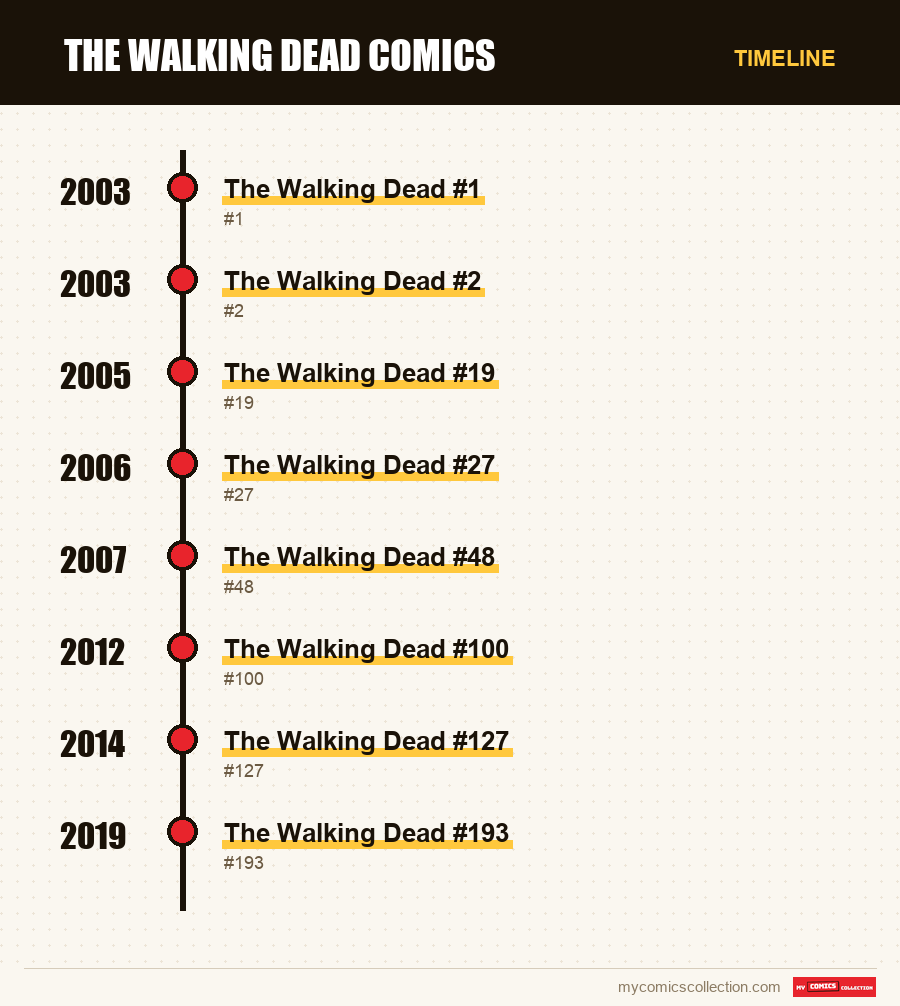
The Walking Dead #1
Première apparition de Rick Grimes , Morgan Jones , Lori , Carl and Shane. First appearance of zombies (prowlers). Drawing of Tony Moore. Tirage initial d'approximately 7 200 exemplaires: an extremely low figure which explains the current rarity. Moore's cover, showing Rick aiming his gun surrounded by zombies, has become iconic.
The Walking Dead #2
First appearance of Glenn and of Lori Grimes (full appearance). Glenn saves Rick in Atlanta. Even lower circulation than #1 because sales had dropped between the first and second issue. Paradoxically, the #2 is sometimes rarer than #1 in very high quality.
The Walking Dead #19
First appearance of Michonne, one of the franchise's most popular characters. Michonne arrives at the prison armed with her katana and accompanied by two chained zombies. Also first appearance of Governor (mentioned). The popularity of Michonne in the TV series, played by Danai Gurira, considerably boosted the rating of this issue.
The Walking Dead #27
First full appearance of Governor (Philip Blake). The first major human antagonist of TWD, whose Woodbury arc defined the "community versus community" narrative model subsequently taken up with Negan and Alpha. Season 3 of the TV series, centered on the Governor played by David Morrissey, amplified the value of this number.
The Walking Dead #48
Death of Lori and of Judith Grimes during the Governor's assault on the prison. One of the most shocking moments of the series: Lori, carrying Judith in her arms, is shot and killed by Lilly Caul, a fighter from Woodbury. This issue redefined the narrative rules of TWD by proving that even the protagonist's family was not protected.
The Walking Dead #100
First appearance of Negan and of Lucille . Death of Glenn, beaten to death by Negan in front of the group. Record mintage of more than 380,000 copies with 9 variant covers (including the Charlie Adlard wrap-around and the Ottley variant). Image Comics' best-selling issue at the time. Negan's interpretation Jeffrey Dean Morgan in the TV series from 2016 maintained the high rating.
The Walking Dead #127
Start of the two-year time jump. First appearance of Magna , Yumiko and other new characters. Beginning of the post-All Out War era, considered the "new beginning" of the series. First indirect mention of Whisperers (Whisperers). This issue marks the transition to the second major half of TWD.
The Walking Dead #193
Le surprise final number of 72 pages. No one in the industry knew TWD was going to end: not retailers, not readers, not even most of the employees at Image Comics. The issue contains a time jump of several decades, showing Carl as an adult with his daughter in a world under reconstruction. Rick, transformed into a zombie and shot dead in the previous issue, has become a legendary figure. The price of this issue jumped upon the announcement, with the first print runs selling out instantly.
The Surprise Ending: How Kirkman Fooled the Entire Industry
Le July 3, 2019, American comic shops receive their weekly delivery containing The Walking Dead #193. Nothing in the May solicitations (the Previews catalogs through which retailers place their orders two months in advance) indicated that this would be the last issue. Requests for #194, #195 and #196 had been sent normally, with synopses and dummy covers. Kirkman had even publicly discussed his plans for the #300.
When readers open #193 and discover an issue of 72 pages (instead of the usual 22) with the words "final issue" on the inside cover, the shock is total. Kirkman explains in a long text at the end of the issue that he always wanted the ending of TWD to be as unpredictable as the series itself. He felt that the arcs of the Commonwealth were beginning to stretch and that the time had come to conclude before the quality declined.
This surprise ending is a unique case in the comics industry. Never has a series of this scale (193 issues, 16 years of publication, millions of readers) ended without anyone knowing in advance. The industry was torn between admiration for the narrative masterstroke and annoyance at retailers who had been unable to order enough copies. TEA #193 sold out within a few hours in most stores.
For collectors, the surprise ending had a paradoxical effect: the first printings of #193 became instantly collectible (massive demand, standard orders), while the previous issues (#190-#192) also increased in value as the final chapters of the Rick Grimes saga. THE #192, where Rick is murdered, is particularly sought after as the penultimate issue of the series.
Did you know? Robert Kirkman revealed that only four people knew about the ending: himself, Charlie Adlard, Cliff Rathburn, and Sean Mackiewicz (his editor at Image/Skybound). Even Image Comics CEO Eric Stephenson didn't learn the news until shortly before publication. Kirkman had everyone involved in the production of the oversized issue sign confidentiality agreements.
Publication formats and special editions
The Walking Dead comes in many collectible formats, each targeting a different type of collector:
- Single issues (#1-#193): the original monthly issues, basic format for the collection.
- Trade Paperbacks (Vols. 1-32): each volume contains 6 issues. Most accessible input format.
- Hardcovers (Vols. 1-16): each volume contains 12 issues. Hardcover, better quality paper.
- Compendiums (1-4): each compendium includes 48 numbers. Compendium 1 (#1-#48) is a perennial bestseller.
- Omnibus (Vols. 1-8): premium hardback format, 24 issues per volume.
- Deluxe Edition (in color): restart in 2020 of the 193 issues in a colorized version by Dave McCaig. First time TWD has been published in color.
For pure collectors, single issues in first print remain the reference. The first issues (#1 to #10) are particularly difficult to find in high quality due to their very low initial print runs. From #100 onwards, print runs are high enough to keep CGC 9.8 copies affordable.
Tips for Building a Walking Dead Collection
If you are starting a TWD collection, here is a structured approach:
- Level 1. The fundamentals: TWD #1 (Rick Grimes), #19 (Michonne), #100 (Negan). These three issues form the basis of any serious TWD collection.
- Level 2. The major arcs: add #2 (Glenn), #27 (Governor), #48 (prison fall), #127 (A New Beginning), #193 (final issue).
- Level 3. The complete run: complete all 193 numbers. Numbers between #50 and #90 are often the most affordable and easiest to find.
The current market (2025-2026) is favorable for buyers. The post-TV series correction brought most numbers back to rational prices. The first issues (#1-#10) remain expensive but are far from their peaks of 2013-2015. This is the ideal time to put together a complete run at a reasonable price, targeting non-key numbers (#50-#90) in bulk on specialized platforms.
To efficiently manage your TWD collection number by issue, identify your missing items and monitor the evolution of values, use a application dedicated to comics collection management which integrates the complete Image Comics catalog with dynamic valuation.
Biography of Rick Grimes (The Walking Dead)
The Walking Dead is a character of Image Comics created by Robert Kirkman, Tony Moore and Charlie Adlard. His first appearance is in The Walking Dead #1 , published in October 2003.
Rick Grimes' identity sheet
- Real name: Rick Grimes (main protagonist)
- Date of birth: October 2003 (creation of the comic)
- Place of birth: Cynthiana, Kentucky, USA (Rick Grimes)
- First appearance : The Walking Dead #1 (October 2003)
- Creators: Robert Kirkman (writer), Tony Moore (original artist) and Charlie Adlard (artist from #7 to #193)
- Editor: Image Comics
- Memberships: Atlanta Survivors, Alexandria, Hilltop, Saviors
Character origins
Rick Grimes, deputy sheriff of Cynthiana, Kentucky, is shot and injured during an intervention and falls into a coma. When he wakes up in the hospital, weeks have passed and the world has fallen into a zombie apocalypse. He sets off in search of his wife Lori and son Carl, joining a group of survivors in Atlanta. The series follows the evolution of these survivors facing the threat of the undead and, above all, that of other humans.
Powers and Abilities
- No superpowers: all characters are ordinary humans
- Rick Grimes: former deputy sheriff, natural leader, firearms expert
- Post-apocalyptic survival: farming, group strategy, combat against "lurkers"
- Psychological evolution: trauma, bereavement, constant moral dilemmas
Costume and visual identity
Civilian survivalist clothing: sheriff's outfit (Rick), pastor's sweater (Gabriel), katana (Michonne), spiked baseball bat "Lucille" (Negan). Realistic universe without heroic uniforms.
Go further
- The Walking Dead Reading Guide: Singles, Compendiums and Key Arcs
- The Best Walking Dead Story Arcs: Essential Runs Ranked for Collectors
- The Best Walking Dead Comic Arcs: A Collector's Guide
- Top 10 essential Walking Dead key issues
- The Walking Dead #1 (2003): First Appearance, CGC Census & Value by Grade
- Walking Dead Comic Collection Guide: The Complete Collector's Handbook