
This is often a beginning collector's first real question: which publisher to start with? Marvel with Spider-Man and the X-Men, DC with Batman and Superman, or Image with Spawn and Walking Dead? The honest answer is there's no bad choice, but each publisher has its specifics in terms of continuity, entry prices, key issue accessibility and community.
This is often a beginning collector's first real question: which publisher to start with? Marvel with Spider-Man and the X-Men, DC with Batman and Superman, or Image with Spawn and Walking Dead? The honest answer is there's no bad choice, but each publisher has its specifics in terms of continuity, entry prices, key issue accessibility and community. This guide helps you navigate these differences to make an informed choice.
The three major publishers: quick introduction
The American comics landscape has been dominated by three publishers sharing most of the market for several decades. Each has a distinct identity, different history and particular relationship with its collectors:
- Marvel Comics: founded 1939 (Timely Comics), market leader since the 60s. Universe centered on "human" heroes with flaws: Spider-Man, X-Men, Avengers, Daredevil.
- DC Comics: founded 1934, home of the first modern superheroes. Archetype universe: Superman, Batman, Wonder Woman, Flash, Green Lantern.
- Image Comics: founded 1992 by Marvel-dissident artists, oriented toward independent properties. Spawn, Walking Dead, Saga, Invincible.
Marvel Comics: the universe of popular heroes
Marvel is the publisher benefiting most directly from the MCU effect since 2008. Every film announcement propels affected characters' first appearances. It's both an opportunity (key issues are easy to identify) and a risk (speculative prices can be high).
Strong points for a beginner
- Accessible continuity: many modern Marvel series read well standalone. Jason Aaron's Thor, Donny Cates's Venom, Tom King's Captain America don't require encyclopedic universe knowledge.
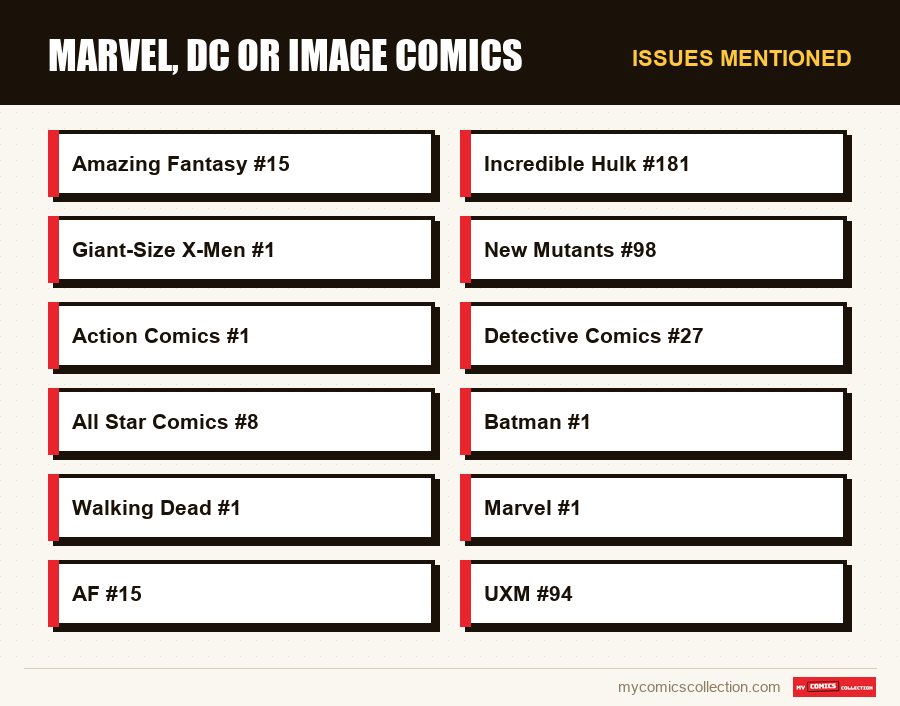
- Well-documented key issues: Marvel first appearances are among the most studied and referenced in the market. GoCollect, CGC Census, Overstreet guides: everyone knows Amazing Fantasy #15 or Incredible Hulk #181.
- Massive community: the largest collector community, both in English and other languages.
Limitations
Main drawback: Marvel's most important key issues are also the most expensive. Amazing Fantasy #15, Giant-Size X-Men #1, New Mutants #98: prices can quickly become prohibitive for a limited budget. Modern variants also multiply at a pace that can discourage collectors wanting to "have it all."
DC Comics: the house of legends
DC Comics is the founders' publisher: the first costumed superheroes were published at DC: Superman (Action Comics #1, 1938), Batman (Detective Comics #27, 1939), Wonder Woman (All Star Comics #8, 1941). This seniority translates into key issues among the most valued in the world, but also continuity sometimes complex to navigate.
Strong points
- History rich in foundational key issues: DC Golden Age comics are the most precious in the world for high-grade pieces
- Exceptional author runs: Frank Miller's Batman: Year One and Dark Knight Returns, Alan Moore's Watchmen, Neil Gaiman's Sandman are autonomous works accessible to any reader
- Historical crossovers: Crisis on Infinite Earths, Blackest Night, Knightfall: well-documented events with clearly identified key issues
Limitations
DC has had several continuity reboots (Crisis, New 52, Rebirth, Dawn of DC) that can disorient new collectors. Where to start? Detective Comics #27 or Batman #1 from 2016? The answer depends on your angle: patrimonial collection or current reading.
Image Comics: the independent revolution
Image Comics was born from a rupture: in 1992, seven of Marvel's most popular artists (Todd McFarlane (Spider-Man), Jim Lee (X-Men), Rob Liefeld (X-Force), Erik Larsen (Amazing Spider-Man) and three others) left Marvel to found their own publisher. Their demand: keep intellectual property of their creations.
The Image model is fundamentally different: each series belongs to its author, not the publisher. This produces works like Walking Dead by Robert Kirkman, Saga by Brian K. Vaughan and Fiona Staples, Invincible by Kirkman again, or Lazarus by Greg Rucka: coherent universes where the creator controls everything A to Z.
Why Image is ideal for some beginners
If you don't like the complex continuity of Marvel and DC's shared universes, Image is liberating. Each series stands on its own. You can start Walking Dead #1 without knowing anything about the rest of Image. Runs are finished (Walking Dead ended at #193) or ongoing but self-contained.
Key tip: Image Comics have initial print runs often lower than Marvel or DC, making some first issues mechanically rare. Walking Dead #1 had an estimated initial print run of 7,500 copies, much less than an equivalent Marvel #1. This partly explains the high valuation of some Image key issues.
Collecting this series?
Track what you own, what you are missing and what your collection is worth. 7 day trial.
Start my trial →Comparison: prices, key issues and accessibility
| Criterion | Marvel | DC | Image |
|---|---|---|---|
| Average entry price (Modern Age) | $5-15 per issue | $5-15 per issue | $3-10 per issue |
| Most famous key issues | AF #15, UXM #94, New Mutants #98, ASM #300 | Action Comics #1, Detective #27, Batman #1 (1940) | Spawn #1, Walking Dead #1, Saga #1, Invincible #1 |
| Continuity difficulty | Medium to high | High (multiple reboots) | Low (independent series) |
| Number of active series | 80-120+ | 60-90+ | 40-70+ |
| English-speaking community | Very active | Active | Growing |
Which publisher to start with based on your profile?
You grew up with MCU films
Start with Marvel. Identify your favorite MCU character and look for his or her first appearance in comics. Spider-Man fan? Amazing Fantasy #15 and Amazing Spider-Man #1. Iron Man? Tales of Suspense #39. These first issues are expensive in high grade but accessible raw to start.
You love classic archetypes and foundational works
DC is for you. Start with autonomous author runs: Batman Year One (#404-407), Dark Knight Returns, Watchmen, Sandman. These works read without prior knowledge and are available in accessible TPB.
You want long coherent stories without heavy continuity
Image Comics is ideal. Walking Dead, Saga, Invincible: three long series, complete or well advanced, readable end to end. The #1s of these series are also good investments.
You want to invest intelligently from the start
Check our guide on investing in comics before deciding. Investment logic applies differently by publisher: Marvel key issues are most liquid, DC Golden Age key issues are rarest, and Image still offers opportunities at accessible prices.
FAQ, Marvel, DC or Image?
Track your collection, whatever the publisher
My Comics Collection lets you catalog your Marvel, DC and Image comics in one place, track each issue's value and identify key issues in your collection.
Try freeNo commitment · Instant access · See pricing