The best budget entry points for The Walking Dead: #19 (first Michonne, €15-25), #27 (first Governor, €10-20), and issues #50-193 regularly found at €2-5 each. The complete series in 193 issues is a realistic goal for a moderate budget.
Robert Kirkman's The Walking Dead is one of the few modern independent comics to achieve global cultural status through the television series. Published by Image Comics from 2003 to 2019, the title has exactly 193 issues: one finished run, which makes it a concrete and achievable collection goal.
If #1 (2003) exploded in value after the success of the TV series, the majority of the 193 issues remain very affordable. The end of the TV series even caused a slight drop in prices, creating a window of opportunity for patient collectors.
Affordable Walking Dead key issues
Walking Dead #1 (first printing) is worth thousands, but later reprints and key issues offer excellent entry points. The first appearances of popular characters from the TV series are the most sought after.
Key numbers under €25
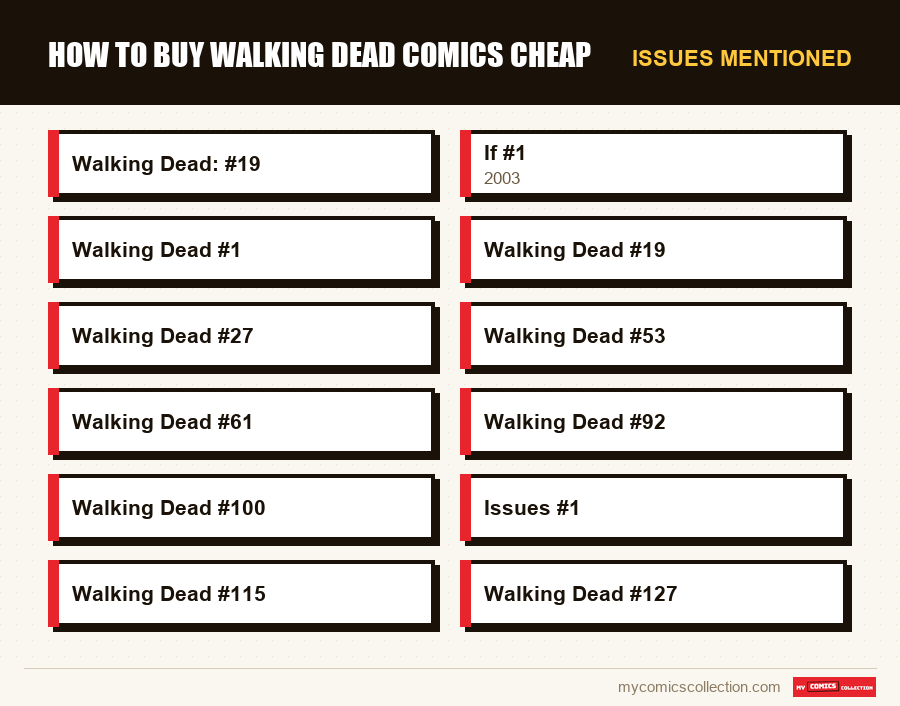
- Walking Dead #19 (first Michonne): €15-25 in mid-grade
- Walking Dead #27 (first Governor): €10-20
- Walking Dead #53 (first Abraham): €8-15
- Walking Dead #61 (first Gabriel): €5-10
- Walking Dead #92 (first Jesus): €8-15
- Walking Dead #100 (first Negan, death of Glenn): €10-20
Check out our complete guide to Walking Dead key issues for all the first appearances and pivotal moments of the series.
Underrated Runs to Grab
The second half of the series (#100-193) is significantly less expensive than the first. Circulations increased with TV popularity, making these issues very common in the secondary market.
Particularly accessible periods
- #50-99: quality pivotal period, €3-6 per issue
- #101-150: Negan arc and beyond, €2-4 per issue
- #151-193: last part, €2-3 per issue, often in batches
- Issues #1 (reprints): multiple reissues are available at €5-15
Where to find Walking Dead cheap in France
Walking Dead was published in VF by Delcourt in albums, but the VO single issues are easily found in France thanks to the popularity of the franchise.
- eBay.com: lots of 20-50 VO numbers regularly under €60
- Comic conventions: specialized Image sellers with large stocks
- Leboncoin: complete or almost complete collections after the end of the TV series
- Facebook Groups: frequent post-TV series fan resales
Budget strategy for Walking Dead
The major advantage of Walking Dead is that the series is over. No number to watch for every month, no FOMO: you can build up the entire run at your own pace by watching for good deals.
Advice : Buy in batches first to cover common issues (#50-193), then complete key issues individually. A lot #100-193 often trades for under €100. The first issues (#2-18) are the most expensive individually: save them for last and watch for bargains at conventions.
Variants and special editions under €20
- Walking Dead #100 (Ottley variant): €8-15 depending on the coverage
- Walking Dead #115 (multiple variants): €3-6 each
- Walking Dead #127 (beginning of “A New Beginning”): €3-6
- Walking Dead #163 (Michonne homage variant): €4-8
- Walking Dead #193 (last issue, surprise): €5-12
#193 (last issue, announced without notice by Kirkman) is a natural collector's item which remains affordable thanks to the publisher's last minute printings.
Complete your Walking Dead run without forgetting
193 numbers is an achievable goal: as long as you know exactly which ones you're missing. My Comics Collection identifies your holes in an instant.
🚀 Free trial 7 days, No obligationReading, checking and storing your Walking Dead run
Once you have the list of key issues, three habits help you avoid unpleasant surprises on a 193-issue run.
Reading landmarks. Robert Kirkman's series tells its story in a straight line: you simply read in order, from #1 (October 2003) to #193 (July 2019). Tony Moore draws the first six issues, then Charlie Adlard takes over from #7 and draws the series to the end. The change of artist is therefore a handy landmark for splitting the read into major periods. The interior pages are in black and white, which sometimes surprises readers who came from the TV show but is part of the series' identity.
Checking each copy. On a title that has been reprinted so often, the first question is always: which printing is it? The early issues went through several reprints, and these state their printing number (for example "second printing") on the cover or in the indicia. Read these notes before buying an early issue sold as a first printing. For a lot, ask for photos of several covers and a few spines: a lot of 50 issues with clean spines is a good sign of consistent storage.
Inspecting condition on arrival. A comic that is black and white inside is still sensitive to humidity and paper yellowing. Flip through each issue, make sure the pages are complete and the staples are not rusty, then slide it into a suitable bag with a backing board. Note the issue number and condition as soon as it arrives: with 193 issues, a tracking sheet prevents buying the same one twice.
Think about collected editions. If your goal is to read more than to collect, the series is also available in collected volumes: 32 volumes in the original edition. They let you discover the story before investing in individual issues, then choose with full knowledge which arcs you want to own as single issues.
A four-step plan. First, lots of the common issues to build the structure of the run. Next, the first appearances listed above, one by one. Then #2 to #18, more expensive individually, bought when the opportunity arises. Finally the variants, which are chosen by taste rather than necessity. This order ensures every purchase brings the run closer to completion instead of scattering your money across isolated issues.
Frequently asked questions
The series runs for exactly 193 issues, published by Image Comics from 2003 to 2019. Because the run is finished, it is a concrete collecting goal: there is no new issue to chase every month.
The most affordable entry points are #19 (first Michonne), #27 (first Governor), #53 (first Abraham), #61 (first Gabriel), #92 (first Jesus) and #100 (first Negan, Glenn's death). These are first appearances of popular characters from the TV show.
Yes. Print runs grew with the popularity of the TV series, so #100 to #193 are very common on the secondary market and often sold in lots. The earliest issues (#2 to #18) are the most expensive individually.
Start with lots to cover the common issues (#50 to #193), then fill in the key issues one by one. Keep the early issues for last and watch for good deals at conventions.
Yes, Walking Dead was published in French by Delcourt, in album format. The original-language single issues are still easy to find in France thanks to the franchise's popularity.