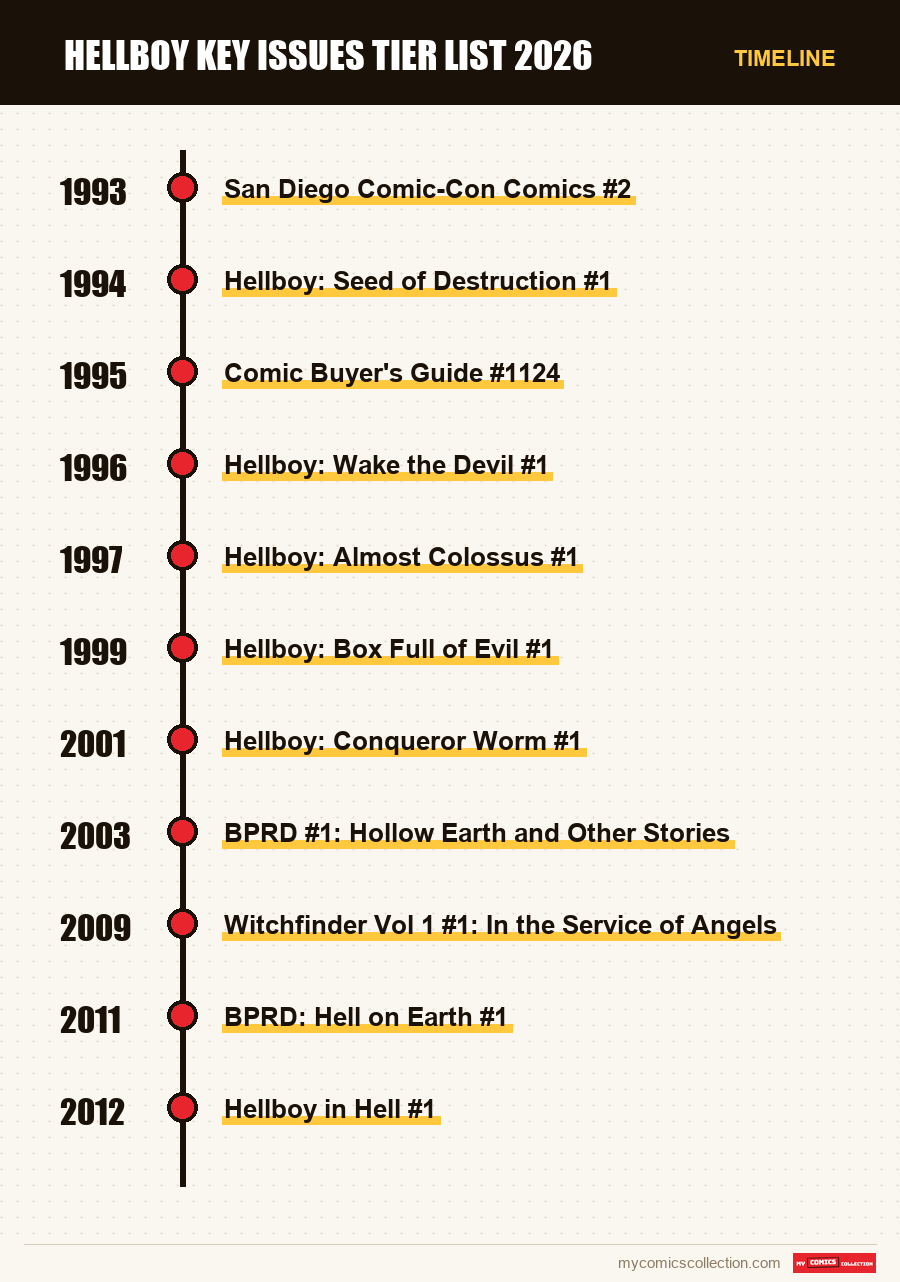
La tier list Hellboy 2026 places four pieces in Tier S blue-chip: San Diego Comic-Con Comics #2 (August 1993, Dark Horse, first Hellboy preview appearance by Mike Mignola), Hellboy: Seed of Destruction #1 (March 1994, Mike Mignola/John Byrne, first four-issue miniseries), Hellboy: Wake the Devil #1 (June 1996, Mike Mignola, second mini founder) and Hellboy: Conqueror Worm #1 (May 2001, Mike Mignola, narrative peak of the run). Tier A includes Hellboy: Almost Colossus #1 (June 1997), The Right Hand of Doom trade paperback (1998), BPRD #1 (March 2003, Mignola/Guy Davis, ongoing start of the spin-off) and Hellboy in Hell #1 (November 2012, Mignola solo in full mastery). Tier B lines up the sleepers Comic Buyer's Guide #1124, Box Full of Evil , Witchfinder Vol 1 #1 and BPRD: Hell on Earth #1. Tier C covers the 2026-2027 spec around the film Hellboy: The Crooked Man (October 2024) and Hellboy Universe TV projects.
Thirty-three years after the creation of Hellboy by Mike Mignola, the scarlet demon with the stone right hand remains the absolute icon of Dark Horse Comics and one of the most singular figures of the American independent landscape. The mapping of the Hellboy market is paradoxical: the character enjoys worldwide popular notoriety (two film trilogies, a new 2024 adaptation, around a hundred serial spin-offs), but his key issues are collected in a relatively narrow niche compared to the Marvel or DC universes. This tier list Hellboy key issues 2026 aims to prioritize the pieces according to rarity-demand-budget ratio, integrating the Dark Horse specificity (moderate print runs, absence of constant numbered relaunch, closed-structure mini-series) and the 2026-2030 spec windows around the potential Hellboy Universe TV.
The methodology uses the grid applied to the blog's other tier lists: Tier S for the central blue-chip pieces (preview exclusive convention, first mini, first ongoing of the spin-off, Mignola narrative summit), Tier A for the underestimated major key issues, Tier B for the latent catalyst sleepers, Tier C for the spec bets with careful sizing. Each tier details the price ranges observed in May 2026 on Heritage Auctions, GoCollect and eBay sold listings, as well as the pitfalls specific to the Hellboy market: con-exclusive distribution of San Diego Comic-Con Comics #2, multiplicity of Hellboy mini-series with repeated #1 numbering, distinction between ongoing Hellboy and BPRD/Witchfinder/Lobster Johnson spin-offs. This tier list constitutes a hub of the cluster strategy pillar comics investment 2027.
Tier list methodology Hellboy 2026
The Hellboy tier list is based on four weighted criteria, identical to those applied to the other universes covered on the blog, but adjusted to the Dark Horse specificity. The first criterion is the narrative significance: a first preview appearance weighs more than an anniversary issue, a founding mini-series weighs more than a crossover guest spot, a narrative paradigm shift (Hellboy Descends into Hell in 2012) weighs more than a simple continuation of a run. The second criterion is the objective rarity measured by the CGC census and the Dark Horse circulation: a comic with less than 300 copies in CGC 9.6 or higher falls into the scarce category, which justifies a higher tier. The third criterion is the market demand assessed by quarterly transaction volume on eBay and Heritage. The fourth criterion is the future catalyst, which covers movie announcements, streaming TV series, video game projects and round anniversaries.
The weighting differs depending on the tier targeted. For Tier S, narrative significance accounts for 40% of the decision, rarity for 25%, demand for 25%, catalyst for 10%. A Tier S part must check three of the four criteria at the maximum level. For Tier A, the weighting is balanced around 30% each, with a tolerance on the catalyst. For Tier B, the catalyst rises to 35% because the sleeper logic is based on an expected asymmetry: little demand today, but a narrative or audiovisual trigger identified at 18-36 months. For Tier C, the catalyst rises to 50%: it is a spec bet whose current intrinsic value is low and whose potential depends exclusively on unconfirmed future events.
The Hellboy market presents three strong specificities compared to Marvel or DC. First specificity: the structure of Dark Horse publications. Unlike Marvel or DC which favor ongoing series with continuous numbering, Mike Mignola structured Hellboy in successive standalone miniseries (Seed of Destruction 4 issues, Wake the Devil 5 issues, The Chained Coffin one-shot, Almost Colossus 2 issues, Conqueror Worm 4 issues, etc.). This structure facilitates the complete collection but multiplies the founding #1s: Seed of Destruction #1, Wake the Devil #1, Conqueror Worm #1, Hellboy in Hell #1 are all distinct key issues, where a Marvel series concentrates the value on a single ongoing #1.
Second specificity: the Dark Horse cast 1993-1995. The first Hellboy appearances occurred at a time when Dark Horse was still a young publisher (founded in 1986 by Mike Richardson), with a less dense distribution network than Marvel or DC. The initial print run of San Diego Comic-Con Comics #2 (August 1993) is estimated between 5,000 and 8,000 copies, distributed mainly during the San Diego convention. This native distributive scarcity justifies the major Tier S premium on this coin. For publisher context, see History of Dark Horse Comics.
Third specificity: the creative tutelage Mike Mignola. Unlike most Marvel or DC franchises where the original writer is quickly replaced, Mignola retained full editorial control of Hellboy for three decades, writing and drawing the majority of the canon arcs himself. This authorial stability concentrates the value on the pieces where Mignola is credited as full writer-artist (Wake the Devil, Conqueror Worm, Hellboy in Hell) rather than on the episodes where he delegates to other artists. The pure Mignola signature is a rating argument independent of other criteria. For biographical detail, see story by Mike Mignola author.
The grid finally integrates the context Hellboy Universe 2024-2026 . The movie Hellboy: The Crooked Man released in October 2024, directed by Brian Taylor with Jack Kesy in the title role, enjoyed modest critical and commercial reception, with no major effect on the ratings of canonical key issues. Persistent rumors of a Hellboy Universe television series in development on several streaming platforms constitute the main catalyst for 2026-2028. For the complete tier prioritization method, see Hellboy key numbers which details each piece individually with its own rating ranges.
Tier S Hellboy: the four central blue-chip pillars
Tier S Hellboy brings together four pieces and only four. This discipline is central: an inflated Tier S loses its prioritization function. These four pieces form the foundation of any serious Hellboy collection, in chronological order of narrative and financial importance. Each ticks at least three of the four criteria at the maximum level.
San Diego Comic-Con Comics #2 (August 1993)
San Diego Comic-Con Comics #2 from August 1993 published by Dark Horse contains the Hellboy's very first preview appearance, drawn and written by Mike Mignola in a short story of a few pages. This number is the functional equivalent of a Amazing Fantasy #15 for Spider-Man or a Detective Comics #27 for Batman: this is the absolute canonical origin piece, to which the entire franchise refers as moment zero. The cover already shows Hellboy with his straight stone hand, stocky figure and signature trench coat, a sign that the visual identity is locked in by design.
The con-exclusive distribution during San Diego Comic-Con 1993 drastically limits the circulation: estimates between 5,000 and 8,000 copies in total, a significant fraction of which is consumed by readers without entering collection circulation. The CGC May 2026 census lists fewer than 220 CGC 9.8 copies and around 380 CGC 9.6 copies across all labels, making it one of the rarest modern previews of the classic Dark Horse. The May 2026 ranges: CGC 9.8 between 800 and 1,200 euros, CGC 9.6 between 380 and 580, CGC 9.4 between 180 and 280, CGC 9.0 between 100 and 160, raw NM between 45 and 90 euros. Heritage 2024-2026 sales confirm an upward trajectory of 18 to 25% per year for grades CGC 9.6 and above.
The trap San Diego Comic-Con Comics #2 is here confusion with other early Hellboy appearances. Several marketplace sources mention Comic Buyer's Guide #1024 (1993) as "first appearance", which is incorrect: CBG #1024 contains advance promotional notice but not a complete sequential story. The canonical appearance recorded by the CGC and online collaborative databases remains the SDCC Comics #2 from August 1993. Always check the CGC label to confirm identification: the words “1st Hellboy preview” appear on the May 2026 labels. For the full narrative profile, see history of Hellboy in the comics.
Hellboy: Seed of Destruction #1 (March 1994)
Hellboy: Seed of Destruction #1 from March 1994 launches first official mini-series dedicated to the character in four issues. Mike Mignola writes and draws the majority, John Byrne writes the complete screenplay in collaboration. Mignola's cover shows Hellboy facing the camera, circular saw in his right hand, on a blood-red background: this is the cover image that will define Hellboy's visual branding for the next twenty years. This mini introduces the complete origin story of the character (Nazi ritual, supernatural ascension, adoption by Professor Bruttenholm, BPRD mission) and lays the mythological foundations that Mignola will exploit for three decades.
The Mignola/Byrne collaboration remains a lasting argument: Byrne is one of the major Marvel and DC architects (X-Men Claremont/Byrne, Fantastic Four post-Lee, Superman 1986), and his narrative support gives the Hellboy launch immediate editorial credibility. The commercial success exceeds Dark Horse predictions and triggers subsequent mini-series. The May 2026 ranges: CGC 9.8 between 250 and 400 euros, CGC 9.6 between 130 and 200, CGC 9.4 between 70 and 110, CGC 9.0 between 40 and 65, raw NM between 22 and 40 euros. The 2024-2026 increase is estimated at 22 to 32% on CGC grades 9.6 and above, driven by continued interest in the Hellboy Universe.
The trap Seed of Destruction #1 concerns reprints and trade paperback. Faced with success, Dark Horse reprinted #1 several times between 1994 and 1997, and compiled the complete arc in Hellboy: Seed of Destruction trade paperback from 1994. Second print copies have a similar cover but are marked “second printing” on the first inside page and have a value 6 to 10 times lower than the first print. The trade paperback compiles all four issues and has no individual spec value. Systematically check the print reference. This part is complementary to the other Tier S and is found in Hellboy key numbers.
Hellboy: Wake the Devil #1 (June 1996)
Hellboy: Wake the Devil #1 from June 1996 launches second Hellboy miniseries in five issues, entirely written and drawn by Mike Mignola alone. This mini delves deeper into Hellboy mythology: Hecate, Rasputin, the resurrection of Vladimir Giurescu, the vampires of Romania. It is in Wake the Devil that Mignola definitively establishes the visual signature that will define the franchise: massive black areas, architectural compositions, Eastern European folkloric references, laconic dialogues. This signature makes it an essential piece for collectors targeting pure Mignola.
Cover #1 shows Hellboy in a tight shot, under an Orthodox cross in the background, in a minimalist style that contrasts radically with the Marvel/DC aesthetic of the 90s over-saturated with effects. This visual singularity contributed to the rapid identification of the Hellboy label as a qualitative alternative to mainstream superheroes. The May 2026 ranges: CGC 9.8 between 160 and 250 euros, CGC 9.6 between 85 and 130, CGC 9.4 between 45 and 75, raw NM between 18 and 32 euros. The rating remained stable between 2020 and 2023 then accelerated in 2024-2025 with the release of the film Hellboy: The Crooked Man which reactivated mainstream interest in the franchise.
The trap Wake the Devil #1 is here confusion with the hardcover collected. Dark Horse published the complete arc in hardcover in 1997, then in multiple trade paperback reprints. Beginning collectors sometimes confuse the hardcover with a floppy first print. Check the physical format (comic floppy 32 pages, stapled, softcover) and the publication date June 1996. For technical distinctions between floppies and collected editions Dark Horse, see History of Dark Horse Comics.
Hellboy: Conqueror Worm #1 (May 2001)
Hellboy: Conqueror Worm #1 of May 2001 launches the four-issue mini-series that critics unanimously consider to be the narrative peak of the classic Mignola run. Mignola writes and draws entirely solo. The arc adapts elements from Edgar Allan Poe (the title comes from the poem The Conqueror Worm) and introduces the fallout from the Rasputin trilogy while laying the mythological foundations of the final Hellboy act. It's in Conqueror Worm that Hellboy explicitly abandons the BPRD to enter his solo phase, which constitutes a major narrative pivot of the franchise.
The cover shows Hellboy with a giant skull in the background, in a cosmic-horror composition that announces the franchise's Lovecraftian turn. The May 2026 ranges: CGC 9.8 between 110 and 180 euros, CGC 9.6 between 60 and 95, CGC 9.4 between 32 and 55, raw NM between 14 and 25 euros. The rating is driven by two distinct factors: the critical recognition of the arc as a modern classic, and the CGC 9.8 rarity due to difficult conservation (dark cover, massive Mignola inking easily damaged). The CGC May 2026 census lists fewer than 280 CGC 9.8 copies.
The trap Conqueror Worm #1 is here confusion with Hellboy: Box Full of Evil #1 (1999) which lays some similar narrative foundations without having the same canonical status. Conqueror Worm is the mini which consecrates the pivot, Box Full of Evil remains a Tier B precursor. Check the date (May 2001) and exact subtitle. This piece constitutes the fourth Tier S pillar and completes the blue-chip mapping of the founding Mignola-era mini-series. For modern spec context on premium Dark Horse, see modern comics invest 2020-2026.
Tier A Hellboy: the four major underestimated key issues
Tier A Hellboy brings together four pieces which would sometimes deserve Tier S but which the more accessible rarity or the slightly secondary narrative significance places at the level just below. These four issues should be in any Hellboy collection beyond beginner level. Their ranges remain accessible to intermediate budgets and offer a favorable significance/cost ratio.
Hellboy: Almost Colossus #1 (June 1997)
Hellboy: Almost Colossus #1 from June 1997 launches the two-issue mini-series which serves as a narrative bridge between Wake the Devil and later arcs. Mike Mignola writes and draws solo. The mini develops the consequences of Wake the Devil on the character of Elizabeth Sherman, one of the major pyrokinetics of the BPRD, and establishes the group dynamic which will structure the spin-off ongoing 2003. This piece is often neglected by beginning collectors because its short format (only 2 issues) makes it pass for a minor side-arc, while it constitutes an important narrative level.
The May 2026 ranges: CGC 9.8 between 95 and 150 euros, CGC 9.6 between 50 and 85, CGC 9.4 between 28 and 45, raw NM between 12 and 22 euros. The rarity in high grade is notable: less than 200 CGC 9.8 copies recorded in the May 2026 census, which justifies the relative premium compared to CGC 9.6. The trap Almost Colossus #1 concerns distinction first print vs second print: Dark Horse reprinted in November 1997 in the face of success. Second print copies are identifiable by the mention on the first inside page and are worth 4 to 6 times less. For issue-by-issue details of the Hellboy mini-series, see Hellboy key numbers.
Hellboy: The Right Hand of Doom (1998 collected)
Hellboy: The Right Hand of Doom published in 1998 is the fourth volume of the Hellboy collected editions bringing together the one-shots and short stories published in various Dark Horse anthologies between 1996 and 1998. This piece is atypical in the Tier A list: it is a trade paperback collected and not an individual floppy, but its narrative significance warrants inclusion. The volume compiles The Wolves of Saint August , The Right Hand of Doom (eponymous title), Almost Colossus, and several one-shots that structure the Hellboy mythology in an essential way.
The May 2026 ranges on the first print Dark Horse 1998 (specific Mignola cover): CGC 9.8 between 75 and 120 euros, raw NM between 25 and 45 euros. The rating of the trade paperback first print Hellboy benefits from the complete collection: any serious collector who wants to cover the entire Mignola-era must own this volume. The CGC rarity on trade paperback is by nature limited (few collectors slap TPBs), which makes high grade CGC copies particularly rare. The trap Right Hand of Doom is there multiplicity of reprints Dark Horse (at least six between 1998 and 2024). Only the 1998 first print has a significant spec value.
BPRD #1 (March 2003): Hollow Earth and Other Stories
BPRD #1 from March 2003, subtitled Hollow Earth and Other Stories , launch it first ongoing spin-off of the Hellboy universe dedicated to the Bureau for Paranormal Research and Defense. Mike Mignola writes, Brian McDonald co-writes, Ryan Sook draws the first mini before the lasting takeover by Guy Davis from the second mini (2003-2004). This issue laid the foundation for an expanded universe that would produce over 200 BPRD issues between 2003 and 2018, creating the Hellboy Universe ecosystem that Mignola methodically built.
The Mignola cover of #1 shows Abe Sapien and Liz Sherman in the center, without Hellboy: a sign of the spin-off's narrative empowerment. The May 2026 ranges: CGC 9.8 between 65 and 110 euros, CGC 9.6 between 35 and 55, raw NM between 12 and 22 euros. The rating is driven by rumors of a potential BPRD TV series as part of a Hellboy Universe streaming, which would make the spin-off a natural audiovisual entry point for the characters Abe Sapien and Liz Sherman. The trap BPRD #1 concerns distinction from earlier BPRD miniseries: Dark Horse published several BPRD miniseries between 2002 and 2003 before the ongoing launch. The Tier A piece is ongoing #1 from March 2003, not the mini prerequisites. For full BPRD detail, see BPRD key numbers.
Hellboy in Hell #1 (November 2012)
Hellboy in Hell #1 of November 2012 marks the Mike Mignola returns to drawing Hellboy after a decade during which he had delegated the majority of the art pages to Duncan Fegredo and Richard Corben. Mignola writes and draws this new mini-series solo which follows Hellboy after his apparent death at the end of The Storm and the Fury (2011). The arc takes place entirely in Hell and allows Mignola to harness his accumulated visual mastery to deliver what many consider his late masterpiece.
The cover shows Hellboy from behind descending an infernal staircase, in a refined composition characteristic of Mignola's graphic maturity. The May 2026 ranges: CGC 9.8 between 55 and 95 euros, CGC 9.6 between 28 and 48, raw NM between 10 and 18 euros. The rating has risen steadily since 2020, driven by the growing critical recognition of the arc Hellboy in Hell as the summit of the Mignola-era. The trap Hellboy in Hell #1 concerns the variant cover Dave Stewart published simultaneously, whose value is slightly higher (CGC 9.8 between 75 and 130 euros) but which regularly creates confusion on marketplaces. Check the artist credit on the CGC label.
Tier B Hellboy: sleepers with high potential
Tier B Hellboy brings together four sleepers whose current rating remains accessible but whose latent catalysts (early Hellboy magazine, rare anthology, first spin-off transformed into a regular series, major editorial event) justify a measured exposure in a diversified collection. These pieces are not major at the beginner level but become strategic beyond the intermediate portfolio.
Comic Buyer's Guide #1124 (May 1995)
Comic Buyer's Guide #1124 from May 1995 contains a Hellboy cover by Mike Mignola and an in-depth report on the franchise as it has just completed its first mini-series. This piece is not a sequential story but a professional magazine devoted to the comics industry, which at the time was the main source of information before the expansion of the internet. The Mignola cover exclusively for CBG has become a collector's item for Hellboy completionists, with a niche recognized by advanced buyers.
The ranges May 2026: raw VF/NM between 25 and 50 euros, very rare CGC copies (less than 40 listed, all labels). The trap CBG #1124 is here difficult to preserve: the large-format magazine format yellows quickly and the corners bend easily. Favor copies preserved in rigid storage boxes. The price doubled between 2022 and 2026, driven by the absolute rarity and completeness of the Hellboy collection. Spec position to be scaled carefully, without exceeding 4% of the total Hellboy budget.
Hellboy: Box Full of Evil #1 (August 1999)
Hellboy: Box Full of Evil #1 from August 1999 launched a two-issue miniseries that served as a precursor to Conqueror Worm by posing certain narrative elements (infernal ritual, first manifestations of the Anung Un Rama lineage, return of the Nazi themes of Seed of Destruction). Mike Mignola writes and draws solo. The mini is often overlooked because it falls between two major narrative peaks (Wake the Devil 1996, Conqueror Worm 2001) but it contains elements that will resonate lastingly in the Hellboy canon.
The May 2026 ranges: CGC 9.8 between 65 and 110 euros, CGC 9.6 between 32 and 55, raw NM between 14 and 22 euros. The rating increased from 35 to 45% between 2023 and 2025, driven by the recent critical recognition of this mini as a major milestone of the Mignola-era. The trap Box Full of Evil #1 is here confusion with the hardcover collected published in 2001 by Dark Horse. Check the 32-page stapled floppy format. This room remains accessible to intermediate budgets while offering real sleeper potential.
Witchfinder Vol 1 #1 (October 2009): In the Service of Angels
Witchfinder Vol 1 #1 from October 2009, subtitled In the Service of Angels , launch it Witchfinder spin-off which follows Sir Edward Grey, occult agent of the Victorian British crown and peripheral figure in the Hellboy mythology. Mike Mignola writes the script, Ben Stenbeck draws. This spin-off expands the Hellboy universe towards the Victorian period and lays the foundations of a parallel historical mythology which multiplies the narrative ramifications. The four-issue mini will be followed by several other Witchfinder miniseries that cement the spin-off as a separate franchise.
The May 2026 ranges: CGC 9.8 between 45 and 75 euros, CGC 9.6 between 22 and 38, raw NM between 10 and 18 euros. The rating is driven by rumors of a potential Witchfinder TV series as part of the Hellboy Universe streaming, which could position the character Edward Gray as a separate headliner. The trap Witchfinder Vol 1 #1 is here multiplication of later Witchfinder #1 (Lost and Gone Forever 2011, The Mysteries of Unland 2014, City of the Dead 2016, etc.). Only Vol 1 #1 from 2009 has founding value. Check the date and subtitle.
BPRD: Hell on Earth #1 (May 2011)
BPRD: Hell on Earth #1 of May 2011 marks the major relaunch of spin-off BPRD in the post-apocalyptic context of the expanded Hellboy Universe. Mike Mignola and John Arcudi write, James Harren draws. This issue opens an editorial phase of 140 issues (until 2017) which completely restructures the BPRD and establishes the cosmic-apocalyptic themes which will dominate the last decade of the Hellboy universe. This is an important narrative pivot often underestimated by collectors who focus on the Hellboy core.
The May 2026 ranges: CGC 9.8 between 35 and 60 euros, CGC 9.6 between 18 and 30, raw NM between 8 and 14 euros. The rating has remained stable since 2020, with no immediate catalyst but with real sleeper potential if a BPRD-Hell on Earth TV series materializes. The trap Hell on Earth #1 is the identification of the editorial phase: the BPRD had several sub-series between 2003 and 2018 (Plague of Frogs, War on Frogs, Hell on Earth, The Devil You Know). Check the exact subtitle to confirm that this is #1 Hell on Earth from May 2011. For the full BPRD mapping, see BPRD key numbers.
Collecting this series?
Track what you own, what you are missing and what your collection is worth. 7 day trial.
Start my trial →Tier C Hellboy: 2026-2027 spec and Hellboy Universe catalysts
Tier C Hellboy covers spec bets related to current or rumored film and television projects surrounding the character. This tier is explicitly speculative: the current intrinsic value is low, the potential depends on announcements and castings whose materialization remains uncertain. Allocating more than 8 to 12% of the total Hellboy budget to this tier constitutes an excessive risk given the historical fragility of Hellboy adapted projects.
The first catalyst is the delayed reception of the film Hellboy: The Crooked Man released in October 2024 and directed by Brian Taylor. The film, more faithful to the folk-horror tone of the original comic than the 2004 and 2008 Del Toro adaptations, had a mixed critical reception and modest commercial results in theaters. Its streaming and home video life cycle 2025-2026 could nevertheless gradually reactivate general public interest and create moderate windows of revaluation on canonical key issues. The source comic Hellboy: The Crooked Man mini-series in three issues published 2008-2009 (Mignola/Richard Corben) saw its rating increase from 60 to 80% between 2023 and 2025 in anticipation of the film. The May 2026 ranges on #1: CGC 9.8 between 75 and 120 euros, CGC 9.6 between 38 and 60.
The second catalyst, more structuring in the medium term, is the persistent rumor of a Hellboy Universe TV series in development on several streaming platforms. At the time of writing (May 2026), no official announcement has been confirmed, but recurring production leaks suggest active discussions between Dark Horse Entertainment, Mike Mignola and premium platforms. An official confirmation would probably trigger a revaluation of 30 to 50% on Tier S and Tier A in 12-18 months. The discipline consists of not anticipating before confirmation and maintaining dedicated spec cash to capture the post-announcement window.
The third catalyst concerns spin-offs candidates for adaptation. If Hellboy Universe streaming comes to fruition, the spin-offs BPRD, Witchfinder, Lobster Johnson, Sir Edward Gray will become the first beneficiaries of subsequent spec windows. The founding key issues of these spin-offs (BPRD #1 March 2003 already in Tier A, Witchfinder Vol 1 #1 already in Tier B, Lobster Johnson #1 January 2012 at around 40 euros CGC 9.8) constitute spec positions with progressive sizing.
The fourth catalyst is 35th birthday Hellboy in 2028. Dark Horse editorial anniversaries traditionally generate commemorative relaunchs, variant tributes and a surge of interest in the original arcs. Mike Mignola has already publicly discussed the possibility of a new Hellboy arc in 2028 to celebrate the 35th anniversary. If this arc comes to fruition with an exclusive Mignola cover, the price of the 1993-2001 originals can accelerate by 25-40% over 12-18 months. Monitor Dark Horse communications and Mignola convention interviews 2026-2027.
Tier C spec key issues to watch in 2026-2027 include Hellboy: The Crooked Man #1 (December 2008, mini Mignola/Corben), Lobster Johnson: The Iron Prometheus #1 (October 2007, mini spin-off founder), Sir Edward Grey: Witchfinder later miniseries, and Abe Sapien: Drums of the Dead #1 (2008, mini founder of the spin-off Abe Sapien). These coins are all trading below 100 euros CGC 9.8, which offers limited downside risk. For spec bets outside the Hellboy universe but linked to the Dark Horse market, see modern comics invest 2020-2026.
Strategy by budget: three Hellboy 2026 portfolios
The budget allocation depends on the available capital and the acceptable level of risk. Three typical wallets cover the majority of Hellboy collecting situations. Each portfolio integrates the four thirds in different proportions to preserve diversification between intrinsic and spec value.
Beginner wallet 800 to 1,800 euros. The objective is to build a solid foundation without taking excessive risk on high CGC grades. Typical allocation: 0% full Tier S (out of reach at these levels for SDCC #2), 55% Tier A, 35% Tier B, 10% Tier C. In practice: Seed of Destruction #1 raw NM (22-40 euros) or CGC 9.4 (70-110 euros), Wake the Devil #1 raw NM (18-32 euros), Almost Colossus #1 raw NM (12-22 euros), BPRD #1 raw NM (12-22 euros), Hellboy in Hell #1 raw NM (10-18 euros), Box Full of Evil #1 raw NM (14-22 euros), a Tier B sleepers of your choice. This portfolio covers the essential narrative without requiring grades CGC 9.8. See comics Image to get started guide for independent spec pedagogy.
Intermediate portfolio 3,000 to 6,000 euros. The objective is to move up in rank on accessible Tier S parts and complete Tier A in CGC 9.6. Typical allocation: 40% Tier S (generally Seed of Destruction #1 in CGC 9.6 or 9.8 + Wake the Devil #1 in CGC 9.8), 35% Tier A complete in CGC 9.6+, 20% Tier B with Box Full of Evil , Witchfinder and BPRD: Hell on Earth in CGC 9.8, 5% Tier C in accumulation. This portfolio allows for real asset growth without over-concentration. Discipline consists of not giving in to the temptation of SDCC Comics #2 raw which would consume an excessive fraction of the budget without sufficient diversification.
Advanced wallet 12,000 euros and more. The objective is to aim for San Diego Comic-Con Comics #2 in CGC 9.4 to 9.6 as a centerpiece, while complementing the other Tier S in CGC 9.8 and building a diversified Tier B and C exposure. Typical allocation: 50% Tier S (SDCC Comics #2 CGC 9.4 or 9.6 + Seed of Destruction #1 CGC 9.8 + Wake the Devil #1 CGC 9.8 + Conqueror Worm #1 CGC 9.8), 30% Tier A in complete CGC 9.8, 15% Tier B extended with variants, 5% Tier C. This portfolio reaches the serious collection level referenced on the CGC Registry databases. For asset management, see strategy pillar comics investment 2027 et comics manager complete guide for tracking odds.
Whatever the portfolio, two transversal rules apply. First of all, never exceed 50% of the total budget on a single piece, same blue-chip: the liquidity of SDCC Comics #2 in CGC 9.6+ is very low (perhaps 5-8 transactions per year globally), and an urgent resale may impose a 20-30% discount. Secondly, maintain a spec cash flow of 10 to 15% to seize opportunities related to unanticipated Hellboy Universe announcements. The Dark Horse spec reacts less quickly than the Marvel or DC spec, but the optimal windows are more durable (3 to 6 months). See free estimate to evaluate your current collection before arbitration.
Hellboy specific traps: con-exclusives, multiple mini-series and collected editions
The Hellboy collection combines several technical traps which distinguish this market from other universes. Identifying these pitfalls upstream avoids costly errors, particularly for intermediary buyers who commit to amounts greater than 300 euros.
The first trap is co-exclusive distribution of San Diego Comic-Con Comics #2. This anthology was mainly distributed at the 1993 San Diego convention, with a limited complement in partner Dark Horse comic shops. This reduced distribution has two consequences: objective rarity justifies the rating, and authenticity must be systematically verified. Several unauthorized reprints and facsimiles circulated between 2010 and 2020 on certain marketplaces. Buy exclusively from CGC slabbed for this part, or from certified Dark Horse dealers. The CGC label mentions “1st Hellboy preview” which authenticates the piece.
The second trap is multiplicity of Hellboy #1 founders. Unlike the Marvel or DC universes where the value is concentrated on a single ongoing #1, Hellboy is structured into successive autonomous mini-series, each of which begins with a #1. At least four Hellboy #1s have real founding value: Seed of Destruction #1 (1994), Wake the Devil #1 (1996), Conqueror Worm #1 (2001), Hellboy in Hell #1 (2012). This multiplicity regularly creates confusion: a beginner who buys The Wild Hunt #1 (2008) or The Storm #1 (2010) when thinking of acquiring a key issue, you are in the wrong room. Always check the exact subtitle and publication date.
The third trap is distinction floppy vs collected edition. Dark Horse systematically publishes the Hellboy arcs in two formats: 32-page stapled floppy comics released month by month, then trade paperback or hardcover compiling the complete arc. The collected editions have their own collectible value (notably the Mignola signed and numbered hardcovers), but are not the founding spec pieces. The rule: for spec value, buy exclusively floppy first prints. Collected editions are objects of reading and library completeness, not primary placement.
The fourth trap is profusion of cover variants Mignola. From 2005, Dark Horse increased the number of variants for Hellboy anniversaries: 10 year, 15 year, 20 year, 25 year, 30 year variants, convention variants, Dark Horse Direct variants, exclusive marketplace variants. These variants create a jungle where it is easy to buy a tribute variant thinking you have a founding piece. The rule: a variant only has a significant spec value if it is linked to a narrative key issue, or if it is explicitly collectible (Mignola variant sketch, virgin cover, hardcover signed and numbered). A standard variant on a mini with no narrative significance remains a rare item but not investable in the long term.
The fifth trap is confusion between Hellboy ongoing and spin-offs. The extended Hellboy universe includes over fifteen distinct series: Hellboy core, BPRD (multiple phases), Witchfinder, Lobster Johnson, Abe Sapien, Sir Edward Grey, Frankenstein Underground, Baltimore (shared Mignola/Chris Golden), Joe Golem (ditto). Each series has its own collectible and spec value, but their narrative status is very different. The Hellboy core remains the spec backbone, BPRD is the major spin-off, the others are peripheral. The discipline consists of not confusing the rarity of a minor spin-off with a Hellboy core issue. For the Image vs Dark Horse comparison on the indie market, see comics Image universe guide pillar.
Monitoring 2026-2030: Hellboy Universe calendar and anticipation of spec cycles
The follow-up to the Hellboy 2026-2030 collection is structured around four time windows. The discipline consists of anticipating each window to position purchases and sales at the right time, without giving in to peaks of enthusiasm or troughs of disinterest. Since the Hellboy market is less liquid than Marvel or DC, the optimal windows are longer but require earlier anticipation.
Window 2026: post-Crooked Man digestion and exploitation streaming rumors. The movie Hellboy: The Crooked Man released in October 2024 enters its home video and streaming phase in 2025-2026, without peak effect but with lasting exposure. Hellboy Universe streaming rumors are intensifying. The optimal buying window for new entrants is summer 2026 (traditional seasonal trough in the Dark Horse market). Tier S holders are evaluating a possible partial sale if the streaming rumors are confirmed in the third quarter of 2026 with an expected short peak.
Window 2027: confirmation or not of the Hellboy Universe project. This window is the most decisive of the 2026-2030 cycle. An official confirmation of a Hellboy Universe TV series by a major streaming platform would trigger an immediate peak of 25-40% on Tier S, followed by consolidation. A prolonged non-confirmation would keep the rating on organic trend without significant spec effect. The discipline consists of keeping 10-15% cash specifically dedicated to this window to quickly seize post-announcement opportunities or cushion a possible temporary peak.
Window 2028: Hellboy 35th anniversary. The 35 year anniversary in 2028 (calculated from the August 1993 SDCC Comics #2 appearance) is a major structural catalyst. Mike Mignola has publicly discussed the possibility of a new memorial arch. If this arc comes to fruition, Dark Horse will likely release variant tributes, hardcover collected anniversary editions, and commemorative relaunchs. The rating of 1993-2001 originals can accelerate by 30-50% over 12-18 months preceding the anniversary. Tier S holders are considering a partial sale at peak (summer 2028), with rotation to Tier B sleepers or Tier C spec.
Window 2029-2030: post-anniversary digestion and anticipation of 40 years Seed of Destruction. After each major catalyst, the Dark Horse market digests for 12 to 18 months with a plateau or slight decline. This phase is the buying opportunity for long-term positions. 30th birthday Seed of Destruction in 2024 has already passed without a major relaunch, which could be interpreted as an opportunity postponed to 2034 or as a signal of relative editorial disinterest. Monitor Mignola communications on future arcs and Dark Horse convention announcements 2028-2029.
Beyond the event calendar, three macro variables must be tracked. Firstly, the evolution of the global Dark Horse market: the financial health of Dark Horse Comics (acquired by Embracer Group in 2021) directly affects the sustainability of the Hellboy ecosystem. Any major editorial restructuring could temporarily suspend new series and depress ratings. Secondly, the audiovisual competition: a possible success of other adapted horror-comic franchises (The Strain, Wytches, Locke and Key relaunch) could divert spec attention and slow down Hellboy's progression. Third, the general inflation of the comics market, which affects the Dark Horse indies differently (less pure speculation, more fundamentals collection) than the majors Marvel/DC. For methodical monitoring of your collection, see comics catalog et key issues comics.
A final variable concerns the compared positioning Hellboy vs other indie tier lists. The premium independent market is limited: a diversified collector generally decides between Hellboy, Witchblade, Spawn, Sandman, Walking Dead, Invincible. The cross-comparison of tier lists makes it possible to identify underweightings on certain characters. See Witchblade tier list key issues 2026 et Sandman tier list key issues 2026 for direct comparisons on the prestige indie segment.
Hellboy tier list 2026 FAQ
What is the most important Hellboy item to acquire first?
If budget allows, San Diego Comic-Con Comics #2 (August 1993) in CGC 9.4 to 9.6 remains the absolute centerpiece of any serious Hellboy collection. This is the first canonical appearance of the character by Mike Mignola, with a con-exclusive cast that justifies the rarity premium. If the budget is more modest, Hellboy: Seed of Destruction #1 (March 1994) in CGC 9.6 or raw NM constitutes the most relevant entry point Tier S: the first mini-series Mignola/Byrne is the official founder of the solo Hellboy with an iconic cover. For tight budgets, Hellboy: Wake the Devil #1 (June 1996) or Hellboy: Conqueror Worm #1 (May 2001) in raw NM offer the most accessible Tier S exposure.
How to distinguish real Hellboy key issues from secondary mini-series #1s?
Four #1s have a real Tier S founding value: Seed of Destruction #1 (1994), Wake the Devil #1 (1996), Conqueror Worm #1 (2001), Hellboy in Hell #1 (2012). The other Hellboy mini-series (Almost Colossus , The Chained Coffin , Box Full of Evil , The Right Hand of Doom , The Third Wish , The Island , The Wild Hunt , The Storm and the Fury) are distinct story arcs with their own value, but without the founding Tier S status. The verification rule: a Tier S Hellboy must check at least two criteria among first miniseries, first major solo Mignola drawing, documented narrative pivot, and objective CGC rarity.
Do Hellboy Universe streaming rumors justify an urgent purchase in 2026?
No, but they justify a progressive positioning. At the time of writing (May 2026), no official TV series announcements are confirmed. Urgent buying on unverified rumors can consume 20-30% of the remaining upside potential if confirmation occurs. The discipline consists of building up the Tier S and Tier A base through patient purchasing during seasonal lows, and maintaining a 10-15% cash flow specifically dedicated to quickly seizing the post-official announcement window. See spec keys 2027 Marvel DC movies series for the supervised spec methodology.
Should we favor slabbed CGC copies or raws for the Hellboy collection?
The rule depends on the amount and the grade targeted. Below 80 euros in value, NM raws offer a better cost-pleasure collection ratio. Between 80 and 400 euros, the CGC 9.6 begins to be justified for fragile pieces (mini-series 1996-2001 with massive Mignola inking, difficult conservation). Above 400 euros, the slabbed CGC is almost major: the buyer's premium on a CGC 9.8 vs raw NM copy is 80 to 150%, and the resale liquidity is much higher. For the San Diego Comic-Con Comics #2 or any Tier S above grade CGC 9.0, slabbing is mandatory to authenticate (risk of unauthorized reprints) and preserve value. Standard tier CGC service takes 60-120 days in 2026.
What strategy should we adopt if Hellboy Universe streaming is not confirmed by the end of 2028?
The prolonged non-confirmation scenario remains plausible: Dark Horse Entertainment may consider the timing inadequate or not finding a platform aligned with Mignola's vision. In this case, the Tier S rating stabilizes rather than falls, because the intrinsic value of the key issues (narrative significance, CGC rarity, pure Mignola signature) remains intact. Tier C, on the other hand, becomes very exposed: bets on Witchfinder TV, BPRD streaming or spin-offs lose their catalyst and can decline by 30 to 50%. Preventive discipline consists of not exceeding 8 to 12% of the total Hellboy budget on Tier C, to favor Tier A and Tier B which resist even without streaming confirmation, and to keep the 35th anniversary 2028 as a backup catalyst independent of audiovisual projects.