
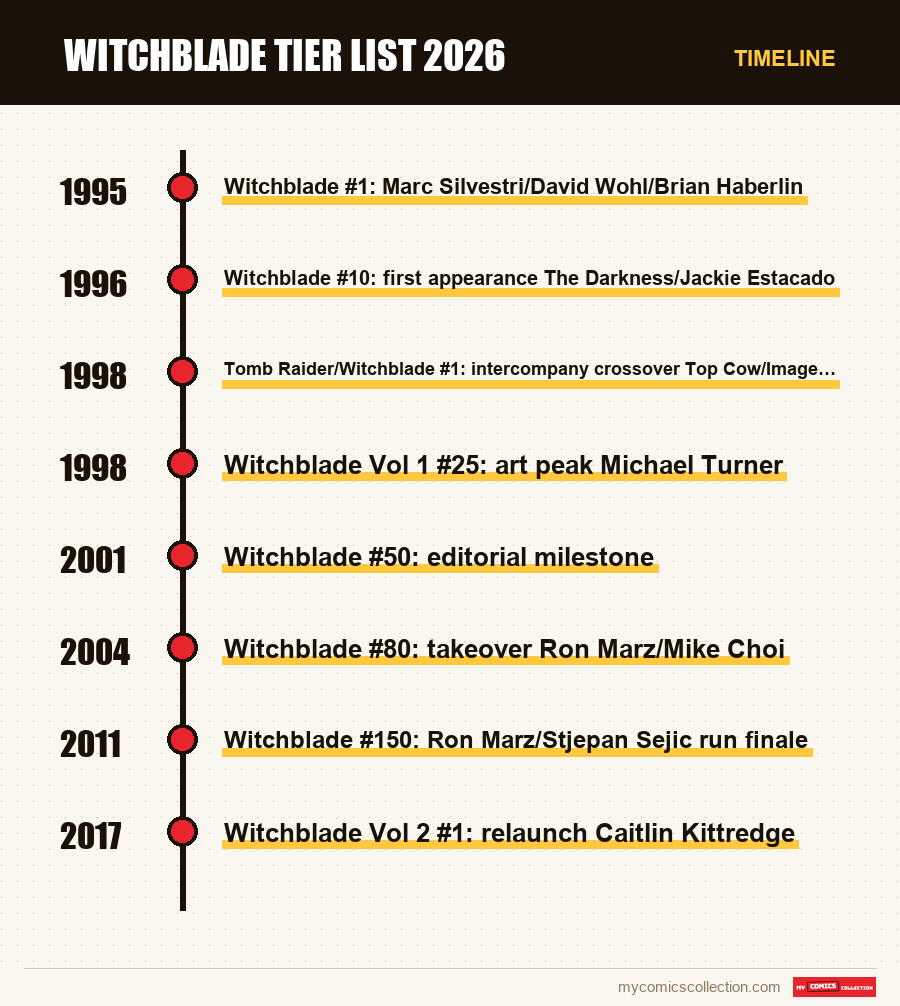
La tier list Witchblade 2026 places four pieces in Tier S blue-chip: Witchblade #1 (November 1995, Marc Silvestri/David Wohl/Brian Haberlin at Top Cow Productions/Image Comics, first appearance Sara Pezzini and the Witchblade), Witchblade #10 (November 1996, first appearance of The Darkness/Jackie Estacado in cliffhanger crossover), the gallery of Michael Turner variant covers from Witchblade #1 (chase covers 1995-1996), and Witchblade #150 (November 2011, final of the Ron Marz/Sejic run). Tier A includes Witchblade #25 (May 1998, art peak Michael Turner), Witchblade #50 (November 2001, milestone and editorial turning point), the crossover Tomb Raider/Witchblade #1 (1998) and Witchblade: Origins (collected 2008). Tier B lines up the sleepers Witchblade/Aliens/Darkness/Predator (2001), Witchblade #80 (October 2004, Ron Marz/Mike Choi takeover), Witchblade: Demon (2003) and Witchblade Vol 2 #1 (October 2017, Caitlin Kittredge relaunch). Tier C covers the 2026-2027 spec around the post-2007 TV revival series and the post-2024 Top Cow/Marvel merger.
The living gauntlet which chooses its wearer among the warriors of each generation remains, more than thirty years after its creation, one of the most unique inventions of the golden age of Image Comics. Sara Pezzini, a New York detective revealed in November 1995 under the pencils of Marc Silvestri, has survived seventeen years as a regular series, two television adaptations (the TNT series from 2001-2002 and the Japanese anime from 2006), a seminal crossover which spawned The Darkness, and a relaunch in 2017. This tier list Witchblade key issues 2026 aims to prioritize the pieces in the Top Cow catalog based on rarity-demand-budget, taking into account recent announcements of post-2001-2002 TV revivals and persistent rumors around a post-2024 Top Cow/Marvel Comics editorial merger. The Witchblade market behaves differently from Spawn or Walking Dead: less spec buzz, but a very loyal collector base that supports the ratings of Michael Turner covers and Darkness crossovers.
The methodology follows the same grid as the other tier lists of the blog: Tier S for the central blue-chip pieces (first appearance of Sara Pezzini and the gauntlet, first The Darkness, art peak Michael Turner, final of the main run), Tier A for the major key issues often neglected but essential to the Witchblade catalog, Tier B for the sleepers which combine rarity and latent narrative catalyst (multi-universe crossovers, author relaunchs), Tier C for spec bets linked to TV announcements and to the Image-Marvel editorial movements. Each tier mentions the price ranges observed in spring 2026 on the Heritage Auctions, GoCollect and eBay sold listings bases, and specifies the pitfalls specific to the Top Cow catalog (multiple Turner covers on #1, fragile embossed covers, several Witchblade Vol 2 #1 relaunch). This tier list is a spoke of the cluster Image Comics universe: complete pillar guide and the strategy pillar comics investment 2027.
Witchblade 2026 tier list methodology
The Witchblade tier list is based on four weighted criteria. The first is the narrative significance: a first canonical appearance weighs more than an anniversary issue, a first founding crossover weighs more than a guest spot. The second is the objective rarity measured by the CGC census: a comic with less than 400 copies in CGC 9.6 or higher falls into the scarce category, which justifies a higher third even for less emblematic issues. The third is the market demand evaluated by quarterly eBay transaction volume and bid-ask ratio on ComicConnect. The fourth is the future catalyst, which covers TV announcements, streaming series, Image-Top Cow editorial events and round anniversaries (30 years of #1 in November 2025, already passed but with a tail effect until 2027).
The weighting differs depending on the tier targeted. For Tier S, narrative significance accounts for 40% of the decision, rarity for 25%, demand for 25%, catalyst for 10%. A Tier S Witchblade piece must tick three of the four criteria at the maximum level, with an additional requirement specific to the Top Cow catalog: the cover must be by Michael Turner or directly linked to a founding narrative event (first The Darkness, finale of the run). For Tier A, the weighting is balanced around 30% each, with a tolerance on the catalyst. For Tier B, the catalyst rises to 35% because the sleeper logic is based on an expected asymmetry. For Tier C, the catalyst rises to 50%: it is a spec bet whose current intrinsic value remains low but whose revaluation potential depends on TV announcements or future editorial movements.
The Witchblade market has three specificities compared to Spawn, Walking Dead or traditional Marvel-DC markets. First specificity: the profusion of chase covers Michael Turner on #1 . Witchblade #1 from November 1995 had several cover variants identified A, B, C and D in the CGC nomenclature, each with different print runs and varying odds. This structure of chase variants, exceptional for an Image title from 1995, complicates identification for the beginning collector. The rule: only the original Turner cover (variant A) constitutes the blue-chip key issue, the other variants remain complete pieces.
Second specificity: the Darkness crossover channel . Witchblade #10 from November 1996 contains the first appearance of The Darkness/Jackie Estacado, which will become a distinct franchise with its own series launched in December 1996. This dual identity (Witchblade key + first Darkness) places #10 in a category of its own: it is coveted simultaneously by Witchblade collectors and by Darkness fans, which creates increased demand and sustainably supports the rating.
Third specificity: the perceptual variability Witchblade according to editorial eras. During the period 1995-2000, the series belongs to the bad girl aesthetic of the mid-90s (suggestive covers, teenage male target demographic). During the period 2001-2008, the TNT series and the Ron Marz run repositioned Sara Pezzini as an adult character, which opened the way to a wider readership. Since the Caitlin Kittredge relaunch in 2017, the perception has moved closer to an urban fantasy horror with a strong female protagonist, which better corresponds to contemporary editorial standards. These oscillations make the diversification between thirds major: each period has its emblematic pieces and its distinct collecting public.
The grid finally takes into account the catalysts 2026-2027. The Witchblade TV revival has been in development since the end of the TNT series in 2002, with several aborted announcements (NBC in 2017, IDW Entertainment in 2018) and a last active project with an unconfirmed studio in spring 2026. The Top Cow/Marvel Comics editorial merger announced at the end of 2024 remains to materialize: it could allow Witchblade/Marvel crossovers, the first time in the history of the two universe, which would be a major catalyst for the entire Top Cow catalog. For the complete prioritization method, see Witchblade key numbers which details each number individually.
Tier S Witchblade: the four central blue-chip pillars
The Tier S Witchblade brings together four pieces and only four. This discipline is central: an inflated Tier S loses its prioritization function. These four pieces are the foundations of any serious Witchblade collection, in chronological order of narrative and financial importance.
Witchblade #1 (November 1995): Marc Silvestri/David Wohl/Brian Haberlin
Witchblade #1 from November 1995 is the absolute pinnacle of the Witchblade pyramid. Published under the Top Cow Productions label at Image Comics, this issue is credited Marc Silvestri (Top Cow creator, former X-Men Marvel artist), David Wohl (story) and Brian Haberlin (concept), with Michael Turner on interior designs and cover for Variant A. first appearance of Sara Pezzini, New York detective at the NYPD, and the first appearance of the Witchblade, a mysterious sentient gauntlet which chooses its wearer from among the warriors of each generation throughout history (Cleopatra, Joan of Arc, etc., according to the mythology subsequently developed). The Michael Turner cover A shows Sara Pezzini in combat stance, armed gauntlet deployed, in a dynamic style that would define the Top Cow aesthetic for a decade.
The issue inaugurates the long regular series which will last 175 issues on Vol 1 between 1995 and 2015 (including the finale of the main run at #150 in November 2011, then a continuity until #185 in reality overflowing due to intermediate relaunchs). The spring 2026 ranges for the original Turner cover (variant A): CGC 9.8 between 320 and 520 euros, CGC 9.6 between 140 and 240, CGC 9.4 between 75 and 130, CGC 9.0 between 40 and 70, raw NM between 22 and 45 euros. The chase variants (B, C, D) according to their rarity of edition: the cover B Turner alternate reaches 180-280 euros CGC 9.8, the cover C rare variant can exceed 400 euros in CGC 9.8 according to Heritage 2024-2025 sales, the extremely rare convention cover D reaches 600-900 euros CGC 9.8 on the rare documented transactions.
The trap Witchblade #1 is threefold. Firstly, the identification of variant covers: marketplace databases often classify copies under the sole term "Witchblade #1" without specifying the variant, which pollutes the search. Check the CGC or CBCS nomenclature on the label to identify the exact variant (A, B, C, D). Secondly, the multiple printings: faced with the initial success, Top Cow reprinted #1 in gold edition and second print in 1996, with covers derived from the original cover A but prices 3 to 8 times lower than the first print. Third, the confusion with the relaunch Witchblade #1 (Vol 2 #1 in 2017, Witchblade: Rebirth in 2011, Witchblade: Origins #1 in 2008) which have no spec relationship with the founding #1. For the full narrative profile of Sara Pezzini, seeSara Pezzini character profileet story of Witchblade in the comics.
Witchblade #10 (November 1996): first appearance The Darkness/Jackie Estacado
Witchblade #10 from November 1996 contains the first appearance of The Darkness/Jackie Estacado, in a crossover cliffhanger that ushers in what will become Witchblade's sister franchise in the Top Cow universe. David Wohl writes, Michael Turner draws. The issue acts as a narrative driver for the series Darkness #1 launched the following month (December 1996), a classic editorial strategy at Top Cow to launch a new title via a crossover with an established series.
Jackie Estacado, young mafioso heir to the ancestral power of Darkness, will become the bearer of a distinct franchise which will last more than 100 issues on Vol 1 and 1 and will generate several major crossovers (Witchblade/Darkness recurring crossovers, Darkness/Spawn). This double identity makes Witchblade #10 a piece coveted by two distinct bases: Witchblade collectors who want a narrative key to the series, and Darkness collectors who want the absolute first appearance of their favorite character before his solo #1. This reinforced demand sustainably supports the rating.
The spring 2026 ranges: CGC 9.8 between 280 and 420 euros, CGC 9.6 between 130 and 200, CGC 9.4 between 65 and 110, raw NM between 28 and 50 euros. The 2024-2026 increase is estimated at 35 to 50% on CGC 9.6+ grades, driven by the resurgence of cult-following Darkness and recurring rumors of adaptation. The trap Witchblade #10 is about distinction first appearance vs first full appearance: some purists consider that the true first appearance of Jackie Estacado is in Darkness #1 (December 1996), Witchblade #10 containing only a cliffhanger cameo. The CGC census recognizes Witchblade #10 as the "first cameo" and Darkness #1 as the "first full". The two pieces complement each other in a serious Top Cow collection, but Witchblade #10 retains the bonus of chronological precedence. For Darkness' full profile, see history of Darkness in comics.
Witchblade #1 variant covers Michael Turner (chase covers gallery)
La complete gallery of Michael Turner variant covers on Witchblade #1 constitutes in itself a sub-project of the Top Cow collection. Top Cow and Image published for #1 in November 1995 several covers identified A, B, C and D in the contemporary CGC nomenclature, plus gold and chrome editions published in 1996. This unusual structure for an independent title from 1995 reflects the exceptional commercial ambition surrounding the Witchblade launch: Marc Silvestri wanted to position Sara Pezzini as the flagship heroine of Top Cow and invested in a variant-cover marketing strategy inspired by Image techniques. the era.
La cover A Turner standard is the main cover of the initial print: Sara Pezzini in close-up, gauntlet deployed, red background. The CGC 9.8 ranges between 320 and 520 euros in spring 2026. cover B Turner alternate offers a different composition with Sara in wide shot, smaller print: CGC 9.8 between 180 and 280 euros. There cover C variant rare is a cover convention limited to an estimated print run of less than 2,500 copies: CGC 9.8 between 400 and 650 euros on rare Heritage sales. There cover D extremely rare is a gold/chrome cover or ultra-limited exclusive agreement, estimated print run of less than 800 copies, prices depending on exact identification: CGC 9.8 between 600 and 1,200 euros, sometimes more on exceptional transactions.
The trap of the chase covers gallery is twofold. Firstly, the precise identification of each variant requires CGC expertise: the internal CGC nomenclature (cover A, B, C, D) does not always correspond to that used on consumer marketplaces, and some amateur sellers present cover B copies as cover C through ignorance. Systematically check recent Heritage and GoCollect sales to calibrate the right price. Secondly, the conservation of Turner covers high grade is demanding: copies from 1995 are 30 years old in 2025, paper from the Top Cow Image period is moderately durable, and non-slabbed copies have often degraded to CGC 9.0 or below. Favor CGC slabbed copies for any transaction above 150 euros on chase covers. For Michael Turner's profile and impact on the Top Cow aesthetic, see story by Michael Turner author.
Witchblade #150 (November 2011): Ron Marz/Stjepan Sejic run finale
Witchblade #150 of November 2011 marks the final main run Ron Marz and constitutes a major editorial anniversary issue for Top Cow. Ron Marz writes, Stjepan Sejic draws. This issue concludes the Sara Pezzini story arc begun in 1995's #1 and begins an editorial transition that will lead to several subsequent relaunchs and continuities until the end of Vol 1 in 2015. The Sejic cover features Sara Pezzini in a retrospective composition that evokes the visual emblems accumulated over 16 years of publication.
The importance of Witchblade #150 goes beyond anniversary marketing: this issue is considered by fans to be the definitive narrative culmination of Sara Pezzini's version of the Witchblade, before subsequent transitions to other wielders in subsequent arcs and relaunchs. This endpoint quality makes it a major completing piece for any serious Witchblade collection. Spring 2026 ranges: CGC 9.8 between 95 and 160 euros, CGC 9.6 between 50 and 85, raw NM between 14 and 25 euros. The rating doubled between 2022 and 2025, driven by the 30th anniversary effect of #1 and by the rediscovery of the Ron Marz run by new entrants.
The trap Witchblade #150 concerns variants anniversary published simultaneously. Top Cow published several covers for #150: the main Sejic cover, a Marc Silvestri tribute cover, a posthumous Michael Turner tribute cover (Turner having died in 2008), and several exclusive conventions. The Silvestri and Turner tribute variants have different prices from the main cover: the Silvestri tribute reaches 180-280 euros CGC 9.8, the Turner tribute (in high demand as a posthumous tribute) can reach 320-480 euros CGC 9.8 on rare 2024-2026 sales. Always check the exact variant on the CGC label or with the seller.
Tier A Witchblade: the four major key issues often underestimated
Tier A Witchblade brings together four pieces which would sometimes deserve Tier S but which the more accessible rarity or the slightly secondary narrative significance places at the level just below. These four issues should be in any Witchblade collection beyond beginner level. Their ranges remain accessible to intermediate budgets between 150 and 600 euros per piece in grade CGC 9.6+.
Witchblade Vol 1 #25 (May 1998): art peak Michael Turner
Witchblade Vol 1 #25 from May 1998 marks the absolute peak art by Michael Turner on the series, before its gradual departure towards Fathom and her own projects in 1999. Christina Z writes, Michael Turner draws. This issue is unanimously considered by Top Cow collectors as the most iconic Turner cover after the original #1: Sara Pezzini in dynamic heroic pose, gauntlet fully deployed, in an exaggerated anatomical style that defined the bad-girl-comics aesthetic of the late 1990s.
The importance of #25 lies in the combination of three factors: editorial milestone (first substantial anniversary issue after #5, #10, #15, #20), identifiable and readable peak Turner art, and intermediate narrative turning point in the Sara Pezzini arc before the transition to the extended Christina Z run. The spring 2026 ranges: CGC 9.8 between 220 and 380 euros, CGC 9.6 between 95 and 170, CGC 9.4 between 50 and 90, raw NM between 18 and 32 euros. The 2024-2026 increase is driven by the rediscovery of Turner art after his death in 2008 (the posthumous halo effect continues to support the ratings 17 years later) and by the 30th anniversary effect of #1.
The trap Witchblade #25 concerns confusion with Witchblade/Aphrodite IX Preview and several exclusive Turner conventions of the time. Check the exact publication date (May 1998) and the Image-Top Cow code to confirm the identification. The distinction direct edition vs newsstand begins to count for 1998 at Top Cow: the newsstand version represents a minority of the initial circulation estimated at less than 15%, which gives it a slight rarity premium in high grade. See story by Michael Turner author for the complete trajectory.
Witchblade #50 (November 2001): editorial milestone
Witchblade #50 from November 2001 constitutes the major editorial milestone from the first period of the series, coinciding with the broadcast of the TNT series Witchblade which began in June 2001 with Yancy Butler in the role of Sara Pezzini. Paul Jenkins writes, Keu Cha draws. This issue is strategic in two ways: it marks the peak of Witchblade visibility in the early 2000s, and it begins a narrative transition that prepares Ron Marz's subsequent run starting with #80 in 2004.
The cover features Sara Pezzini in a modernized style that is less exaggerated than the Turner covers of the 1995-1999 era, reflecting Top Cow's visual maturation toward a more mainstream style. The spring 2026 ranges: CGC 9.8 between 140 and 230 euros, CGC 9.6 between 65 and 110, CGC 9.4 between 35 and 60, raw NM between 12 and 22 euros. The rating increased from 25 to 35% between 2024 and 2026, driven by TNT nostalgia and recurring rumors of a TV revival which places Yancy Butler as executive producer of a hypothetical future project.
The trap Witchblade #50 concerns multiple variants published in 2001: Top Cow published a main cover, a Greg Land variant cover, a Yancy Butler/TNT photo cover and several exclusive conventions. The TNT photo cover is today particularly coveted by nostalgia collectors but remains rare in high grades due to its fragility (shiny laminate which deteriorates). The Greg Land variants reach 180-280 euros CGC 9.8. Check the exact variant before transaction.
Tomb Raider/Witchblade #1 (June 1998): intercompany crossover Top Cow/Image-Eidos
Tomb Raider/Witchblade #1 from June 1998 inaugurates one of the Top Cow's first major intercompany crossovers with a video game franchise (Lara Croft from Eidos Interactive). Dan Jurgens writes, Andy Park draws. This one-shot capitalizes on the dazzling commercial success of tomb Raider (first game 1996, sequel 1997, global cultural blockbuster) by bringing together Lara Croft and Sara Pezzini on an archaeological adventure story involving a mystical artifact related to the Witchblade.
The importance of this crossover goes beyond just a marketing gimmick: it establishes the commercial viability of Witchblade crossovers with external universes, which will pave the way for later crossovers with Aliens, Predator, Darkness and even JLA/Witchblade. For Witchblade collectors, this is also the first opportunity to position Sara Pezzini as a character capable of standing up to an external pop culture icon. Spring 2026 ranges: CGC 9.8 between 160 and 260 euros, CGC 9.6 between 80 and 140, raw NM between 18 and 32 euros. The rating is supported by the double collector base (Witchblade + Tomb Raider) and by peaks in demand with each release of a new Tomb Raider game or Lara Croft film.
The trap Tomb Raider/Witchblade #1 concerns multiplicity of covers: main Andy Park cover, Michael Turner variant cover, Marc Silvestri variant cover, photo cover, plus two or three exclusive conventions. The Turner variant on this piece is extremely rare and reaches 380-600 euros CGC 9.8 on documented sales 2024-2026. Verify the precise identification of the variant.
Witchblade: Origins (collected 2008)
Witchblade: Origins, collected series published by Top Cow in 2008 (reformatted reissue of the first Witchblade arcs #1-#19), constitutes a editorial entry point post-death Michael Turner which offers a new approach to presenting the origins of Sara Pezzini. The collected series reformats, partially recolors and republishes the founding arcs with contextual annotations. Ron Marz coordinates the project, Top Cow team ensures the reissue.
The importance of Origins 2008 lies in its role as a reintroduction to the character for new readers after six years of editorial turbulence following the end of the TNT series (2002). This collection is also the first affordable opportunity to read the entire Turner arcs without having to acquire the original single issues from 1995-1996 which have become expensive. The spring 2026 ranges for volume 1 hardcover: CGC 9.8 between 95 and 160 euros, CGC 9.6 between 50 and 80, raw NM hardcover between 35 and 55 euros. The softcover trade paperback trades between 18 and 32 euros raw NM.
The trap Origins concerns the distinction signed/numbered hardcover vs standard hardcover vs softcover. Top Cow published a limited hardcover version signed by Ron Marz, edition of 1,500 numbered copies, which reached 280-450 euros CGC 9.8 on the rare documented transactions. The standard hardcover version remains around 95-160 euros CGC 9.8. The softcover trade paperback version is the most accessible. Check the exact edition before transaction above 100 euros.
Tier B Witchblade: sleepers with high potential
Tier B Witchblade brings together four sleepers whose current rating remains accessible but whose latent catalysts (first appearance of antagonist, multi-universe crossover format, start of author's run, significant relaunch) justify measured exposure in a diversified collection. These pieces are not major at the beginner level but become strategic beyond that.
Witchblade/Aliens/Darkness/Predator (2001): quadruple intercompany crossover
Witchblade/Aliens/Darkness/Predator, a crossover mini-series published in 2001 by Top Cow in partnership with Dark Horse (holder of the Aliens and Predator licenses) and the independent publisher, constitutes one of the most ambitious crossovers ever made by Top Cow. The project brings together Sara Pezzini (Witchblade), Jackie Estacado (Darkness), the Xenomorphs (Aliens) and the Yautja (Predator) in a horror-action story set against a backdrop of expanded alien mythology.
Spring 2026 ranges: CGC 9.8 between 130 and 220 euros, CGC 9.6 between 65 and 110, raw NM between 18 and 32 euros for #1 of the mini-series. The rating doubled between 2022 and 2025, driven by the Aliens-Predator boost post-release of the films Prey (2022) and Alien: Romulus (2024) which brought public attention back to the Xenomorph and Yautja franchises. The trap concerns the relative rarity at high grade: the mini-series was not massively preserved when it was released in 2001, which makes CGC 9.8 truly rare (less than 200 copies recorded). The cover is fragile due to the glossy period format. Spec position to be scaled carefully, without exceeding 8% of the total Witchblade budget.
Witchblade #80 (October 2004): takeover Ron Marz/Mike Choi
Witchblade #80 from October 2004 marks the start of the run Ron Marz on the series, accompanied by Mike Choi on the drawings. This editorial takeover creatively relaunches the series after several years of commercial decline following the end of TNT (2002). Marz, experienced screenwriter from DC Comics (run Green Lantern Kyle Rayner) and Image-CrossGen, repositions Sara Pezzini as a mature adult character, gradually abandons the bad-girl visual and establishes a police procedural tone mixing urban fantasy horror.
The importance of #80 lies in its role as starting point for Witchblade's most respected run after the founding Turner era. Ron Marz will remain writer of the series until #150 in November 2011, or 70 consecutive issues, which constitutes one of the longest runs in Top Cow history. Spring 2026 ranges: CGC 9.8 between 110 and 180 euros, CGC 9.6 between 50 and 85, raw NM between 12 and 22 euros. The rating doubled between 2022 and 2025, driven by the rediscovery of the Marz run by new entrants and by the halo effect of the #150 final.
The trap Witchblade #80 concerns the relatively small circulation due to the 2004 post-TNT commercial trough, which creates a real objective scarcity but often underestimated by amateur sellers. Copies in CGC 9.8 are really rare (less than 150 recorded in the May 2026 census), which can justify exceptional transactions well above the indicative range. See Witchblade key numbers for the details of the Marz run.
Witchblade: Demon (2003): spin-off miniseries
Witchblade: Demon, a mini-series published in 2003 by Top Cow, offers a gothic horror spin-off centered on the demonic aspect of the Witchblade and the ancient origins of the gauntlet throughout history (Cleopatra, Joan of Arc, and other historical wielders according to the mythology developed by David Wohl from 1996). The miniseries expands the Witchblade canon by exploring the occult and esoteric dimensions that will remain underutilized in Sara Pezzini's present-focused regular series.
The spring 2026 ranges: CGC 9.8 between 85 and 140 euros, CGC 9.6 between 40 and 70, raw NM between 12 and 22 euros for the #1 of the mini. The rating has remained stable since 2020, without an immediate spec catalyst but with a slow cult-following potential driven by the contemporary urban fantasy horror revival (boost The Witcher, Locke & Key, Shadow and Bone). The trap Witchblade: Demon is the correct identification: Several Witchblade mini-series were released between 2002 and 2008 (Witchblade: Obakemono, Witchblade: Bloodlines, Witchblade: Distinctions) which have different ratings. Check the exact title and date before transaction.
Witchblade Vol 2 #1 (October 2017): relaunch Caitlin Kittredge
Witchblade Vol 2 #1 from October 2017 marks the first contemporary relaunch of the series after the end of Vol 1 in 2015. Caitlin Kittredge writes, Roberta Ingranata draws. This relaunch offers a new wielder of the Witchblade, Alex Underwood, a New York journalist who survived a demonic attack, who inherits the gauntlet through tragic circumstances. The tone is resolutely contemporary urban fantasy horror, closer to Locke & Key or The Magicians than to the bad-girl aesthetic of 1995-2000.
The importance of Vol 2 #1 lies in its role as first major editorial relaunch post-Marz finale, which repositions the franchise for a new generation of readers and for 2017-2020 editorial standards (strong female protagonist, your adult horror without visual gratuity, full female creative team for the first time on the franchise). Spring 2026 ranges: CGC 9.8 between 50 and 85 euros, CGC 9.6 between 25 and 40, raw NM between 9 and 16 euros. The rating has been stable since 2020 with a slight decline in 2024 (the Vol 2 series stopped at #14 in 2019, which tempered the collectors' spec), but the potential for revaluation exists if the TV revival materializes with a contemporary approach inspired by the Kittredge relaunch rather than the 1995-2000 aesthetic.
Trap Vol 2 #1 concerns numerous variants published in 2017: cover A Stjepan Sejic (main variant), cover B Roberta Ingranata, cover C Sana Takeda rare variant, cover D Marc Silvestri tribute. The Sejic and Silvestri tribute variants can reach 120-180 euros CGC 9.8 compared to 50-85 for the main variant. For modern alternatives to the Image catalog, see comics collector woman 2026 et calendar Image independent comics.
Collecting this series?
Track what you own, what you are missing and what your collection is worth. 7 day trial.
Start my trial →Tier C Witchblade: 2026-2027 spec and catalysts TV-Marvel
Tier C Witchblade covers spec bets linked to the TV revival in development and the Top Cow/Marvel merger announced at the end of 2024. This tier is explicitly speculative: the current intrinsic value is low, the potential depends on announcements and editorial movements whose materialization remains uncertain. Allocating more than 8-12% of the total Witchblade budget to this tier constitutes excessive risk.
Le central catalyst 2026-2027 is the Witchblade TV revival. The 2001-2002 TNT series (two seasons, Yancy Butler as Sara Pezzini) left a lasting cult following. Since the shutdown in 2002, several revival projects have been announced and aborted: NBC in 2017, IDW Entertainment in 2018, several unconfirmed studios between 2020 and 2024. In spring 2026, an active project is assigned to a studio not publicly confirmed, with casting and format still to be determined. If the revival materializes with a launch announced in 2026 for broadcast in 2027-2028, the spec catalyst would be modest but lasting (TNT 2001 effect on #50 demonstrates the TV-ratings correlation).
Le secondary catalyst is the Top Cow/Marvel Comics merger announced at the end of 2024. This editorial movement, unprecedented in the history of the two universes since the creation of Image in 1992 (Top Cow being a founding studio of Image), opens the theoretical possibility of Witchblade/Marvel crossovers on compatible themes: Sara Pezzini/Daredevil (two New York street-level characters), Witchblade/Doctor Strange (magical compatibility), Witchblade/X-Men (inherited power theme). If Marvel and Top Cow announce a concrete crossover in 2026-2027, the halo effect on the Witchblade catalog would be substantial, particularly on #1 and #10 which are the pieces most exposed in value.
Le tertiary catalyst is the 30th anniversary of #1 in November 2025 (already passed in spring 2026) with tail effect until 2027. Top Cow published in November 2025 a commemorative anniversary issue with covers tributes Silvestri, posthumous Turner, and Sejic, which reactivated attention to the franchise. The anniversary effect typically extends 12 to 24 months after the main event, supporting Tier S and A ratings.
Tier C spec key issues to watch for in 2026-2027 include the first appearances of historical Witchblade wielders explored in mini-series (Cleopatra, Joan of Arc, others) which could be adapted into an ambitious multi-era TV revival, plus special variants from recent relaunchs. These coins are mostly trading below 50 euros CGC 9.8, which offers limited downside risk. For related bets related to the Image and Top Cow universe, see Spawn tier list key issues 2026 et Walking Dead tier list key issues 2026 which complete Image mapping. For the general spec strategy, see strategy pillar comics investment 2027.
Strategy by Budget: Three Witchblade 2026 Portfolios
The budget allocation depends on the available capital and the acceptable level of risk. Three typical wallets cover the majority of Witchblade collecting situations. Each portfolio integrates the four thirds in different proportions to preserve diversification between eras (1995-2000 Turner, 2001-2003 TNT, 2004-2011 Marz, 2017+ Kittredge) and types of pieces (cover variants, crossovers, anniversary, relaunchs).
Beginner wallet 800 to 2,000 euros. The objective is to build a solid base without taking excessive risk on Turner chase covers. Typical allocation: 0% Tier S CGC 9.8 (out of range at these levels), 70% Tier A and Tier S raw NM or intermediate CGC, 25% Tier B, 5% Tier C. In practice: Witchblade #1 cover A Turner raw NM (22-45 euros), Witchblade #10 raw NM (28-50 euros), Witchblade #25 raw NM or CGC 9.4 (50-130 euros), Witchblade #50 raw NM or CGC 9.4 (35-60 euros), Witchblade #150 raw NM (14-25 euros), a Tier B sleepers of your choice (Witchblade #80 or Vol 2 #1). This portfolio covers the narrative pillars without requiring CGC 9.8 grades or C/D Turner chase covers.
Intermediate portfolio 3,500 to 7,000 euros. The objective is to move up the ranks on Tier S pieces and begin exposure to Turner chase covers. Typical allocation: 50% Tier S (cover A Turner CGC 9.8 + Witchblade #10 CGC 9.6+ + Witchblade #150 CGC 9.6+), 30% Tier A in complete CGC 9.6+, 15% Tier B with Witchblade #80 and Vol 2 #1 in CGC 9.8, 5% Tier C in accumulation on special variants. This portfolio allows for real wealth progression without over-concentration on a single variant. The discipline consists of not giving in to the temptation of C/D Turner chase covers which would consume the entire budget without sufficient diversification.
Advanced wallet 12,000 euros and more. The objective is to aim for the complete gallery of Turner chase covers on #1 (minimum A, B, C variant, ideally D if transaction available) while completing the other Tier S in CGC 9.8 and building a diversified Tier B and C exhibition. Typical allocation: 60% Tier S (complete Turner #1 chase covers + #10 CGC 9.8 + #150 CGC 9.8 all main variants), 25% Tier A in CGC 9.8 complete, 10% Tier B expanded, 5% Tier C. This portfolio reaches the serious collection level referenced on the CGC Registry Top Cow bases. For the asset management of such portfolios, see strategy pillar comics investment 2027 et comics manager complete guide for tracking odds.
Whatever the portfolio, two transversal rules apply to the Witchblade catalog. First of all, never exceed 50% of the total budget on #1 and its variants alone, even if the chase cover Turner temptation is strong: the liquidity of chase covers C/D is low (less than 5 documented transactions per year), and an urgent resale can impose a discount of 20 to 35%. Secondly, maintain a spec cash flow of 10 to 15% to seize opportunities linked to unanticipated TV announcements. The Top Cow spec reacts quickly to studio news and a one-week delay can cost 25-40% upside potential. See free estimate to evaluate your current collection before arbitration and comics catalog for sourcing.
Witchblade specific pitfalls: Turner variants, embossed, multiple #1 reboots
The Witchblade collection combines several technical traps which distinguish this market from other Image universes (Spawn, Walking Dead) and Marvel-DC. Identifying these pitfalls upstream avoids costly errors, particularly for intermediate buyers who commit to amounts greater than 200 euros per item.
The first trap is identification of variant covers Michael Turner on #1. The CGC nomenclature distinguishes cover A (main cover majority draw), cover B (cover alternate secondary draw), cover C (exclusive convention or limited ratio variant), cover D (cover gold/chrome or ultra-exclusive convention). Consumer marketplaces often use simplified or erroneous nomenclature which can make a cover B appear to be a copy that is actually cover A, or vice versa. The verification rule: systematically require a slabbed CGC or CBCS copy for transactions above 100 euros, and check that the label explicitly specifies the variant ("Cover A" or "Variant Cover" with specific Turner attribution). Raw copies require solid visual expertise: composition of the cover, color palette, information printed on the back.
The second trap is multiplication of Witchblade #1 reboots. Beyond the founding #1 in November 1995, the title has had several distinct #1s: Witchblade: Origins #1 collected 2008 (reformatted reissue), Witchblade Vol 1 #131 numbered as a "new beginning" in 2009 (internal relaunch without volume change), Witchblade: Rebirth #1 in 2011 (spin-off mini-series), Witchblade Vol 2 #1 in October 2017 (Kittredge relaunch). Each #1 has its own editorial logic, but only the founding #1 from 1995 (cover A Turner) constitutes the blue-chip key issue. The other #1s are complete collection pieces at very lower prices. The rule: systematically check the publication date (November 1995 for the real #1) and the period Top Cow Image barcode.
The third trap is embossed and chromium format on certain issues from the 90s-2000s. Top Cow used these marketing gimmicks on several Witchblade issues: embossed cover on #25 (May 1998) as an alternate variant, chromium cover on #50 (November 2001), foil cover on #75 (April 2004). These formats are fragile: the relief is damaged, the foil is scratched, the chromium peels off. High grade conservation is demanding and the CGC 9.8 rarity is real, but the market remains segmented: collectors target these variants as Top Cow curiosities, not as primary investment. Favor CGC slabbed copies for these formats.
The fourth trap is distinction Witchblade #10 vs Darkness #1 for the first appearance of Jackie Estacado. Witchblade #10 (November 1996) contains a cliffhanger appearance at the end of the issue, Darkness #1 (December 1996) contains the first full appearance. The CGC census lists Witchblade #10 as "first cameo" and Darkness #1 as "first full". This distinction creates two distinct markets: Darkness purists prefer Darkness #1 as key issue, Witchblade completionists prefer Witchblade #10 for its chronological precedence. The two pieces complement each other but have slightly different rating trajectories: Witchblade #10 progresses faster in the case of a Witchblade catalyst, Darkness #1 progresses faster in the case of a Darkness catalyst. The discipline in advanced collecting consists of holding the two complementary pieces.
The fifth trap is distinction direct edition vs newsstand on Top Cow comics 1995-2003. Top Cow initially distributed mainly in specialized comic shops (direct publishing), with a minority newsstand presence estimated between 10 and 15% of the circulation. For Witchblade key issues from the 90s-2000s, newsstands carry a rarity bonus of 1.3 to 2 times at high grade CGC 9.6+. On Witchblade #1 cover A (1995), a CGC 9.8 newsstand can reach 700-1,100 euros compared to 320-520 for a direct edition. For Witchblade #10 (1996), a CGC 9.8 newsstand reaches 500-750 euros compared to 280-420 for a direct edition. Verification is done by the visible UPC barcode (newsstand) vs. the printed Image-Top Cow square (direct edition). For the grid compared Witchblade vs other Image series, see Spawn tier list key issues 2026 et Walking Dead tier list key issues 2026.
Monitoring 2026-2030: TV-Marvel calendar and anticipation of spec cycles
The follow-up to the Witchblade 2026-2030 collection is structured around four time windows. The discipline consists of anticipating each window to position purchases and sales at the right time, without giving in to peaks of enthusiasm or troughs of disinterest.
Window 2026: 30-year anniversary operation and Top Cow/Marvel merger. The 30th anniversary of #1 (November 1995) generated a commemorative anniversary issue in November 2025 with covers tributes to Silvestri, posthumous Turner and Sejic, which extends its effect into 2026. The Top Cow/Marvel editorial merger announced at the end of 2024 should materialize in 2026 with the first concrete announcements: Witchblade/Daredevil or Witchblade/Doctor Strange crossover being the most probable hypotheses according to editorial leaks. The optimal buying window for new entrants is summer 2026 (traditional seasonal low) before the pre-announcement fall rise.
Window 2027: potential concrete TV revival announcement. If the TV revival in development since 2017 materializes with an official launch in 2026 for broadcast in 2027-2028, the effect on Tier S ratings will be comparable to that of the TNT series in 2001 (+40 to +60% over 18 months). Tier S holders are considering a partial resale at peak (summer 2027 or winter 2028 depending on the exact timing of release) with rotation to Tier B sleepers. New entrants avoid peaks and wait until the post-announcement trough (fall 2027 or winter 2028).
Window 2028-2029: post-revival TV digestion and realization of Marvel crossovers. After each major TV catalyst, the market digests for 6 to 12 months with the rating plateauing or slightly declining. This phase is the buying opportunity for long-term positions. If the Witchblade/Marvel crossovers materialize in 2028-2029 (plausible hypothesis if the 2024 editorial merger is successful), the Tier S and A ratings may experience a second upward cycle. Monitor Image-Top Cow and Marvel communications at every San Diego Comic-Con and every New York Comic-Con.
Window 2030: 35 years anniversary of #1 and potential 20 years of TNT series. Editorial anniversaries traditionally generate commemorative relaunchs, tribute variants and a surge of interest in the original arcs. Witchblade #1 (November 1995) will turn 35 in November 2030, the traditional window for hardcover anniversary editions and reprint variants. The TNT series (June 2001) will reach its 30th anniversary in 2031, which may generate a vague secondary nostalgia if the late 2020s TV revival is not currently airing. The rating of first prints cover A Turner CGC 9.8 can accelerate by 30 to 50% over 12 to 18 months before the 35th anniversary.
Beyond the TV-Marvel schedule, two macro variables need to be tracked. Firstly, the evolution of the global Image Comics market: each TV-cinema success of an Image series (Walking Dead, Spawn, Saga, Invincible) creates a halo effect on the entire Image catalog, from which Top Cow benefits indirectly. Secondly, the general inflation of the modern age comics market, which affects key issues 1990s-2000s (including the entire Witchblade catalog) evenly. The 2022-2024 monetary squeeze caused the Witchblade #1 cover A CGC 9.8 rating to rise by 35% in two years, regardless of any TV catalyst. For methodical tracking of your collection on these windows, see comics catalog et key issues comics.
Witchblade tier list 2026 FAQ
What is the most important Witchblade piece to acquire first?
If budget allows, Witchblade #1 cover A Michael Turner (November 1995) in CGC 9.8 remains the centerpiece of any serious Witchblade collection. This is the first canonical appearance of Sara Pezzini and the Witchblade gauntlet, with the iconic Turner cover. If the budget is more modest, Witchblade #1 cover A in raw NM (22-45 euros) or CGC 9.4 (75-130 euros) constitutes the most accessible Tier S entry point. For intermediate budgets, Witchblade #10 (November 1996) in CGC 9.6+ offers a double exposure Witchblade + first The Darkness/Jackie Estacado with a rating very supported by the two collector bases.
How to distinguish Michael Turner chase covers A, B, C and D from Witchblade #1?
The CGC nomenclature distinguishes four variants. Cover A: main cover of the majority print, Sara Pezzini in close-up, gauntlet deployed, red background. Cover B: alternate Turner cover with different composition (Sara in wide shot), secondary print. Cover C: exclusive agreement or limited ratio variant, print run of less than 2,500 copies. Cover D: gold/chrome cover or ultra-exclusive convention, estimated print run of less than 800 copies. The verification rule: require a slabbed CGC copy for any transaction above 150 euros and check the label which explicitly specifies the variant. Raw copies require solid visual expertise. The spring 2026 ranges go from 320-520 euros CGC 9.8 for cover A to 600-1,200 euros CGC 9.8 for the extremely rare cover D.
Witchblade #10 or Darkness #1 for the first appearance of Jackie Estacado?
The two pieces complement each other in a serious Top Cow collection. Witchblade #10 (November 1996) contains the first cliffhanger appearance of Jackie Estacado at the end of the issue, classified as a "first cameo" by CGC. Darkness #1 (December 1996) contains the first full appearance, classified as "first full" by CGC. Witchblade #10 has chronological precedence and is more exposed to the Witchblade catalyst, Darkness #1 is more exposed to the Darkness catalyst. For a complete collection, holding both is the recommended discipline. For a limited budget, favor Witchblade #10 if the priority is Sara Pezzini, or Darkness #1 if the priority is Jackie Estacado.
Does the Witchblade TV revival in development warrant an urgent purchase?
No, but it justifies a progressive repositioning. Several revival projects have been announced and aborted since 2017 (NBC 2017, IDW 2018, various studios 2020-2024), which calls for caution regarding unconfirmed promises. If the revival materializes with an official 2026-2027 launch, the effect on Tier S ratings will be comparable to that of the TNT series in 2001 (+40 to +60% over 18 months). The discipline consists of avoiding panic buying at rumor peaks (casting leaks, scripts) and favoring seasonal lows (July-August, January-February). Rush buying on a peak can consume 20-30% of the remaining upside potential. See spec keys 2027 Marvel DC movies series for the general tactical grid.
Should we favor slabbed CGC copies or raws for the Witchblade collection?
The rule depends on the amount and the grade targeted. Below 100 euros in value, the raws in VF or NM offer a better cost-pleasure ratio collection. Between 100 and 400 euros, the CGC 9.6 begins to be justified for fragile parts (embossed Witchblade #25 variant, chromium #50, foil #75) and for Turner chase covers where identification of the exact variant is critical. Above 400 euros, the CGC slabbed is almost mandatory: the buyer's premium on a CGC 9.8 vs raw NM copy is 80 to 200% on Turner C/D chase covers, and the resale liquidity is much higher. For the Witchblade #1 cover A in CGC 9.8 or any Turner chase cover above 200 euros, slabbing is mandatory to authenticate the exact variant and preserve the value. Standard tier CGC service takes 60-120 days in 2026.