La tier list Spawn 2026 places four blue-chips at the top: Spawn #1 (May 1992, Todd McFarlane writer and artist, founding of Image Comics with a record circulation of 1.7 million copies), Spawn #5 (September 1992, McFarlane's first full appearance of Cy-Gor), Spawn #9 (March 1993, first appearance of Angela scripted by Neil Gaiman) and Spawn #350 (February 2024, McFarlane anniversary issue). Tier A includes Spawn #4 (August 1992, first full appearance of Violator), Spawn #11 (May 1993, Frank Miller guest writer), Spawn #100 (November 2000, anniversary milestone) and Spawn #200 (August 2011, ongoing milestone). Tiers B and C cover sleepers Alan Moore and spec 2026-2027 around the Blumhouse film with Jamie Foxx.
La tier list Spawn 2026 prioritizes the key issues of the character created by Todd McFarlane by expected yield, observed rarity and rating resilience at 36 months. The method does not consist of stacking the first appearances by date: a serious tier ranking crosses four dimensions, the historical value (Spawn #1 remains the heritage pivot of the modern independent market, Image Comics foundation June 1992), the liquidity of the market (how many monthly CGC sales on eBay and Heritage), the potential for spec adaptation (the Blumhouse Spawn film with Jamie Foxx in development for several years and the Netflix animated project relaunch the speculative cycles) and the raw entry price ratio / CGC rating. The four Tier S pieces alone account for more than 75% of the character's historical collectible value, a more concentrated ratio than for most contemporary Image Comics franchises.
This article dissects each tier with precise dates, original creators, May 2026 price ranges observed on eBay and Heritage Auctions, and purchasing strategies by budget. Spawn is one of the most trapped modern characters on the key issues market: the record circulation of 1.7 million copies on #1 maintains a structural abundance which contrasts with the CGC 9.8 rarity, the distinction between multiple prints of #1, the trap of newsstand vs direct on the first issues 1992-1993, or the sensitive issue of the legal conflict Gaiman vs McFarlane around Angela and Medieval Spawn deserve a dedicated section. The 2026-2030 tracker indicates likely resale windows and arcs to anticipate for the long-term spec around the announced live-action film and animated series.
Spawn tier list methodology: how to classify a key issue?
A tier list comics Spawn is not a fan's subjective opinion, it is an analytical grid applicable to any serious collection of the character and the independent Image Comics universe. The S, A, B, C classification used here is based on four weighted and measurable criteria, adapted to the specificities of the Image market. First criterion, historical value. A key issue which marks the first appearance of a character that has become iconic or the founding of a universe enters Tier S by default. Spawn #1 falls into this category without possible debate: it is the comic which commercially validated the Image Comics foundation in June 1992 and which demonstrated that an independent creator could sell 1.7 million copies of a creator-owned title, lastingly transforming the economy of the American market.
Second criterion, liquidity observed over 12 rolling months. The eBay and Heritage marketplace publishes between 25 and 50 CGC sales each month for Spawn #1, a volume which makes it one of the most liquid modern comics after New Mutants #98 and Walking Dead #1. For the other Spawn keys, the liquidity drops quickly: 5 to 12 monthly CGC sales for #9 Angela, 3 to 8 for #5 Cy-Gor, 2 to 5 for the other Tier As. This liquidity conditions the ease of resale and explains the premium of #1 compared to the other keys despite its massive circulation.
Third criterion, resilience in the face of spec cycles. A Tier S comic maintains its rating even if an adaptation is postponed or disappointing. Spawn #1 changed little between 2018 and 2020 then increased by 40 to 60% between 2021 and 2024 with the relaunch of the Blumhouse film project, without falling since. A Tier C, on the other hand, can drop by 50 to 70% in 6 months if the adaptation disappoints or is canceled. Fourth criterion, the raw entry price / CGC 9.8 rating ratio. Spawn presents a special case: the massive print run of #1 makes the raw NM accessible (15 to 30 euros) but the CGC 9.8 rating remains high (500 to 800 euros) because the 1.7 million copies suffered massively on newsstands and among children in the 1990s. The ratio is therefore exceptionally favorable to grading for pristine candidate pieces.
The weighting retained for this Spawn 2026 tier list attributes 40% to historical value, 25% to liquidity, 20% to resilience and 15% to the entry ratio. With this grid, the four Tier S pieces obtain a score greater than 85/100. Tier A is between 70 and 84. Tier B between 55 and 69. Tier C, more speculative, oscillates between 40 and 54. This hierarchy is revised each year based on sales documented over 12 rolling months and official announcements around film and animation projects. To understand the methodology compared on other Image titles, see the Walking Dead 2026 tier list et the Invincible 2026 tier list, particularly relevant to situating Spawn in the Image Comics landscape.
The tier list does not exempt you from reading the Spawn key numbers complete nor a comparative analysis of major arcs like the history of Spawn in comics. It serves as a prioritization tool: where to start a Spawn collection with 500, 2,000, 10,000 or 50,000 euros? The answer changes depending on the preferred tier, risk tolerance and hold horizon (3 years, 7 years, 15 years). The following sections provide the exact figures to arbitrate each tier with a consistent allocation discipline, adapted to the specificity of Image Comics where high condition CGC rarity takes precedence over absolute print rarity.
Tier S. The four unassailable Spawn blue-chips
Le Tier S Spawn brings together the four comics whose absence in a serious collection of the character is prohibitive. These coins concentrate historical value, dominate the secondary market in terms of liquidity, and resist speculative cycles around film and animation projects. Buying these four issues, in any grade suited to the budget, constitutes the heritage base of a Spawn collection and more broadly of an Image Comics foundation collection.
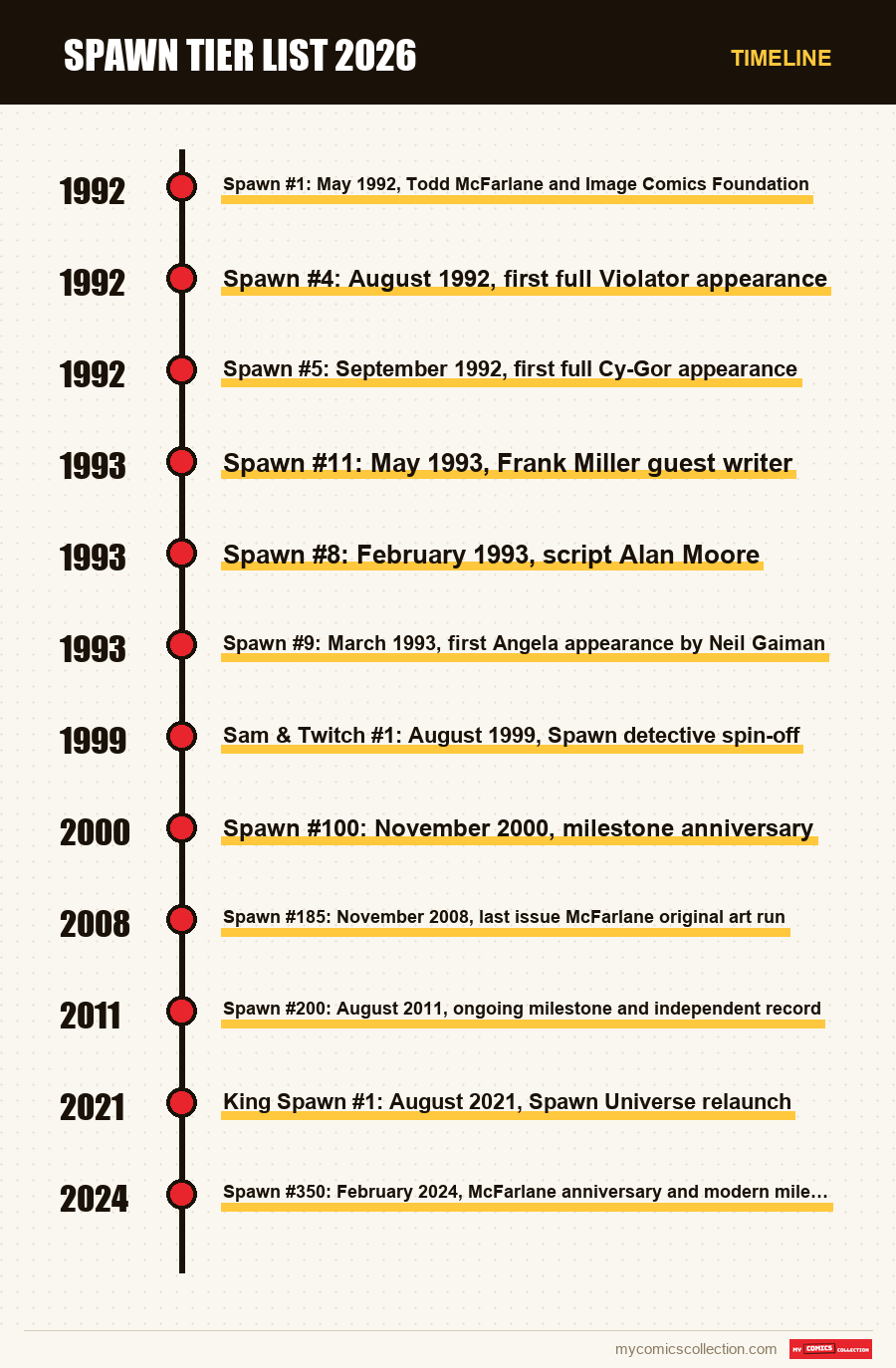
Spawn #1: May 1992, Todd McFarlane and Image Comics Foundation
Spawn #1, dated May 1992 (cover date), written and drawn by Todd McFarlane, contains the first full appearance of Al Simmons, aka Spawn, as well as the first appearance of Wanda Blake and Sam Burke (one of the detectives who will populate the Sam & Twitch series). The issue was released in May 1992 and the Image Comics publishing house was officially announced in February 1992 and then legally founded in June 1992 by McFarlane, Jim Lee, Rob Liefeld, Erik Larsen, Marc Silvestri, Jim Valentino and Whilce Portacio. Spawn #1 is, with Youngblood #1 and WildC.A.T.s #1, one of the three founding Image titles which commercially validated the creator-owner project.
The initial print run of Spawn #1 is estimated at 1.7 million copies, making it the most widely printed independent comic in history. This massive volume has two contradictory consequences: structural abundance of raw (the issue circulates in quantity on eBay and flea markets) but real CGC 9.8 rarity (copies purchased on newsstands by children have suffered massively). The cover, by McFarlane, shows Spawn chained in the iconic pose that would define the Image aesthetic of the 1990s. The date May 1992 corresponds to the Marvel-style cover date: it went on newsstands in March-April 1992.
Rating May 2026: CGC 9.8 between 500 and 800 euros according to Heritage sales observed in March and April 2026. CGC 9.6 between 180 and 280 euros. CGC 9.4 between 90 and 140 euros. CGC 9.0 between 50 and 80 euros. CGC 8.0 between 28 and 45 euros. CGC 6.0 between 15 and 25 euros. Raw NM (CGC 9.0-9.4 equivalent) between 15 and 30 euros. Raw VF between 6 and 12 euros. The CGC 9.8/raw NM ratio is around 25, one of the most favorable grading levers in modern Tier S. The rating increased from 40 to 60% between 2021 and 2024 with the relaunch of the Blumhouse film project and stagnates slightly in 2026 after the peak. For the complete genealogy of Image Comics, see history Image Comics 30 years.
Spawn #5: September 1992, first full Cy-Gor appearance
Spawn #5, dated September 1992, written and drawn by Todd McFarlane, contains the first full appearance of Cy-Gor (Cyber-Gorilla), one of the series' most iconic recurring antagonists. Cy-Gor is a half-man, half-gorilla hybrid soldier created by the government's military experiments, and he will become a major narrative pivot of the 1995-2000 arcs with his own spin-off miniseries. The issue is crucial for two reasons: it marks the transition of the series from the purely urban register to the body-horror and science fiction register which will define Spawn over time, and it introduces the mechanics of spin-offs of secondary characters which will structure the Spawn universe for 30 years.
Rating May 2026: CGC 9.8 between 280 and 450 euros. CGC 9.6 between 95 and 160 euros. CGC 9.4 between 45 and 75 euros. CGC 9.0 between 25 and 40 euros. Raw NM between 8 and 18 euros. Raw VF between 3 and 7 euros. The circulation of #5 is significantly lower than that of #1 (estimates around 600,000 to 800,000 copies, or half as much) but remains massive by modern Image standards. The CGC 9.8 / raw NM ratio exceeds 20, one of the best grading levers in Tier S Spawn. Position #5 remains undervalued by the general market which underestimates the narrative importance of Cy-Gor: it is probably the most relevant Tier S position for an intermediate budget 250-500 euros.
Spawn #9: March 1993, first Angela appearance by Neil Gaiman
Spawn #9, dated March 1993, written by Neil Gaiman with art by Todd McFarlane, contains the first appearance of Angela, a celestial headhunter who will become one of the most hotly contested characters in the modern comic book market. The issue is crucial for three reasons: it marks the collaboration between McFarlane and one of the most prestigious screenwriters in the industry (Gaiman, then at the height of his Sandman fame), it introduces Angela who would later be transferred to Marvel after the resolution of the legal dispute between the two creators, and it solidifies the Spawn strategy of attracting high-profile guest writers to boost the visibility of the series.
The legal context surrounding Angela is worth mentioning: Neil Gaiman and Todd McFarlane have been at odds for over a decade over the ownership of Angela, Medieval Spawn and Cogliostro, created by Gaiman in Spawn #9 (Angela), #9 (Medieval Spawn), and #26 (Cogliostro). After several lawsuits and successive settlements, Marvel finally bought Angela in 2013 and the character appeared in Age of Ultron #10, then in its own Marvel series from 2014. This legal story paradoxically reinforces the heritage value of Spawn #9: it is the only Image comic which contains the first appearance of a character who has officially become Marvel.
Rating May 2026: CGC 9.8 between 800 and 1,200 euros according to Heritage 2026 sales. CGC 9.6 between 280 and 450 euros. CGC 9.4 between 130 and 210 euros. CGC 9.0 between 65 and 100 euros. CGC 8.0 between 35 and 55 euros. Raw NM between 25 and 50 euros. Raw VF between 12 and 22 euros. The CGC 9.8 / raw NM ratio is around 25, comparable to #1. The rating doubled between 2013 (Marvel takeover) and 2020 then increased further by 30 to 50% with the spec on an Angela appearance in the MCU phase 7-8. For full character background, see Angela story in comics.
Spawn #350: February 2024, McFarlane anniversary and modern milestone
Spawn #350, dated February 2024, written and drawn by Todd McFarlane, is the anniversary issue which celebrates 32 years of uninterrupted publication of the series, an absolute record for a creator-owned title in the American comics industry. The issue is crucial for two reasons: it establishes Spawn as the longest independent series in history (ahead of Cerebus and Bone), and it serves as a platform for McFarlane to narratively relaunch the Spawn universe (Universe expansion) with several simultaneous spin-offs.
#350 was released with multiple variant covers (12 variants in total identified), including a McFarlane main cover, covers by Greg Capullo, J. Scott Campbell, Sean Murphy and several legendary Image artists. This multi-variant strategy increases the liquidity of the secondary market and creates a specific hierarchy between covers (the A McFarlane cover remains the reference). The estimated circulation of each cover is between 8,000 and 15,000 copies, or 100 times less than #1, which constitutes a major objective rarity for a modern issue.
Rating May 2026: CGC 9.8 cover A between 80 and 150 euros. CGC 9.6 between 35 and 65 euros. Raw NM between 18 and 35 euros. The issue is recent but its Tier S position is justified by the historical status (32 years continuous series) and by the rarity of the variant edition. The 36-month upside potential is estimated between 30 and 80% if the Blumhouse film project is successful and #350 serves as a narrative reference for the adaptation. Tier S long hold position, budgetarily accessible and liquid.
Tier A: Spawn secondary essentials
Le Tier A Spawn brings together comics that immediately follow Tier S in importance, without reaching absolute blue-chip status. These four pieces are important for a coherent collection of the character and often offer a better entry price / upside potential ratio than the Tier S already historicized and widely recognized by the market.
Spawn #4: August 1992, first full Violator appearance
Spawn #4, dated August 1992, written and drawn by Todd McFarlane, contains the first full appearance of Violator (in his clown form and then his transformed demonic form). Violator is Spawn's main antagonist in the original arc and remains one of the most iconic characters in the series, with his clown-demon design influencing the entire horror-comics culture of the 1990s. The issue is crucial for four reasons: Violator will become Spawn's recurring rival for 30 years of publication, the character will have his own mini-series (Violator 1994 by Alan Moore), he will appear in the Spawn 1997 film adaptation played by John Leguizamo, and he will probably be present in the Blumhouse 2026-2027 project.
Rating May 2026: CGC 9.8 between 220 and 380 euros. CGC 9.6 between 80 and 140 euros. CGC 9.4 between 40 and 65 euros. CGC 9.0 between 22 and 38 euros. Raw NM between 8 and 16 euros. Raw VF between 3 and 7 euros. The CGC 9.8 / raw NM ratio is exceptional (around 25), comparable to Tier S. The number remains budget-friendly and constitutes a priority Tier A position, particularly if the rumor of Violator's inclusion in the Blumhouse film is confirmed. The rating increased from 50 to 80% between 2021 and 2024 with the film spec and stagnates in 2026.
Spawn #11: May 1993, Frank Miller guest writer
Spawn #11, dated May 1993, written by Frank Miller (with art Todd McFarlane), is the issue which sees the arrival of the writer of Dark Knight Returns and Sin City on the series. The McFarlane-Miller collaboration is part of the strategy of attracting prestigious screenwriters which also brought Neil Gaiman (#9), Alan Moore (#8 and #37) and Dave Sim (#10). The issue is crucial for two reasons: it establishes Spawn as an attractive platform for the industry's top talent, and it establishes the darker-mature tone that will define the series from the second arc onwards.
Rating May 2026: CGC 9.8 between 180 and 320 euros. CGC 9.6 between 65 and 110 euros. CGC 9.4 between 30 and 50 euros. Raw NM between 6 and 14 euros. Raw VF between 3 and 6 euros. The CGC 9.8 / raw NM ratio exceeds 25, among the most relevant in Tier A Spawn. The issue remains undervalued by the general market which underestimates the importance of the Miller episode, even though it is the only Image comic ever written by Miller as a solo guest. Priority Tier A position for cross-publisher Miller collectors.
Spawn #100: November 2000, milestone anniversary
Spawn #100, dated November 2000, written and drawn by Todd McFarlane with contributions from Greg Capullo (who will take over art for the series starting with #185), is the anniversary issue of the 100th episode, a milestone that no other Image creator-owned title had reached before it. The issue contains the death of Cogliostro and a major change in Spawn's narrative status (which uncovers crucial elements about his origin). The issue was released with 4 variant covers (A, B, C, D), of which cover A McFarlane and cover D Capullo remain the most sought after.
Rating May 2026: CGC 9.8 cover A between 120 and 200 euros. CGC 9.6 between 50 and 85 euros. CGC 9.4 between 22 and 38 euros. Raw NM between 8 and 16 euros. Raw VF between 3 and 7 euros. The estimated circulation is 75,000 to 100,000 copies per cover, or 15 to 20 times less than #1. Tier A long hold position, budgetarily accessible and with moderate but real upside potential if the Netflix animated project devotes a season to the 90-100 arc (death of Cogliostro).
Spawn #200: August 2011, ongoing milestone and independent record
Spawn #200, dated August 2011, written by Todd McFarlane and drawn by Todd McFarlane with contributions from Greg Capullo, Whilce Portacio, Michael Golden and several guest artists, is the issue that establishes Spawn as the longest modern independent series ever published to that date. The issue was released with a 64-page anniversary format and several variant covers. It also marks the narrative transition to the 2011-2015 arcs which will bring Jim Downing then the return of Al Simmons in 2015.
Rating May 2026: CGC 9.8 between 80 and 140 euros. CGC 9.6 between 35 and 55 euros. Raw NM between 10 and 18 euros. Raw VF between 4 and 8 euros. Very affordable Tier A position, recommended for collectors who want a modern milestone without being exposed to the high price of #1 or #9. Liquidity remains moderate but the upside potential over 36 months is estimated between 20 and 40% if the announced Netflix series materializes. For the complete schedule of Image releases that mark the milestones, see Calendar Image Independent Comics.
Tier B: Spawn Underrated Sleepers and Bows
Le Tier B Spawn brings together the sleepers, that is to say the issues which deserve the attention of informed collectors but whose value the general market has not yet fully recognized. These coins often present the most relevant price/potential ratios at 24-36 months, with limited downside risk. Four typical examples in 2026, particularly interesting in the context of the announced film and animation relaunches.
Spawn #8: February 1993, script Alan Moore
Spawn #8, dated February 1993, scripted by Alan Moore (with art Todd McFarlane), is one of two Spawn issues scripted by Moore (along with #37 in November 1995). Alan Moore is the author of Watchmen , V for Vendetta and From Hell, and his contribution to Spawn represents one of the few Moore-McFarlane collaborations ever documented. The issue is crucial for two reasons: it establishes Spawn as an attractive platform for leading Vertigo/independent writers, and it establishes the philosophical-theological tone that will structure the Spawn mythology from the second arc onwards.
Rating May 2026: CGC 9.8 between 140 and 240 euros. CGC 9.6 between 50 and 85 euros. CGC 9.4 between 22 and 38 euros. Raw NM between 6 and 12 euros. Raw VF between 3 and 6 euros. The CGC 9.8 / raw NM ratio is exceptional (around 25-30), among the most relevant grading levers for Tier B Spawn. The issue is undercut by the general market which favors #9 Gaiman and neglects #8 Moore, even though both represent the same editorial strategy of prestigious invited talents. Priority Tier B position for cross-publisher Moore collectors.
Spawn #185: November 2008, last issue McFarlane original art run
Spawn #185, dated November 2008, story by Todd McFarlane and drawn by Whilce Portacio, is the final issue of the first ongoing phase before regular art transitions to Greg Capullo and other artists. It marks the end of the McFarlane direct art era on the regular series (McFarlane will occasionally return to anniversary issues such as #200, #250, #300 and #350, but will no longer be a regular artist). The issue is crucial for two reasons: it marks the series' generational transition to a new creative team, and it represents a historic entry point for Jim Downing's 2008-2015 phase as the new Spawn.
Rating May 2026: CGC 9.8 between 80 and 140 euros. CGC 9.6 between 30 and 55 euros. Raw NM between 6 and 14 euros. Raw VF between 3 and 6 euros. The number remains largely underpriced by the general market which underestimates the importance of the McFarlane-Capullo transition. Priority Tier B position for collectors who want a historical entry point before the 2008-2015 phase. The upside potential at 36 months remains moderate but the downside risk is very low given the narrative centrality of the issue.
Sam & Twitch #1: August 1999, Spawn detective spin-off
Sam & Twitch #1, dated August 1999, written by Brian Michael Bendis (then at the start of his career at Marvel and Image) and drawn by Angel Medina, launches the spin-off series centered on the two detectives Sam Burke and Maximilian Williams (Twitch) who have inhabited the Spawn universe since #1 of 1992. The issue is crucial for three reasons: it establishes Spawn as an extended universe capable of carrying several simultaneous series (foreshadowing the Spawn Universe arc 2021), it marks the arrival of Brian Michael Bendis as a leading screenwriter at Image (Bendis will then become lead screenwriter at Marvel), and it introduces the noir-police genre into the Spawn universe which will be taken up in several subsequent spin-offs.
Rating May 2026: CGC 9.8 between 100 and 180 euros. CGC 9.6 between 40 and 70 euros. CGC 9.4 between 18 and 30 euros. Raw NM between 5 and 12 euros. Raw VF between 2 and 5 euros. The CGC 9.8 / raw NM ratio is excellent (around 25). Priority Tier B position for Bendis early collectors and for fans of the Spawn extended universe. The potential increase over 36 months is estimated between 40 and 80% if a TV adaptation of detectives is announced (the concept lends itself particularly well to a black series streaming format).
King Spawn #1: August 2021, Spawn Universe relaunch
King Spawn #1, dated August 2021, written by Sean Lewis with art by Javier Fernandez (cover Todd McFarlane), launches the first spin-off series of the Spawn Universe arc announced by McFarlane in June 2021. The issue is crucial for three reasons: it consecrates the Spawn Universe editorial relaunch 30 years after #1, it introduces a new narrative dynamic around Spawn as King who rules the underworld, and it establishes the commercial precedent that will allow the launch of Gunslinger Spawn , The Scorched and several other simultaneous spin-offs over 2021-2024.
Rating May 2026: CGC 9.8 cover A between 50 and 90 euros. CGC 9.6 between 22 and 38 euros. Raw NM between 10 and 18 euros. The circulation of #1 King Spawn exceeds 200,000 copies (post-2020 modern Image record), which maintains the raw abundance but leaves the CGC 9.8 rarity intact. Tier B position accessible budgetarily with moderate but real upside potential if the Blumhouse film adopts the King Spawn concept for its 2026-2027 version. Liquidity remains high (10 to 20 monthly CGC sales).
Collecting this series?
Track what you own, what you are missing and what your collection is worth. 7 day trial.
Start my trial →Tier C: Spec 2026-2027 and windows to anticipate
Le Tier C Spawn brings together speculative bets linked to film and animation projects in development. This category presents the highest risk/reward ratio: a successful bet can multiply the stake by 5 to 10 in 18-24 months (typical case of a first appearance of a central character in an adaptation), but a production failure can divide the odds by 2 or 3 over the same period. The Tier C allocation discipline must never exceed 15% of the total collection budget.
Spawn Blumhouse film: Jamie Foxx in development
The Spawn film project by Blumhouse Productions with Jamie Foxx in the title role has been in development since 2017, under the creative direction of Todd McFarlane himself who directs and co-writes. The project has experienced several delays (script, casting, financing) and the release date is not confirmed as May 2026, but McFarlane's successive announcements in 2024 and 2025 point to a start of filming in 2026 and a possible release 2027-2028. Confirmed cast includes Jamie Foxx (Spawn), Jeremy Renner (a detective, likely Twitch), and Jamie Bell (role unconfirmed).
Tier C spec strategy: position Tier S and A before firm release date confirmation. Once the date is confirmed and marketing launched (typically 12 to 18 months before release), the speculative peak begins and purchasing opportunities close. The comics most exposed to peak film are Spawn #1, #4 (Violator), #5 (Cy-Gor), #8-#9 (Moore and Gaiman), #11 (Miller) and the entire first year of the series (#1-#12). Recommended position: accumulate raw NM or CGC 9.4-9.6 on these keys between 2026 and 2027 before the firm announcement. For the global spec film-series strategy 2026-2030, see spec keys 2027 Marvel DC movies series.
Spawn Netflix animated series: project announced
A Spawn animated series has been in development at Netflix since 2019, initially announced as a spiritual sequel to the 1997-1999 HBO series (which won an Emmy for Outstanding Animated Program). The project has evolved several times and is not confirmed as of May 2026, but McFarlane's announcements in 2024 and 2025 keep the option open. If the series comes to fruition, it represents a secondary but real catalyst on the adapted story arcs (likely the original arc #1-#25 and the Sam & Twitch arc).
Strategy spec Tier C animated series: less priority than the Blumhouse film but to be anticipated. The comics on display are Sam & Twitch #1 (1999), early arcs #1-#25, and potentially Curse of Spawn #1 (1996). The optimal purchasing window remains 2026-2027 before any firm announcement of a release date. For beginning Image collectors, see first comics Image to get started guide before any Tier C spec purchase.
Strategy by budget: 500, 2,000, 10,000 or 50,000 euros
The budget allocation of a Spawn 2026 collection depends on the available budget and the hold horizon. The following sections detail the trade-offs for four typical budgets, with concrete positions and target grades.
Budget 500 euros: Tier S start accessible
With 500 euros, the absolute priority is the acquisition of Spawn #1 in adapted grade. Three possible scenarios. Scenario 1: Spawn #1 raw NM (15-30 euros) plus Spawn #9 raw VF (12-22 euros) plus Spawn #5 raw NM (8-18 euros) plus Spawn #4 raw NM (8-16 euros) plus Spawn #8 raw NM (6-12 euros). Total: between 49 and 98 euros, leaving 400 euros to expand to Tier A (Spawn #11 Miller raw NM, Spawn #100 raw NM, Spawn #200 raw NM) and complete with some Tier B (Sam & Twitch #1, King Spawn #1).
Scenario 2: Spawn #1 CGC 8.0 (28-45 euros) plus Spawn #9 raw NM (25-50 euros) plus Spawn #5 raw NM (8-18 euros). Total: 61-113 euros, leaving 400 euros for Spawn #4 and completing Tier A. More ambitious scenario 3: aim for a CGC 9.4 for #1 (90-140 euros) by sacrificing extended coverage. Recommendation 2026: scenario 1 remains optimal for a beginner who wants to understand the series narratively before investing in CGC. For a comparative Image budget analysis, see comics Image to get started guide.
Budget 2,000 euros: upgrade to Tier S
With 2,000 euros, the optimal arbitration mixes CGC grading and raw depending on the parts. Recommended allocation: Spawn #1 CGC 9.4 (90-140 euros) plus Spawn #9 CGC 9.4 (130-210 euros) plus Spawn #5 CGC 9.4 (45-75 euros) plus Spawn #350 CGC 9.8 cover A (80-150 euros). Total Tier S: 345-575 euros. Remaining 1,425-1,655 euros for Tier A: Spawn #4 CGC 9.4 (40-65 euros), Spawn #11 CGC 9.4 (30-50 euros), Spawn #100 cover A CGC 9.6 (50-85 euros), Spawn #200 CGC 9.8 (80-140 euros). Total Tier A: 200-340 euros. Remaining 1,100-1,450 euros for Tier B and sleepers margin: Spawn #8 CGC 9.4 (22-38 euros), Sam & Twitch #1 CGC 9.6 (40-70 euros), King Spawn #1 CGC 9.8 (50-90 euros), plus raw collection extension.
This allocation guarantees a complete Tier S + A base in intermediate grades, with room to extend raw on the other keys and complete the narrative series up to #25 or #50. The recommended hold horizon is 5-7 years with partial resale possible around the release of the Blumhouse film 2027-2028.
Budget 10,000 euros: Tier S CGC 9.6+ collection
With 10,000 euros, the strategy moves to systematic CGC 9.6+ grading on Tier S and Tier A. Recommended allocation: Spawn #1 CGC 9.6 (180-280 euros) plus Spawn #9 CGC 9.6 (280-450 euros) plus Spawn #5 CGC 9.6 (95-160 euros) plus Spawn #350 CGC 9.8 set variants (300-500 euros for 4 covers). Total Tier S: 855-1,390 euros. Remaining 8,600-9,150 euros for complete Tier A in CGC 9.6 plus selective Tier B in CGC 9.4-9.6 plus complete raw narrative collection #1-#100 (estimated 800-1,500 euros). The budget also allows for a Tier C bet with 2-3 King Spawn variants and Spawn Universe spin-offs in CGC 9.8.
This allocation builds a balanced heritage collection with optimal exposure to the 2027-2028 film cycle. Recommended holding horizon 7-10 years with strategic partial resale 30% around peak film. For the long-term transversal comics investment strategy, see comics investment update 2027 strategy pillar.
Budget 50,000 euros: Tier S CGC 9.8 and rare opportunities
With 50,000 euros, the objective is the acquisition of Tier S CGC 9.8 and access to rare variants and signature series. Recommended allocation: Spawn #1 CGC 9.8 (500-800 euros), Spawn #1 CGC 9.8 by McFarlane (1,800-3,500 euros if available), Spawn #9 CGC 9.8 (800-1,200 euros), Spawn #9 CGC 9.8 by Gaiman (3,000-5,000 euros if available), Spawn #5 CGC 9.8 (280-450 euros), Spawn #350 CGC 9.8 set 12 variants (1,200-2,200 euros). Total Tier S high-grade and signature: between 7,580 and 13,150 euros.
Remaining 36,850-42,420 euros for: Tier A CGC 9.8 complete (Spawn #4, #11, #100, #200, total 580-960 euros), Tier B CGC 9.6+ complete (Spawn #8, Sam & Twitch #1, King Spawn #1, total 250-450 euros), complete raw NM narrative collection #1-#350 (estimated 4 000-6,500 euros), selective rare CGC 9.8 variants (1:25, 1:50 on anniversary arcs, budget 5,000-10,000 euros), and Tier C spec margin (10,000-15,000 euros on Blumhouse and Netflix). Hold horizon 10-15 years with partial strategic resale. To estimate the value of an existing collection before arbitration, the free estimate provides an indicative range by grade and state.
Pitfalls to avoid in Spawn 2026: 4 classic mistakes
The Spawn market has several specific pitfalls linked to the record print run of #1 and the particularities of the Image Comics edition of the 1990s. Identifying these pitfalls before any purchase avoids significant losses and sub-optimal arbitrage.
Trap 1: Spawn #1 circulation 1.7 million and modest raw rating
The record circulation of 1.7 million copies on Spawn #1 creates a structural abundance that surprises collectors accustomed to modern rarities. The raw NM can easily be found between 15 and 30 euros on eBay, and the price will never increase like that of New Mutants #98 (circulation 300,000) or Walking Dead #1 (circulation 7,000). The modest raw rating is not a trap in itself, but it becomes a trap if it suggests that the CGC 9.8 will also be modest: the truth is the opposite, the CGC 9.8 rarity is extreme because the 1.7 million copies suffered massively on newsstands, and the CGC 9.8 rating reaches 500-800 euros, i.e. an exceptional CGC 9.8 / raw NM ratio (25-30).
The practical consequence: for Spawn #1, grading is the preferred position if the copy is a pristine candidate. A raw NM purchased for 25 euros which outputs CGC 9.8 after grading (submission cost 60-100 dollars) generates a mechanical added value of 400-700 euros. The rule also applies to other Tier S and A: Spawn #5, #9, #4, #11 all have CGC 9.8 / raw NM ratios greater than 20, which justifies systematic grading for any 9.8 candidate copy.
Trap 2: Spawn #9 Gaiman vs. McFarlane conflict and Angela identification
The Gaiman vs. McFarlane legal dispute surrounding Angela, Medieval Spawn, and Cogliostro lasted over a decade and generated lasting confusion over attribution of first appearance. Several sellers present Spawn #9 as "co-creator Angela" while the cover and content are clearly scripted by Gaiman alone (McFarlane does the art). The distinction is crucial for cross-publisher Gaiman-oriented collectors: Spawn #9 is one of three Gaiman comics ever published by Image in the mainstream (along with Spawn #26 Cogliostro and Spawn/Medieval Spawn limited). The rarity Gaiman-writes at Image reinforces the heritage value of #9.
The secondary pitfall concerns the Medieval Spawn version: some sellers present Spawn #9 as "first appearance Medieval Spawn" while Medieval Spawn appears briefly in Spawn #9 and then in full page in Spawn #10 (April 1993, written by Dave Sim of Cerebus). So the first full appearance of Medieval Spawn is Spawn #10, not #9. This confusion is common and can create 30-50% buy arbitrages in favor of the underpriced Spawn #10. For the full timeline, see Angela story in comics.
Trap 3: newsstand vs direct edition on the first Spawn
The first Spawn issues (1992-1995) were published in newsstand and direct edition versions, with a barcode distinction similar to that seen on Marvel-DC comics of the same era. The newsstand proportion is estimated at 15-20% of the draw depending on the numbers. The newsstand rarity justifies a rating premium of 30 to 60% in CGC 9.6+. CGC has noted the distinction on the slab since 2019 only, creating an arbitrage on the old slabs not labeled newsstand. The classic trap is to sell a newsstand at the price of a live broadcast (30-60% loss) or conversely to buy a live broadcast at the price of a newsstand (symmetrical loss).
Verification is done on the barcode at the bottom left of the cover: full UPC barcode with price = newsstand, Image Comics style barcode with Image logo = direct edition. Verification is quick but must be systematic for any purchase over 100 euros. On Spawn #1, the CGC 9.8 newsstand premium reaches 800-1,200 euros compared to 500-800 euros for the standard live, or 60% premium. On Spawn #5, #9 and other Tier S-A, the premium is around 40-50%.
Trap 4: multiple reprints and facsimile editions Spawn #1
Image has published several reprints and facsimile editions of Spawn #1 in the years 2000, 2010 and 2020, identically reproducing the contents of the 1992 first print but with modified cover colors and a modern cover price. The 25th Anniversary Edition (2017) and the 30th Anniversary Edition (2022) are the most common on the secondary market. These facsimiles bear an “Anniversary Edition” or “Reprint” label on the cover and a modern price ($4.99 or $5.99), but unscrupulous sellers sometimes present them as originals in blurry listings or low-resolution photos.
The verification is immediate on the cover price (1.95 dollars for the first print 1992 vs. 5.99 dollars for the facsimile) and the edition mention. The facsimile rating remains modest (10-25 euros raw NM, 60-120 euros CGC 9.8), without any connection with the original. The trap only arises in the event of a misleading listing, which is common on eBay for modern comics. The rule: systematically check the cover price and the edition mention before any purchase above 30 euros. For the long-term transversal comics investment strategy, see comics investment update 2027 strategy pillar.
Monitoring 2026-2030: resale windows and cycles to anticipate
Le long-term follow-up Spawn over 2026-2030 must integrate several probable catalysts. The Blumhouse film starring Jamie Foxx represents the main catalyst, with an estimated release window of 2027-2028. The Netflix animated series represents a secondary catalyst with a 2026-2028 window. The celebration of Image Comics' 35th anniversary in 2027 (founded June 1992) represents a third media catalyst but without a firm direct impact on ratings. The 350th issue (#350 February 2024) remains a narrative reference which can be increased by a possible #400 in 2028.
Indicative calendar 2026-2030. Year 2026: optimal purchasing window on Tier S, A and B before Blumhouse rise. Year 2027: if firm announcement of film release date, start of the major speculative cycle, purchase window gradually closes on Tier S and A. Year 2028: probable speculative peak around the release of the Blumhouse film, optimal resale window on Tier S (30-60% above 2026), Tier A (50-100%) and B (60-150%). Year 2029: post-peak digestion, rating stabilized or slightly decreasing, waiting for the next catalyst. Year 2030: new cycle possible with Netflix series season 2 or sequel film announcement.
The empirical rule observed on modern Image Comics key issues over 15 years: 50% of the pre-film increase occurs in the 12 months preceding the release, 30% at the release, 20% in the following 6 months. Beyond that, partial descent of 15 to 25% before stabilization. For Tier S Spawn, the 2028 peak should represent a partial resale opportunity, particularly on parts purchased in 2022-2024 at prices that are still reasonable. The optimal resale window extends from June to December 2028 according to this cycle.
Daily monitoring of Tier S ratings requires a tracking tool. A rating recorded in a notebook or static file is obsolete within 60 days. Daily-updated valuation by grade in a Comics Manager provides the necessary refreshment to manage a 36-60 month hold strategy; pair it with eBay saved searches for price alerts. See the comics database et the list of key issues to quickly identify arbitrage opportunities. For collectors new to Image, read first comics Image to get started guide et comics Image universe guide pillar before any purchase above 500 euros. Monthly monitoring of Heritage and eBay sales remains the basis for any purchase or resale decision on Tier S Spawn.
FAQ: Tier list Spawn 2026
Why does Spawn #1 dominate Tier S despite its record circulation of 1.7 million?
Because it is the founding comic of Image Comics in May 1992 and the first full appearance of Al Simmons, created by Todd McFarlane who provides script and drawing. The massive print run of 1.7 million copies creates a raw abundance but a real CGC 9.8 rarity, because the copies suffered massively on newsstands in the hands of children in the 1990s. The CGC 9.8 rating reaches 500-800 euros in 2026, i.e. an exceptional CGC 9.8 / raw NM ratio around 25-30, one of the best grading levers in Tier S Image modern. Image's founding status and market liquidity (25-50 monthly CGC sales) confirm the position at the top of Tier S.
Is Spawn #9 really worth 800-1,200 euros in CGC 9.8 with the Gaiman vs McFarlane conflict?
Yes, and the legal conflict paradoxically reinforces the heritage value of the number. Spawn #9 contains the first appearance of Angela, a character written by Neil Gaiman and subsequently purchased by Marvel in 2013 after more than a decade of legal proceedings. This is the only Image comic that contains the first appearance of a character who officially became Marvel, making it a unique historical piece. The Gaiman-McFarlane collaboration (prestigious Sandman screenwriter guest on Image) adds to the value. The rating doubled between 2013 and 2020 then progressed further with the spec on an Angela appearance in the MCU phase 7-8. Tier S position non-negotiable.
Is Spawn #5 Cy-Gor really Tier S at 280-450 euros in CGC 9.8?
Yes, and it probably represents the most undervalued Tier S Spawn piece by the general market. Cy-Gor has been a recurring antagonist of Spawn since 1992, with his own spin-off miniseries and several appearances in major arcs from 1995-2020. The issue marks the series' transition towards the body-horror and science fiction register that will define Spawn over time. The print run is less than half of #1 (estimates 600,000 to 800,000 copies), which makes the CGC 9.8 mechanically rarer. The CGC 9.8 / raw NM ratio exceeds 20. Priority Tier S position for intermediate budget 250-500 euros.
Should we favor raw or CGC for a Spawn 2026 collection?
The rule depends on the tier and the condition. For Spawn #1 and #9 Tier S, CGC grading is non-negotiable above 200 euros investment per piece: counterfeits, undeclared restorations and newsstand/direct confusions make raw too risky. For Spawn #5, #4, #11 Tier S and A, CGC grading is justified from CGC 9.6, where the raw price / CGC price ratio justifies the cost of grading (60-100 dollars per copy). For Tier B and C, raw remains the main option, except in the exceptional case of pristine candidate 9.8. The exceptional CGC 9.8 / raw NM ratio on Tier S Spawn (around 25) justifies the systematic grading on pristine examples.
Should we anticipate the Blumhouse Spawn film to position Tier C in 2026?
Yes, but with strict allocation discipline. The Blumhouse film starring Jamie Foxx in development since 2017 remains unconfirmed as of May 2026 in terms of a firm release date, but McFarlane's successive announcements in 2024 and 2025 point to a 2026 shoot and a 2027-2028 release. The optimal strategy is to accumulate raw NM or CGC 9.4-9.6 on Tier S and A (Spawn #1, #4, #5, #8, #9, #11) between 2026 and 2027 before the firm announcement of the date. Once the date is confirmed and marketing launched, the speculative peak begins and buying opportunities close. The Tier C allocation must never exceed 15% of the total collection budget to limit downside risk.