
Spawn #1 appeared in May 1992, created by Todd McFarlane after his resounding departure from Marvel. It is the founding title of Image Comics, sold to 1.7 million copies from the first issue, a record for an independent comic. The main series today exceeds 370 numbers, making it the longest independent series in American comics history. With the spin-offs (King Spawn, Gunslinger Spawn, The Scorched, Sam & Twitch), the Spawn universe represents more than 600 published issues. #1 in CGC 9.8 trades between $400 and $800, and the #301 record (longest independent run in history) made McFarlane an industry legend.
Spawn is one of the most significant creations in the history of independent comics. Born from the imagination of Todd McFarlane, former star artist of Amazing Spider-Man and Spider-Man at Marvel, the character of Al Simmons, a betrayed soldier transformed into Hellspawn, redefined what a creator could accomplish outside of the two major publishers. In more than thirty years of almost uninterrupted publication, the Spawn franchise has generated dozens of series, a film, an Emmy Award-winning animated series, and thousands of action figures through McFarlane Toys.
For a collector, the Spawn universe represents an immense and sometimes confusing territory. Between the main series which exceeds 370 issues, the multiple spin-offs launched in the 90s then relaunched in the 2020s, the crossovers with other Image titles, and the countless variant covers, it is easy to get lost. This article traces the complete history of the franchise, issue by issue, with the information a collector needs: dates, creators, print runs, and current key issue values.
Whether you're looking to build a complete Spawn collection or identify which issues are actually worth something on the secondary market, this guide covers the entire universe, from the founding of Image Comics in 1992 to the latest releases.
The founding of Image Comics: the background to the birth of Spawn
Impossible to understand Spawn without understanding the Image Comics revolution. In December 1991 and January 1992, seven of Marvel's most popular artists left the publisher to found their own publishing house. Todd McFarlane (Spider-Man), Jim Lee (X-Men), Rob Liefeld (X-Force), Marc Silvestri (Wolverine), Erik Larsen (Amazing Spider-Man), Jim Valentino (Guardians of the Galaxy) and Whilce Portacio form Image Comics with a revolutionary premise: each creator remains the owner of their characters.
Image's model was a direct response to the practices of Marvel and DC, where creators had no rights to their creations. Jack Kirby had created most of the Marvel Universe without receiving a cent in royalties. Todd McFarlane, who had dramatically boosted sales of Spider-Man, owned nothing of what he had created at Marvel. The accumulated frustration fueled a historic rupture.
The first Image titles arrived in bursts in the spring and summer of 1992: Youngblood by Liefeld in April, Spawn by McFarlane in May, Savage Dragon by Larsen in July, WildC.A.T.s by Lee in August. Each is a massive commercial success, driven by the speculative frenzy of the time but also by real public curiosity. Of all these launches, it is Spawn who will leave the most lasting mark.
Spawn #1 (May 1992): the independent sales record
The first issue of Spawn appeared in May 1992 with a cover by McFarlane that would become iconic: Al Simmons, flowing red cape and chains, emerging from the darkness. The number sells at 1.7 million copies, an absolute record for an independent comic that will stand for decades. Only The Walking Dead #1 can claim to have had a comparable impact in the independent world, but with much lower initial sales figures (7,000 copies upon its release in 2003).
The story features Al Simmons, a CIA agent murdered by his superior Jason Wynn, who makes a pact with the demon Malebolgia to return to Earth. He wakes up five years after his death, disfigured, endowed with supernatural powers but with a limited reserve of necroplasmatic power. Her symbiotic suit, the K7-Leetha, is one of the character's most distinctive visual elements.
Current value of Spawn #1
Despite its massive print run, Spawn #1 retains a respectable value thanks to its historical significance:
- CGC 9.8 (Newsstand): $600-1,200 depending on recent sales. The newsstand edition is significantly rarer than the direct market version.
- CGC 9.8 (Direct Edition): $300-500. Most common version but demand remains strong.
- CGC 9.6: $100-200.
- Raw (ungraded, very good condition): $20-60.
- Spawn #1 Black & White Edition: limited variant, $150-400 in CGC 9.8.
Collector's advice: The newsstand version of Spawn #1 is significantly rarer than the direct market edition. If you are looking for a copy to grade, choose the newsstand: the premium compared to the direct version can reach double in high grade. Check the UPC barcode on the cover (newsstand) versus the Image logo without a barcode (direct).
The main Spawn series: complete timeline (1992-present)
The main Spawn series is divided into several major eras, each with its own creators, story arcs, and specific key issues. Here is the detailed timeline that every collector should know.
McFarlane solo era (1992-1999): issues #1 to #100
Todd McFarlane wrote and drew the first issues, but quickly called on renowned writers. Issues #1 through #7 are entirely by McFarlane. From #8, he invites prestigious guest writers: Alan Moore (#8, #37), Neil Gaiman (#9), Dave Sim (#10), Frank Miller (#11). This strategy makes Spawn a unique creative showcase.
- #8 (February 1993, Alan Moore / McFarlane): First guest-writer. Intro to Vindicator. Moore brings unprecedented narrative depth. $30-80 in CGC 9.8.
- #9 (March 1993, Neil Gaiman / McFarlane): First appearance of Angela and Medieval Spawn. This number is at the center of the famous Gaiman vs. McFarlane trial. Angela will then be bought by Marvel. $80-250 in CGC 9.8.
- #10 (May 1993, Dave Sim / McFarlane): Crossover with Cerebus. First appearance of Cyan Fitzgerald. $20-50 in CGC 9.8.
- #11 (June 1993, Frank Miller / McFarlane): One of the most appreciated numbers by Miller fans. $30-70 in CGC 9.8.
- #19 (March 1994): Introducing Spawn's redesigned look by McFarlane. The costume evolves significantly.
- #100 (November 2000): Double anniversary issue, the death of Malebolgia (and Angela). Multiple covers by McFarlane, Alex Ross, and Greg Capullo. $20-60 depending on variant.
The Greg Capullo era and the major arcs (2000-2010): issues #100 to #200
Greg Capullo, who later became DC's Batman artist with Scott Snyder, was Spawn's lead artist for a long time. The script was taken over by Brian Holguin and then David Hine, while McFarlane remained involved as co-writer and editor.
- #117 (February 2002): First issue of the "Hellspawn War" arc. Important narrative turning point.
- #150 (May 2005): Anniversary number. Cover by McFarlane. $15-40.
- #174-175 (2008): David Hine's run brings a new darkness to the series.
- #185 (October 2008, written by McFarlane, drawn by Whilce Portacio): McFarlane resumes writing. Jim Downing officially becomes the new Spawn.
- #200 (February 2011): Double birthday number. Al Simmons returns. Variant covers by McFarlane and other artists. $15-30.
The renaissance and the record (2011-2024): issues #200 to #370+
The modern period of Spawn is marked by two major events: the return of Al Simmons as the main character and the race towards the world record for the longest run for an independent comic.
- #296-300 (2019): The climb to the record. Sales explode as the market understands the historic significance of the event.
- #297 (April 2019): Part of the run-up to #300, where Jessica Priest makes her first appearance as She-Spawn. $20-80 in CGC 9.8.
- #298 (May 2019): Introducing Reaper. The hype around #300 drives up sales of previous issues.
- #300 (September 2019) : The historic number. Spawn beats Cerebus' record (300 issues) to become the longest independent series in history. Screenplay by McFarlane, with art by J. Scott Campbell, Greg Capullo, Jason Shawn Alexander and Jerome Opeña. Massive print run, many variations. The issue sold over 265,000 copies. $10-30 for common variants, up to $200 for some limited variants in CGC 9.8.
- #301 (September 2019): First number beyond Cerebus' record. McFarlane on screenplay and drawing. Symbolically very important. $15-50 in CGC 9.8.
- #311 (August 2020): First Spawn cover by Puppeteer Lee. Beginning of an ongoing artistic collaboration.
- #350 (2024): New milestone reached. Spawn continues to break his own records.
Why Spawn #300 and #301 matter so much: When Spawn surpassed 300 issues of Dave Sim's Cerebus, it became the longest-running independent comic in history. This record is not only symbolic: it has brought the attention of the media, speculators and nostalgic collectors back to the series. Monthly sales increased tenfold between #295 and #300. For a collector, numbers #296 to #301 form a block to keep.
Major spin-offs from the Spawn universe
The Spawn universe is not limited to the main series. Since 1993, numerous spin-offs have explored the supporting characters and expanded the mythology. Here are the essential series listed in chronological order.
Angela (1994-1995): 3 issues
Angela, Spawn's hunting angel created by Neil Gaiman in Spawn #9, had her own three-issue miniseries in 1994-1995, written by Gaiman and drawn by Greg Capullo. The character, a celestial warrior sent to eliminate the Hellspawns, immediately won over readers with her design and personality.
After the lawsuit between Gaiman and McFarlane over the rights to the character, Angela was sold to Marvel Comics in 2013 and brought into the Thor universe by Gaiman himself in Age of Ultron #10. She then had her own series at Marvel, Angela: Asgard's Assassin. Image originals have become collectible curiosities sought precisely for their unique legal status. Angela #1 (Image): $10-30 in CGC 9.8.
Violator (1994): 3 issues + Violator vs Badrock (1995): 4 issues
The Violator, aka the Clown, is one of Spawn's most iconic antagonists. Its 1994 miniseries was written by Alan Moore and drawn by Bart Sears. Moore brings the same narrative density as to his issues of Spawn. Violator #1 (Alan Moore): $10-25 in CGC 9.8. The sequel, Violator vs Badrock, is a crossover with Rob Liefeld's title, less sought after by collectors.
Curse of the Spawn (1996-1999): 29 issues
Anthology series that explores the dark corners of the Spawn universe. Different artists and writers take turns telling stories involving other Hellspawns throughout history, from feudal Japan to World War II. Written primarily by Dwayne Turner and Alan McElroy, with art by Danny Miki and Dwayne Turner.
Issues are generally affordable ($2-10 each), but the complete run of 29 issues in good condition is increasingly difficult to collect. The latest issues (#25-29) have had particularly low circulations and may require patience to find them. For collectors who want to explore the Spawn universe beyond Al Simmons, this is a great low-budget entry point.
Sam & Twitch (1999-2004): 26 issues + Sam & Twitch: The Writer (2010): 4 issues
Detectives Sam Burke and Twitch Williams, recurring supporting characters from Spawn, had their own detective series. The first arc is written by Brian Michael Bendis, then at the start of his career, just before he became Marvel's star writer with Ultimate Spider-Man and New Avengers. Sam & Twitch #1 (Bendis): $15-40 in CGC 9.8, primarily sought after for the Bendis signing.
Spawn: The Dark Ages (1999-2001): 28 issues
Series set in the Middle Ages, centered on Lord Covenant, a crusader knight turned medieval Hellspawn. Written by Steve Niles (future author of 30 Days of Night) and drawn by Liam Sharp (who would later draw Wonder Woman at DC with Greg Rucka). It's one of the best-written spin-offs in the Spawn universe, with a dark fantasy atmosphere very distinct from the main series.
The Dark Ages stands out for its tone, closer to Vertigo than to a classic Image comic from the 90s. Liam Sharp's work on armor, castles and battles is remarkable. For collectors who appreciate the medieval Spawn seen in Gaiman #9, this series is a natural extension. #1: $8-20 in CGC 9.8. The complete series is generally found between $60 and $150.
Hellspawn (2000-2003): 16 issues
Alternative series with a more adult and experimental approach. Written by Brian Michael Bendis (#1-6) then Steve Niles, with art by Ashley Wood. Ashley Wood's visual style, expressionist and almost abstract, makes it an atypical collector's item in the Spawn universe. Hellspawn #1: $10-25 in CGC 9.8.
Gunslinger Spawn (2021-present): 30+ issues
One of three titles launched by McFarlane in 2021 to create a true "Spawn universe" with interconnected series. Gunslinger Spawn explores the story of Javier Calderón, a Hellspawn from the Wild West. Written by Todd McFarlane and drawn by Brett Booth. #1 sold over 200,000 copies. Gunslinger Spawn #1: $10-30 in CGC 9.8.
King Spawn (2021-present): 40+ issues
Al Simmons' solo series alongside the main series. King Spawn focuses on the more personal aspects of the character and his interactions with the human world, far from the cosmic battles of the parent series. Written by Sean Lewis then McFarlane, with drawings by Javi Fernández then Thomas Nachlik.
The launch of King Spawn was a major commercial event. #1 sold over 490,000 copies, a spectacular number for a 2021 launch, and the best independent debut issue in years. This success proved that the Spawn brand still had considerable power of attraction among collectors and speculators. King Spawn #1: $10-25 in CGC 9.8. Ratio variants (1:50, 1:100) can reach $80-200.
The Scorched (2022-present): 30+ issues
Team-up series featuring She-Spawn, Medieval Spawn, Reaper, Gunslinger Spawn and other Hellspawns. Written by Sean Lewis then John Layman, with art by Stephen Segovia. The Scorched is the "team book" title of the Spawn universe, equivalent to an Avengers or a Justice League for the franchise. The Scorched #1: $8-20 in CGC 9.8.
Rat City (2024-present)
The latest spin-off, centered on Peter Cairn, a character introduced in the main series. Written by Erica Schultz and drawn by Ze Carlos. Rat City adopts a more down-to-earth urban thriller tone than other titles in the franchise, exploring the underbelly of a city riddled with corruption.
Rat City represents the continued expansion of the Spawn universe into new characters and new narrative tones. For McFarlane, each new spin-off is an opportunity to test different genres while maintaining an overall mythological coherence. Early issues are still available at cover price, making it an accessible entry point for collectors who want to follow the contemporary Spawn universe from the start.
Todd McFarlane's Role: Creator, Editor, Entrepreneur
To understand Spawn is to understand Todd McFarlane. Few comic book creators have had such a broad influence on the industry.
- 1988-1991 at Marvel: McFarlane revolutionizes the visual design of Spider-Man with his organic webs and dynamic style. His run on Amazing Spider-Man (#298-328) then on Spider-Man (#1-16) broke sales records. Spider-Man #1 (1990) sold 2.5 million copies.
- 1992: founding of Image Comics: McFarlane is one of the seven founders. Its title, Spawn, became the publisher's mainstay.
- 1994: McFarlane Toys: He founded his own figurine company, which would become one of the largest figurine manufacturers in the world. Spawn figures from the 90s have become collectibles themselves.
- 1997: Spawn movie: The film with Michael Jai White is a modest success at the box office ($87 million worldwide). A reboot has been in development for years, with Jamie Foxx long attached to the lead role.
- 1997-1999: HBO animated series: Spawn: The Animated Series wins an Emmy Award. Adult tone, dark animation, considered one of the best comic book adaptations of the time.
- 1998: baseball: McFarlane buys Mark McGwire's 70th home run ball for $3 million, illustrating his passion for collectibles beyond comics.
McFarlane is unique in the industry: he retained ownership of his character for over thirty years, refused any exclusive licensing to a Hollywood studio, and maintained monthly publication without significant interruption. His model proves that a creator can build a publishing empire from a single character, without depending on Marvel or DC.
The weight of McFarlane Toys in the collection: The Spawn figures produced by McFarlane Toys since 1994 constitute a collectible market in their own right. The first series (Series 1 to 10, 1994-1998) in sealed box sell for between $30 and $200 depending on rarity. Limited editions like the Spawn Alley playset or the oversized Medieval Spawn figurines are particularly sought after. Many collectors of Spawn comics also build a collection of figurines, the two markets feeding off each other.
Key issues Spawn: the numbers that are worth money
Here is the consolidated list of Spawn issues most sought after by collectors, with their estimated values in 2025 based on recent sales. Prices indicated are for copies in CGC 9.8 unless otherwise stated.
- Spawn #1 (May 1992): $300-800 (newsstand: $600-1,200). First Spawn, first title Image by McFarlane.
- Spawn #1 Black & White Edition: $150-400. Highly sought-after limited variant.
- Spawn #9 (March 1993): $80-250. First appearance of Angela (Neil Gaiman). Key issue major.
- Spawn #11 (June 1993): $30-70. Frank Miller on screenplay.
- Spawn #174 (2008): $40-100. Low circulation number, difficult to find in high grade.
- Spawn #221 (2012): $80-200. Tribute cover Walking Dead #1. Highly sought-after visual crossover.
- Spawn #228 (2013): $50-120. Tribute cover Batman (Dark Knight Returns). Low circulation.
- Spawn #234 (2013): $40-100. Tribute cover Amazing Fantasy #15 (Spider-Man).
- Spawn #286 (December 2018): $30-80. First appearance of She-Spawn (costume version).
- Spawn #297 (April 2019): $20-80. Part of the run-up to #300, where Jessica Priest makes her first appearance as She-Spawn.
- Spawn #300 (September 2019): $10-200 depending on the variant. Historical record. Multiple covers.
- Spawn #301 (September 2019): $15-50. First number beyond the Cerebus record.
Tribute covers: the niche of Spawn collectors. Starting in the 2010s, McFarlane published a series of homage covers to other iconic comics: Walking Dead #1 (Spawn #221), Batman: The Dark Knight Returns (Spawn #228), Amazing Fantasy #15 (Spawn #234). These low-run issues have become highly sought-after collector's items, often more expensive than much earlier issues in the series. If you're looking for Spawn with upside potential, this is the niche to keep an eye on.
Collecting this series?
Track what you own, what you are missing and what your collection is worth. 7 day trial.
Start my trial →The Neil Gaiman vs. Todd McFarlane Trial
No comprehensive article on Spawn can ignore the long legal dispute between Neil Gaiman and Todd McFarlane. In 1993, Gaiman wrote Spawn #9 and created the characters Angela, Medieval Spawn and Cogliostro. The question of ownership of these characters, created by Gaiman but in McFarlane's universe, sparked a lawsuit that lasted years.
In 2002, a court ruled in favor of Gaiman, recognizing that he was co-owner of the characters he created. In 2013, Gaiman sold his rights to Angela to Marvel Comics, where the character was brought into the Thor universe by Gaiman himself in Age of Ultron #10. McFarlane introduces new characters to replace those lost in the trial, including Nyx replacing Angela.
This conflict has direct implications for collectors: issues involving Angela (Spawn #9, the Angela miniseries) have dual value, historical and legal. They are the only Image comics to feature a character who now lives at Marvel, a unique anomaly in the history of the industry.
Collecting Spawn Today: Strategy and Tips
Building a Spawn collection in 2025 takes strategy. Here are the recommended approaches based on your budget and goals.
Complete Main Series Collection
Collecting all 370+ issues of the main series is an ambitious but achievable project. The majority of issues between #30 and #270 can be found between $2 and $8 each in comic shop bins and online. The points of difficulty are the low-print runs of the years 2007-2015 (#160-270 approximately), where the monthly print runs sometimes fell below 20,000 copies. These issues are paradoxically rarer than the first in the series.
Plan a total budget of $2,000 to $5,000 for a complete collection in good condition, excluding graded key issues. The best strategy is to buy in batches: sellers on eBay and at conventions regularly offer runs of 50 to 100 consecutive issues at very attractive prices compared to buying by issue.
Key issues only
If you prefer to target important numbers, focus on: #1, #9, #100, #221, #228, #234, #286, #297, #300, #301. These ten numbers represent the skeleton of the collection and the pieces that are appreciated the most. Budget: $1,000 to $3,000 in CGC 9.8 for the set.
The Complete Expanded Universe
For ambitious people who want it all: main series + all the spin-offs. That's over 600 numbers in total. The 90s spin-offs (Curse of the Spawn, Sam & Twitch, Dark Ages) are easily found in the $1-5 per issue range. Recent titles (King Spawn, Gunslinger Spawn, The Scorched) are still available at cover price for most issues.
To effectively manage a Spawn collection of this magnitude, a collection management application is essential. Number-by-number tracking allows you to instantly identify missing items and avoid duplicates when purchasing at a convention or online. Also see our guide to completing missing comics in a long series collection.
Spawn in the context of the current market
The Spawn comic market has gone through several cycles. After the speculative explosion of the 90s and a long period of troughs in the years 2000-2010, the race towards #300 has revived interest. In 2021, the simultaneous launch of King Spawn, Gunslinger Spawn, and The Scorched created a mini-event. Combined sales of the four Spawn titles regularly exceeded 400,000 monthly copies, an impressive figure for an independent publisher.
Since 2023, sales have stabilized at more modest but still solid levels. The main series remains the best-selling independent title month after month, ahead of Invincible (relaunched by the success of the Amazon series), Saga and The Walking Dead in reprints.
The Spawn film project at Blumhouse, if it comes to fruition, could trigger a further increase in demand for key issues, as happened for Venom and Carnage after the Sony films. The announcement of a casting or a release date is typically the moment when key issue prices rise by 30 to 50% in a few weeks. Savvy collectors position themselves before these announcements, which makes the early purchase of Spawn key issues potentially strategic.
For a detailed analysis of the most valuable numbers and their evolution in value, consult our dedicated guide Spawn key numbers. If you are starting your collection, our Spawn collection guide will give you a step-by-step action plan.
Spawn Universe Summary Timeline
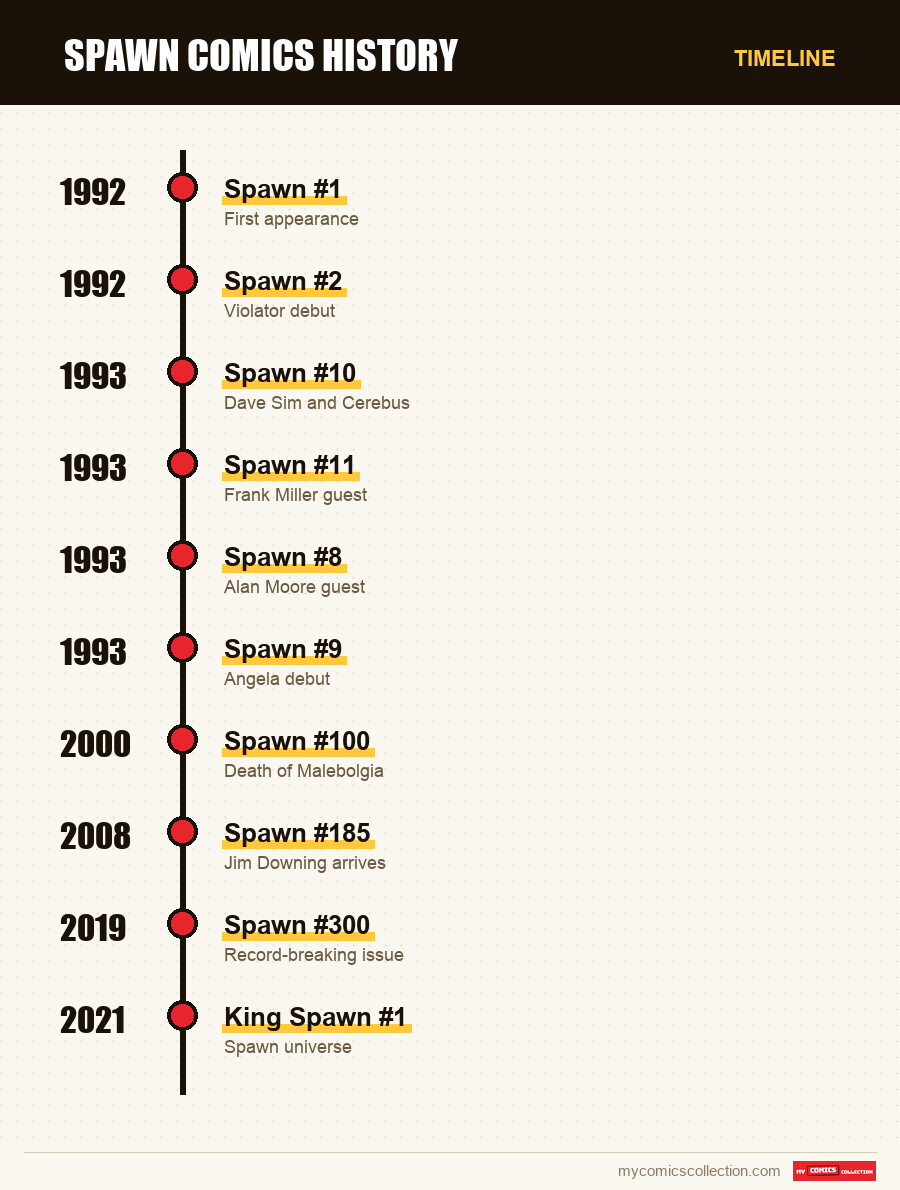
- 1992: Spawn #1 (May). Image Comics Foundation. 1.7 million copies sold.
- 1993: Angela and Medieval Spawn (Spawn #9, Neil Gaiman). Violator miniseries (Alan Moore).
- 1994: McFarlane Toys founded. Angela miniseries.
- 1995: Spawn exceeds 50 issues. One of the best-selling comics of the decade.
- 1996-1999: Curse of the Spawn (29 issues). Spawn: The Dark Ages. Sam & Twitch (Bendis).
- 1997: Spawn Movie (Michael Jai White). HBO animated series (Emmy Award).
- 1999-2003: Hellspawn (Bendis, Ashley Wood). Sam & Twitch continues.
- 2000: Spawn #100. Death of Malebolgia.
- 2011: Spawn #200. Return of Al Simmons.
- 2012-2013: Start of the tribute covers (#221, #228, #234). Gaiman lawsuit resolved.
- 2019: Spawn #300 beats Cerebus' record. Longest independent series in history.
- 2021: Launch of King Spawn, Gunslinger Spawn and The Scorched. Expansion of the universe.
- 2024: Spawn #350+. Launch of Rat City. The Spawn universe continues to expand.
The Spawn universe is one of the most improbable and enduring success stories in independent comics history. Thirty years after its creation, the character of Todd McFarlane continues to break records and generate new series. For a collector, this is rich territory, still relatively accessible compared to Marvel and DC key issues of the same era, and whose key pieces continue to appreciate. The key is knowing what to look for, and in a franchise of over 600 issues, a good number by number tracking tool makes all the difference.
Biography of Albert Francis "Al" Simmons (Spawn)
Spawn is created by Todd McFarlane and published by Image Comics. His first appearance is in Spawn #1 in May 1992.
Identity sheet
- Full name: Albert Francis "Al" Simmons
- Date of birth: May 1992 (creation)
- Place of birth: New York, USA
- First appearance : Spawn #1 (May 1992)
- Creators: Todd McFarlane (writer, designer, creator)
- Editor: Image Comics
- Memberships: Hellspawn Army, underworld gangs, various allies
Origins
Al Simmons, a former American special forces (CIA) officer, is murdered by his employer Jason Wynn. Sent to Hell for his brutal military actions, Simmons accepts a pact with the demon Malebolgia: return to Earth to see his wife Wanda again. In exchange, he becomes a Hellspawn, a soldier in the infernal army destined to lead the demons during Armageddon. He returns but deformed and 5 years after his death. His wife remarried. Spawn then becomes a tortured anti-hero who fights the forces of evil without really belonging to either Heaven or Hell.
Powers and Abilities
- Superhuman strength and endurance (Hellspawn)
- Symbiotic living suit (Necroplasm) with its own intelligence
- Manipulation of Darkness and Hell
- Teleportation and interdimensional travel
- Living Capes: weapons, defense, mobility
- Extreme Regeneration (can survive mortal wounds)
- Pact with Malebolgia: unlimited resources but exhaustible energy
Costume and visual identity
Living black jumpsuit with spider on torso (floating blood red capes). White mask with luminous green eyes. Chains attached to the body. Extreme horrorpunk aesthetic created by McFarlane.
Key issues to know
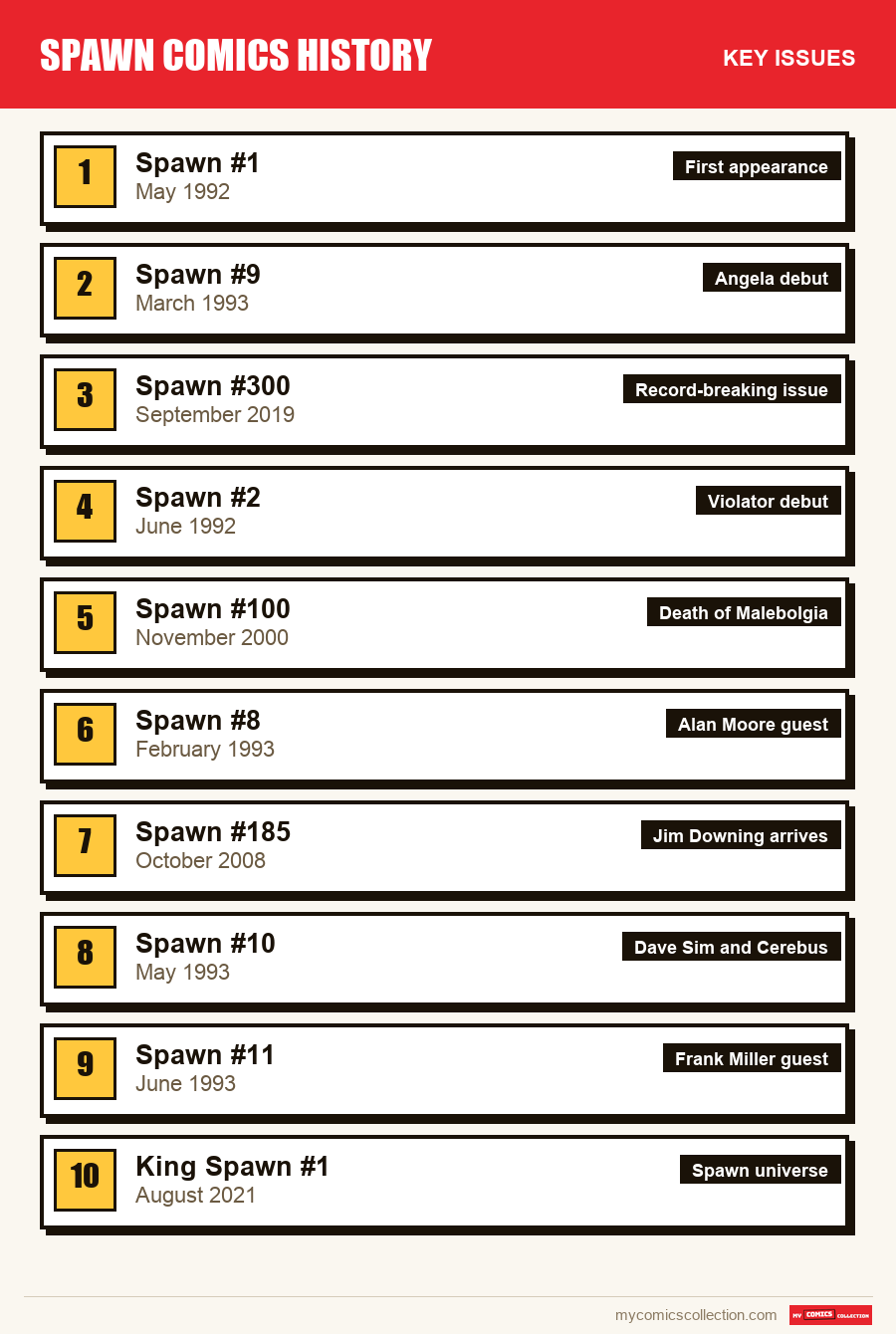
Spawn #1
Written and drawn by Todd McFarlane, this first issue introduces Al Simmons, a murdered former CIA agent who returns to Earth after a pact with the demon Malebolgia to see his wife Wanda again. Malebolgia also makes his first appearance here. It is McFarlane's founding title at Image Comics.
Spawn #9
Neil Gaiman writes and introduces Angela, a Hellspawn hunter in the service of Heaven, along with Count Cogliostro, Spawn's future mentor; a medieval Spawn appears in flashback. It is also the first time Spawn's master is named Malebolgia. The issue is at the heart of the later dispute between Gaiman and McFarlane.
Spawn #300
Written by Todd McFarlane, this anniversary issue takes the series to 300 issues, matching Cerebus's run before #301 surpasses it. Al Simmons tracks Violator to Albania, and Jessica Priest appears as She-Spawn for the first time. A symbolic milestone in independent comics history.
Spawn #2
McFarlane introduces the Clown, a grotesque little man revealed to be Violator, a demon sent to guide and torment Spawn. After slaughtering mobsters, he tells Al Simmons he is a Hellspawn. He becomes the series' most iconic antagonist.
Spawn #100
Todd McFarlane (script) and Greg Capullo (art): Spawn descends into Hell to face Malebolgia, with Angela's help. The demon is defeated, but Angela also dies in the clash. The hundredth issue closes a major cycle of the series.
Spawn #8
The first of the issues handed to guest writers: Alan Moore follows Billy Kincaid into Hell, where the Vindicator greets him. The issue launches the run of high-profile guests that turns Spawn into a creative showcase in the early 1990s.
Spawn #185
Todd McFarlane returns as writer with Whilce Portacio on art for "Endgame": the issue introduces James Downing, who takes over from Al Simmons in the Spawn costume. The start of a new era for the series.
Spawn #10
Written by Dave Sim, this issue sends Spawn, via Angela's lance, into a strange world where Cerebus the Aardvark shows him imprisoned heroes: creators who signed away the rights to their creations. A fable about creators' rights, a founding theme of Image Comics.
Spawn #11
Frank Miller writes this issue drawn by McFarlane, centered on Spawn's life among the homeless in his alleys, with Boots and Billy. It is the last of the four big early guests, after Alan Moore, Neil Gaiman and Dave Sim.
King Spawn #1
Written by Sean Lewis and drawn by Javier Fernandez, this launch opens the expansion of the Spawn universe into several linked series, alongside Gunslinger Spawn and The Scorched. Al Simmons investigates with his old ally Terry Fitzgerald. A milestone of the modern franchise.
Go further
- Spawn Reading Guide: Where to Start and in What Order
- Best Spawn Comic Runs: The Essential Reading Guide for Collectors
- The Best Spawn Story Arcs: A Collector's Guide
- Top 10 essential Spawn key issues
- Spawn #1 (1992): First Appearance, CGC Value, Variants & Collector's Guide
- Spawn Comic Collection Guide: How to Collect Spawn Key Issues