Launched in 1992 by Todd McFarlane at Image Comics, Spawn is one of the most important and enduring independent comic franchises in history. A dark and tormented character, Al Simmons: a CIA agent assassinated then returned as Spawn, a warrior of Hell: became a comic-culture icon beyond Marvel and DC alone.
Launched in 1992 by Todd McFarlane at Image Comics, Spawn is one of the most important and enduring independent comic franchises in history. A dark and tormented character, Al Simmons: a CIA agent assassinated then returned as Spawn, a warrior of Hell: became a comic-culture icon beyond Marvel and DC alone. With more than 300 issues published without interruption, Spawn holds the record for the longest continuously published creator-owned comic in American comic history.
This guide lists the 10 essential Spawn key issues for any collector, with their editorial context, franchise importance, and estimated CGC 9.8 value. Whether you're looking to build a Spawn key-issue set or complete a run, this ranking gives you all the necessary keys.
Spawn's history: from Image Comics to global pop culture
The Spawn series was born from Todd McFarlane's determination, along with his fellow superstar artists, to create an independent publisher where creators own their characters. Founded in 1992, Image Comics initially gathered McFarlane, Jim Lee, Rob Liefeld, Marc Silvestri, Erik Larsen, Jim Valentino and Whilce Portacio, all Marvel superstars. Spawn is McFarlane's flagship creation and Image's emblematic series:
- The Early Years (#1-8): McFarlane draws the first issues himself, laying down the character's entire mythology
- The guest-creator era (#9-100): prestigious authors like Neil Gaiman, Frank Miller and Alan Moore contribute special episodes
- The film (1997): adapted for cinema with Michael Jai White, then as an HBO animated series: two adaptations that propelled the franchise to the general public
- The #301 record (2019): Spawn surpasses Cerebus as the longest-running creator-owned comic in history
- Series continues: still being published, with regular collaborations and an ever-expanding universe
The Spawn series is ideal for precise management with the Collection tracking feature in My Comics Collection, notably for identifying missing issues across such a long run.
Top 10 Spawn key issues
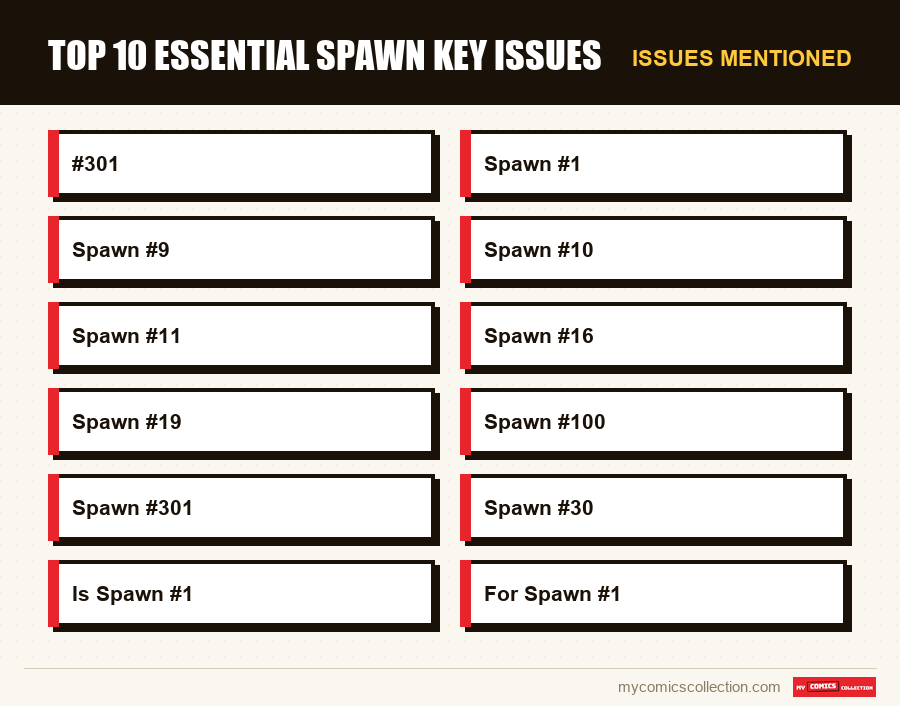
Here are the ten absolutely essential issues for any Spawn collector, from the first appearance to series milestones.
Spawn #1
Spawn #1 is the founding issue of one of the greatest independent comic franchises in history. This first issue introduces Al Simmons, a CIA agent assassinated by his own employer and resurrected as Spawn thanks to a pact with the demon Malebolgia. McFarlane delivers spectacular art and dark narration here that radically departs from the Marvel and DC superheroes of the era. This inaugural issue sold more than one million copies at release, symbolizing the phenomenal enthusiasm for new Image Comics creations. A centerpiece of any Spawn or Image Comics collection.
Spawn #1 Newsstand
The newsstand edition of Spawn #1 is the most sought-after variant of the first issue. Distributed in general-audience newsstands and bookstores rather than specialty comic shops, this edition is distinguished by its UPC barcode on the cover. Newsstand copies were generally less well-preserved than direct editions bought by collectors, making high-quality copies particularly rare. For a collector wanting the "complete set" of Spawn #1, owning the newsstand version in CGC 9.8 is a hard-to-reach grail.
Spawn #1 Black & White Edition
The Black & White edition of Spawn #1 is a 1993 special reissue in black and white, allowing McFarlane's art to be appreciated in its full technical purity, without coloring. This limited edition was distributed in restricted quantities, mainly through specialty channels. It represents a distinct collectible from the original color edition, prized by collectors interested in McFarlane's pure graphic work. In CGC 9.8, this edition is notably rarer than the original color version.
Spawn #9
Spawn #9 is doubly remarkable: it marks the first appearance of Angela, the angel hunter created by Neil Gaiman, and it represents the collaboration between McFarlane and one of the greatest English-language comic writers. Angela has had a unique editorial history: after a long legal battle between Gaiman and McFarlane over character rights, Angela was bought by Marvel in 2013 and integrated into the Marvel universe, notably appearing in Guardians of the Galaxy and as Odin's daughter in Thor. This issue therefore constitutes a first appearance that simultaneously belongs to two editorial universes.
Spawn #10
Spawn #10 continues the Angela arc started in the previous issue, still written by Neil Gaiman. This issue completes Angela's introduction and her confrontation with Spawn. Though considered a minor key issue compared to the #9 first appearance, it's systematically collected as a complement by Angela saga fans and fans of Neil Gaiman's work in the Image Comics universe. Its value is driven by Gaiman's fame and Angela's particular status, now Marvel property.
Spawn #11
Spawn #11 is one of the series' most unique issues: it's a crossover between Spawn and Cerebus the Aardvark , Dave Sim's character who would himself hold the longest-running creator-owned comic record that Spawn would later surpass in 2019. Written by Sim himself, this issue is a fascinating collectible that brings together two of the most important independent creations of the 1990s. For fans of independent comic history and Image Comics, this issue is a must. The CGC 9.8 value reflects its nature as both editorial curiosity and key issue.
Spawn #16
Spawn #16 , titled "Trembling Giant", is considered one of the best issues of the series narratively. Unlike pure action issues, this issue offers an introspective and poetic story centered on the relationship between Spawn and a child living on the streets of New York. It perfectly illustrates the humanist and melancholic dimension that distinguishes Spawn from traditional superhero comics. This issue is regularly cited among McFarlane's best outings and represents an important milestone in building the series' mythology, beyond mere spectacular action.
Spawn #19
Spawn #19 introduces The Redeemer, one of Spawn's most important adversaries in the series mythology. The Redeemer is a character sent by Heaven to counterbalance the Spawn from Hell, thus creating a narrative dynamic between celestial and demonic forces that would be at the heart of many subsequent arcs. This issue fits in the expansion of Spawn cosmology, introducing antagonists linked to Heaven rather than just Hell, and considerably enriching the series' thematic universe beyond the simple narrative of an infernal agent.
Spawn #100
Spawn #100 is one of the franchise's most striking issues and an important editorial milestone for Image Comics. This centennial issue is distinguished by a shocking narrative event: the death of Al Simmons, the original Spawn, opening the way to a new era for the series. McFarlane delivers an ambitious issue here, celebrating ten years of franchise existence while radically evolving it. "Centennial" issues of creator-owned series are always prized collectibles, and Spawn #100 is no exception with its multiple variant covers and event-based narration.
Spawn #301
Spawn #301 is a historic issue for the entire independent comic industry: it's the issue that allows Spawn to break the Cerebus record (300 issues) and officially become the longest continuously published creator-owned comic in American comic history. This exceptional editorial milestone is celebrated with numerous variant covers and tributes to the entire franchise history. For an independent comic collector or comic history fan, this issue is a collectible in its own right, symbolizing the unique longevity of Todd McFarlane's vision.
Collecting this series?
Track what you own, what you are missing and what your collection is worth. 7 day trial.
Start my trial →Essential Spawn story arcs
The Spawn series was built around several founding narrative arcs that define the character's mythology. Here are the sets to own to understand the franchise as a whole:
The Early Years: McFarlane
The first eight issues drawn by McFarlane himself lay the entire Spawn mythology: Al Simmons, the pact with Malebolgia, Clown/Violator, and the tragedy of the relationship with Wanda. The most important run to own.
Angela Saga
The arc written by Neil Gaiman that introduces Angela and explores conflicts between Hell and Heaven. A rare run because it brings together McFarlane and Gaiman, two English-language comic giants, in a unique collaboration.
The Redeemer Arc
The introduction of The Redeemer and expansion of Spawn cosmology toward celestial forces, enriching the Hell/Heaven dynamic at the core of the series. A major arc to understand Spawn's narrative structure.
Cogliostro Chronicles
The arcs centered on Cogliostro, Spawn's mysterious mentor whose past reveals deep ties to the series' infernal mythology. These issues considerably deepen Spawn's narrative dimension beyond pure action.
To organize and track these arcs across a run as long as Spawn, use the Story Arcs feature in My Comics Collection: ideal for creating custom arc-by-arc lists and tracking your progress.
How My Comics Collection handles your Spawn collection
Collecting Spawn presents a particular challenge due to the series' exceptional length (more than 330 issues to date), multitude of cover variants, and off-series special issues. A precise tracking tool is indispensable.
My Comics Collection offers all the necessary features:
- Import the complete Spawn series catalogue from our database
- Mark your owned copies, identify missing issues with the Missing comics feature
- Track your CGC-graded copies with individual value
- Manage your Spawn #1 cover variants and other multi-edition key issues
- Estimate the total value of your Spawn run with daily-updated valuation
FAQ: Spawn key issues
Start managing your Spawn collection
Track your key issues, organize your variants and estimate the value of your Spawn run. 7-day free trial.
Start free 7-day trialNo commitment · Cancel anytime · Instant access