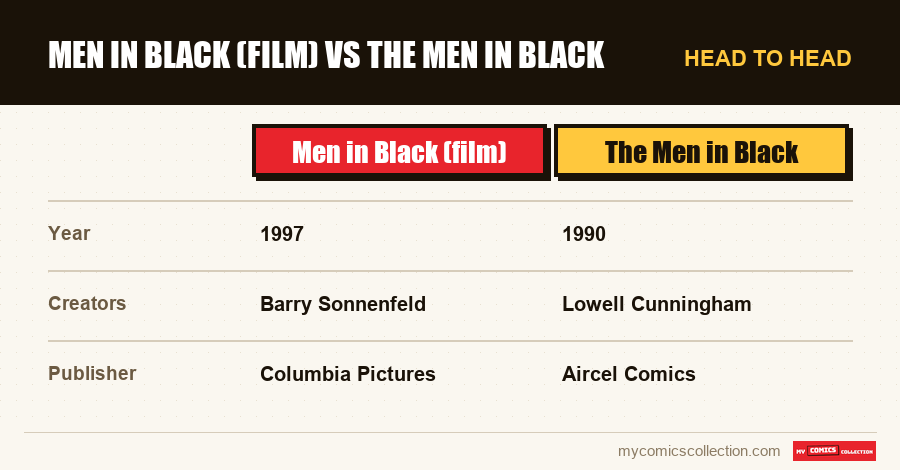
Men in Black (1997) Barry Sonnenfeld , with Will Smith and Tommy Lee Jones , adapts the comic The Men in Black by Lowell Cunningham (Aircel/Malibu Comics, 1990). The film transforms a dark story into an action comedy, keeping only the concept of the secret agency. Here is the detailed comparison, film versus comics.
Cult blockbuster based on a little-known independent comic, Men in Black illustrates how much an adaptation can reinvent the tone of its source. Source-by-source decryption.
As in each article in this series, only verified information (creators, distribution, dates, publishers) is stated; the comparative analysis is ours, without reproducing dialogue or protected images.
Title : Men in Black (1997)
Director: Barry Sonnenfeld
Actors: Will Smith (Agent J), Tommy Lee Jones (Agent K), Vincent D'Onofrio (Edgar)
Exit : July 1997
Studio: Columbia Pictures
The Men in Black (1990): Lowell Cunningham & Sandy Carruthers
Aircel Comics: then Malibu Comics
A secret agency: monitoring the paranormal
A dark tone: conspiracy thriller
- L'secret agency men in black.
- THE black suits and sunglasses.
- La monitoring phenomena hidden from the public.
- The duo of one veteran and a recruit.
- The erasure of memories witnesses.
- The dark tone becomes a action comedy.
- Officers only monitor aliens (not the broad paranormal).
- The comic was more violent and conspiratorial.
- The characters J and K are developed for the film.
- Humor replaces darkness.
The Men in Black (1990): an independent and dark comic book
Men in Black adapts the comic strip The Men in Black, created by Lowell Cunningham and drawn by Sandy Carruthers, published in 1990 by Aircel Comics, a small independent publisher, then taken over by Malibu Comics. Far from the popular image of the film, the original comic book is a dark and conspiratorial story. The Men in Black form an ultra-secret agency responsible for monitoring and hiding from the public not only aliens, but also a whole range of paranormal phenomena: ghosts, demons, mutants, conspiracies. Ruthless and morally ambiguous, the agents do not hesitate to resort to violence and murder to preserve secrecy. This comic, published by a modest publisher, played on themes of paranoia, information control and secret societies.
The film takes up the central concept: a secret agency of agents dressed in black, with dark glasses, responsible for monitoring hidden phenomena and erasing the memories of witnesses. It also maintains the dynamic of the duo formed by a veteran agent and a young recruit. These fundamental elements come directly from the comic strip. The film, however, radically transforms the tone and scope of the agency, moving from a dark and violent thriller to a mainstream action comedy. This reinvention, one of the most significant of its kind, illustrates how an adaptation can preserve the skeleton of a work while completely changing its spirit and atmosphere.
From a dark thriller to an action comedy
The most striking transformation between the comic and the film concerns tone. Where The Men in Black by Lowell Cunningham is a dark, violent and paranoid story, Barry Sonnenfeld's film makes it a light action comedy, carried by the humor and charisma of Will Smith. This reorientation, decided to appeal to a wide audience, erases the darkness of the original work in favor of family entertainment. The agents, morally ambiguous and brutal in the comics, become sympathetic and funny heroes. The universe, once populated by various paranormal threats, is refocused on extraterrestrials, treated in a humorous and cartoonish way. This metamorphosis illustrates the power of an adaptation to completely reinvent the tone of its source.
This radical change explains the success of the film, but also the ignorance of its source. Most spectators are unaware that Men in Black is based on a comic book, as the film has appropriated the concept to make it a franchise in its own right. This successful reinvention demonstrates the capacity of cinema to transform confidential material into a global cultural phenomenon. The film retains the core (the secret agency, the costumes, the secrecy, the erasure of memories) but dresses it in a tone opposite to that of the original. For the reader, this transformation is fascinating: it shows that the same idea can give rise to radically different works depending on the treatment. It invites you to discover the original comic strip, darker and more adult, which offers a striking counterpoint to the comedy that the general public knows, revealing an unsuspected facet of the concept of men in black.
A concept born from modern paranoia
The concept of the “men in black” draws on a real and popular imagination: that of mysterious government agents supposed to conceal the existence of extraterrestrials and intimidate UFO witnesses. This urban legend, born in ufological circles of the 20th century, has fueled numerous science fiction and paranoia stories. Lowell Cunningham's comic strip takes it to create a fiction about the control of information and secret societies, in the conspiracy spirit of the times. By adapting this concept, the film and the comic book are part of a rich cultural tradition, mixing science fiction, conspiracy and satire. This dimension explains the resonance of the concept with the public.
The film exploits this modern mythology with humor, playing on the idea that aliens live among us, hidden by an omniscient agency. It transforms the paranoia of comics into a source of comedy, while retaining the fascinating idea of a reality hidden beneath our everyday world. This intelligent exploitation of the concept made the success of the film, which was able to make accessible and entertaining a previously anxiety-provoking imagination. For the reader, this connection illustrates how comics take hold of contemporary myths to reinvent them. She recalls that Men in Black, beneath its comedic trappings, has its roots in an independent comic strip that darkly explored modern anxieties of secrecy and control. Discovering this source means measuring the path traveled between a confidential work and a global cultural phenomenon.
Collecting this series?
Track what you own, what you are missing and what your collection is worth. 7 day trial.
Start my trial →The characters, from paper to screen
- Agent K: The deadpan veteran, developed for the film.
- Agent J: The charismatic young recruit, creation of the film.
- The agency (MiB): The secret organization, the heart of the comic strip.
- Edgar / the “bug”: The alien antagonist, invention of the film.
- Zed: The director of the agency, adapted for the film.
An adaptation that eclipsed its source
Men in Black is a textbook case of an adaptation that has completely eclipsed its source material. The film and its sequels enjoyed worldwide success, making Men in Black a cult franchise, to the point that the original comic book is now almost forgotten by the general public. This situation illustrates the power of cinema to appropriate a work and make it a global cultural property. Few people know that this comic blockbuster is based on a dark independent comic book published by a small publisher. This eclipse testifies to the success of the transformation effected by the film, but also to the unfair ignorance of the work of Lowell Cunningham.
This dynamic raises an interesting reflection on the relationship between adaptations and their sources. A film can give immense visibility to a concept while erasing the work that spawned it. The Men in Black, a confidential comic strip, inspired one of the most popular franchises in cinema, without garnering recognition for it. For the reader and collector, this story is an invitation to rediscover the original comic strip, witness to an often neglected independent creativity. She reminds us that behind many blockbusters lie little-known comic book works, whose richness and originality deserve attention. Men in Black, beneath its veneer of comedy, owes everything to a small comic strip from the 1990s, which it made both famous by its concept and invisible by its own success.
When cinema reveals the wealth of small publishers
The story of Men in Black illustrates a recurring phenomenon: cinema will draw its ideas from the pool of small independent publishers, often well beyond the giants of the sector. Aircel and Malibu Comics, which published Lowell Cunningham's comics, were modest structures, far from the behemoths of the industry. However, it was in their pages that a concept that became one of the most profitable franchises in cinema germinated. This observation reminds us that the creativity of comics is not limited to large publishing houses, and that powerful ideas can be born anywhere, including in publications with small circulations and confidential distribution.
This reality promotes the work of independent creators and small publishers, whose works regularly nourish cinema. Men in Black, Kick-Ass, Sin City, Ninja Turtles: many big screen successes have their origins outside the major superhero publishers. For the reader and the collector, this diversity is an invitation to explore the unsuspected richness of comics, beyond the most well-known figures. She reminds us that behind a blockbuster can hide a modest and daring work, the fruit of the imagination of authors working in the shadows. Men in Black is the perfect example of this bridge between independent creativity and global popular success, a bridge that cinema takes more often than we imagine, revealing treasures buried in the catalogs of small publishers.
Where to start reading
To discover the source, the comic strip The Men in Black by Lowell Cunningham and Sandy Carruthers (1990) is available in collection. A dark and conspiratorial tale, it offers a striking counterpoint to the comedy of the film. This short and autonomous work can be enjoyed without prerequisites. It reveals an unsuspected facet of the concept popularized by cinema.
Chronology of comics to know
- 1990: The Men in Black #1: the beginning of comics at Aircel Comics.
- 1991: Malibu Comics resumes publication of the series.
- 1997: The film propels the concept to the forefront of the world stage.
Collection side: what numbers to aim for after the film
Men in Black points to independent keys. The Men in Black #1 (1990, first issue of the comic book from Aircel) is the key sought after by collectors, all the rarer as the publisher was modest. The issues of the series, published in small print runs, are prized items for fans of independent comics. These numbers cover generally accessible budgets, despite their rarity. As always, condition and gradation determine value; relying on real recent sales is strongly recommended.
Its place in the saga and for the collector
Men in Black will remain as the perfect example of an adaptation that reinvented and eclipsed its source, transforming a dark thriller into a cult comedy. For the collector, it recalls the existence of The Men in Black #1, the key to a little-known independent comic book. It illustrates the power of cinema to appropriate a work. Beyond the blockbuster, the original comic book deserves to be rediscovered for its darkness and originality. Men in Black reminds us that behind many successes lie confidential comic strips, whose creativity has nourished cinema without always receiving the credit.
The verdict: a faithful concept, a transformed tone
- Loyalty: the secret agency, the black suits, the surveillance of hidden phenomena, the veteran-recruit duo and the erasure of memories come from comics.
- Freedoms: the dark tone turned comedy, the field refocused on the aliens, the violence erased, the characters J and K developed for the film, the omnipresent humor.
- Collectible numbers: The Men in Black #1 (1990, Aircel Comics).
Men in Black adapts a dark, conspiratorial indie comic and transforms it into a cult action comedy. Faithful to the concept of the secret agency and its codes but completely reversing the tone of its source, the film has eclipsed the comic strip that inspired it. For both the reader and the collector, it is an invitation to rediscover The Men in Black #1, a little-known work by Lowell Cunningham.
Frequently asked questions
Yes. The film adapts The Men in Black, a comic book created by Lowell Cunningham and drawn by Sandy Carruthers, published in 1990 by Aircel Comics then Malibu Comics. Few spectators know this, as the film has eclipsed its confidential source.
Very. The comic is a dark, violent and conspiratorial story, where agents monitor aliens but also ghosts, demons and plots, even if it means killing. The film makes it a light action comedy refocused on aliens, erasing the darkness of the original.
The concept of the veteran-rookie duo comes from the comics, but the personalities of J and K, carried by Will Smith and Tommy Lee Jones, were largely developed for the film. Their comedic alchemy is a cinematic creation that has made the franchise successful.
From a 20th century UFO urban legend: mysterious agents supposed to conceal the existence of extraterrestrials and intimidate UFO witnesses. The comic takes it to make a fiction about the control of information, which the film transforms into a comedy.
The Men in Black #1 (1990, first issue from Aircel Comics) is the key you were looking for, all the rarer as the publisher was modest. The issues of the series, in small print runs, are popular with fans of independent comics.
Does the film make you want to collect? Estimate the value for free of your issues (The Men in Black #1…) with our tool based on current eBay listings.