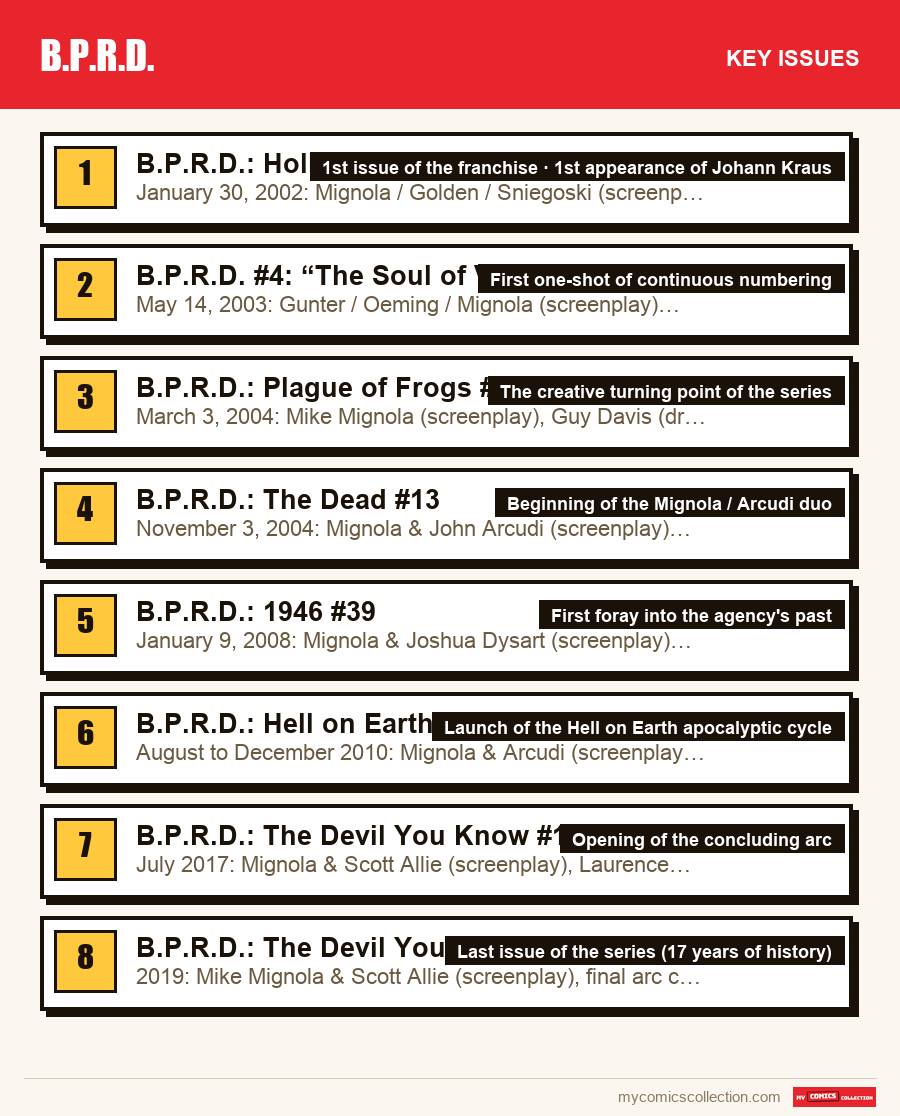
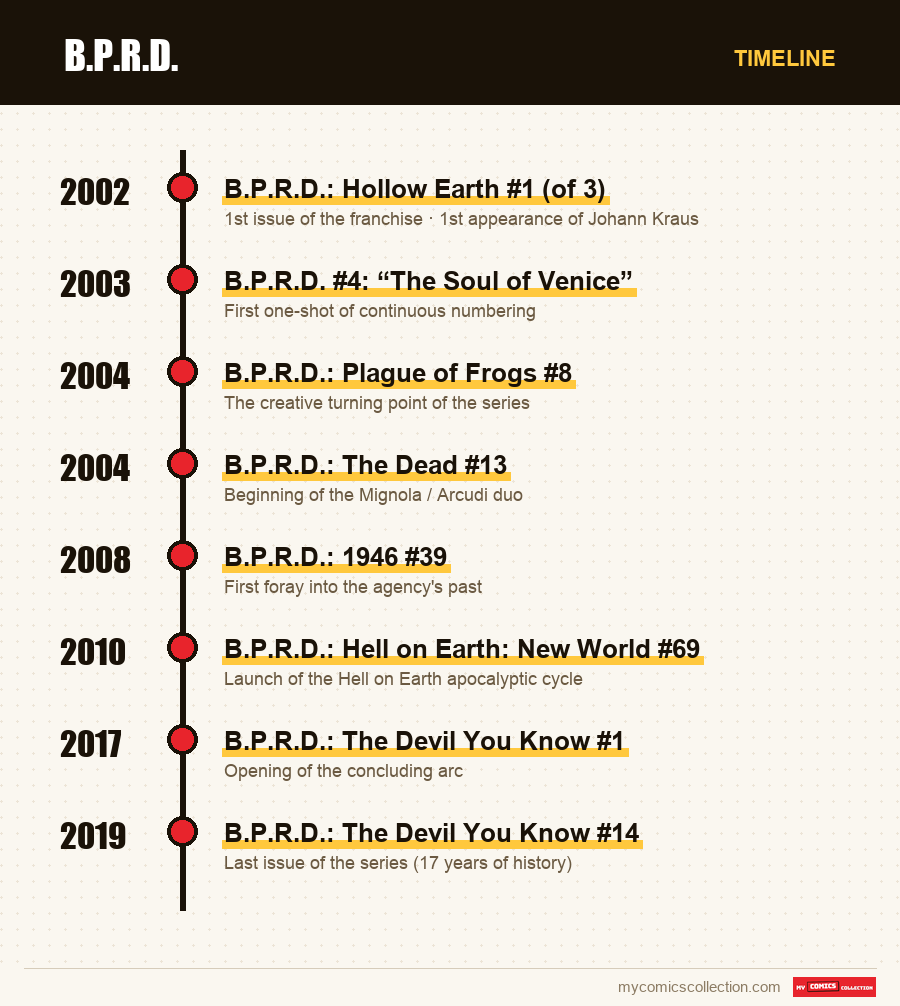
The absolute key number of B.P.R.D. stay Hollow Earth #1 (January 30, 2002, Mike Mignola / Christopher Golden / Tom Sniegoski on screenplay, Ryan Sook on drawing): first comic book in the franchise and first appearance in bookstores by Johann Kraus. Next come Plague of Frogs #8 (2004), which established Guy Davis as a reference designer and shifted the series towards its long-term intrigues, and Hell on Earth: New World #69 (2010), which opens the apocalyptic cycle considered to be the creative peak of the title. Unlike superhero comics, B.P.R.D. has never had a dedicated film or series adaptation: its rating is based almost entirely on the demand of readers and collectors of complete runs, not on speculation linked to a film.
B.P.R.D. occupies a particular place in the landscape of the American comic book: it is neither a superhero title carried by an audiovisual license, nor an interchangeable anthological series, but the logical extension of an author's universe, that of Mike Mignola, built around the Bureau for Paranormal Research and Defense already mentioned in the pages of Hellboy since 1993. When Dark Horse Comics launched the agency's first solo mini-series in January 2002, no one yet knew that the title would stretch over seventeen years, around ten major arcs and nearly a hundred issues with continuous numbering: a rather singular editorial architecture which deliberately complicates the identification of the "real" key issues for those discovering the series today.
This guide covers the real editorial history of the title, arc by arc, to identify the issues that really matter: first appearances of characters, structuring creative team changes, launches of narrative cycles and numbering shifts. Each file indicates what is actually documented (publication dates, creators, story context) without putting forward invented rating figures where no reliable data exists publicly. For an independent, direct-market comic book series like B.P.R.D., it is precisely the relative scarcity of CGC population and sales figures information that should guide the buyer's caution, much more than a hypothetical blockbuster effect.
From the confidential mini-series to the cult soap opera: the editorial construction of B.P.R.D.
Before existing as a series, B.P.R.D. became known through a three-page teaser published as a serial in Dark Horse Extra #42 to #44, between December 2001 and February 2002, intended to announce the upcoming miniseries. It is in this teaser that Johann Kraus appears for the first time, the Austrian medium reduced to a form of ectoplasm confined in a diving suit, but his real entry in a comic book sold on newsstands and in stores takes place with B.P.R.D.: Hollow Earth #1 (of 3), released on January 30, 2002. Written by Mike Mignola with Christopher Golden and Tom Sniegoski, drawn by Ryan Sook, this three-issue miniseries tells the story of the rescue mission of agent Liz Sherman, held in an Arctic monastery, and brings together for the first time the hard core who will carry the series for almost two decades: Kate Corrigan, Abe Sapien, Roger and therefore Johann Kraus.
Dark Horse's most structuring editorial choice comes just after: rather than chaining together the mini-series with their own numbering as is usual, the publisher adopts a single continuous numbering for the entire title, which runs through all the mini-series and all the subsequent one-shots without ever starting at 1. Concretely, Hollow Earth occupies issues 1 to 3, then each subsequent story picks up the numbering where the previous one left off, regardless of its narrative status (standalone one-shot, five-issue miniseries, annual arc). This is a fairly rare mechanism in the history of American comic books, and it explains why the same "number 1" in the catalog can in reality designate number 8, 13, 39 or 69 of the complete collection depending on the arc concerned: a point that any buyer must check on the index before paying extra for a supposed "first issue".
Between 2003 and the launch of Plague of Frogs, the series alternates one-shots with rotating creative teams: number 4, The Soul of Venice (May 14, 2003, scenario Miles Gunter / Michael Avon Oeming / Mike Mignola, drawing Michael Avon Oeming), number 5, Dark Waters (July 23, 2003, script Brian Augustyn, drawing Guy Davis: his very first contribution to the franchise), number 6, Night Train (September 17, 2003, script Geoff Johns and Scott Kolins), and number 7, There's Something Under My Bed (November 19, 2003, script Joe Harris, drawing Adam Pollina). This period of editorial trial and error ends with Plague of Frogs, where Mike Mignola takes over the screenplay alone and where Guy Davis takes over as designated designer: a tandem which will shape the visual and narrative identity of the title until 2011.
B.P.R.D.: Hollow Earth #1 (of 3)
This is the absolute starting point for the series in the form of a comic book sold in stores, after the three-page teaser released at the end of 2001 in Dark Horse Extra. The story sends a select Bureau team (Kate Corrigan, Abe Sapien, Roger, and new recruit Johann Kraus) to rescue Liz Sherman from an Arctic monastery. Johann Kraus, who appeared in a three-page sketch a few weeks earlier, gets his first real appearance in a full comic book here; Roger already existed as an inert corpse in Hellboy: Wake the Devil #3 (1996), but it is in this episode that Abe Sapien permanently reactivates him by electrical overload, making him a full member of the regular cast.
B.P.R.D. #4: “The Soul of Venice”
After the three numbers Hollow Earth, Dark Horse switched to a format of standalone one-shots while retaining uninterrupted numbering: a decision that defined the collecting logic of the entire series. Issue 4 entrusted the drawing to Michael Avon Oeming and inaugurated a period where each short story received its own creative team, a formula which continued with Dark Waters (#5), Night Train (#6) and There's Something Under My Bed (#7) before the series stabilizes with the arrival of Guy Davis.
B.P.R.D.: Plague of Frogs #8
First issue of the mini-series which gives its title to an entire era of the franchise, Plague of Frogs marks the moment when Mike Mignola takes sole reins of the script and where Guy Davis establishes himself as the artist who will visually carry the series until 2011. It is this arc, widely cited by critics and long-time readers as the real tipping point, which sets up the long-term intrigues (the invasion of amphibious creatures, the slow mutation of the world) and makes B.P.R.D. a coherent horror series rather than a series of isolated stories. Roger also gains a much more central place in the group dynamic.
B.P.R.D.: The Dead #13
It is with this arc that John Arcudi officially joins the creative team as co-writer, after a first foray on the short story “Born Again”. From The Dead, Arcudi takes care of most of the writing for the issue, while Mignola focuses on the overall architecture of the mythology: a sharing of tasks that will remain in place until the conclusion of the series in 2019. This issue therefore marks less a first appearance of a character than a change of creative team which has lastingly shaped the tone of the title.
B.P.R.D.: 1946 #39
First arc entirely constructed in flashback, set in the immediate post-war period, 1946 entrusted the drawing to Paul Azaceta and relaunched the thread of the vampire Vladimir Giurescu, already mentioned in Hellboy: Wake the Devil in 1996 but never developed until then. This issue 39 opens a parallel historical continuity that Dark Horse will extend with the mini-series 1947 and 1948, which has since become an integral part of the franchise for readers interested in the Cold War origins of the Bureau.
B.P.R.D.: Hell on Earth: New World #69
Within the continuous numbering, this number 69 corresponds to the first episode of New World, the mini-series which officially renamed the title "B.P.R.D.: Hell on Earth" and finally triumphed the amphibious invasion that began as early as Plague of Frogs: The Earth itself begins to transform under the influence of the creatures. Drawn by Guy Davis, winner of an Eisner Award in 2009 for his work on the series, this arc is considered by a large part of critics to be the creative peak of the title alongside Plague of Frogs. It also introduces the subplot that will irrigate the rest of the run: Agent Devon's suspicions that Abe Sapien is, unbeknownst to him, an agent of evil.
B.P.R.D.: The Devil You Know #1
This issue opens the final arc of the saga, the one which will close seventeen years of uninterrupted continuity. Liz Sherman leads a team of survivors through creature-infested ruins on what is billed as the most important mission of her life, while rival cults attempt to capitalize on the world's ongoing collapse. Hell on Earth . The Devil You Know reconnects directly with the outcome of the parent series Hellboy in Hell, and closes the loop with the arrival of Johann Kraus in 2002.
B.P.R.D.: The Devil You Know #14
Conclusion number of the entire B.P.R.D. adventure, which closes seventeen years of continuous history launched with Hollow Earth #1 in 2002. As is often the case for the last issues of an author's series at the end of the editorial cycle, immediate demand upon publication is generally lower than for the first issues of a launch: a classic direct-market phenomenon which tends, in the medium term, to reduce the number of well-preserved copies in circulation compared to the very first issues of the series, very widely stockpiled upon release by speculators of the time.
Collecting this series?
Track what you own, what you are missing and what your collection is worth. 7 day trial.
Start my trial →The Hellboy effect: what place for B.P.R.D. on screen?
Unlike Marvel or DC franchises whose ratings for certain issues soar when a film or series is announced, B.P.R.D. never got its own film or television adaptation as a standalone title. Discussions circulated around 2011 about a possible spin-off television series project, without any official announcement having materialized since. This lack of dedicated adaptation has a direct and measurable effect on the secondary market: the demand for B.P.R.D. numbers. remains structured almost exclusively by comic book readers and collectors of complete runs, not by a one-off influx of buyers from cinema: which limits speculative peaks but also ensures a more stable demand and less subject to fashion effects.
This does not mean that the world of the Office has remained confined to the printed pages. The central characters of B.P.R.D. (Liz Sherman, Abe Sapien, Kate Corrigan) appeared on screen in all three feature films Hellboy in live action: the first two directed by Guillermo del Toro (2004 and 2008) with Selma Blair and Doug Jones reprising their roles, then the 2019 reboot directed by Neil Marshall. More directly linked to the B.P.R.D. franchise, two animated films released directly on DVD, Hellboy Animated: Sword of Storms (aired on Cartoon Network on October 28, 2006) and Hellboy Animated: Blood and Iron (March 17, 2007), features the Bureau and its agents with Ron Perlman, Selma Blair, Doug Jones and John Hurt reprising their respective voices from the live-action films. These on-screen appearances maintained the notoriety of the Bureau staff without ever transforming a particular issue of B.P.R.D. as an object of cinema speculation: an important point to keep in mind for those who buy with "adaptation key" in mind rather than "editorial key".
Buying guide for collecting B.P.R.D.
- Check the indicia before the number displayed on the cover. Because of the continuous numbering, the same story can be sold under several names (arc title + internal number): always check the number printed inside the comic, not just the one announced by the seller.
- Think by arc rather than by isolated number. The series was designed in cycles of four to five episodes (Plague of Frogs , The Dead , Hell on Earth: New World...): a single issue, taken out of its arc, loses a good part of its narrative interest and therefore of its appeal for collectors of complete runs.
- Do not pay a grading premium without a numerical rarity benchmark. Due to lack of CGC population published massively on this segment, first compare what the difference between two notes really implies before deciding: our comparison CGC 9 vs 9.8 helps to assess whether the additional cost of a higher rating is justified on this type of direct-market draw.
- Monitor the condition of the covers by Guy Davis and Ryan Sook. The dark areas and matte covers typical of the Dark Horse style of the period particularly mark the folds and micro-scratches; inspect the corners and the edge before purchasing.
- Favor sellers with established sales history on the Dark Horse/Mignolaverse titles rather than the generic "horror comics" lots, where the actual state of the B.P.R.D. issues. is often under-described.
- Use a tracking tool to organize your run, especially if you are aiming for the complete collection since Hollow Earth #1 until The Devil You Know #14: L'comic collection app allows you to spot missing numbers at a glance in such a long series.
- Before purchasing a number advertised as "key", ask for an estimate based on current eBay listings rather than on the price displayed by a single seller, via the site's estimator.