Neil Gaiman is a British screenwriter born in 1960, revealed by his revival of Miracleman in 1990 then dedicated by Sandman (DC/Vertigo, 1989-1996), series of 75 issues which brought comics into the field of literature. His most sought-after key issues remain Sandman #1 (first appearance of Morpheus, January 1989) and Sandman #8 (first appearance of Death, August 1989). Since 2024, the accusations of sexual assault brought against him have led to the cancellation of several projects (Netflix, Dark Horse, Disney) and cast an unprecedented shadow over an author previously considered untouchable in the world of comics.
There are few writers in the history of American comic books whose name alone is enough to increase the rating of an issue. Neil Gaiman is one of them. For nearly forty years, this discreet Englishman, nourished by science fiction and mythology, built a work that turned entire generations of readers towards a medium that they previously considered reserved for superheroes in tights. Sandman, his flagship series, remains today one of the rare comics to appear in the “literature” sections of certain general bookstores, alongside his own novels.
For collectors, the story of Neil Gaiman is not just a bibliography: it is a precise editorial trajectory, made up of interrupted series, publisher bankruptcies, unexpected revivals decades later, and a recent biographical turning point which reshuffled the market cards. Understanding this chronology allows you to know exactly which issues to look for, why certain ones have become cult and how the author's current affairs influence, or do not influence, the value of his comics.
This article traces Gaiman's journey in the comic book industry, from the British fanzines of the 1980s to the cancellation of the Netflix adaptation of Sandman in 2025, including the works that forged his reputation: Miracleman, Sandman, Books of Magic and 1602.
From journalist to cult screenwriter: the editorial debut of Neil Gaiman
Neil Richard Gaiman was born on November 10, 1960 in England. Before becoming a screenwriter, he worked as a journalist, a stint which forged his sense of documentary detail, very perceptible in the way he then weaved mythology, folklore and real history into his stories. His very first scripts published in the comics industry were "Future Shocks", these short one-panel science fiction stories that the British magazine 2000 AD published to test young authors, between 1986 and 1987. It is a classic learning format from the British school of comics, the same one which trained Alan Moore, Grant Morrison and Warren Ellis.
It is precisely his meeting and his friendship with Alan Moore that proves decisive. Moore, already author of Watchmen and V for Vendetta, introduced Gaiman to writing comic book scripts according to the rules of the art. Subsequently, Gaiman co-wrote three graphic novels with cartoonist Dave McKean that would become milestones in the genre: Violent Cases, Signal to Noise, and The Tragical Comedy or Comical Tragedy of Mr Punch. This collaboration with McKean, which would then continue on the covers of Sandman, was foundational: it immediately established the dark, pictorial and adult visual identity that would become Gaiman's signature in the eyes of American readers.
This British learning process explains why, when Gaiman arrived at American publishers at the end of the 1980s, he did not arrive as a novice screenwriter but as an author already trained in dense, literary writing, built on quotation and folklore. It is this background that will make all the difference on his first major American project: the revival of a little-known English character on the other side of the Atlantic, Marvelman, renamed Miracleman.
Miracleman: the founding work left unfinished for twenty-eight years
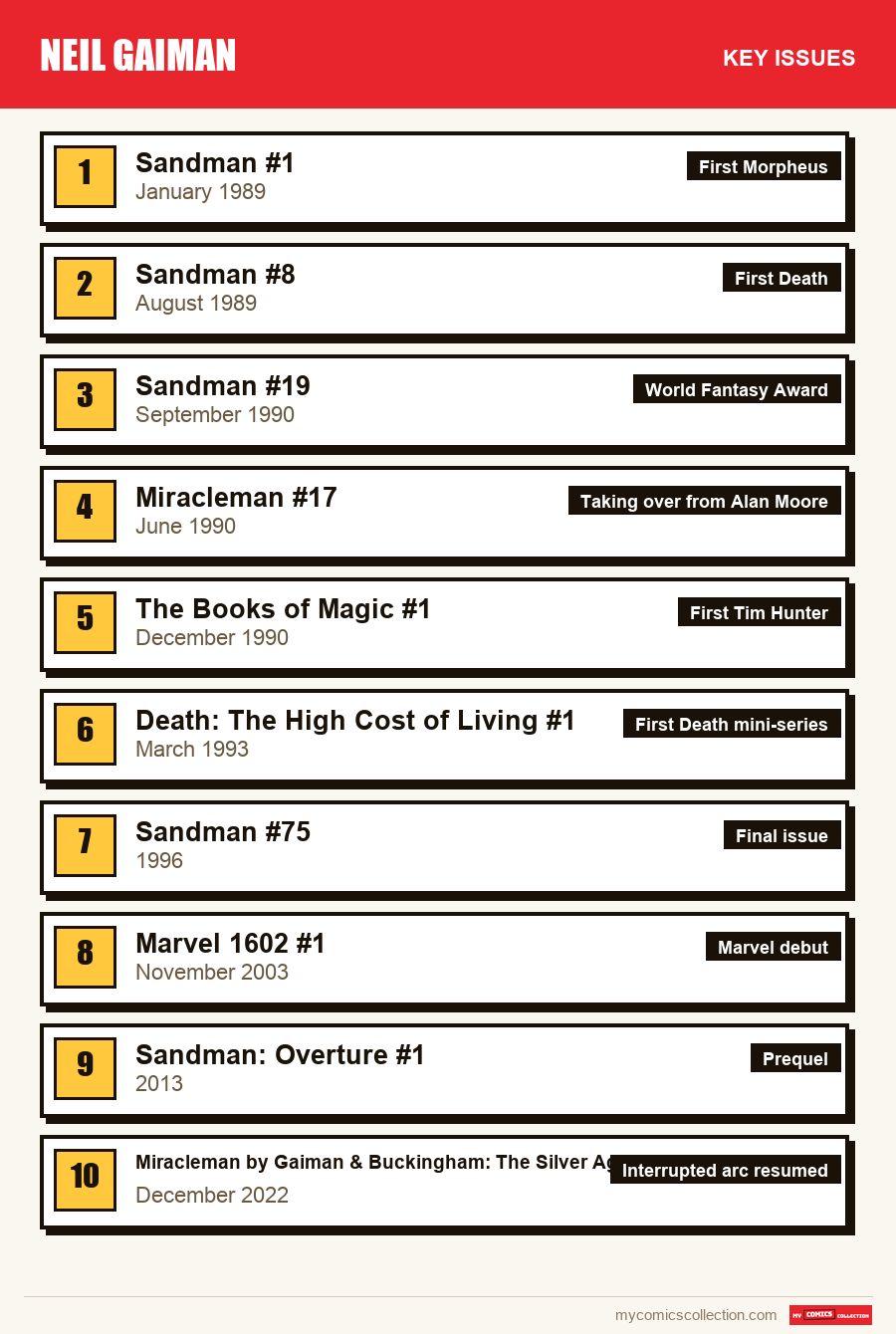
Before Sandman, there was Miracleman. Alan Moore revived this forgotten character from the British Golden Age at Eclipse Comics in the early 1980s, making him a radical and acclaimed deconstruction of the superheroic myth. When Moore left the series, it was Gaiman who took up the torch, supported by artist Mark Buckingham, starting with issue #17, published in June 1990. The project was ambitious: three narrative arcs of six issues each, entitled The Golden Age, The Silver Age and The Dark Age, which were to extend Moore's reflection on what becomes of a society governed by a quasi-divine being.
A sudden interruption
The Golden Age appears in full in issues #17 to #22. The Silver Age, on the other hand, ends abruptly after only two chapters published. Eclipse Comics ceased business in 1994 before filing for bankruptcy in 1995: the series stopped at issue #24. A twenty-fifth issue had already been completed by Gaiman and Buckingham, but due to lack of payment from the publisher, the authors recovered their original pages and the story remained unpublished. The Dark Age, the third and final planned arc, will never even be started. For nearly three decades, Miracleman thus became one of the great sea serpents of the comic book industry: a cult story, praised by critics, but interrupted in mid-flight and deprived of a conclusion.
An unexpected recovery at Marvel
It was not until 2013 that Marvel Comics, having secured the rights to the character after years of complex legal disputes, began republishing the complete Miracleman. But it was not until June 2022 that Marvel officially announced that Gaiman and Buckingham would take up the pen again to complete The Silver Age, with an effective release from October of the same year under the title Miracleman by Gaiman & Buckingham: The Silver Age. For readers who followed the series at the time of Eclipse, this conclusion thirty-two years after the start of the arc remains one of the most extreme cases of editorial "unfinished business" in comic book history. For collectors, this episode explains why the original Eclipse issues, printed in much more modest quantities than the DC or Marvel productions of the same era, retain a particular aura: they document a story that its own author took nearly thirty years to complete.
Sandman (1989-1996): the series that changed the way we look at comics
It is obviously Sandman which established Neil Gaiman as a cult screenwriter, and which remains today at the heart of all collector interest in his work. DC Comics entrusted him with a character that had fallen into disuse, the Sandman of the 1970s by Joe Simon, with almost total freedom of reinvention. Gaiman makes him Morpheus, the incarnation of the Dream, one of the seven Endless, cosmic entities older than the gods themselves. The series has 75 issues published between 1988 and 1996, then republished in ten collections which remain, even today, among the best sellers in the comics section of general bookstores.
Sandman #1: The Birth of Morpheus
The first issue appeared on November 29, 1988 (cover-dated January 1989) from DC Comics, for a cover price of 2 dollars and 52 pages, with a cover signed Dave McKean which immediately established the distinct graphic identity of the series, very far from the classic superheroic codes of the time. This is the very first appearance of Morpheus under Gaiman's pen, which mechanically makes it the most sought-after issue in his entire comic book bibliography. On the current market, specialized quotation bases report copies graded CGC 9.8 offered for around $60 by certain graded professionals, while a record sale listed reached $650 for a particularly well-preserved copy: a gap which illustrates the extent to which, on this issue as on many comics from the end of the 1980s, the state of conservation weighs more heavily in the value than the simple rarity of the print run.
Sandman #8: "The Sound of Her Wings" and the first appearance of Death
If Sandman #1 introduced Morpheus, it was issue #8, published on August 10, 1989 under the title "The Sound of Her Wings", which introduced the most popular character in all of the Gaiman mythology: Death, Dream's older sister, represented not as a macabre figure but as a benevolent teenage goth. Scripted by Gaiman, drawn by Mike Dringenberg with a cover by Dave McKean, this 36-page issue sold for $1.50 at the time is considered by a large part of critics to be the real moment when the series found its voice. The Overstreet 2021 guide valued this copy at around $125 in NM-(9.2) condition, an order of magnitude which gives a good idea of the value base of the issue excluding occasional outbreaks linked to news of the television adaptation.
A series that brought comics out of the superheroic ghetto
What distinguishes Sandman from contemporary DC production is not only its literary tone: it is the way in which Gaiman constructs a coherent mythology by drawing as much from English folklore, Greek mythology, the Arabian Nights or the history of Shakespeare, as well as from the history of crime and American serial killers. The series obtained critical recognition then unprecedented for a comic book, to the point of receiving a World Fantasy Award for one of its issues: a distinction which would subsequently push the organizers to modify the rules of the prize to exclude comics from the short fiction category. It is this critical legitimation, as much as the intrinsic quality of the story, which explains Sandman's particular place in the publishing history of the medium, and the persistence of collector demand for its very first issues almost four decades later.
Books of Magic, 1602 and other milestones in his comics bibliography
The success of Sandman allows Gaiman to multiply projects in shorter formats, often just as sought after by specialist collectors. The Books of Magic, a four-issue prestige miniseries published by DC/Vertigo beginning in December 1990, introduces Tim Hunter, a bespectacled English teenager destined to become the greatest magician in the world, introduced by major figures from the DC magical universe. The first issue, painted entirely by John Bolton, marks the first appearance of Tim Hunter and remains a key issue for collectors of Vertigo comics from the 1990s.
In 2003, Gaiman signed his very first project for Marvel Comics with 1602, a uchronia transposing classic Marvel characters-Professor Xavier, Nick Fury, the Fantastic Four-in Elizabethan England at the beginning of the 17th century, with illustrations by Andy Kubert. The first issue topped US comic sales for August 2003, a rare commercial performance for a screenwriter from the DC/Vertigo side who had, until then, never worked for the rival publisher. Notable fact for the editorial history of the title: the series' profits went to fund Marvels and Miracles LLC, Gaiman's company, which was then fighting for the rights to Marvelman.
Added to this are the comic book adaptations of several of his novels, notably American Gods and Coraline, which extend his universe towards a wider readership without however achieving, on the vintage comics collector's market, the aura of the founding series Miracleman and Sandman. For anyone building a coherent Gaiman collection, these are nevertheless interesting pieces to integrate, in particular because their prints, later and therefore better documented, make it possible to constitute a complete set at a lower cost than the DC/Vertigo issues from the years 1989-1991.
Collecting this series?
Track what you own, what you are missing and what your collection is worth. 7 day trial.
Start my trial →The impact of adaptations on the rating
Sandman went through two attempts at a television adaptation before it came to fruition. It is finally Netflix which puts the first season online on August 5, 2022, with ten episodes followed by an eleventh added on August 19 of the same year. As with most successful comic book adaptations, the release of the series mechanically brought the founding issues back into the spotlight to a broader collector audience, particularly Sandman #1 and Sandman #8, the latter directly benefiting from the popularity of Death's character on screen.
But the recent history of Neil Gaiman has taken a turn that few screenwriters of his stature have experienced. From July 2024, the British media Tortoise is publishing a four-episode podcast series entitled "Master: The Allegations Against Neil Gaiman", in which several women accuse him of sexual assault in relationships that they initially presented as consensual. Between July and August 2024, a total of five women made similar accusations, and a complementary investigation by Vulture magazine published in January 2025 collected other testimonies. One of the plaintiffs has also filed a lawsuit against Gaiman and his ex-wife Amanda Palmer. Neil Gaiman disputes these accusations.
The professional consequences are immediate and cascading. Disney is halting production on the film adaptation of its novel The Graveyard Book. Filming on the third season of Good Omens, adapted from one of his novels co-written with Terry Pratchett, is suspended then Gaiman officially leaves the project in October 2024. Dark Horse Comics breaks its collaboration with the author and cancels the ongoing adaptation of Anansi Boys. Netflix, for its part, announces that the second season of Sandman, already filmed, will be the last: the platform had anyway planned to close the series due to lack of sufficient material for an additional season, but the decision comes in a context where the controversy makes any sequel deemed improbable by industry observers.
For the vintage comic book market, this situation is unprecedented in its scale but not totally isolated in the history of the medium: several authors who have been the subject of personal controversies have seen their comics continue to circulate and be priced on the sole basis of collector demand, without any mechanical link with the reputation of the author at the time of purchase. The issues of Sandman published between 1989 and 1996 remain historical objects documenting a work completed before the alleged facts, and their collector interest is based above all on their status of first publication, their state of conservation and the solidity of the long-term demand for the series: criteria which do not vary according to the legal news of the author. This is a point that every buyer must keep in mind: the recent biographical context can occasionally influence the media attention given to a title, but it does not redefine either the rarity or the editorial history of an issue already published for more than thirty years.
Buying Guide: How to Collect Neil Gaiman Smartly
Building a coherent collection around Neil Gaiman requires clearly distinguishing the truly founding milestones from later derivative products. Here are the points to know before buying:
- Prioritize the two founding issues of Sandman. Sandman #1 (first appearance of Morpheus, January 1989) and Sandman #8 (first appearance of Death, August 1989) are the two most documented and liquid issues on the market; These are the ones to be targeted as a priority if the budget is limited.
- Always check if it is a first print. Sandman has undergone numerous reprints over the course of reissues linked to the growing success of the series and then the Netflix adaptation; only the mention of first printing on the first pages guarantees the collector's value of a key issue.
- Don't overlook Miracleman's Eclipse numbers. Published in much smaller print runs than the DC or Marvel production of the same period, issues #17 to #24 signed Gaiman document a story that remained unfinished for nearly thirty years: their material rarity is often underestimated by buyers who only know the DC/Vertigo then Marvel version of Sandman.
- Books of Magic #1 is an affordable piece to expand the collection. The first issue entirely painted by John Bolton, it remains a good entry point outside of Sandman to document Gaiman's Vertigo period at a lower cost than the DC issues of 1989-1990.
- Check the condition before signing or drawing. On comics from the late 1980s and early 1990s, the difference in value between an average copy and a high-end graded copy can be considerable: always prioritize the state of conservation over the simple supposed rarity of the issue.
- Differentiate between collector request and author's news. Peaks of interest linked to adaptation releases (Netflix, Marvel) are temporary; the substantive value of a key issue rests on its editorial status (first appearance, first printing) and not on Gaiman's recent news.
- Track your collection over time. With such a catalog spanning time, from 1986's Future Shocks to 2022's Marvel publications, keeping an accurate inventory of issues, condition and provenance greatly facilitates future valuations and resales.
To effectively structure a collection centered on such a prolific author, the use of a dedicated tracking tool saves considerable time: the comic collection management application allows you to catalog each issue, its condition and its purchase history, in order to keep a clear overview over the course of acquisitions.
Key issues to know
Sandman #1
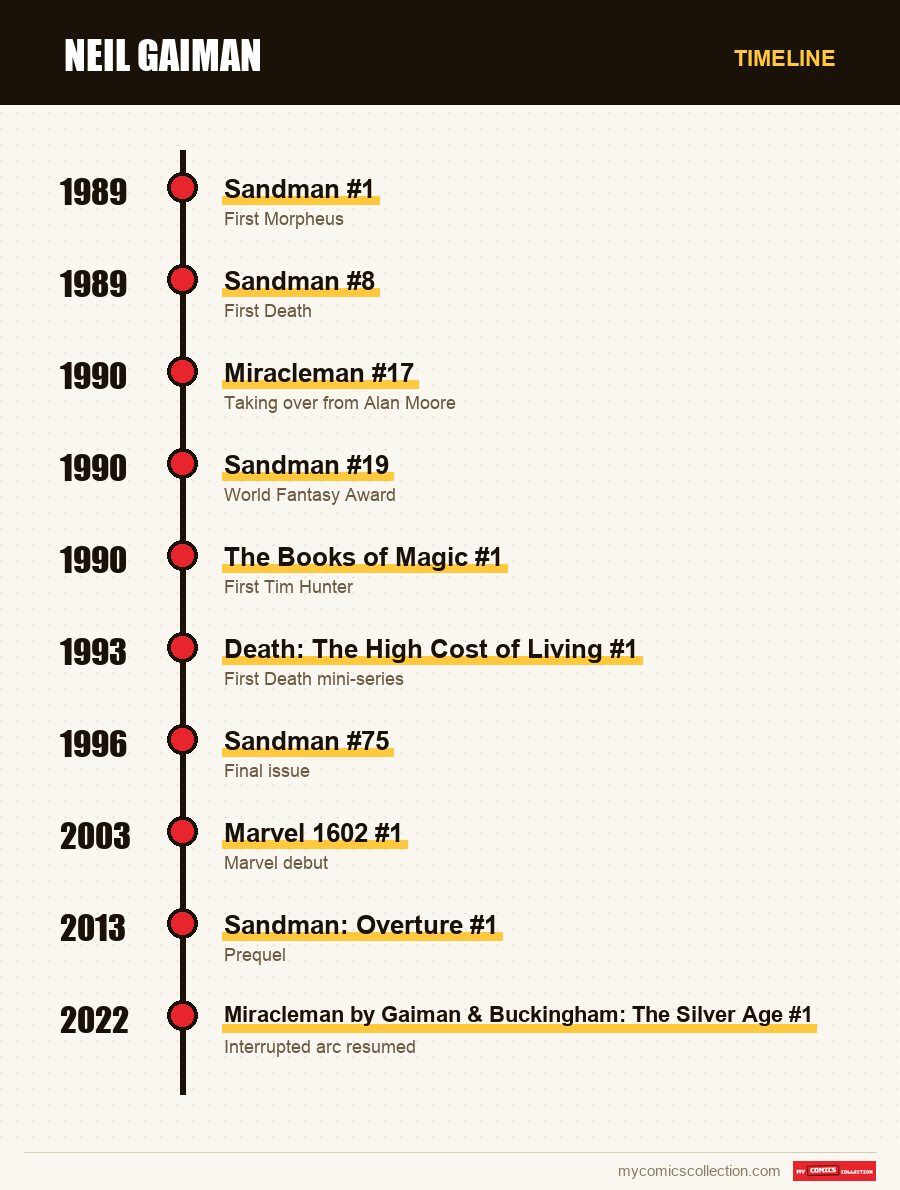
Neil Gaiman, Sam Kieth and Mike Dringenberg open the series with occultist Roderick Burgess, who captures Dream in 1916 while trying to trap Death. Freed decades later, Morpheus sets out to recover his stolen tools. This 40-page opening story also debuts Dave McKean's covers.
Sandman #8
In The Sound of Her Wings, drawn by Mike Dringenberg, Dream meets his older sister Death, a kind young goth woman, and follows her on her rounds. She becomes the most popular character in Gaiman's universe.
Sandman #19
With Charles Vess, Gaiman imagines the first performance of Shakespeare's A Midsummer Night's Dream, staged before the real fairy folk. The issue won the 1991 World Fantasy Award for Best Short Story, a first for a comic.
Miracleman #17
Gaiman and Mark Buckingham succeed Alan Moore at Eclipse with The Golden Age, running from #17 to #22, which explores everyday life in a world ruled by Miracleman. The next arc stops at #24 when the publisher goes under.
The Books of Magic #1
First part of a four-issue mini-series fully painted by John Bolton. Young Englishman Tim Hunter, destined to become a great magician, is introduced to magic by a group of DC Universe mages.
Death: The High Cost of Living #1
Gaiman and Chris Bachalo devote three issues to Death, who takes human form for one day every century. She spends that day in New York with a suicidal teenager. Gaiman would later write a second mini-series about her.
Sandman #75
With Charles Vess, Gaiman closes the series with Shakespeare writing The Tempest, the second play commissioned by Dream. This 75th issue concludes a work completed by its author, later collected in ten volumes.
Marvel 1602 #1
Gaiman transposes the publisher's heroes to the England of 1602, with Andy Kubert on pencils and Richard Isanove on digital colour. Issue #1 of this eight-issue mini-series topped that month's pre-orders. Its profits helped fund the legal fight over the Marvelman rights.
Sandman: Overture #1
Twenty-five years after the series began, Gaiman and J.H. Williams III tell what had weakened Dream at the time of his capture in 1916. The mini-series runs six issues, published until 2015.
Miracleman by Gaiman & Buckingham: The Silver Age #1
Nearly thirty years after the Eclipse stoppage, Gaiman and Mark Buckingham resume The Silver Age at Marvel. This first issue centres on Young Miracleman, back in a world transformed by his old friend.