Watch the trap: Neil Gaiman's Sandman (Morpheus) debuted in January 1989: he's a Modern-age character, so there are no "Bronze Age" key issues of HIS series. The only genuinely Bronze-Age Sandman is a completely different character: the Joe Simon and Jack Kirby one (DC, 1974, six issues), whose first appearance trades today in the tens of euros. If you're after the real Gaiman keys, those are 1989 issues, starting with Sandman #1 (median €8 across 76 listings, June 2026).
"Sandman Bronze Age key issues" is a tricky search, because it blends two unrelated characters who share the same name. The confusion is so common that it deserves an honest correction before any value ranking.
This guide sticks to the verifiable: real-time eBay medians (via our estimator) and documented editorial facts. When a precise figure isn't reliable, too few listings, we state it qualitatively rather than inventing it.
Three different Sandmen: don't mix them up
The name "Sandman" has been carried by several DC characters across different eras. For a collector, that's the first thing to sort out:
- Wesley Dodds: the Golden-Age Sandman (1939). First appearance in Adventure Comics #40 (1939): a gas-mask vigilante. No connection to Gaiman.
- The Simon & Kirby Sandman: Bronze Age (1974). A character named Garrett Sanford, created by Joe Simon and Jack Kirby. This is the only genuinely Bronze-Age Sandman. Short run: six issues (1974-1976).
- Neil Gaiman's Sandman: Dream / Morpheus (1989). The Vertigo icon. Modern (Copper) age, so there are no Silver-Age or Bronze-Age issues in HIS series.
Bottom line: if you want a "Bronze-Age Sandman" in the strict sense, you're after the 1974 Kirby title: not Morpheus.
The real Bronze-Age key: Sandman (1974) #1
Sandman #1 (on stands late December 1973, cover-dated 1974) is the final collaboration between the legendary Joe Simon and Jack Kirby, inked by Mike Royer. Originally conceived as a one-shot, it spawned a six-issue series with Kirby covers: a collectible prized by Bronze-Age fans, but with no narrative connection whatsoever to the modern Sandman.
On value, it's a sought-after Bronze-Age comic: raw copies in nice shape commonly trade in the tens of euros, with high-grade slabbed copies fetching considerably more. This is THE issue to target if your goal is genuinely "Bronze-Age Sandman."
The real Gaiman Sandman keys (1989+): actual values
If, like most readers, you actually had Gaiman's Sandman in mind, here are the issues that matter. Values = median of active eBay listings, all editions and grades combined (our estimator, eBay.fr + eBay.com, June 2026).
| Issue | Why it matters | eBay median |
|---|---|---|
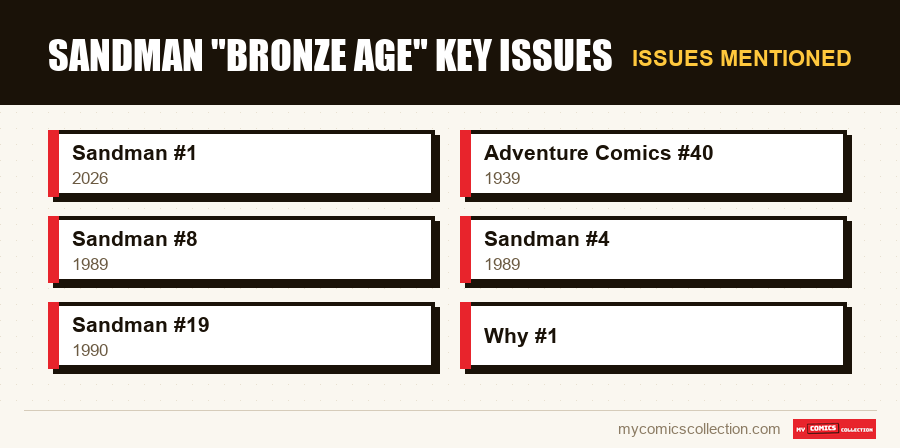
| Sandman #1 (Jan. 1989) | First issue, "Sleep of the Just": first appearance of Morpheus | €8 · 76 listings |
| Sandman #8 (1989) | First appearance of Death of the Endless | "thin" data (see below) |
| Sandman #4 (1989) | Appearance of Lucifer | €6 · 16 listings |
| Sandman #19 (1990) | "A Midsummer Night's Dream": 1991 World Fantasy Award |
An honest caveat: Sandman #8 currently rests on just 8 listings in our estimator: too few to cite a stable median. The raw median observed runs to several tens of euros, but treat it as a ballpark, not a firm value. It is nonetheless the series' most coveted key: the first appearance of Death, Dream's sister, in "The Sound of Her Wings."
Why #1 and #8 dominate
- #1: the cornerstone. "Sleep of the Just" (January 1989), first appearance of Morpheus, art by Sam Kieth then Mike Dringenberg, design and covers by Dave McKean. It's the natural entry point for any Sandman collection, and it stays very accessible (€8 median across 76 listings: good liquidity).
- #8: the first Death. Death of the Endless instantly became one of DC's most beloved characters. Her debut makes #8 the series' sought-after grail.
- #19: the award-winner. "A Midsummer Night's Dream" is the only comic ever to win a World Fantasy Award (Best Short Fiction, 1991): a one-of-a-kind distinction that makes it a prestige key beyond its raw value.
Collector strategy (grounded in real data)
- Don't conflate the titles. Always check the year: 1974 = Simon & Kirby (Bronze Age, Garrett Sanford); 1989+ = Gaiman (Morpheus). Buying "a Sandman #1" without specifying the year can land you two entirely different comics.
- #1 (1989) = the best Gaiman entry point. Low median and high listing volume: easy to buy and easy to resell.
- Grade is everything. On the 1989 keys, only very high grade (CGC 9.6/9.8) creates scarcity. Always check condition and live value before buying: the medians above date from June 2026 and prices move.
Own a Sandman comic: the 1974 or the 1989 version? Get a free value estimate with our tool based on real eBay sales to see its low, median, and high value.
Frequently asked questions
At least three: Wesley Dodds, the gas-mask vigilante of the Golden Age (Adventure Comics #40, 1939), Garrett Sanford, the Joe Simon and Jack Kirby Sandman (1974), and Dream/Morpheus, Neil Gaiman's Vertigo icon (1989). Do not mix them up when buying.
No. That series dates from January 1989, so from the modern era (Copper Age): it has no Silver Age or Bronze Age issues. The only truly Bronze Age Sandman is the 1974 Simon and Kirby title.
It is the last collaboration between Joe Simon and Jack Kirby, inked by Mike Royer. Planned as a one-shot, it spawned a 6-issue series with Kirby covers, appreciated by Bronze Age fans but with no narrative link to the modern Sandman.
Sandman #1 (January 1989, "Sleep of the Just", first appearance of Morpheus), #4 (appearance of Lucifer), #8 (first appearance of Death) and #19, "A Midsummer Night's Dream", the only comic to have won a World Fantasy Award (1991).
Always check the year: 1974 for Simon and Kirby, 1989 and after for Gaiman. Buying "a Sandman #1" without specifying it can give you two unrelated comics. For Gaiman, #1 is the best entry point, and only very high grade creates scarcity on the 1989 keys.