V for Vendetta (2005) James McTeigue , with Hugo Weaving and Natalie Portman, adapts the graphic novel by Alan Moore and David Lloyd (1982-1989). The film takes up the masked revolutionary and the totalitarian regime, while modernizing the political subject. Here is the detailed comparison, film versus comics.
A dystopian fable about freedom and tyranny, V for Vendetta took the mask of Guy Fawkes to the status of a global icon. The film draws on a major political work from the 1980s. Decryption source by source.
As in each article in this series, only verified information (creators, distribution, dates, comic numbers) is stated; the comparative analysis is ours, without reproducing dialogue or protected images.
Title : V for Vendetta (2005)
Director: James McTeigue
Actors: Hugo Weaving (V), Natalie Portman (Evey), John Hurt (Adam Sutler), Stephen Rea (Finch)
Exit : March 2006 (int. 2005)
Studio: Warner Bros.
V for Vendetta (1982-1989): Alan Moore & David Lloyd
A dystopia: the United Kingdom under a fascist regime
The mask of Guy Fawkes: symbol of revolt
V: the masked and vengeful anarchist
- V, the masked revolutionary and his vendetta.
- Le Guy Fawkes mask and its symbolism.
- Le totalitarian regime British.
- The transformation of Evey and his imprisonment.
- The origin of V in a detention camp.
- L'anarchism of the comic becomes a broader anti-tyranny discourse.
- The context is modernized (terrorism, media).
- The relationship V-Evey is romanticized.
- Le final uprising is more explicit.
- Some political nuances are simplified.
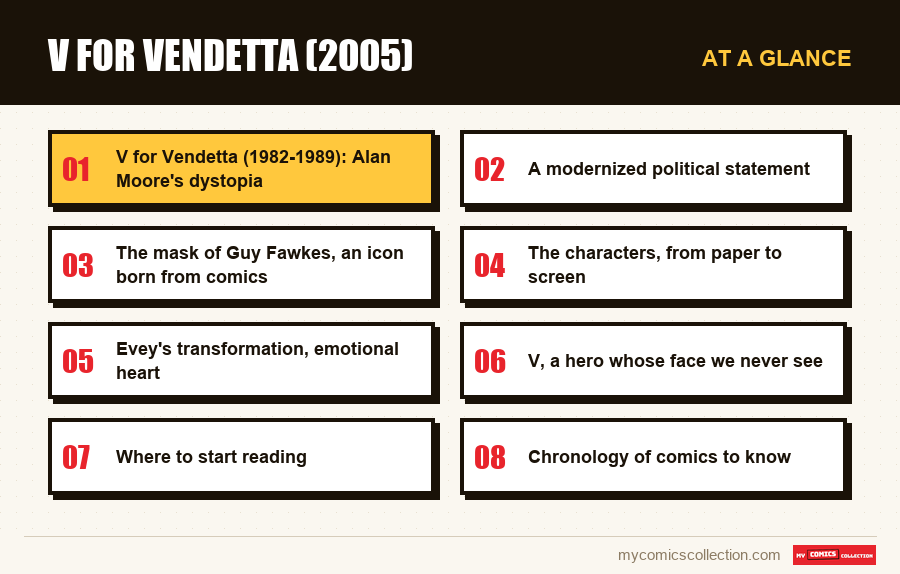
V for Vendetta (1982-1989): Alan Moore's dystopia
V for Vendetta adapts the graphic novel written by Alan Moore and drawn by David Lloyd, originally published in the British magazine Warrior from 1982, then completed and re-released by DC in the late 1980s. The work depicts a dystopian United Kingdom that has fallen under the thumb of a fascist regime after a global catastrophe. Into this world of surveillance, censorship and persecution, emerges V, a masked and theatrical revolutionary, driven by a personal vendetta against the regime that tortured him and by an anarchist ideal. Wearing the mask of Guy Fawkes, historical figure in the conspiracy against the English Parliament, V leads a campaign to awaken the people and bring down tyranny. A deeply political work, V for Vendetta explores themes of freedom, power, resistance and anarchy.
The film faithfully reproduces the central plot and themes: V, the mask of Guy Fawkes, the British totalitarian regime, the vendetta and the fight for freedom. Hugo Weaving plays the masked revolutionary, whose face is never revealed, true to the spirit of the character. Natalie Portman plays Evey, a young woman whose existence V turns upside down. The film preserves V's origin in a detention camp, its culture, its theatricality and its quest for revenge mixed with idealism. However, he modernizes the political statement and romanticizes certain relationships, adapting the work to a context and an audience of the 2000s.
A modernized political statement
The main evolution of the film concerns its political statement. Alan Moore's graphic novel is anchored in the context of the 1980s and explicitly defends an anarchist philosophy: V not only wants to overthrow the regime, but to abolish all authoritarian order in favor of a stateless society. The film, made in the 2000s, attenuates this anarchist dimension in favor of a broader discourse against tyranny, surveillance and media manipulation. It incorporates contemporary themes (terrorism, fear, propaganda, restrictions on freedoms) which resonate with the time of its release. This update makes the subject more accessible, but dilutes the philosophical radicality of the original work.
This modernization illustrates the choices of an adaptation transposing a dated work into a new context. Where Moore criticized Thatcherism and defended anarchy, the film offers a universal fable about resistance to oppression. Alan Moore, known for his rejection of adaptations of his works, has also distanced himself from the film. Nevertheless, the transposition preserves the emotional power and symbolic force of the story. For the reader, this gap illustrates the difference between a specific political work and its general public adaptation. The film invites you to discover the graphic novel, where the anarchist subject and political criticism are developed with a depth and radicality that the cinema has chosen to temper, while preserving the heart of the message: freedom is worth fighting for.
The mask of Guy Fawkes, an icon born from comics
One of the most striking legacies of V for Vendetta is the Guy Fawkes mask worn by V. Inspired by the conspirator of the Gunpowder Plot of 1605, this mask with the frozen smile and pointed mustache became, after the film, a global symbol of protest and resistance. Adopted by activist movements and collectives around the world, it embodies the anonymity of revolt and opposition to power. This symbolic significance, born in the pages of the graphic novel and amplified by the film, goes far beyond the framework of fiction and illustrates the cultural influence of the work.
The film played a decisive role in this diffusion. By popularizing the image of V and his mask, he transformed a comic book symbol into an icon of global protest culture. This phenomenon illustrates the power of the images created by comics and their ability to irrigate society. The Guy Fawkes mask has become a visual language of dissent, detached from its original context. For the reader, this destiny underlines the scope of the work of Moore and Lloyd, whose imagery continues to resonate. The film, by giving flesh and voice to V, helped to make the mask a universal emblem, proving that comics can generate symbols that lastingly mark the collective and political imagination well beyond their pages.
Collecting this series?
Track what you own, what you are missing and what your collection is worth. 7 day trial.
Start my trial →The characters, from paper to screen
- V: The masked revolutionary, faithful to the graphic novel.
- Evey Hammond: The young woman transformed by V, role fictionalized for the film.
- Adam Sutler: The leader of the totalitarian regime, adapted from the comic.
- Finch: The inspector investigating V, faithful to his quest for truth.
- The mask of Guy Fawkes: Central symbol, become global icon.
Evey's transformation, emotional heart
Beyond the action and politics, V for Vendetta is also the story of Evey's transformation. An ordinary young woman living in fear under the regime, Evey is taken under the wing of V, who drags her into his fight. Through a terrible ordeal (her imprisonment and torture, orchestrated by V himself to free her from her fear) she transforms, frees herself from terror and embraces the cause of freedom. This initiatory journey, central in the graphic novel, gives the work its human and emotional dimension. Evey embodies the people who awaken and find the courage to resist.
The film faithfully preserves this arc, one of the strongest sequences in the story. Natalie Portman embodies Evey's transformation, from fear to emancipation, in a striking performance. The film preserves the ordeal of imprisonment and its meaning: liberation through overcoming fear. This intimate dimension balances the political statement and anchors the story in a universal human experience. For the reader, Evey's journey is the emotional heart of V for Vendetta, illustrating how freedom begins with victory over fear. The film, by restoring this transformation, honors the depth of the graphic novel and reminds us that, behind the political fable, there is an intimate story of awakening, courage and rebirth, which gives the work all its resonance.
V, a hero whose face we never see
One of the boldest features of V for Vendetta is that its protagonist never removes his mask. Throughout the story, V remains a mystery: we do not know his face, his name, his exact past. This lack of revealed identity is a deliberate narrative choice by Alan Moore, which makes V less of an individual than an embodied idea. V is not a man, but a symbol: that of revolt, of freedom, of resistance to oppression. By depriving him of a face, the work suggests that anyone could become V, that the idea he carries transcends the person. This conceptual dimension radically distinguishes V from traditional superheroes, whose secret identity always ends up being revealed.
The film faithfully respects this bias. Hugo Weaving interprets V solely through voice and gestures, the Guy Fawkes mask never leaving his face. This constraint, far from weakening the character, reinforces its symbolic significance: V becomes a universal figure, a mask that everyone can wear. The film even pushes this idea in its final scene, where the anonymous crowd appropriates the symbol. For the reader, this absence of face is at the heart of the genius of the work: it transforms a character into a concept, an avenger into an emblem of freedom. V thus embodies the idea that symbols are more powerful than men, and that ideas, unlike individuals, do not die. The film fully honors this vision, making V a timeless icon of resistance.
Where to start reading
To discover V for Vendetta, the ideal is to read the complete graphic novel by Alan Moore and David Lloyd, available as a complete collection. An independent work, it can be enjoyed without prerequisites. Originally published in Warrior magazine (1982) and then completed by DC, it constitutes a political comic book classic. This story is sufficient in itself and requires no further reading.
Chronology of comics to know
- 1982: V for Vendetta: the first chapters appear in Warrior magazine.
- 1988-1989: The series is completed and re-released in color by DC.
- 1990: Publication in collections: the graphic novel becomes a classic.
Collection side: what numbers to aim for after the film
V for Vendetta points to British and modern keys. Magazine issues Warrior (from 1982) containing the first chapters are pieces sought after by collectors. The DC series (1988-1989) and the complete collection are accessible and essential targets for any reader. These numbers cover various budgets. As always, condition and gradation determine value; relying on real recent sales is strongly recommended.
Its place in the saga and for the collector
V for Vendetta will remain as a landmark adaptation, having transformed the mask of Guy Fawkes into a global icon of protest. For the collector, it reinforced interest in the graphic novel and its editions, political classics of comics. It illustrates the cultural significance of a comic book work. Beyond the film, V for Vendetta remains essential reading, to be discovered in its entirety. By celebrating freedom in the face of tyranny, it reminds us that comics can convey powerful ideas and generate symbols that mark their era.
The verdict: a faithful and modernized political fable
- Loyalty: V, the mask of Guy Fawkes, the totalitarian regime, the vendetta, the origin in a camp and the transformation of Evey come from the graphic novel.
- Freedoms: the anarchism attenuated into anti-tyranny discourse, the context modernized, the V-Evey relationship romanticized, the final uprising explained, the political nuances simplified.
- Collectible numbers: issues of Warrior (1982), the DC series (1988-89), the complete collection.
V for Vendetta brings to the screen Alan Moore and David Lloyd's masked revolutionary, pitted against a totalitarian regime. Faithful to the character, to the mask of Guy Fawkes and to the transformation of Evey but modernizing the political message and attenuating the anarchism of the original, the film delivers a universal fable about freedom. For both the reader and the collector, it is an invitation to discover the full graphic novel.
Frequently asked questions
From the graphic novel by Alan Moore and David Lloyd, originally published in the British Warrior magazine beginning in 1982, then completed and re-released by DC in the late 1980s. It depicts a dystopian United Kingdom under a fascist regime. The film adapts it faithfully.
Largely. It preserves V, the mask of Guy Fawkes, the totalitarian regime, the vendetta and the transformation of Evey. But it modernizes the political subject, attenuates the anarchism of the original in favor of a broader anti-tyranny discourse, and romanticizes certain relationships.
Born in the graphic novel and popularized by the film, the mask with the frozen smile became, after 2006, a global symbol of protest and resistance, adopted by militant movements. He embodies the anonymity of revolt against power.
No. Known for his rejection of adaptations of his works, Alan Moore distanced himself from the film and asked that his name not be associated with it, believing in particular that its anarchist dimension had been attenuated. The film, however, remains a powerful transposition.
Issues of Warrior magazine (from 1982) containing early chapters are sought. The DC series (1988-1989) and the complete collection are accessible and essential targets for any reader wishing to discover the work.
Does the film make you want to collect? Estimate the value for free of your numbers (Warrior, V for Vendetta…) with our tool based on current eBay listings.