Blank variants are comics with a completely white cover, published by Marvel, DC, and Image between 2010 and 2026 to give collectors a canvas for convention sketches and artist signatures. An unillustrated copy typically runs between $1 and $5. Once a recognized artist like Jim Lee, Todd McFarlane, or David Finch has added a sketch, value jumps anywhere from $50 to $5,000 depending on the artist's standing, the quality of the work, and the associated CGC Sketch Cover grade.
A white comic cover surprises, and sometimes disappoints, the casual reader who assumes it's a printing defect. In reality, the blank variant cover is a deliberate publishing category, launched at scale by Marvel in 2010 with Deadpool Corps #1, adopted by DC starting in 2012, and embraced by Image Comics throughout 2015-2020. The sole purpose: provide a neutral, logo- and artwork-free surface so a convention artist can draw directly on it, turning a mass-produced comic into a one-of-a-kind piece. This guide covers the editorial mechanics, publisher distinctions, pre- and post-sketch price ranges, storage techniques, authentication pitfalls, and the specific secondary market for blank covers. By the end, you'll know how to identify a blank variant, estimate its real value, and protect it properly.
What is a blank variant cover?
A blank variant cover: also called a blank cover variant: refers to a specific edition of a comic whose front cover is entirely white. The format keeps the standard back cover with barcode, price, legal copy, and publisher logo. The title sometimes appears along the top in minimal black lettering, or disappears altogether depending on the publisher. The remaining surface: roughly 10 inches tall by 6.5 inches wide: is left completely bare, ready for original artwork.
The publishing logic comes down to one sentence: create a standardized physical canvas that a collector brings to a convention, has sketched or signed by an attending artist, and keeps as a unique piece. Before blank variants became widespread in 2010-2012, fans asked artists to sign the standard printed cover: which created two problems: the signature got lost against the printed art, and any sketch added would overwrite the original cover artist's work. The blank cover solves both issues at once.
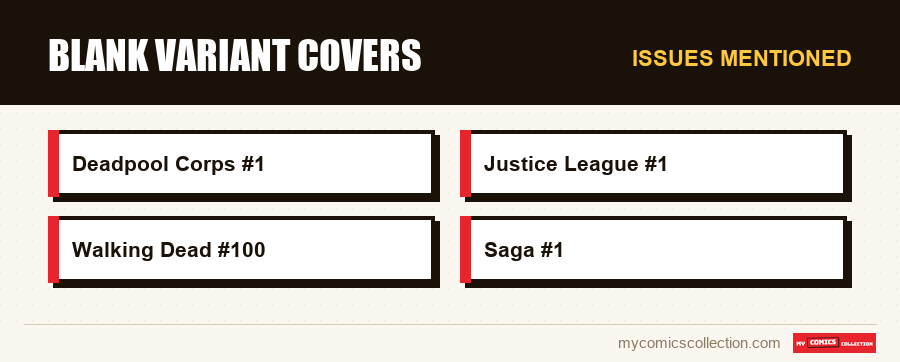
Marvel popularized the format with Deadpool Corps #1 in May 2010, distributed at roughly 5,000 copies in blank form. DC followed in 2012 with the New 52 relaunch, notably Justice League #1 blank variant. Image Comics adopted the format later, starting around 2014-2015, but with more restricted print runs, making them collectible right out of the gate. For a full picture of the variant ecosystem, the variant covers complete guide breaks down all 12 existing categories.
The blank variant is technically distinct from the sketch cover: a term sometimes used interchangeably, but one that historically refers at Marvel to an official printed edition bearing a "Sketch Cover Edition" notation at the bottom. That technical distinction matters for authentication and post-grading value.
Publisher breakdown: Marvel, DC, Image
The three major publishers have distinct blank variant policies, and those differences are directly reflected in secondary market prices.
Marvel has published blank variants consistently since 2010, typically on the #1 issues of relaunches and major events. Print runs fall between 3,000 and 8,000 copies per title, making them semi-rare. A Marvel blank always retains a small title in the upper left, the standard barcode in the lower right, and a discreet "Blank Variant Edition" notation on the back. Distribution runs exclusively through the Direct Market via independent comic shops: never on newsstands.
DC Comics takes a similar approach but sometimes goes wider, printing up to 10,000 copies on Batman, Superman, or Justice League blanks. DC covers stand apart because some editions omit the title from the front cover entirely, maximizing the artist's available canvas. Distribution follows the same Direct Market channels as Marvel.
Image Comics publishes blank variants far less frequently. The titles involved (Saga, The Walking Dead, Invincible, Spawn) are limited to 1,500-3,000 copies in blank form. That scarcity pushes up the base price: a Walking Dead #100 blank variant without a sketch trades between $30 and $80, versus $5 to $15 for a comparable Marvel or DC blank. For context on the publisher, see Image Comics: 30 years of history.
Independent publishers (Dark Horse, IDW, Boom! Studios, Dynamite) occasionally release blank variants, usually on licensed titles with strong convention potential: Star Wars at Dark Horse through 2014, TMNT at IDW, Buffy at Dark Horse. Print runs are often undisclosed and frequently fall below 1,500 copies.
Base prices: $1 to $5 for an unillustrated blank
The price range for an unillustrated blank variant depends on three variables: publisher, title, and age. At Direct Market shops on release day, a standard Marvel blank sells for $3.99-$4.99. DC is similar, ranging from $3.99 to $5.99 depending on the title.
On the secondary market (eBay, six months to two years after release) an unillustrated blank often loses a bit of value, dropping to $1-$3 for titles with no particular demand. It's counterintuitive: the value of the object lies in its transformation potential, not its raw state. A collector buying a blank ahead of a convention pays current market price; a reseller sitting on uninked blanks typically moves them at a loss.
Exceptions push prices up. A blank variant on the #1 issue of a major event (Secret Wars 2015, Civil War II 2016, Heroes Reborn 2021, Death of Doctor Strange 2021) holds its initial value and can climb to $8-$15 in clean condition. Image blanks on Saga, Invincible, or Walking Dead reach $30-$80 on eBay in the US: pure print-run scarcity at work. For more on how print runs drive value, see understanding comics print runs.
Value explodes after a sketch by a recognized artist. A blank Amazing Spider-Man with a convention sketch by Todd McFarlane trades between $800 and $5,000 depending on the quality of the drawing, its scope (head sketch vs. full figure vs. full cover art), and the associated CGC Sketch Cover grade. A Jim Lee sketch on a Batman blank can reach $1,500-$3,000 in completed sales. Sketches by lesser-known artists stay in the $50-$200 range: still well above the cost of the blank itself.
Oversized bags: storing illustrated blanks
Storing an illustrated blank variant presents a specific technical challenge: a sketch done in ink, marker, or Copic can add thickness beyond that of a standard cover, and some artists use mixed media (ink + watercolor wash + Copic coloring) that adds physical relief. Standard BCW bags sized for modern comics at roughly 6.75 x 10.25 inches still work, but with very little room to spare.
Specialty manufacturers have developed oversized bags for sketch covers, available since 2014-2015. BCW offers the "Thick Comic Bag" at 7 x 10.5 inches with double-thickness walls (approximately 4 mil, versus 2 mil for standard Mylar). E. Gerber Products sells Mylites 4, designed specifically for comics with sketches or multiple signatures. Extra-rigid backing boards at 24 or 42 point (versus the standard 18 point) keep a sketch from warping under the pressure of vertical storage.
Cost goes up accordingly: a standard bag + backing runs $0.30-$0.50 per comic; an oversized bag + 24-point backing runs $1.20-$2.50 per comic. For a collection of 50 sketch covers, that's an extra $50-$100: a small price to protect pieces whose combined value can easily exceed $5,000. The article protecting comics: the storage guide covers temperature, humidity, and shelving parameters in detail.
Horizontal storage is the rule for recent sketches that are not yet fully dry (acrylic inks, alcohol markers). A drying period of 7 to 30 days is needed before bagging: skip it and you risk ink transfer onto the Mylar or smearing on contact with the plastic surface. Professional artists typically advise collectors on the recommended drying time.
No trade dress: advantages and drawbacks
A comic's trade dress refers to all the printed graphic elements on the cover: title, issue number, publisher logo, price, barcode, and legal copy. On a blank variant, the trade dress is intentionally stripped to the bare minimum: barcode on the back, discreet legal copy, and sometimes a tiny title at the top.
The advantage for the artist is obvious: the entire surface is available for composition. A full cover art piece, an illustration covering 100% of the cover, simply isn't possible on a standard cover where the title already takes up 20-30% of the space. The blank removes that constraint. Artists like Adam Hughes, Frank Cho, Mark Brooks, and J. Scott Campbell can produce work that rivals standalone original art on paper, which sells separately at significantly higher prices ($1,500-$8,000 for an original cover painting).
The drawback involves authentication and possible confusion with a virgin cover. A virgin cover is a printed variant that includes the artwork but omits the title and trade dress, sold as a special edition (often at a 1:25 or 1:50 ratio). An uninformed buyer can mix up a virgin cover with a blank that has been sketched by an artist. The difference is verified by comparing the illustration against publisher databases: if the image appears on the official cover list, it's a virgin; if not, it's a sketch on a blank. For a clear breakdown of the distinction, see virgin covers: collecting logo-free editions.
Another practical downside: without a visible title or issue number, filing in a box requires a parallel labeling system. Many collectors write the title, issue number, and the sketching artist's name on the outside of the bag to avoid spending 20 minutes hunting for one Batman blank among 30 others at a show or during a sale.
CGC Sketch Cover authentication and grading
CGC, the leading grading authority in the United States, created a dedicated Sketch Cover label in 2014 for illustrated blank variants. The label acknowledges the artwork as a post-publication addition, notes the artist's name on the slab if verified, and grades the comic on standard criteria (overall condition, corners, creases, printing defects).
The CGC Sketch Cover authentication process has three tiers. Universal Sketch Cover: the sketch is noted but the artist is not authenticated: yellow-green label. Signature Series Sketch Cover: the artist drew the blank in the presence of a CGC-authorized witness (Convention Witness): yellow label with "Signature Series" notation. Yellow Label Authenticated: the drawing was certified directly by the artist through the CGC program: yellow label with specific notation. The value gap between Universal and Signature Series often reaches 40-60% for the same artist.
Sketch Cover grading costs more than standard grading: roughly $65-$150 depending on the tier and whether signature authentication is included, versus $30-$60 for a standard comic. Turnaround stretches to 6-12 months for Signature Series submissions, which require coordination around specific convention appearances. The article grading comics with CGC: the complete guide details current CGC tiers and fees.
The Sketch Cover grade follows the standard CGC scale from 0.5 to 10.0, with one caveat: added artwork can lower the grade if it bleeds onto the spine, creates creases, or damages the paper. Conversely, a perfectly executed sketch on a Mint comic can hold a 9.8 grade. Most graded Sketch Covers land between 9.4 and 9.8.
Secondary market and 2024-2026 trends
The blank variant market has shifted considerably since 2020. Three structural trends are shaping current supply and demand.
First trend: rising prices for sketches by top-tier artists. A full-figure sketch by Stanley Lau (Artgerm) on a blank variant traded between $200 and $500 in 2018; by 2025, those same pieces regularly exceed $1,200-$2,500. The same dynamic is hitting all the top names: Adam Hughes, J. Scott Campbell, Frank Cho, David Finch, Mark Brooks, Peach Momoko. The post-pandemic shortage of artists willing to appear at conventions (roughly 2022-2024) constrained supply, and prices rose mechanically.
Second trend: the professionalization of mail-order commissions. Many artists now accept blank covers sent by mail, sketch them at home, and ship the finished piece back. Prices are set upfront (head sketch $80-$300, full figure $250-$800, full cover art $600-$3,000 depending on the artist). The risk lies in shipping loss: serious collectors insure the package and use UPS or FedEx with mandatory signature confirmation.
Third trend: speculation on rare unillustrated blanks. Some collectors buy Image blank variants in quantity (5 to 20 copies of the same title), betting on future scarcity. The strategy occasionally pays off: a Saga #1 blank purchased for $8 in 2014 resells for $60-$120 in 2026. But returns are inconsistent and generally trail an illustrated blank in the same title.
The article comics set to rise in value 2026-2027 identifies titles to watch for blank variants, and 2025 comics market recap provides broader market context. For investment strategy, see investing in comics: the strategic guide.
Practical tips before buying or commissioning
Before purchasing a blank variant or commissioning a sketch, five points are worth checking. First, verify the publisher's stated print run (often listed on Heritage Auctions or ComicBookRealm). A Marvel blank at 8,000 copies will never command the same price as an Image blank at 1,500: even with a sketch by the same artist.
Next, check the condition of the blank before the sketch goes on. A comic at NM 9.4 minimum is necessary to have a realistic shot at a CGC Sketch Cover grade of 9.6 or 9.8 post-illustration. A blank with bent corners, creases, or printing flaws will never recover its value, even with a sketch by a major artist.
Check whether the artist participates in the CGC Signature Series program. Not all artists are enrolled, and a sketch by a non-authenticatable artist automatically falls into Universal Sketch Cover territory: cutting potential value by 30-50%. The list of eligible artists is updated monthly on the CGC website.
Document every sketch the moment it happens at a convention: a photo of the artist in the act of drawing, a photo of the finished blank, any payment receipt, and a signed certificate if provided. These serve as proof in case of doubt during a future sale. A comics manager like My Comics Collection lets you attach photos and notes to each entry in your database.
Finally, keep in mind that the sketch cover market is less liquid than the standard comics market. An illustrated blank can take 6 to 18 months to sell at your target price on eBay or Heritage Auctions. If quick liquidity matters to you, stick to mainstream Marvel/DC titles and top-tier artists: whose work tends to find a buyer in under 90 days on average.
Manage your blank variants with My Comics Collection
Catalog your blank variants, sketch covers, and virgin covers in a dedicated database. Track the artist, CGC Sketch Cover grade, original print run, and up-to-date estimated value. Photos, notes, and provenance history per issue.
FAQ
Can a blank variant be mistaken for a printing defect?
No. A blank variant carries "Blank Variant Edition" or a standard barcode with publisher reference on the back. A genuine printing defect (an accidentally white cover) is a unique, one-off item, not listed in any publisher database, and usually carries special numbering. The difference is verifiable on ComicVine or Heritage Auctions in under 30 seconds.
Should I write my name on the back of a blank to prove ownership?
No. Any mark added to the back of a comic automatically lowers the CGC grade: sometimes by as many as 2 full points. Proof of ownership comes from your purchase receipt, a convention photo with the artist, or the CGC Signature Series slab that seals the authentication.
How much does a top-tier artist sketch on a blank cost in 2026?
Ranges vary by artist and complexity. An Adam Hughes head sketch runs $300-$600, a full figure $1,200-$2,500, and a full cover art piece $3,000-$8,000. Mid-tier artists (Mark Brooks, David Finch) typically fall at roughly half those figures.
What bag should I use to store an illustrated blank?
A BCW Thick Comic Bag (oversized) or E. Gerber Products Mylite 4, paired with a 24- or 42-point backing board. The added cost is $1-$2.50 per sketch: less than 0.1% of the typical value of the artwork.
Is a blank variant worth anything if it stays unillustrated?
Yes, but modestly. An unillustrated Marvel or DC blank typically resells for $1-$5 on the secondary market. Rare Image or independent blanks (Saga, Walking Dead, Invincible) can reach $30-$120 even without a sketch, purely on print-run scarcity.
How long should I let a sketch dry before bagging?
At least 14 days for a felt-tip or alcohol marker, and 30 days for india ink or alcohol-based markers. Bagging too early causes irreversible ink transfer onto the Mylar and ruins the artwork.
Can I commission a sketch remotely by mail?
Yes. The majority of artists have accepted mail-order commissions since 2022. Shipping typically adds $30-$80 for insured round-trip service. Use UPS or FedEx with mandatory signature confirmation to minimize the risk of loss.
Is CGC Signature Series required to maximize a sketch's value?
Yes, for top-tier artists (Hughes, Lee, McFarlane, Campbell). The value gap between Universal and Signature Series reaches 40-60% for the same artist. For mid-tier or lesser-known artists, the Universal Sketch Cover is sufficient and costs 30-50% less to obtain.