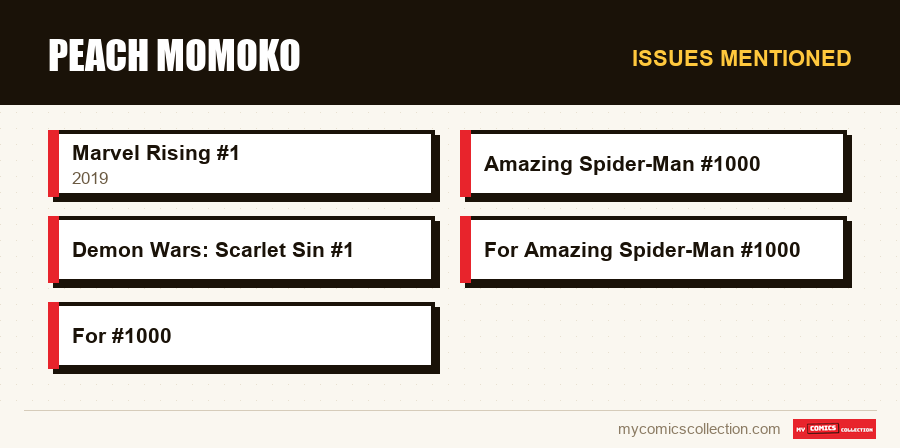
Peach Momoko is a Japanese artist whose first cover for a major American publisher is a variant of Marvel Rising #1 (2019). Under exclusive contract with Marvel since late 2020, she received the Eisner Award for Best Cover Artist in 2021 and in 2024. Her covers fall into five families: one-off variants on regular series, labeled "Momoko Variant" and often doubled by a textless version; themed waves (Star Wars in March 2023, kimonos in March 2025); the covers of her own series (Demon Days from 2021, Ultimate X-Men from 2024); exceptional collaborations, like the variant with Frank Miller on Amazing Spider-Man #1000; and her pre-exclusivity work for other publishers. This guide helps identify them, without giving any price or ratio.
Few cover artists have built such immediate recognition in so little time. A Peach Momoko cover can be recognized from afar: fine-featured female silhouettes, a muted palette, motifs borrowed from woodblock prints and Japanese folklore, and a way of turning any Marvel hero into a figure from a tale. This recognition has a consequence for collectors: her variants are numerous, sought-after, and easy to confuse with one another.
This guide does not say which covers are worth the most. It has no honest means to: allocation ratios are not always published, and observed prices change too fast to be cited without a date or source. It offers instead a map: how the artist's output is organized, how to identify a cover precisely, and how not to buy the same thing twice under two different names.
Who is Peach Momoko
Peach Momoko is a pseudonym. The artist was born in Saitama Prefecture, Japan. She studied video game design before turning to illustration, lived several years in Portland, in the United States, from 2010, then returned to Japan in 2013. Her first published works belong to illustration, gallery and textile work, well before comics.
Her entry into American comics goes through the artist Adi Granov, who introduces her to Marvel. Her first illustration for a major publisher is a variant cover of Marvel Rising #1, in March 2019. She then works for several publishers, before signing in late 2020 an exclusive contract with Marvel, as part of the publisher's young talent program, the Stormbreakers. The exclusivity leaves her the right to honor her earlier commitments.
Recognition follows very quickly: the Eisner for Best Cover Artist in 2021, then again in 2024, and a Ringo Award in 2021. Her appearance at the October 2022 New York Comic Con left a memory in the community: the line for her free signings was the longest of all the guests, to the point of causing tensions and the cancellation of a session.
The five families of covers
1. One-off variants on regular series
It is the most numerous family. Marvel regularly entrusts Momoko with an alternate cover for an issue of an ongoing series, often among the titles linked to the X-Men, the Avengers or the publisher's major figures. The publisher's encyclopedic database records, for 2025 alone, her covers on titles as varied as Ultimate X-Men, Magik, Psylocke, Storm, Uncanny X-Men, Fantastic Four or Avengers.
These covers are labeled "Momoko Variant" in catalogs and reference databases. Very often, a second version exists: the "Momoko Variant Textless," that is, the same illustration without the logo or the usual notices. The market also speaks of a "virgin" version. These are two distinct covers, with two distinct references.
2. Themed waves
Several times, Marvel has organized a series of Momoko covers around a theme, published across several titles within the same month. In March 2023, she made a series of variants for Women's History Month across the publisher's entire Star Wars line. In March 2025, a series of covers depicted Marvel characters in kimono.
For a collector, these waves raise a question of scope: should you get the whole wave, or only the characters who interest you? There is no right answer, but it has to be settled before starting, otherwise a multi-title wave quickly turns into an endless list.
3. The covers of her own series
Momoko is not only a cover artist. She writes and draws her own stories, and that is where her universe takes on its full dimension.
Demon Days
A rereading of Marvel characters through Japanese folk tales, published in five one-shots then gathered in a collection in 2022. It opens what the artist herself calls the "Momoko-verse," continued by Demon Wars, a transposition of Civil War into the same setting. Her cover for Demon Wars: Scarlet Sin #1 is among the works cited for her 2024 Eisner.
Ultimate X-Men
Announced in October 2023, this series relaunches the X-Men in the Ultimate universe recreated that same year. It is Marvel's first regular title entrusted entirely to the artist. Its issues also carry Momoko-signed variants, in addition to covers by other artists.
She also designed the clones of Spider-Gwen for the 2023 miniseries Spider-Gwen: Shadow Clones, which explains her presence in collections centered on Spider-Gwen, and she signed in November 2023 a one-shot of Star Wars: Visions that bears her name.
4. Exceptional collaborations
The latest is the most visible. For Amazing Spider-Man #1000, released on September 30, 2026, Momoko signs with Frank Miller the story "Tears of the Spider-Queen," their first collaboration, in which Spider-Man faces the Hand. A variant cover pairs the two artists. It is one of the nine covers Marvel had to allocate to retailers for the release, then send back to press. The mechanics of this kind of release are described in our article on the nine allocated covers of a single release, and the issue's full set of covers in our #1000 collecting guide.
5. Pre-exclusivity covers
Before late 2020, and for commitments already made afterward, Momoko made covers for other publishers, including IDW, Image and Dark Horse according to the publisher's database. These covers are fewer and less known to the general public. They interest collectors who want to trace the artist's career from her beginnings, and they require more research work, since they do not appear in lists centered on Marvel.
Identifying a cover precisely
Read the exact designation
"Momoko Variant," "Momoko Variant Textless," themed-wave cover, store-exclusive cover: these are all different products. The designation appears in the retailers' catalog and in reference databases.
Check the barcode
At Marvel, the last digits of a recent issue's barcode indicate the issue, the cover and the printing. Two copies of the same issue with two different covers do not have the same supplemental code.
Distinguish with and without text
The textless version takes the same illustration without the logo. It is not a printing defect, it is a separate variant, often produced in smaller quantity.
Spot the reprints
A cover sent back to press, like those of #1000, may carry a printing notice. A first printing and a second are not the same object for a collector.
Check the certification label
On a certified copy, the label must name the variant. A label that does not specify it deserves a check with the seller before any purchase.
Ratios and scarcity: what can be said, and what cannot
Some of Momoko's covers are ratio variants: a retailer must order a certain number of copies of the main cover to receive one. Others are open-order variants, with no condition. Still others are reserved for a store or an event. The scarcity difference between these categories is real, but it is not always public, and the figures that circulate are sometimes approximate or wrong.
Our rule is simple: only retain a ratio if it appears in a publisher or distributor source, for the exact cover concerned. To understand how these ratios work and what they really imply, see our article on variant ratios and scarcity. And keep in mind that a limited print run does not, by itself, create lasting demand: that depends on the illustration, the character and the issue.
Building a coherent collection
With several dozen covers a year, collecting everything is a goal out of reach for most. Three approaches give more coherent collections.
By character. Keep the Momoko covers devoted to a character you already follow: the mutants, Spider-Gwen, or the publisher's heroines, whom she has depicted a lot.
By universe. Focus on the "Momoko-verse": Demon Days, Demon Wars, then Ultimate X-Men. It is where the artist is both writer and illustrator, and it is the part of her work most likely to count durably.
By milestone. Keep only a few landmark pieces: her Marvel debut in 2019, the award-winning covers, and the collaboration with Frank Miller on Amazing Spider-Man #1000.