Amazing Spider-Man #1000 came out on September 30, 2026: 104 pages, main story by Joe Kelly and Pepe Larraz, more than 400,000 preorders, and despite that a sellout on day one. Marvel allocated nine covers and sent them all back to press, with a second printing scheduled and unfilled orders announced for November 4, 2026. For a collector, the essentials fit in one sentence: an issue printed at more than 400,000 copies will not become rare, whatever the fever of the first Wednesday. What can matter in the long run is the copy you picked knowingly, and the record you keep of it. This article details the issue's contents, sorts out its nine covers, and places the 1000th milestone in the line of the series' landmarks.
On September 30, 2026, a single issue occupied every conversation among French-speaking collectors. Not because it announced an editorial revolution, but because it carried four digits on its cover and vanished from the shelves before noon. Twenty-four hours later, the questions coming in were still the same: which of the nine covers should you hunt, should you wait for the second printing, and above all, will this object be worth anything.
These three questions have answers, and they are not the ones the atmosphere of release day suggests. This guide does not deal with anniversary issues in general, nor with the mechanics of allocated covers, nor with stock-outs as a phenomenon: three subjects that have their own articles. It deals with one specific, dated object whose contents, team, page count and order volume are known. That is enough to decide without guessing.
A note on method before going into detail: no dollar amount will appear in these lines about this issue. As of October 2, 2026, it has been out for two days, no price guide entry exists, and anyone telling you its future value today is making up a number. What we can do, on the other hand, is compare with real, documented print runs from the past. That is far more instructive.
Why this issue carries the number 1000 in 2026
The question is not trivial, because it explains the nature of the object. The current series does not have a thousand issues behind it: it restarted at 1 in April 2025, after the Eight Deaths of Spider-Man story, and it stood at thirty-six issues in August 2026. The number 1000 comes from elsewhere.
Marvel adds up every incarnation of the title since March 1963. The first series ran from 1963 to November 1998, that is 441 issues. A second one restarted at 1 in January 1999 for 58 issues, before the publisher went back to the original numbering in December 2003, at issue 500. That continuation stopped at 700, in December 2012. A volume in 2014 followed, then another in 2015, another in 2018, another in 2022, and the current volume in 2025. Since the 2018 relaunch, the publisher prints both numbers side by side on the cover: the one for the current volume and the cumulative total. It is this total that reaches 1000 on September 30, 2026.
A practical consequence, and it matters: this issue is not an entry point into a story. It is a marked stage in the middle of an ongoing narrative, the one Joe Kelly has been writing since April 2025. Publishers build these milestones to be readable on their own, and this one is generous, but you are buying a chapter of a run, not a first issue. The difference matters as soon as you think in terms of collecting, because a first issue is resold to people who are starting out, whereas a milestone is resold to people who already follow the series.
What is in the 104 pages
The page count is the most reliable piece of information we have on an issue of this kind, and 104 pages is an anthology format, not a monthly issue. At this size, a publisher places a long main story and several short tales handed to guest teams.
The main story is by Joe Kelly, writing, and Pepe Larraz, drawing. These two names deserve a pause, because they say something about the issue's place in the title's history.
Joe Kelly is no passerby. He wrote The Amazing Spider-Man between 2008 and 2010, a period that produced several stories still cited, including "American Son" and "Grim Hunt." He thus returns to the title some fifteen years after leaving it, and he is the one who relaunched the series in April 2025. His 1000th milestone is not a one-off commission handed to an outside author: it is the peak of an arc he has been building for eighteen months. For anyone who wants to understand the issue, the right preparation is to have read the issues that precede it, not to have read a story from 1963.
Pepe Larraz arrives with the soundest reputation possible on a Marvel milestone: he is the one who drew House of X in 2019, the six issues that refounded the mutant franchise. He is also one of the two artists on the current volume of The Amazing Spider-Man, alongside John Romita Jr. Handing the main part of a number 1000 to Larraz rather than to a prestigious passing guest is a coherent decision: the publisher treats the milestone as an episode of its own story, not as a postcard.
The Amazing Spider-Man #1000
More than 400,000 preorders before release, a sellout on release day, nine covers allocated and then sent back to press, a second printing scheduled, unfilled orders announced for November 4, 2026. The issue combines every sign of commercial success, and no sign of scarcity.
Nine covers: which to keep, and on what criterion
Marvel allocated nine covers to this issue and sent them all back to press after the sellout. The publisher announced artwork by Lee Bermejo, Ed McGuinness, Paco Medina, Humberto Ramos, Marcos Martin, Skottie Young, Peach Momoko, Frank Miller and J. Scott Campbell, as well as a remastered reprise of a drawing by Steve Ditko. The mechanics of this allocation are covered in our article on allocated variants; here, the only question is which of these nine images has a chance of mattering.
The useful criterion is not aesthetic. It comes down to three tests you can apply from memory, standing in front of a display rack.
Is the cover the one the publisher will reuse?
An image becomes an issue's official representation when it is used to announce it, then to reissue it in a collected edition. That is almost always the main cover. The other eight live for a season. With thirty years of hindsight, the covers that remain identifiable are the ones the publisher itself canonized.
Does the artist have a history with this specific title?
Here, the list sorts itself. Humberto Ramos drew part of issue 800, in 2018. Ed McGuinness launched his career with Joe Kelly on Deadpool in the late 1990s, which makes his participation an inside nod rather than a prestige signature. Steve Ditko co-created the character. Those three names have a reason to be on this issue. The others are invitations extended to renowned artists, with no particular link to the title.
How many copies of this cover exist?
A question with no public answer on release day, and that is precisely why you should not pay a premium blind. A cover whose print run you do not know is not rare: it is simply opaque. The information eventually circulates, often months later, and it generally disappoints those who bet.
That leaves the special case of the remastered Ditko, which does not belong to the same family as the other eight. It is not a new drawing: it is an archive image updated for today's printing. Its interest is documentary and sentimental, and it is real: Ditko is the man who drew the 24 pages of Amazing Fantasy #15 in 1962, and it is the only cover of the nine that physically ties the 1000th milestone to the character's origin. On the other hand, an archive reprise creates no scarcity: it can be reproduced at will, and it was in fact sent back to press like the others. If you take it, take it for what it tells, not for what it might earn.
The operational conclusion fits in two lines. If you want a single copy, take the main cover: it is the one that will stay readable as "the number 1000" in ten years. If you want two, add the Ditko for the coherence of your collection. Beyond that, you are buying the same comic nine times.
Why 400,000 copies never produce scarcity
This is the heart of the subject, and it is the point on which the collective memory of the hobby is most faulty. An enormous order figure and a sellout on release day seem to say the same thing: the object is sought after, so it will be rare. They are in fact two independent facts, and the first cancels the second in the medium term.
Three documented precedents are enough to show it, and none of the three is an opinion.
Spider-Man #1, August 1990, by Todd McFarlane. Initial print run of 2.35 million copies, to which the publisher added 500,000 copies to meet demand, about 2.5 million in all counting the polybagged editions and the cover variants. The most aggressive launch in the house's history up to that date. Thirty-six years later, this issue is one of the easiest issues to find in existence, in every condition.
X-Men #1, 1991, by Chris Claremont and Jim Lee. More than 8.1 million copies, making it the best-selling comic book of all time according to the record certified by Guinness World Records, publicly announced in August 2010. And the sales mechanism was exactly the one that concerns us: five different covers, four of which, placed side by side, formed a single image, plus a fifth foldout reproducing the whole. Retailers ordered massively in anticipation that readers would buy several copies to get the full set of covers. They were right on volume, and that volume sealed the object's fate.
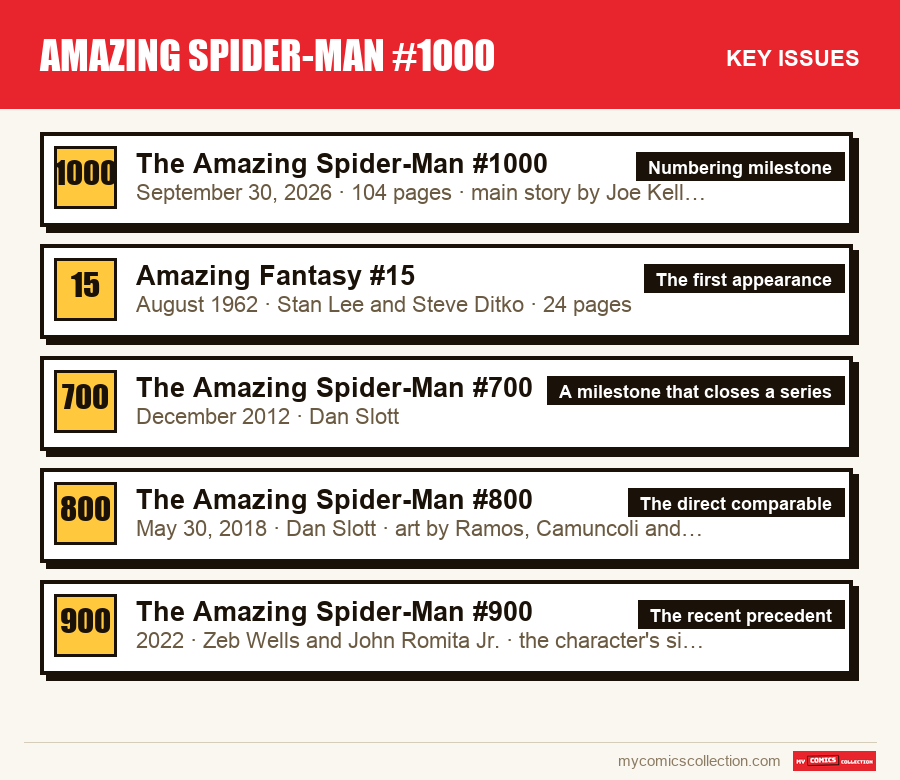
The Amazing Spider-Man #800, May 30, 2018. The most relevant precedent, because it is the same title, the same type of milestone and the same kind of setup. Written by Dan Slott, drawn by several teams including Humberto Ramos, Giuseppe Camuncoli and Stuart Immonen, it concluded "Go Down Swinging." It sold 411,480 copies and was the best-selling comic of May 2018. This figure should be set against the 400,000 preorders of number 1000: the 2026 milestone sits in the same order of magnitude as its 2018 predecessor. Eight years on, the 800 is neither impossible to find nor expensive.
The lesson is not that these issues are bad. All three are interesting objects, and two of them had a real effect on their franchise. The lesson is arithmetic: scarcity is a ratio between a number of copies and a number of later buyers. When the numerator is at six or seven digits, there is no future in which the ratio turns favorable, because the people who will want this issue in twenty years are in large part the ones who already bought it in 2026.
The September 30 sellout contradicts none of this. It says that a stock was exhausted at a given moment and in a given channel, which is a logistics problem, not a scarcity indicator. The question "what is sold out, and where" is treated in detail in our guide to release-day sellouts.
The line of the series' milestones, from 1962 to today
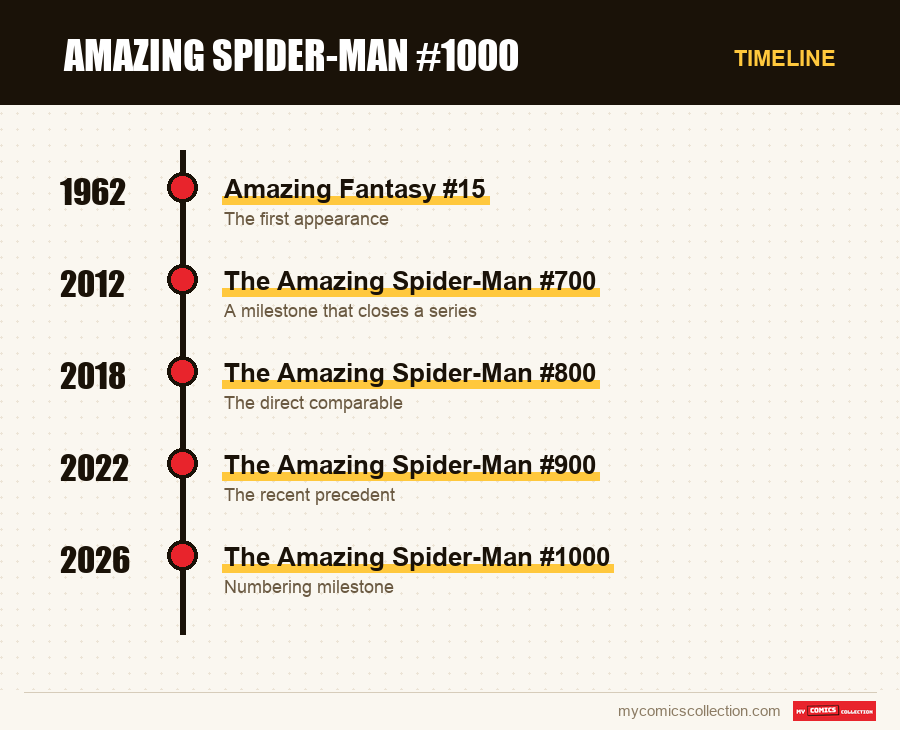
Placing the 1000 in this line is the best antidote to hype, because the series has already crossed four thresholds of this kind and we know how each one aged.
Amazing Fantasy #15
The character's first appearance came out in the last issue of an anthology slated to end. The publisher, according to Stan Lee's own account, had nothing to lose. Sales contradicted the cancellation decision, and the character's own series arrived seven months later. Ditko's original artwork was donated to the Library of Congress in 2008.
The Amazing Spider-Man #700
The most interesting case in the line, because the milestone served a purpose other than celebrating itself. It concluded "Dying Wish," a story in which Peter Parker dies and Otto Octavius takes his place after a consciousness swap, and it made way for The Superior Spider-Man as early as January 2013. A round number used as a series finale, not as a party.
The Amazing Spider-Man #800
Conclusion of "Go Down Swinging," with the final showdown against the Red Goblin, a version of Norman Osborn fused with the Carnage symbiote. Thick format, several art teams, 411,480 copies sold and first place in the month's sales.
The Amazing Spider-Man #900
The 900 threshold was crossed in 2022, in the volume launched in April of that year with Zeb Wells writing and John Romita Jr. drawing, the character's sixtieth anniversary year. It is the most recent milestone, so the one whose aging is easiest to read: four years later, it can be found without particular difficulty.
One detail deserves emphasis: none of these four milestones is among the most sought-after issues of the series. The issues people really hunt are those where something happens for the first time, like The Amazing Spider-Man #1 from March 1963 or The Amazing Spider-Man #300. The round number draws attention at release; the first appearance holds it for decades. The difference between these two logics is developed in our article on anniversary issue strategy.
Second printing and the November 4 orders: what to do now
If you did not get the issue on September 30, your situation is better than you think. Marvel announced a second printing, the nine covers were sent back to press, and unfilled orders are announced for November 4, 2026. In other words, the object will be back, in quantity, in five weeks.
Three courses of action present themselves, and only one holds up.
The first is to look for a first printing on the secondhand market right now, paying the urgency premium. It is the most expensive and the least justified: you would pay an availability surcharge for an issue of which more than 400,000 copies exist and whose reprint is dated.
The second is to wait for November 4 and take a copy of the second printing. It is reasonable if your goal is to read and own the issue. Just know that first and second printings are not the same object in the eyes of a future buyer, and that the distinction can be spotted: our guide to second printings details how, and in which rare cases a later printing has its own value.
The third, the one we recommend, is to do both things in the right order: reserve a copy for November 4, and during these five weeks, watch first-printing offers go by without hurrying. The urgency of release day dissipates quickly when a reprint is announced, and asking prices almost always come down as the date approaches. You will buy either a first printing at a price back to normal, or a second printing without having missed anything.
In every case, one thing should be done immediately, whichever option you choose: write down exactly what you own. On an issue with nine covers and two printings, there are eighteen possible combinations, and six months later nobody remembers theirs. A record with the cover, the printing, the purchase date and a photo of the back is worth more than any estimate. That is exactly the job done by a collection app, and it is the only investment of the week whose return is certain.
Should you get a copy graded
The question comes up every time on a release like this, and the answer is no, not in the first weeks, for a reason of simple arithmetic.
On a modern issue bought new from a display rack, a high grade is not a performance: it is the expected condition. Copies come off the press in good shape, travel in a box and are handled once. Having certified an object whose quality is the norm produces no rare information, while the cost of the operation is fixed and known. You commit a certain expense against an unknown valuation.
There are two situations where the reasoning changes. The first is documentary: if you want to freeze the condition of a copy because this issue matters to you, certification is a legitimate choice, provided you own it as a preservation expense and not as an investment. The second is the authentication of a signature, which falls under a separate service and has its own logic.
For everything else, the reasonable course is unchanged: store it properly, wait to see whether this issue leaves a mark on continuity, and decide later. A well-stored copy can always go to grading in three years; the reverse is not true, and the fees spent do not come back. The criteria for deciding are detailed in our CGC grading guide.
What this issue is really worth your while
After all this, the 1000th milestone remains a good buy, provided you have changed the question. It is not a rare object and it never will be. It is 104 pages drawn by one of the publisher's best artists, at the culminating point of a story built over eighteen months by an author who has known this character since 2008. It is also a numbering landmark that will not come back, and the kind of issue you are glad to have in your run when you look at it ten years later.
What makes no sense, on the other hand, is buying nine copies, paying an urgency premium for an object that is being reprinted, or having it certified on the day you buy it. Enthusiasm around a release is a good thing: it is the sign of a living market, and the week of September 30, 2026 showed it. It becomes costly only when it replaces decision with reflex.
If this release made you want to work back up the series, it is the best thing that could come of it, and the work is easier than it looks: drawing up the list of what is missing in a long title takes one evening, and it is spending spread over time instead of a bet on a Wednesday. The Spider-Man hub lists the issues to start with.
New on the blog
- Ravage: who is the new Spider-Man villain born in #1000
- Amazing Spider-Man: volumes and legacy numbering, from the 1963 #1 to #1000
- Amazing Spider-Man by Joe Kelly and Pepe Larraz: the reading order up to #1000
- The best Marvel comics of 2026
- Gift for a Spider-Man fan: which comic to give based on their profile