As of early October 2026, the best Marvel comics of the year are, in the order of our ranking: Joe Kelly's Amazing Spider-Man, crowned by #1000 on September 30 (104 pages, Pepe Larraz on art for the main story); the conclusion of Ultimate Spider-Man by Jonathan Hickman and Marco Checchetto, finished in February at #24; Chip Zdarsky's diptych, Captain America then Avengers: Armageddon, where David Colton becomes Miracleman in #4 (September 16); Al Ewing's The Mortal Thor, the most consistent series in the catalog; and the Death Spiral event (February to April), shared between Spider-Man and Venom. DNX, begun on September 16, and the Midnight line, launched on October 7, will be judged at year's end. This review stops on October 3: nothing is said here about October to December.
An annual ranking written in October has an obvious flaw: it is missing three months. It also has a less visible quality: it judges on evidence. The series included here have all published enough issues to say whether they kept their promises. Those that have just begun or begin in the coming weeks are mentioned, but not ranked, and that is deliberate.
The angle is that of reading, not speculation. We do not say which issue will be worth the most, which nobody can honestly say about series of the year. We say what deserves to be read, in what order and in what form. For the collecting trade-off on the autumn lineup alone, our analysis of the Marvel autumn relaunches handles it; for a ranking across all publishers drawn up at the start of the year, see our 2026 reads tier list.
Our method: three criteria, and a cutoff date
A series appears in this ranking if it meets three conditions as of October 3, 2026. It has published enough issues in 2026 to form at least one complete arc. It has kept its creative team and its pace. And it has produced at least one moment that will still be talked about in a few years: a revelation, an ending, a character transformation.
These criteria mechanically exclude two categories. Series launched after summer, of which only one or two issues have been read. And announcements, however promising. New York Comic Con takes place October 8 to 11: announcements are expected there, and they obviously have no place in a review of what has been published.
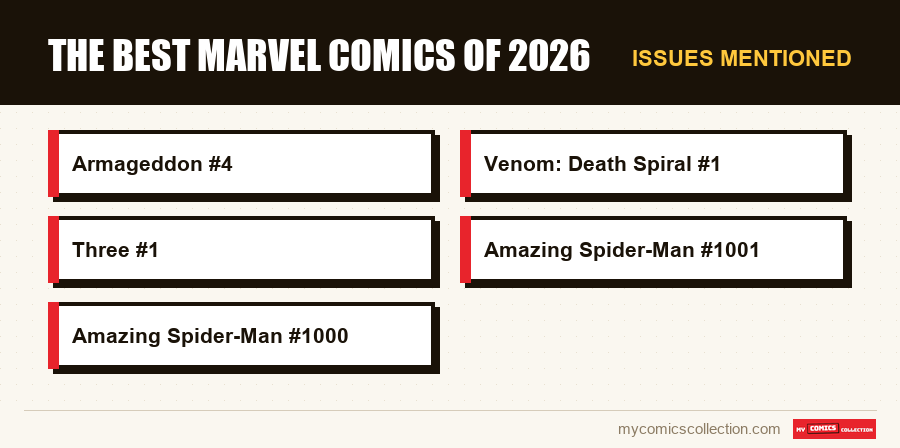
1. Amazing Spider-Man, by Joe Kelly: the year of #1000
Amazing Spider-Man (2025-) and #1000
Launched on April 9, 2025 with a new #1, which also carries the historic number 965, Joe Kelly's run spent 2026 preparing its hundredth milestone. #26 of April 8 introduces, without naming him, a wealthy philanthropist, Mac Crane; the summer issues reveal his secret; #1000 turns him into Ravage.
#1000, released on September 30 two weeks late for printing reasons, runs 104 pages. The main story, "Ravaged," is by Joe Kelly and Pepe Larraz. Around it, six anniversary stories bring together teams covering the character's history: Dan Slott and Marcos Martin, Brian Michael Bendis and Stuart Immonen, Frank Miller and Peach Momoko, Noah Hawley and Patrick Gleason, J.M. DeMatteis and Humberto Ramos, Larry Lieber and Giuseppe Camuncoli. An interview with Tom Holland completes the issue. More than 400,000 copies were ordered, and a second printing is announced for October 28.
What makes the year's quality, however, is not the figure. It is the coherence. Ravage, whose power consists of absorbing, erasing and materializing memories, is a villain designed for Spider-Man: he attacks Aunt May's memory, therefore what Peter holds most dear. Our page on Ravage details the character, and our reading guide to Joe Kelly's run gives the complete order.
How to read it: the useful minimum before #1000 comes down to ten issues, from #26 to #35 without #28. For everything else, wait for the collections, which take up the arcs in order. The guide to the seven stories of #1000 lets you read the issue knowing which period each team refers to.
2. Ultimate Spider-Man: the best-held ending of the year
The Ultimate Spider-Man by Jonathan Hickman and Marco Checchetto, launched in January 2024, ended in February 2026 at #24, written from start to finish by the same writer. It is the quality most readily credited to it: a series that announced its length, kept it, and closed its story instead of letting it fray.
The principle did not change: an adult Peter Parker, married to Mary Jane, father of two children, who becomes Spider-Man late in a world where heroes did not exist. The series turned this premise into a family and political drama, and its ending owns the consequences of twenty-four issues of choices. For a reader who had not followed it, it is today one of the few recent Marvel series you can read from end to end, without wondering where to stop.
The Ultimate line, for its part, continues: as of June 8, 2026, it counted seven ongoing series. Its future goes beyond the scope of this review.
3. Captain America and Avengers: Armageddon: the Miracleman bet
Captain America (2025-) and Avengers: Armageddon
In his Captain America, Zdarsky introduces in 2025 a character named David Colton. The five-issue miniseries Avengers: Armageddon makes him Miracleman in #4, released on September 16, 2026.
The maneuver is of rare ambition. Miracleman, born Marvelman in 1954, resurrected by Alan Moore in 1982 then continued by Neil Gaiman, carries a literary heritage few characters possess. Inserting him into the main continuity through a new character, patiently built over a year of Captain America, is an auteur's gesture. Our page Who is Miracleman? traces this past.
One reservation, however: the arc is not finished. The last issue of Armageddon comes out on October 21, and Zdarsky launches on November 4 a new Avengers with Marco Checchetto, whose lineup includes Miracleman. The final judgment will come with these two issues. To date, the construction is remarkable. Our guide to preparing for Zdarsky's Avengers gives the minimal reading path.
4. The Mortal Thor: consistency as a quality
There are series that make the event and series that make the catalog. The Mortal Thor by Al Ewing belongs to the second category, and that is a compliment. In 2026 Ewing continues the long work begun with Immortal Thor: a god of thunder treated as a mythological figure, with his cycles, debts and rebirths, rather than as a caped superhero.
What places the series in this ranking is its continuity: the same writer, the same vision of the character, and a story that moves from arc to arc without changing course. For a reader looking for a series to follow monthly without fearing a reversal, it is one of the safest bets in the catalog. Ewing also co-wrote the first issue of Death Spiral, proof of his central place in the organization of the year. The Thor page places the series among the character's great runs.
5. Death Spiral: an event that served the series
Death Spiral is a nine-part event, shared between Amazing Spider-Man and Venom, from February to April 2026, followed by an epilogue. It opens on February 25 with Amazing Spider-Man / Venom: Death Spiral #1, written by three hands, Joe Kelly, Al Ewing and Charles Soule, and drawn by Jesús Saiz.
Its merit is to have served the series instead of interrupting them. Many events pause regular plots for the duration of a crossover. This one moved Spider-Man's forward (Mary Jane's revelations take on their full meaning there) and prepared what follows, since #28 draws its consequences directly. The genre's usual flaw remains: you have to read the episodes that came out in Venom to follow, which traps the reader who follows only one series.
Mentions: what mattered without entering the ranking
The Eternals 50th anniversary special, published on April 1, 2026 in 40 pages and centered on Ikaris and Captain America, pays a careful tribute to Jack Kirby's creation. A single issue does not make a series, but this one recalls the importance of the original material. Our dossier on the key issues of the Eternals places it in fifty years of history.
Queen in Black, a Venom-centered crossover, ended on September 30. It opens the way to the seventh volume of Venom, by Charles Soule and Tommaso Bianchi, expected on October 14. The whole will be judged in the light of this sequel.
To judge at year's end: what cannot yet be ranked
Several important 2026 titles are ongoing or have not started. Ranking them now would be prediction, not review.
DNX (September 16 to November 18)
X-Men and Fantastic Four event in five issues, by Jed MacKay and Federico Vicentini. Two issues out as of October 3. Our DNX reading guide gives the complete order.
The Midnight line (from October 7)
Three #1s the same day: Midnight X-Men (Hickman), Midnight Spider-Man (Phillip Kennedy Johnson), Midnight Fantastic Four (Benjamin Percy). No issue read to date. See our complete Midnight guide.
Zdarsky's Avengers (November 4)
The logical follow-up to Armageddon, with an already announced team. It will decide whether the Miracleman bet was the right one.
Amazing Spider-Man #1001 and #1002
The issues that follow an anniversary often say more about a series' health than the anniversary itself.
Read in collected form or in single issues?
For most titles in this ranking, the collection is the right answer. Ultimate Spider-Man, now complete, ideally reads in volumes. The Mortal Thor too: the series gains from being read by whole arcs. Marvel's French editions are published by Panini Comics, generally with several months' lag behind the original version; check the availability of each volume before making it a gift or a purchase.
Two exceptions. Amazing Spider-Man #1000 is first an object: its format, covers and status as a round-number issue are part of its interest, which our #1000 collecting guide details. And Avengers: Armageddon, a five-issue miniseries, is easily followed in single issues for anyone who wants to read the conclusion on release day.
What 2026 says about Marvel
Three trends emerge from the year, at least until October. First, Marvel bet on its anniversaries (#1000, the Eternals' 50 years, Captain Britain's in October) and treated them as occasions for storytelling, not just for covers. Second, the publisher entrusted its boldest bets to writers who had time to build them: Kelly on Spider-Man, Zdarsky on Captain America, Ewing on Thor. Finally, it multiplied launches in the fall, to the point of making autumn unreadable on a reasonable budget.
This last trend is the only worrying one. It makes this October ranking all the more useful: it identifies what held up before the wave. What comes after will be judged in due course.