Miracleman is a British superhero born in 1954 under the name Marvelman, created by Mick Anglo to urgently replace an American series whose publication had just ceased. He transforms by speaking the magic word "Kimota." Forgotten in 1963, he is resurrected in 1982 by Alan Moore in the magazine Warrior, then renamed Miracleman in the United States in 1985 to avoid a conflict with Marvel. After Moore, Neil Gaiman and Mark Buckingham continue the series until the publisher's bankruptcy. Marvel acquires the rights in 2009. In 2026, the name returns to the forefront: David Colton, a Captain America created by Chip Zdarsky in 2025, becomes Miracleman in Avengers: Armageddon #4 (September 16, 2026) and is part of the team of Avengers #1, scheduled for November 4, 2026.
Since the announcement of the new Avengers team, a question keeps coming up among readers who did not follow the British comics of the 1980s: who is this Miracleman who rubs shoulders with Spider-Man, Wolverine and Captain Marvel? The answer is double, and that is what makes the character puzzling. There is the historic Miracleman, one of the most important heroes in the medium's history despite his limited fame. And there is the 2026 one, who bears the same name and the same powers, but not the same face.
This article answers the direct question first, then goes back through the character's editorial history, one of the most tortuous in comics, before presenting the current version and what it implies for anyone who wants to read or collect.
The short answer: two Miraclemen
The historic Miracleman is Michael Moran, an ordinary man who, by saying "Kimota," becomes a nearly invulnerable superman. In Alan Moore's version, Moran forgot this word for years and finds it again as an adult, discovering along the way that everything he believed about his heroic past was false.
The 2026 Miracleman is David Colton, a soldier turned super-soldier who receives, through a series of events specific to the current Marvel universe, the powers of a Michael Moran from another reality. He too speaks a magic word, and is reborn in this form.
The two share a name, powers and a theme: what does an all-powerful being do with an imperfect world? It is no accident. The whole story of Miracleman has revolved around this question since 1982.
1954: a replacement hero
The character's origin is a matter of commerce. In the early 1950s, a British publisher, L. Miller & Son, reprints in the United Kingdom the adventures of a very popular American superhero. When that hero's publication ceases in the United States, following a plagiarism lawsuit, the British publisher finds itself with nothing to reprint.
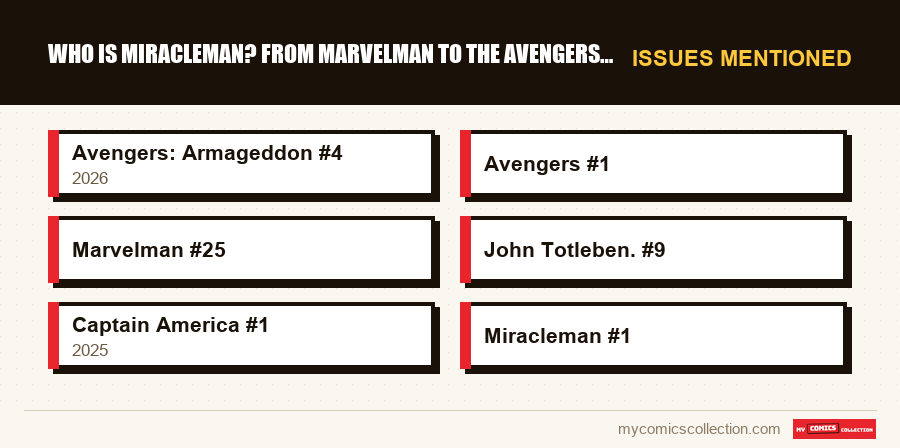
It then asks Mick Anglo, who runs a creative studio, to supply a replacement. Anglo conceives Marvelman, a young reporter, Micky Moran, who transforms into a superhero by saying "Kimota," the word "atomic" read backward phonetically. So as not to lose readers, the new series keeps the numbering of the old one: Marvelman #25, dated February 1954, is therefore the character's first issue.
Two companions follow quickly, Young Marvelman and Kid Marvelman, the latter embodied by a young boy, Johnny Bates. The series lasts almost ten years, with stories aimed at children, unpretentious. It stops in 1963. The character falls into oblivion, and everything suggests he will stay there.
1982: Alan Moore and Warrior
In March 1982, the British publisher Dez Skinn launches Warrior, a black-and-white anthology magazine aimed at an adult readership. He entrusts a still little-known young writer, Alan Moore, with the relaunch of Marvelman. The first artist is Garry Leach, soon replaced by Alan Davis.
Moore's proposal is radical. Michael Moran is now a middle-aged journalist, married, prone to migraines and strange dreams. He finds the magic word by chance, transforms, and discovers that his memories of heroic adventures were fabricated. The childlike 1950s character thus serves as the starting point for a very dark reflection on power, manipulation and what a superman would really do if he existed.
The historical importance of these episodes is considerable. There we find, several years before Watchmen, the idea that superheroes can be treated with psychological and political realism. To understand the writer's trajectory, see our history of Alan Moore and our key issues of Watchmen.
1985: Marvelman becomes Miracleman
Warrior stops in 1985, and Moore's series remains unfinished. The American publisher Eclipse Comics offers to take it up and finish it. An obstacle immediately arises: Marvel Comics objects to the use of the word "Marvel" in the title of a series published in the United States. The character is therefore renamed Miracleman, and it is under this name that Eclipse publishes, from 1985, the colorized episodes of Warrior, then the new continuation.
Moore leads the series to #16, published in late 1989, with several artists, including Rick Veitch and John Totleben. #9, which shows a birth explicitly, causes a stir. Moore's last book, "Olympus," drawn by Totleben, ends with a complete transformation of the world by the supermen, and with one of the most violent clashes ever drawn in a superhero comic, against Kid Miracleman.
1990-1993: Gaiman, Buckingham and the interruption
Moore entrusts the continuation to Neil Gaiman, then the author of Sandman, and to artist Mark Buckingham. Their plan is to tell the utopian world set up by Miracleman, in three cycles. The first, "The Golden Age," comes out in #17 to #22. The second, "The Silver Age," begins with #23 and #24.
Then everything stops. Eclipse goes bankrupt in the mid-1990s, and the character's rights get caught in a legal tangle involving the former publisher, the original creator, the successive writers and a publisher buying part of Eclipse's assets. For nearly fifteen years, Miracleman can no longer be reprinted. The Eclipse issues become hard to find, and the character acquires a reputation as an unobtainable masterpiece.
2009: Marvel buys the character
In 2009, Marvel announces it has acquired the rights to Marvelman from Mick Anglo. It will take several more years to settle the other questions and republish Moore's episodes, whose reissue begins in 2014. Moore, in disagreement with the use of his works, asked that his name not appear: he is credited as "The Original Writer."
Gaiman and Buckingham then resume their story where they left it, and Marvel publishes from 2022 the continuation of "The Silver Age." It is the culmination of a wait of nearly thirty years for the series' readers.
2025-2026: David Colton and the Avengers
The character's current version is born from an entirely different direction. On July 2, 2025, Chip Zdarsky and Valerio Schiti launch a new Captain America series. They introduce David Colton, a young man who saw the attacks of September 11, 2001, enlisted despite severe asthma, and received a super-soldier serum. He serves under the name Captain America in the wars of Afghanistan and Iraq, and returns deeply marked.
Captain America #1 (2025)
It is the issue where the character who will become the 2026 Miracleman first appears. At this stage, he has no link with Miracleman. For all of the title character's series, see our Captain America reading guide.
Gravely wounded, Colton is saved by Wolverine, who uses on him a device from Earth-6160, the reality of the Ultimate line relaunched in 2023. He receives considerable powers from it, whose origin he does not know. During the Armageddon event, he faces Red Hulk, disarms the planet's nuclear powers and worries the heroes. It is in Avengers: Armageddon #4, released on September 16, 2026, that a vision of his mother whispers a magic word to him: he is then reborn with the full extent of his powers, those of Earth-6160's Michael Moran. In other words, of Miracleman.
Avengers: Armageddon #4
The transformation issue. The Armageddon miniseries has five issues and ends on October 21, 2026.
The team of Avengers #1, written by Zdarsky and drawn by Marco Checchetto, scheduled for November 4, 2026, brings together Spider-Man, Wolverine, Captain Marvel, Daredevil, Luke Cage and Miracleman. Before this announcement, we had analyzed the leads considered in our article on the speculation around the sixth member, written before the lineup was public. For everything about the team, see also our Avengers hub.
What to read, depending on what you are looking for
The historic Miracleman
Marvel's reissues of Moore's work, which take up the Warrior and Eclipse episodes in order. Expect harsh stories, particularly in the last book.
The utopian sequel
"The Golden Age" by Gaiman and Buckingham, then "The Silver Age," whose continuation Marvel has published since 2022. A very different tone, more contemplative.
The 2026 Miracleman
Zdarsky's Captain America series since the July 2025 #1, then Avengers: Armageddon, then Avengers #1 in November 2026. No Moore reading is needed to follow the plot.
For collectors: do not confuse the editions
The same title, Miracleman, was used by Eclipse in the 1980s and by Marvel from 2014 for its reprints, with #1s in both cases. A Miracleman #1 is therefore not necessarily an old issue. The date in the indicia and the publisher's name are enough to settle it. Eclipse issues, especially those from the end of the series, were printed in far smaller quantities than the recent reprints, and for a long time they were the only way to read the work. For the Warrior issues, these are black-and-white British magazines, to be shelved and identified as such.
On the 2026 version side, Zdarsky's issues were published recently and in large numbers. Their collecting interest will depend on the place Colton takes in the coming years, which nobody can predict today. Read them for the story; do not accumulate them on a hypothesis.