The sixth member of the new Avengers team by Chip Zdarsky and Marco Checchetto is no longer an unknown: it is Miracleman, in the form of David Colton, the 21st-century Captain America introduced in Zdarsky's Captain America series launched on July 2, 2025. The publisher named him in the August 20, 2026 announcement itself, alongside Spider-Man, Wolverine, Captain Marvel, Daredevil and Luke Cage. The character's turn took place in Avengers: Armageddon #4, out on September 16, 2026, and Avengers #1 comes out on November 4, 2026. In other words, the window during which you could speculate on this identity is closed, and it only ever lasted a few weeks. This article tells how this information really arrived, what an editorial clue is worth when one remains, and why buying on an unconfirmed hypothesis remains the collector's worst reflex.
There is a particularly costly category of rumor: the one concerning an identity the publisher has not yet spoken. A lineup announced at five names out of six leaves an empty slot, and an empty slot attracts bets. For a few weeks, in summer 2026, that slot existed for the new Avengers series. The reflex of many readers was to look for who would fill it, then to buy in anticipation the issues likely to become the first appearance of the suspected candidate.
This reflex is doubly losing, and the present case demonstrates it cleanly. First because the answer was a character nobody expected there. Next, and above all, because the slot was not a puzzle left to the public: it was a communication calendar. The publisher knew who held the sixth place, chose the date on which it would say so, and built a commercial apparatus around that date. Understanding this mechanism is worth more than guessing a name.
It is October 2, 2026. This article sticks to what the publisher itself has published, with dates, and separates what is established from what remains open.
The real chronology of the information
The first thing to do faced with an unrevealed identity is to reconstruct the sequence of press releases. Not to guess the answer, but to measure whether the publisher left a gap to fill or simply scheduled an announcement. In this precise case, the reconstruction is unambiguous.
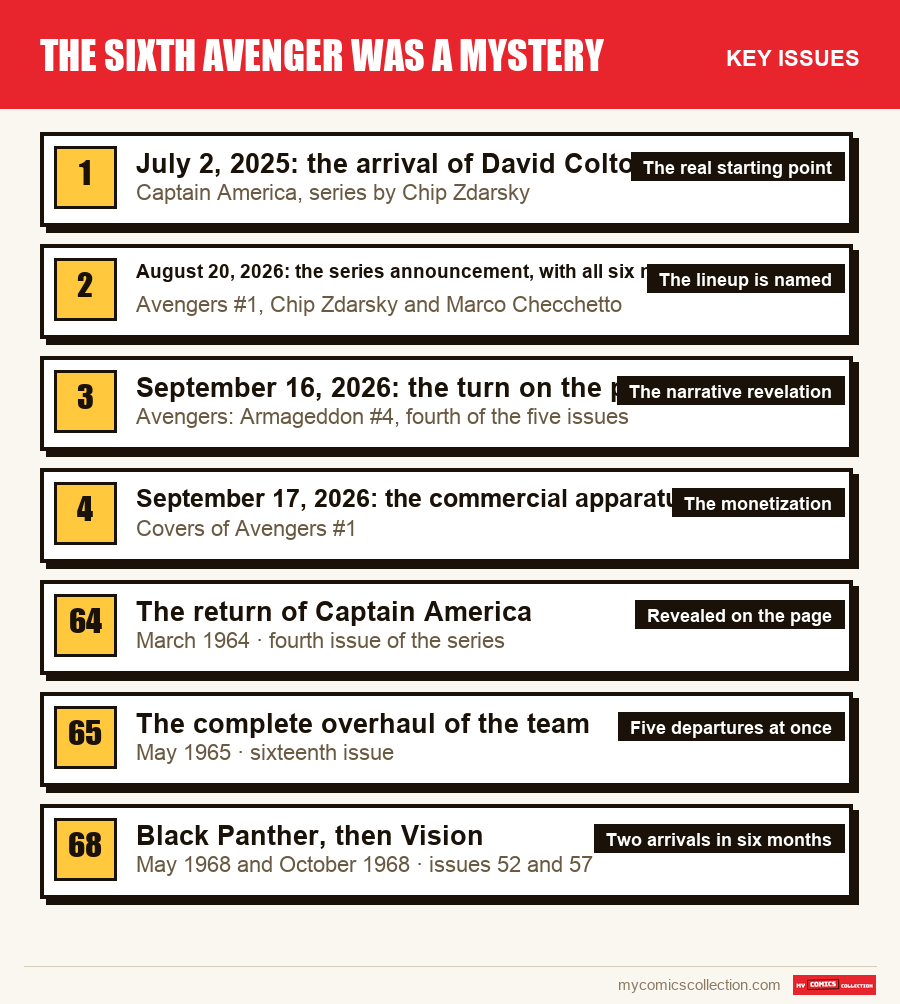
July 2, 2025: the arrival of David Colton
Fourteen months before the Avengers announcement, Zdarsky launches a new Captain America series and introduces David Colton, presented by the writer as a Captain America sponsored by the American state, conceived in a post-September 11, 2001 world. Nobody then links this character to the main team, and for a good reason: it is not yet announced. It is nonetheless there that the decisive piece is found.
August 20, 2026: the series announcement, with all six names
The publisher announces the new series for November 4, 2026, coming out of the five-issue miniseries Avengers: Armageddon, written by Zdarsky and drawn by Delio Diaz and Frank Alpizar. The press release gives the complete lineup, and leaves no slot empty: Spider-Man, Wolverine, Captain Marvel, Daredevil, Luke Cage, and Miracleman, who the release specifies is making his debut in the Marvel universe there. Checchetto recalls having worked with Zdarsky on Daredevil from 2019 then on Ultimate Spider-Man in 2024.
September 16, 2026: the turn on the page
The penultimate issue of the miniseries explains where Colton's power comes from: the origin box that transformed him comes from Miracleman. The same day, the publisher posts a note owning the unveiling, shows a reveal variant cover by Michael Cho, the main cover of number 5 by Dike Ruan and a variant by John Romita Jr. kept secret until then. Number 5 is announced for October 21, 2026.
September 17, 2026: the commercial apparatus
The next day, the publisher posts the final main cover of Avengers #1, where Miracleman appears with the rest of the team, and releases the variants held back until then: a piece by Alan Davis, whom it presents as the character's reference artist, covers by Artgerm, Skottie Young, Jim Cheung and Julian Totino Tedesco, and the complete version of Kaare Andrews's panoramic cover, now augmented with Miracleman.
What an editorial clue is worth, and what it is not
It remains legitimate to reason on partial information. You still need to know what each type of clue weighs. Here is the hierarchy as this file brings it out, from the most reliable to the most misleading.
A dated publisher press release that names. It is the only level that authorizes writing a name. It is verifiable, it is timestamped, and it commits whoever publishes it. Everything else is at best a probability, at worst a copied invention.
A silhouette, a masked panel, a blurred cover. This proves that an announcement will come, not whom it concerns. A partial visual is a calendar tool: it serves to hold attention between two order dates. Deducing an identity from it amounts to reading a delivery date in packaging.
A publisher's sentence in the form of a wink. In the August 20, 2026 announcement, the series' editor, Wil Moss, ends his statement by inviting the reader to wait to discover the complete lineup. It is an authentic clue, and a precious one, but it says nothing other than this: the team of six is not necessarily the final team. It names nobody. An honest clue is recognized by the fact that it reduces uncertainty without removing it, and that it does not allow buying.
A deduction through the writer's catalog. This is the reasoning that would have worked here, and the only one worth practicing. Zdarsky had been writing Captain America since 2025, had set up a new character there with an unexplained power, and was simultaneously writing the miniseries leading to the Avengers. This type of deduction has a decisive advantage over betting: even wrong, it leads you to read recent, available issues.
An unsourced claim, copied in a chain. Level zero, and recognizable by this: the text names a character but names neither the date nor the origin of the information. Any publication talking about a "still unknown sixth member" after August 20, 2026 is copying an outdated state of the information. We ourselves came across this phrasing while preparing this article, and it was the check of dated press releases that corrected it.
Who Miracleman is, and why this arrival is unusual
Most arrivals on the team concern characters born in-house. This one does not, and that is what makes it interesting for a collector, far more than the question of who held the sixth slot.
The character was created by Mick Anglo under the name Marvelman, and published in the United Kingdom by L. Miller & Son between 1954 and 1963. He then disappears for nearly twenty years. In 1982, Alan Moore resurrects him for a revisionist story in the pages of the anthology magazine Warrior, at Quality Communications. From 1985, renamed Miracleman, he moves to Eclipse Comics in the United States, where the series continues until 1993 under the pens of Moore then Neil Gaiman, with Garry Leach, Alan Davis, John Totleben and Mark Buckingham on art depending on the period. Eclipse files for bankruptcy in 1995, and the series is left without a publisher.
One of the most discussed rights blockages of the medium follows. The common hypothesis held that Anglo had ceded his rights in the 1980s. In 2009, it emerges that he had in fact kept them since 1954. Marvel, under Joe Quesada's creative direction, then deals directly with him and obtains a license. Reissues begin in 2014, and in 2022 the publisher announces the completion of the The Silver Age arc, left unfinished since Eclipse's bankruptcy.
This path explains the wording of the August 20, 2026 press release: Miracleman makes his debut in the Marvel universe. During seventeen years of license, the character had been reissued and continued, but always apart, in his own continuity. Bringing him into the flagship team amounts to linking two editorial histories that had never communicated. For a collector, it is a structural fact, far more durable than a lineup rumor.
A precision of vocabulary, which avoids a frequent mistake: the series is regularly credited as one of the first critical rereadings of the superhero, predating Watchmen and Dark Knight Returns. That holds for the 1982 to 1993 material. The character joining the team in 2026 is David Colton, who inherits the mantle and the power: the 1980s issues therefore do not become the first appearance of the 2026 Avengers member.
Lineup surprises in the series' history
Before judging the 2026 apparatus, you need to look at how the team handled its recompositions over sixty years. Three milestones are enough, and they all say the same thing.
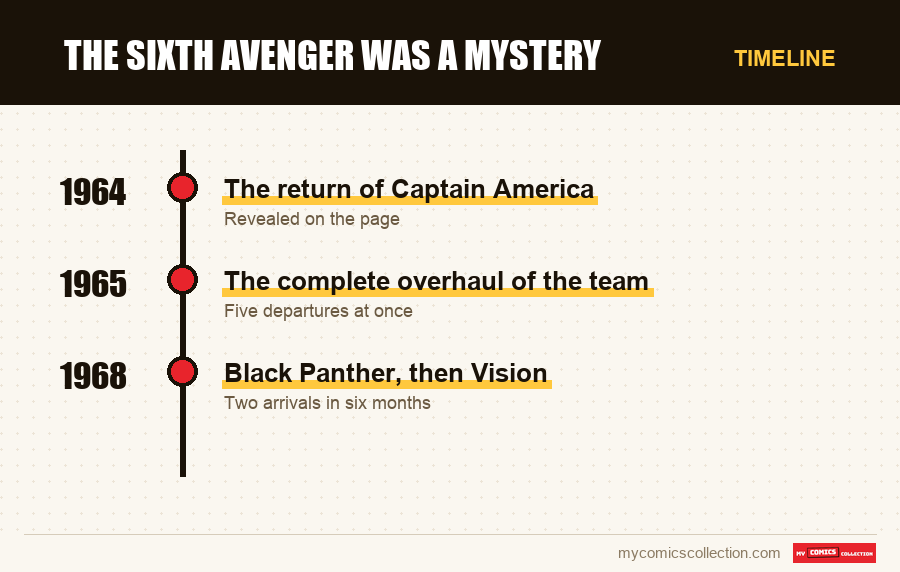
The return of Captain America
The character is found in suspended animation and joins the team founded six months earlier by Iron Man, Thor, Hulk, Ant-Man and the Wasp. It is probably the most consequential lineup addition in the whole history of the series, and it was preceded by no guessing campaign. The issue was bought to find out, not to bet before knowing. Its hub is available: Avengers #4.
The complete overhaul of the team
All members except Captain America leave the team, replaced by three former adversaries: Hawkeye, the Scarlet Witch and Quicksilver. It is the series' most radical precedent, and it shows that a recomposition does not need a hidden name to be an event: it only has to be owned. Giant-Man and the Wasp will return in number 28.
Black Panther, then Vision
Black Panther joins the team in issue 52, in May 1968. Vision appears in issue 57, in October of the same year, and joins the team right after. His hub also exists: Avengers #57. Here again, no prior guessing: the two characters arrive, and it is what follows that decides their importance.
The conclusion of this path is clear, and it is not nostalgic. The identity kept secret as a selling point does not belong to the team's long history. It belongs to the era of the variant cover, where withheld information becomes an order lever. It is a distribution fact, not a story fact, and the mechanism is detailed in our article on allocated covers for a single release.
The method, in five steps
Here is the procedure we apply, and which produced this article. It requires neither a contact in the industry nor a subscription to an information service.
Go back to the original press release
Not to the article that talks about it, but to the press release itself, on the publisher's site, with its publication date. In this file, three pages dated August 20, September 16 and September 17, 2026 are enough to establish everything. Information that has no dated primary source is not information, it is an opinion in circulation.
Date your own knowledge
A claim true in July can be false in October. Write the date next to what you believe you know. It is the only protection against copying an outdated state of the information, and it is the most widespread fault on this precise subject.
Look for the answer in the writer's recent work
A writer who opens an empty slot almost always fills it with something he has already set up elsewhere. Reading the last twelve months of his series is more productive than reading twelve forums. And that reading has value in itself, which is not the case for a bet.
Tell the narrative revelation from the commercial apparatus
Ask yourself what is held back: the name of a character, or visuals to sell. When it is the visuals, as here, the wait is not a riddle to solve but a marketing sequence. There is nothing to gain by getting ahead of it.
Buy nothing before confirmation
It is the step that makes the difference, and the only one that costs money when skipped. If the hypothesis is right, the issue concerned remains accessible after confirmation in the great majority of cases. If it is wrong, you hold an issue bought above its level for a reason that has vanished.
What really remains open as of October 2, 2026
Once the sixth place is assigned, it would be dishonest to claim everything is known. Three uncertainties remain, and they are of different natures.
The complete lineup. The series editor's statement explicitly invites waiting to know the whole group. Six names are published; nothing says there will not be others. It is a documented uncertainty, and the only one on which reasoning is still allowed. No additional name has been announced to date, and we will therefore propose none.
The end of the miniseries. Avengers: Armageddon #5 comes out on October 21, 2026. It concludes Colton's transformation, and its content is not public. Everything written today about the character's state on entering the new series is extrapolation.
The announcements expected in October. A large North American convention takes place October 8 to 11, 2026, and the publisher has posted the list of its panels. Announcements are therefore expected there, but none has yet been made at the time of writing. Any sentence claiming something was announced there is, as of October 2, 2026, necessarily false.
On the question of amounts, finally, we abstain. No price guide value exists for an issue that only comes out on November 4, 2026, and the most recent public sales report does not concern these titles. Anyone who puts a number today on the future value of Avengers #1 is producing an opinion disguised as data. The distinction between the two approaches is covered in our article on the difference between speculation and investment.
The honest advice
It fits in one sentence: you do not buy on a hypothesis. Not because the hypothesis would always be wrong, but because its return is structurally unfavorable, and the sixth-member file illustrates it point by point.
When the hypothesis is wrong, the loss is immediate and total on the premium paid. When it is right, the gain is small, because the targeted issue remains available after the announcement: publishers reprint, and strong demand triggers a second printing rather than a thinning. And when it is right and the issue does indeed become hard to find, it is because the sellout happened on release day, a phenomenon that strikes regardless of forecasts and whose useful reflexes we detail in our article on release-day sellouts.
That leaves the question of what to do. For an arrival like this one, the reasonable answer is to buy the issue because you want to read it, in one copy, in the main cover, and to record it properly in your tracking. The variants held back and then released are a distinct market, which obeys allocation rules and not the quality of the story. If you wish to situate issues you already own, our free estimate and the collection tracking app are made for that.
The last remark is perhaps the most useful. In this file, the real information was not the identity of the sixth member: it was that a character born in 1954 in the United Kingdom, immobilized for a quarter-century by a rights question, is entering for the first time the main continuity of an American publisher. That fact was public as of August 20, 2026 and required no guessing. Speculation has this costly aspect that it occupies attention where there was nothing to find, and diverts it from what was written in black and white. For the long context in which this arrival will find its place, see our history of the Avengers and our file devoted to the team.