When a comic is announced sold out on release day, it almost always means the distributor has no more copies to send to stores, not that the object has vanished from the planet. Copies already shipped are on the shelves, in subscribers' pull boxes, and with readers. In 2026, Amazing Spider-Man #1000 sold out on September 30 despite more than 400,000 preorders, with a second printing already planned and unfilled orders announced for November 4, 2026. The right reaction is therefore neither to pay any price in a panic, nor to give up: it is to understand at which level the sell-out happens, let the first weeks pass, and reserve your next releases instead of chasing them.
There are few phrases able to make people buy as fast as "sold out". It triggers a very old and very bad-advice reflex: if the door is closing, you must get through right now. In the world of comics, that door closes several times a year, often on titles nobody was talking about three weeks earlier, and almost always leaving two or three other doors wide open behind it.
The year 2026 has provided a series of clear examples, with cases where the sell-out came before the release date. These are distribution facts, not market facts, and that is exactly what makes the subject interesting: most decisions regretted over a sell-out come from confusion about what the word describes. This article separates the two, then gives a course of action for the day you open your screen and read that the issue you were waiting for is no longer available.
A clarification before going into detail: we will not talk here about the value of reprints, covered elsewhere, nor about the making of variants. The subject is the sell-out itself, and the decision it imposes.
"Sold out": at whose level, exactly?
The vocabulary of official announcements is misleading for a simple reason: it describes the position of an actor in the chain, not that of the reader. When a publisher communicates about a sold-out title, it is talking about its own stock and that of its distributor. In other words: the boxes have gone, there is nothing left to ship to stores that would ask for more.
Three levels must therefore be distinguished, which empty at different times.
The publisher and distributor level
This is the one the announcements talk about. It can empty days or weeks before release, when firm orders exceed the decided print run. Nothing has reached a store yet, but the reserve is already at zero.
The store level
Each shop received the quantity it had ordered, no more, no less. It may well have copies on the shelf the day after the sell-out announcement, simply because it ordered wide. Conversely, a cautious shop can be dry from the first hour.
The reader level
It is the only one that never really empties. All the copies sold still exist, and some will come back into circulation in the following months, through the secondhand market. A title "sold out" at level 1 therefore remains accessible at level 3, at a price that depends on the demand of the moment.
Remember this hierarchy, because it alone explains most of the bad decisions. Reading "sold out" and concluding "impossible to find" amounts to confusing the tap and the bathtub. The tap is closed; the bathtub is full.
Why a publisher gets caught off guard by its own success
The question deserves to be asked frankly: how can a publisher that receives more than four hundred thousand preorders on an issue end up sold out on its release day? The answer lies in the structure of the specialty distribution chain, which has almost nothing in common with that of a book in a general bookstore.
First point, the most decisive: in this chain, unsold copies are not taken back. A store that orders three hundred copies and sells one hundred twenty is stuck with the other one hundred eighty. In exchange for this risk, it gets a bigger discount than in traditional commerce. This rule, which has structured the sector for decades, mechanically pushes every merchant to order as tightly as possible. Caution is not a character flaw, it is an accounting consequence.
Second point: orders are firm and closed before release. The merchant decides their quantity from what they know, that is, from the number of customers on a named pull list, the title's history and their intuition. Once the window has closed, they can no longer adjust. If enthusiasm rises in the last days, or if an occasional audience shows up on release Wednesday, the quantity is already fixed.
Third point: the publisher's print run follows orders, not demand. The print is calibrated on what stores reserved, plus a margin. When real demand exceeds that sum, nobody has a reserve to mobilize. The publisher then restarts the presses, but a reprint takes weeks, and during those weeks the title is officially sold out.
These three mechanisms combine to produce a very regular paradox: the more an issue is anticipated, the more the risk of a sell-out rises, because the anticipation attracts an audience that had not signed up in advance and therefore was not counted. A low-profile title can sell out for the exact opposite reason: orders were so low that the print run was too, and the slightest spotlight is enough to empty everything.
The verified 2026 sell-outs, and what they show
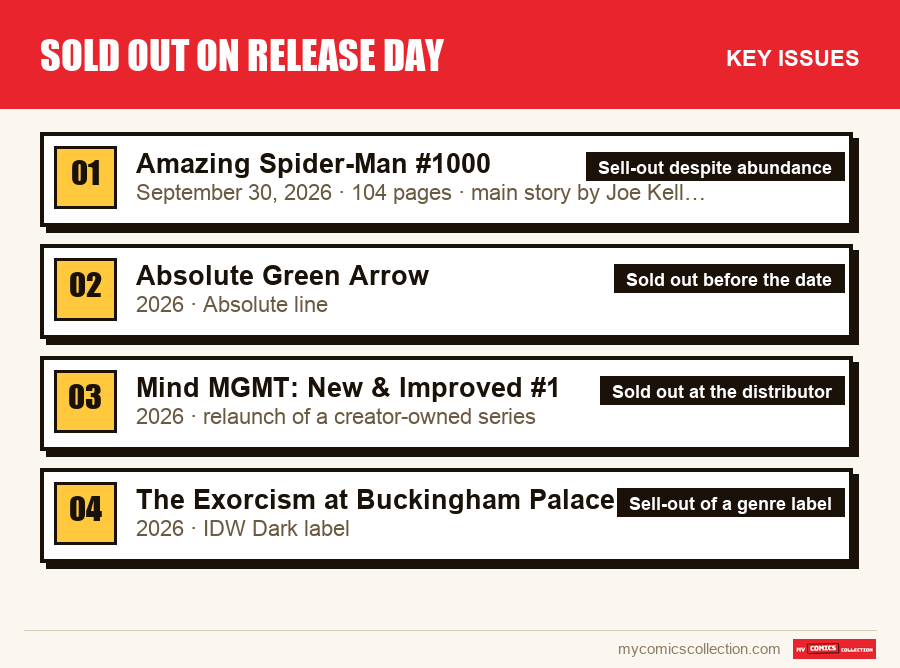
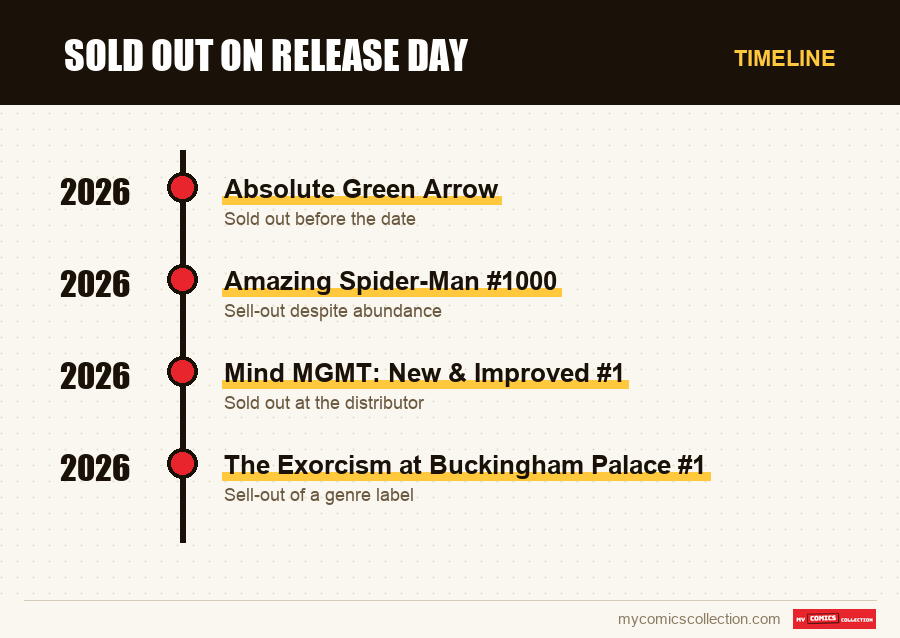
Four cases from the year illustrate four different configurations. They are reported here for what they are, distribution facts. No price guide or quantified price movement accompanies them, because no source consulted publishes any for this period.
Amazing Spider-Man #1000
More than four hundred thousand preorders, a second printing planned even before release, and despite that a sell-out on release day. The publisher had planned wide: nine covers allocated, all put back to press. Unfilled orders are announced for November 4, 2026. It is the textbook case of a sell-out by excess demand on an object that will remain, by construction, very widespread among readers.
Absolute Green Arrow
Here, the stock emptied a week before release. Stores that had not ordered enough therefore had no chance to catch up, and those that had guessed right served their customers normally. This configuration says something important: the sell-out happened in a professional channel, invisible to the public, while the shelves filled as planned.
Mind MGMT: New & Improved #1
Third configuration: sell-out at the distributor before release, on a creator-owned title whose audience is loyal but numerically modest. The initial print run was calibrated on cautious orders, and late demand found nobody to serve it. It is the most frustrating scenario for a reader attached to a series, because there is no surplus pile elsewhere in the chain.
The Exorcism at Buckingham Palace #1
Same mechanics as the previous case, on a horror first issue published by a mid-sized publisher. Sold out at the distributor level. Genre launches are particularly exposed: they have no sales history to guide orders, and a good review on the eve of release is enough to blow up demand that nobody had provisioned.
These four cases share one trait: in none of them did the object cease to exist. In three of them, the sell-out happened out of the public's view, in a professional link. And in none does the sell-out in itself constitute information on future value, only on the gap between a forecast and a reality.
What the reprint changes, and what it does not
As soon as a sell-out is announced, the next question arrives: "there will be a second printing, does that break the first?" Two effects need to be cleanly separated.
The first effect is on access, and it is massive. A reprint restores the availability of the story. If your goal is to read the story and keep a complete series on your shelf, it solves your problem entirely, and at the original price. It is the answer most often forgotten in the heat of the news.
The second effect is on the number of copies of the first printing, and it is nil. Reprinting does not add a single copy to that first printing nor remove any. The quantity of the first printing is fixed the day the presses stop. What the reprint changes is the urgency: by making the story accessible another way, it removes demand from the part of the public that simply wanted to read, leaving facing the first printing only those who want the object.
The detail of what a later printing is worth, how to recognize it and in which cases it really counts is the subject of a separate guide: the real value of second printings. We do not go back over it here, and it deserves to be read before any buying decision on a title that has just sold out.
A word finally on unfilled orders, the mechanism used for Amazing Spider-Man #1000 with an announced date of November 4, 2026. It is a commitment to deliver later the quantities the chain could not honor. For the reader, it means one thing, and it is good news: the queue exists and it moves. Patience is here a supply strategy, not a resignation.
You missed a release: the course of action
Here is the sequence of decisions, in the order in which it costs the least.
First check that the issue really is missing
It seems absurd, and yet it is the most widespread mistake in a rush. A heavily publicized milestone is often bought twice by the same collector, because it was already on a pull list or in a recent lot. An up-to-date missing list settles the question in a few seconds and avoids an unjustified panic purchase.
Call your shop rather than searching online
This is level 2 described above. A shop may hold copies the day after the sell-out announcement, or recover an unclaimed pile after its subscribers' holding period. The specialty chain remains the only place where the original price still applies. A useful reference if you have no address: specialty shops in France.
Ask to be put on the reprint or on the unfilled orders
If a reprint is announced, sign up for it immediately. It commits you to nothing other than paying the normal price in a few weeks. Many readers skip this step because they want the object "now", and end up paying several times that price to gain a month.
Let two to six weeks pass before looking at the secondhand market
The first days after a sell-out are the worst time to buy: supply is made of opportunistic resellers, demand is emotional, and the rates asked reflect no stable transaction. The following weeks see the arrival of copies from readers who had taken two, then those from unclaimed piles. Supply widens, tension eases.
Decide what you are buying: a story or an object
If you want to read, the reprint or a later bound edition will do, and will cost less. If you want the first-printing object, accept that its price will be volatile for several months and set yourself a written limit before looking at anything. That limit is your only protection against the closing-door reflex.
Record the decision, even a negative one
Noting "missed, waiting for the reprint" in your tracking tool spares you from restarting your thinking from zero three weeks later, when an offer appears. A collection is managed by written traces, not by memory.
The four lines of reasoning that cost dearly
"Sold out means scarce." No. Sold out describes the state of a stock at a given moment, in a precise link. Scarce describes the number of existing copies. An issue printed at several hundred thousand copies and sold out in twelve hours is still an issue of several hundred thousand copies. To judge scarcity, the number of copies recorded by a grading service is a far more serious indicator than a sell-out announcement.
"If I don't buy now, I will never have the chance again." That is false for a modern title, by construction. All the copies sold still exist, and a significant share comes back into circulation within the year. The only thing you lose by waiting is priority, which has no market value.
"The price asked today is the market price." An asking price is not a transaction. In the days following a sell-out, the gap between what is asked and what actually closes is at its maximum. Judging a price at that moment is taking a temperature during a fever spike. Wait for transactions to accumulate before considering that a price level exists.
"The sell-out proves the title will matter." It proves that an order forecast was lower than demand. It is information about the supply process, not about the story's quality or its legacy. Durably important titles never sold out; spectacular sell-outs fell back into anonymity within a quarter. Confusing a supply incident with an editorial judgment is the most tempting and least reliable shortcut.
No longer suffering: the organization that avoids the hunt
A sell-out is not handled well in the moment, it is prevented upstream. Three habits are enough, and none requires extra money.
Reserve instead of buying. The named pull list in a shop exists precisely for this: it transmits your demand before the order window closes, at the moment it can still be counted. It is the only mechanism that puts you on the right side of the sell-out. On a title you really follow, signing up is non-negotiable.
Know what is coming. Releases are announced long in advance, and launches at risk of selling out are identifiable: first issue of a new series, numbered milestone, return of an awaited creator, genre label with no history. A regular glance at the release calendar turns surprise into a planned decision.
Automate vigilance. Tracking about ten ongoing series by hand is a recipe for forgetting. A wish list fed automatically by new releases of your characters and series does this work without you. Combined with issue-by-issue tracking, it spares you the two most unpleasant situations: buying the same issue twice, and discovering three months too late that you are missing the first of a series whose next six you own.
If your thinking concerns an old issue rather than a recent release, the logic is different: there is no more sell-out possible, only a secondhand market and a condition to judge. A reasoned estimate is more useful there than a quick reaction.
The conclusion is perhaps disappointing, and that is good news: in the vast majority of cases, missing a release has no lasting consequence on a collection. What does is the habit of reacting in a rush to badly read information. The 2026 sell-outs made a lot of noise, and they will continue. They have removed not a single copy from the world.