My Comics Collection has integrated a comics release calendar since June 2026, powered by public data from Metron.cloud (CC-BY-SA 4.0 license). In the app, the calendar, uncapped series tracking and the auto-wishlist feature, which automatically turns every tracked release into a purchase alert, are part of the subscription: you can try them free for 7 days, then the price depends on your country.
Keeping up with new comic releases has historically been a serious discipline. Dedicated collectors juggled Diamond Distribution newsletters (English-only, often late), publisher Twitter accounts, sites like PreviewsWorld or League of Comic Geeks, and their own paper notes or Excel spreadsheets. That fragmentation comes at a measurable cost: according to a 2024 study by GoCollect, nearly 42% of North American collectors say they've missed at least one first appearance of a character who became major within the following 18 months: simply because they didn't know the issue was coming out.
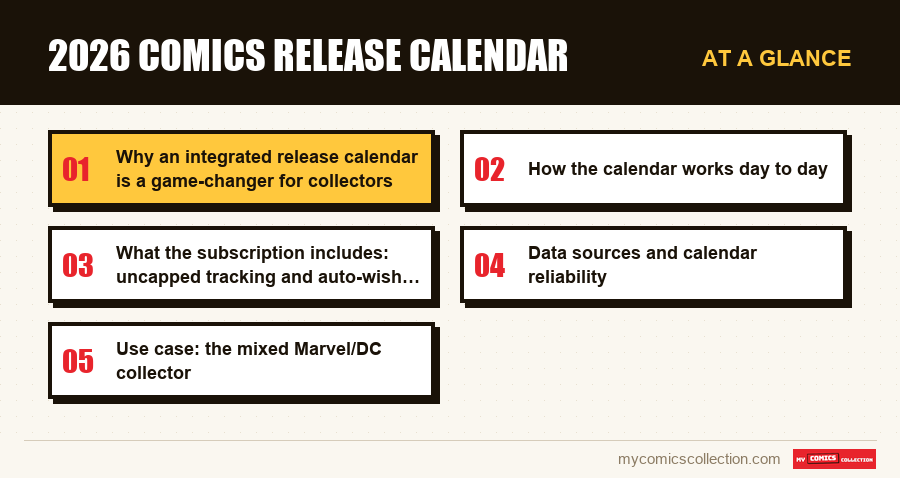
Why an integrated release calendar is a game-changer for collectors
The calendar built into My Comics Collection solves this problem by consolidating information in one place, synced daily with a collaborative database: Metron.cloud: that aggregates official publisher solicitations three months in advance. In practice, as soon as a comic is announced in a publisher catalog, it shows up in your calendar view the next day. For the most profitable first appearances, that means you'll never be caught flat-footed again.
How the calendar works day to day
Access it from the navigation menu via two dedicated entries: 📅 Upcoming Releases, which lists all issues from every publisher over the next 90 days, and 📆 My Calendar, which filters down to only the series you're following. These two views serve two distinct purposes: the first is for discovery, the second is for budgeting your purchases.
Each calendar entry shows the comic cover (fetched from Metron via a disk cache for reliability), the issue number, release date, publisher, and a "Follow" button. Clicking that button adds the series to your personal pull list. The top of the page always shows how many series you follow.
The calendar also offers filters by month , by publisher , and by publisher key (Marvel, DC, Image, Dark Horse, IDW, etc.). That level of granularity is invaluable for planning: a Marvel collector can filter out DC noise and focus on next month's Spider-Man, X-Men, or Avengers solicitations.
What the subscription includes: uncapped tracking and auto-wishlist
My Comics Collection has no free version: the calendar and active tracking (your personal pull list) are part of the subscription, which you can test during the 7-day free trial, and the number of followed series is not capped. To get started, three series often cover the core collection of a casual collector: their main ongoing series, an indie title they love, and a second series they're exploring.
The subscription (7-day free trial, no charge during the trial, then pricing by country) also activates the auto-wishlist feature: every new release in a tracked series is automatically added to your wishlist, with a visual badge distinguishing auto-added entries from manual ones. For a practical breakdown of the difference, check out our comparison guide Pull List: What a Subscription Really Changes.
Data sources and calendar reliability
The raw data comes from Metron.cloud, a community database founded in 2018 under a Creative Commons BY-SA 4.0 license. That license allows commercial reuse provided the source is credited and content is redistributed under the same license: which My Comics Collection complies with fully via a "Data: Metron.cloud (CC-BY-SA 4.0)" notice displayed on every page using that data. On the technical side, a cron job runs every morning at 9 AM Paris time to fetch new solicitations and update the upcoming_releases table in the database.
Cover images are fetched through a server-side proxy with disk caching (the cache/metron_covers/ directory): this architecture avoids broken images caused by Metron CDN hotlinking limits, which previously broke images roughly half the time. Resolution averages 300×450 pixels, which is sufficient for a calendar thumbnail without taxing mobile bandwidth.
For releases more than 6 weeks out, it's worth knowing that publishers sometimes shift their schedules. An issue originally solicited for July 15 might slip to July 22 or get pushed to the following month. The calendar updates those shifts automatically the next day, but the cautious collector should treat any date beyond T+8 weeks as indicative, not guaranteed.
Use case: the mixed Marvel/DC collector
Let's say Sophie has been collecting Amazing Spider-Man (ASM) and Batman since 2018. As a subscriber, she follows both series, then clicks "Follow" on Saga from Image Comics after a Reddit recommendation. Three months later, Marvel announces the return of a Daredevil series she loves: she adds it to her pull list without removing anything, since the number of followed series is not capped.
With 4 active series, the value of the subscription becomes concrete: the auto-wishlist alone prevents multiple missed purchases per year whose future value can easily outweigh its cost.
For power users tracking more than 10 series, often collectors running complete runs on multiple characters, uncapped tracking isn't a comfort; it's operationally essential. Check out our guide comics app for large collections 1,000+ for a full analysis of the power-user workflow.
What's next? The calendar roadmap
The calendar launched in June 2026 is a solid first iteration, but it's built to evolve. Several improvements are in the works for the coming months: adding cover variants (incentive ratios, retailer exclusives, blank covers), integrating MSRP pricing with automatic €/$/£ conversion, email or push notifications for upcoming releases in followed series, and a CSV export mode for your pull list: for collectors who want to cross-reference their projected purchases against a budget spreadsheet.
Longer term, integration with the Wishlist module will let you visualize the gap between your long-term want list and imminent releases, turning the calendar into a genuine 90-day budget planning tool. If you'd like to influence the roadmap, the suggestion form at the bottom of every calendar view lets you submit requests directly to the product team.
Frequently asked questions
Two views: "Upcoming releases", which lists releases for the next 90 days across all publishers, and "My calendar", which only shows the series you follow. Each entry displays the cover, issue number, release date, publisher and a "Follow" button.
It comes from a public community database under a Creative Commons BY-SA 4.0 licence, which aggregates publishers' official solicitations three months ahead. An automated job updates it every morning at 9:00 Paris time, and the source is credited on every page that uses it.
Yes, the calendar offers filters by month, publisher and publisher key (Marvel, DC, Image, Dark Horse, IDW, etc.). A Marvel collector can hide DC releases to focus on Spider-Man, X-Men or Avengers.
It is a feature that automatically adds every new release of a followed series to your wishlist. A badge distinguishes automatic additions from manual ones.
No, My Comics Collection has no free version: the calendar, unlimited series tracking and the auto-wishlist are part of the subscription. You can try them for 7 days with no charge, after which the price depends on your country.