Amazing Spider-Man #1000, released on September 30, 2026 at 104 pages, gathers seven stories. The main one, "Ravaged", is by Joe Kelly and Pepe Larraz and introduces a new villain, Ravage. Around it are six anniversary stories: Dan Slott and Marcos Martin ("Now I Can Rest"), Brian Michael Bendis and Stuart Immonen ("The Gesture"), Frank Miller and Peach Momoko ("Tears of the Spider-Queen"), Noah Hawley and Patrick Gleason ("Still Standing"), J.M. DeMatteis and Humberto Ramos ("Requiem for a Goblin") and Larry Lieber and Giuseppe Camuncoli ("Of Webs and Six-Guns"). Each team points back to a specific period in the character's history. This guide says nothing about covers or buying: for each story, it tells you which run or arc to reread next to understand what the creator is replaying there.
An anniversary issue of this size is often read like a buffet: you taste everything, remember two dishes, and forget the rest. That is a shame, because the contents of #1000 were not put together at random. Each guest name matches a chapter of the series, sometimes an entire decade, and most of the short stories are written as winks aimed at those who read that particular chapter.
In other words, #1000 works like a table of contents. Read alone, it is enjoyable. Read as a gateway, it becomes a reading program of several months. That second approach is the one we offer here: one entry per story, what it is about in broad strokes when that is publicly known, then the recommended path back to the source.
A word on method. We have only kept facts verified as of October 3, 2026. The details of the short plots are not always publicly documented, and we do not invent them: when we do not know what a story is about beyond its title, we say so, and we focus on what the team did before.
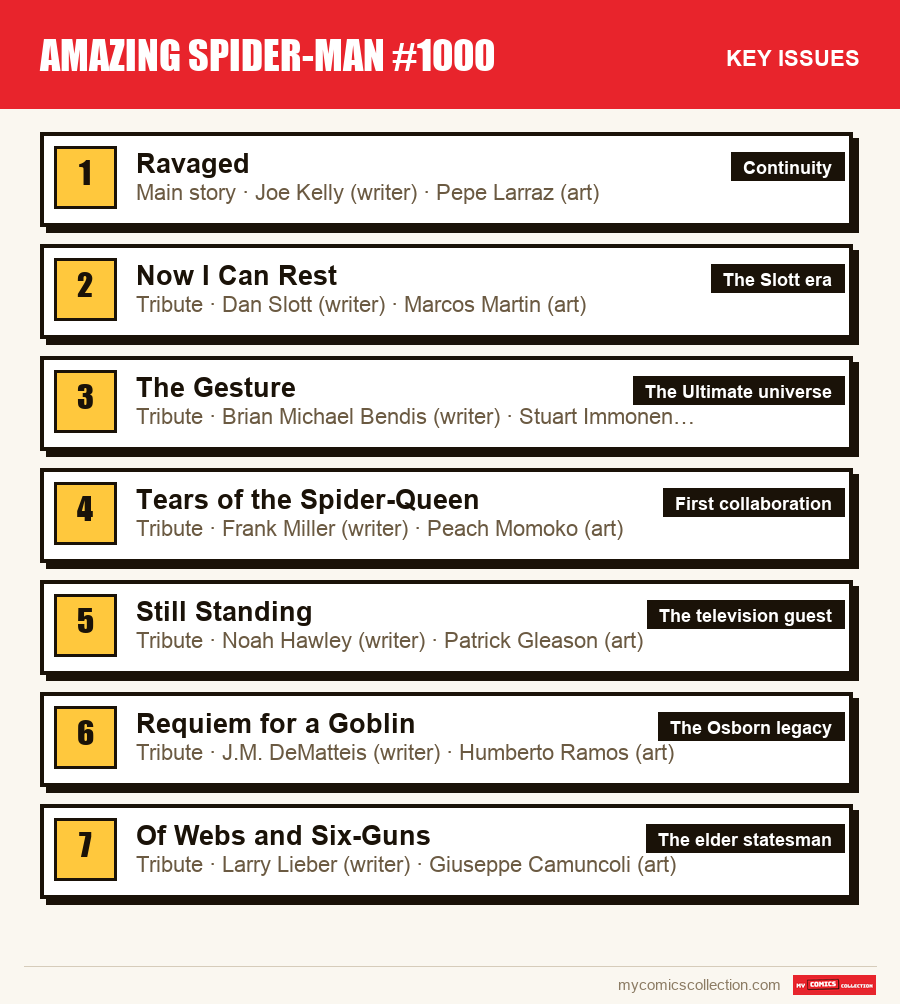
How to read this table of contents
Issue #1000 mixes two logics. The first is that of the ongoing series: "Ravaged" belongs to the volume launched in April 2025, whose first issue carried the legacy numbering #965. That story has consequences, introduces an adversary and touches on Aunt May. The second logic is commemorative: the six anniversary stories can be read independently, as tributes.
This distinction changes the reading order. For "Ravaged", you only need to look back about thirty issues. For the tributes, you sometimes have to go back forty or sixty years. We have ordered the entries accordingly: first the main story, then the tributes, from the most recent to the oldest period evoked.
If you are new to the character, start instead with our general Spider-Man reading guide, then come back here: the paths below assume you already know the basics.
"Ravaged": Joe Kelly and Pepe Larraz
Ravaged
This is the only story in the issue that moves the series forward. It introduces Ravage, a brand-new villain, and tackles Aunt May's fate. Kelly is the regular writer of the volume opened in 2025, with Larraz and John Romita Jr. alternating on art. So #1000 is not an interlude: it is a chapter of the serial, which continues with #1001 and #1002 in October 2026.
Kelly is no newcomer to the character. He was part of the team of writers who took turns on the series from 2008, during the so-called Brand New Day period, when the title came out three times a month. His tone was already recognizable there: dry humor, tightly paneled action scenes, and attention to supporting characters. Outside Spider-Man, his readers know him for a late-1990s Deadpool run that set a good part of the modern voice of the talkative mercenary.
Larraz, for his part, won over the general public by drawing House of X in 2019, the miniseries that remade the X-Men. His take on Spider-Man keeps the same taste for large architectural pages. To gauge what he brings, compare an action scene from "Ravaged" with any double-page spread of House of X: the handling of space is the same.
"Now I Can Rest": Dan Slott and Marcos Martin
Now I Can Rest
Slott wrote the series for a decade, first within the 2008 collective, then alone from 2010 with the "Big Time" relaunch, until his departure in 2018. In between, he dreamed up Superior Spider-Man in 2013, where Otto Octavius occupies Peter Parker's body. Marcos Martin is one of his most admired artists, with a clean, almost graphic-design style that stands out against the dominant realism.
For a longer path, the recommended order is as follows: the start of "Big Time" at #648, then the 2011 "Spider-Island" arc, then Superior Spider-Man in its entirety, and finally Peter Parker's return and the 2014 "Spider-Verse" event. It is a read of several hundred issues, but it divides very well into self-contained arcs. The anniversary story's title, which evokes rest, also reads differently when you know how Slott put his hero through the wringer for ten years.
"The Gesture": Brian Michael Bendis and Stuart Immonen
The Gesture
Bendis wrote Ultimate Spider-Man from its launch in 2000 to its end, first with Mark Bagley for 111 consecutive issues, then with Immonen. The duo reunited on All-New X-Men in 2012. Bendis was also the one who created Miles Morales with Sara Pichelli in 2011. Their presence in the main series' #1000 is therefore a bridge between two universes.
The clearest path goes through our selection of Ultimate Spider-Man key issues, which lets you spot the essential arcs without rereading the first hundred issues in one go. For the logical follow-up, the ranking of the best Miles Morales runs shows how the character born under Bendis' pen kept going. The entry for the issue of his first appearance rounds out the set. Bendis also returns in December 2026 with a miniseries devoted to Jessica Jones, another creation from his Marvel period.
"Tears of the Spider-Queen": Frank Miller and Peach Momoko
Tears of the Spider-Queen
This is the first collaboration between Miller and Momoko, and the story pits Spider-Man against the Hand, the ninja organization Miller invented during his time on Daredevil in the early 1980s. Momoko, for her part, has developed a universe of her own at Marvel, Demon Days, which reinterprets the publisher's heroes through Japanese folklore. The crossover is logical: the Hand is already, at its origin, a Western rereading of Japanese motifs.
To place these issues, the selection of Daredevil key issues and the entry for Daredevil #168 are the two natural steps. Miller has since left superheroes for personal stories, including Sin City, and it is rare to see him return to Spider-Man. That is one of the reasons this story was the most talked about when the contents were announced.
"Still Standing": Noah Hawley and Patrick Gleason
Still Standing
Hawley is first and foremost a television writer and producer, known for Fargo and for Legion, a series about a character from the X-Men universe. His participation is an outside invitation, the kind anniversary issues often welcome. Gleason, on the other hand, is a seasoned comics artist, long associated with writer Peter J. Tomasi at DC, on Batman and Robin and then on Superman.
This pairing of two 1000th issues is not trivial. Gleason is one of the few artists to have drawn in two milestone issues from two different publishers. The entry on Action Comics #1000 will give you the context of that other anniversary.
"Requiem for a Goblin": J.M. DeMatteis and Humberto Ramos
Requiem for a Goblin
DeMatteis wrote "Kraven's Last Hunt" in 1987, with Mike Zeck, and authored very introspective Spider-Man stories at the turn of the 1990s. He also wrote the death of Harry Osborn, the second Green Goblin, in Spectacular Spider-Man #200 in 1993. The title "Requiem for a Goblin" fits unambiguously into that lineage. Ramos is an artist with an angular, nervous style, very present on the series in Slott's era.
To untangle the various wearers of the Goblin mask, our feature on Green Goblin key issues traces the genealogy, from Norman to Harry and beyond. It is a useful prerequisite: without it, the requiem of #1000 does not tell you for whom it is sung.
"Of Webs and Six-Guns": Larry Lieber and Giuseppe Camuncoli
Of Webs and Six-Guns
Larry Lieber, born in 1931, is Stan Lee's younger brother. He scripted the very first adventures of Thor, Iron Man and Ant-Man in the early 1960s, then wrote and drew Rawhide Kid, a western series, from 1964 to 1973. Above all, he drew the daily Spider-Man newspaper comic strip from 1986 to 2018. The title, which pairs webs and revolvers, obviously points to his western work.
Camuncoli is a regular of the web-slinger's anniversary issues: he had already drawn a story in Amazing Fantasy #1000 in 2022. His presence alongside the dean of the publisher's living creators is one of the most touching choices in the contents. We devote a separate article to Larry Lieber's career, from the monsters of the late 1950s to this comeback at 94.
A five-step reading path
If you want to turn this issue into a program rather than an isolated read, here is an order that takes into account how hard each period is to find.
The current volume
Read the series from April 2025 through #1000, then continue with #1001 and #1002. This is the only part that matters for the immediate follow-up to "Ravaged".
The 2000s and 2010s
Ultimate Spider-Man for Bendis and Immonen, then Slott's long run. These are the periods easiest to find in collected editions.
The late 1980s
"Kraven's Last Hunt," then the Harry Osborn cycle through 1993. DeMatteis is at his peak there.
The early 1980s
Miller's Daredevil and his two Spider-Man annuals. A short read, but foundational for the Hand.
The 1960s
The annuals drawn by Lieber, and a detour through the western. It is the oldest period, but the most illuminating about what "Of Webs and Six-Guns" celebrates.
A practical note: at each step, keep track of what you already own. The runs cited add up to several hundred issues, and it is common to buy the same collected edition twice under two different titles. If the question of which copy to keep comes up for #1000 itself, it is covered in our Amazing Spider-Man #1000 collecting guide, and nowhere here.
What the contents say about the series
Put end to end, the guest names draw a history of Spider-Man seen from the inside: the brother of the co-creator, the man of the psychological dramas of the late 1980s, the founder of the Ultimate universe, the longevity record holder of the 2010s, the author of the Hand. Of course, periods are missing, and there will always be some in a 104-page issue. But the range is wide enough for each generation of readers to find its own Spider-Man.
The decision to give the main story to the current team, rather than to a guest star, is also a message. #1000 is not a parenthesis in the series: it is an issue of the series. That is why the first step of the path above is the most important, even if it is the least prestigious.
Finally, the interview with Tom Holland is a reminder that the character now lives on several media at once. For many readers who arrived through the movies, this issue may be the first Spider-Man comic they open. This guide is meant for them too: each entry is an invitation to follow the thread back.
Read also
- Ravage: who is Spider-Man's new villain born in #1000
- ASM #1000 second printing: how to recognize the October 28 pencil covers
- Amazing Spider-Man: volumes and legacy numbering, from the 1963 #1 to #1000
- From #100 to #900: what each Amazing Spider-Man centennial told
- Joe Kelly and Pepe Larraz's Amazing Spider-Man: the reading order through #1000