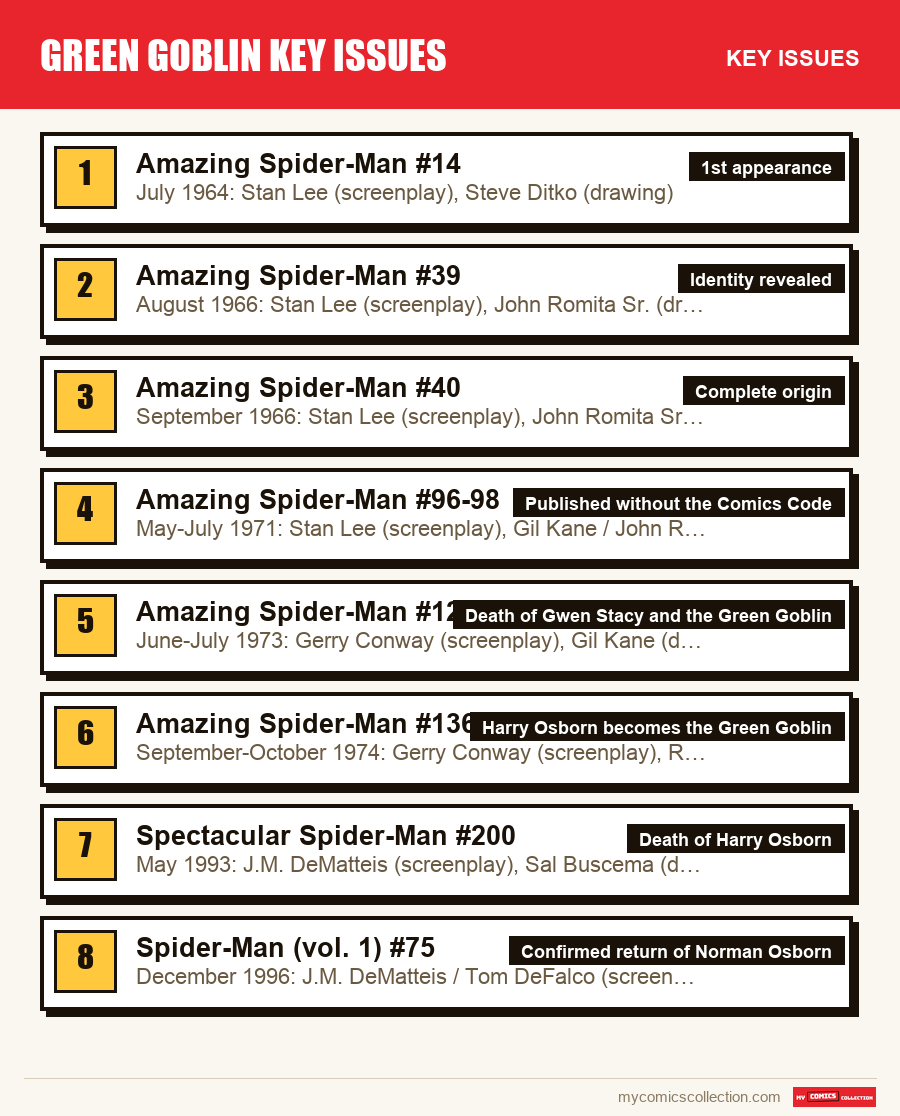
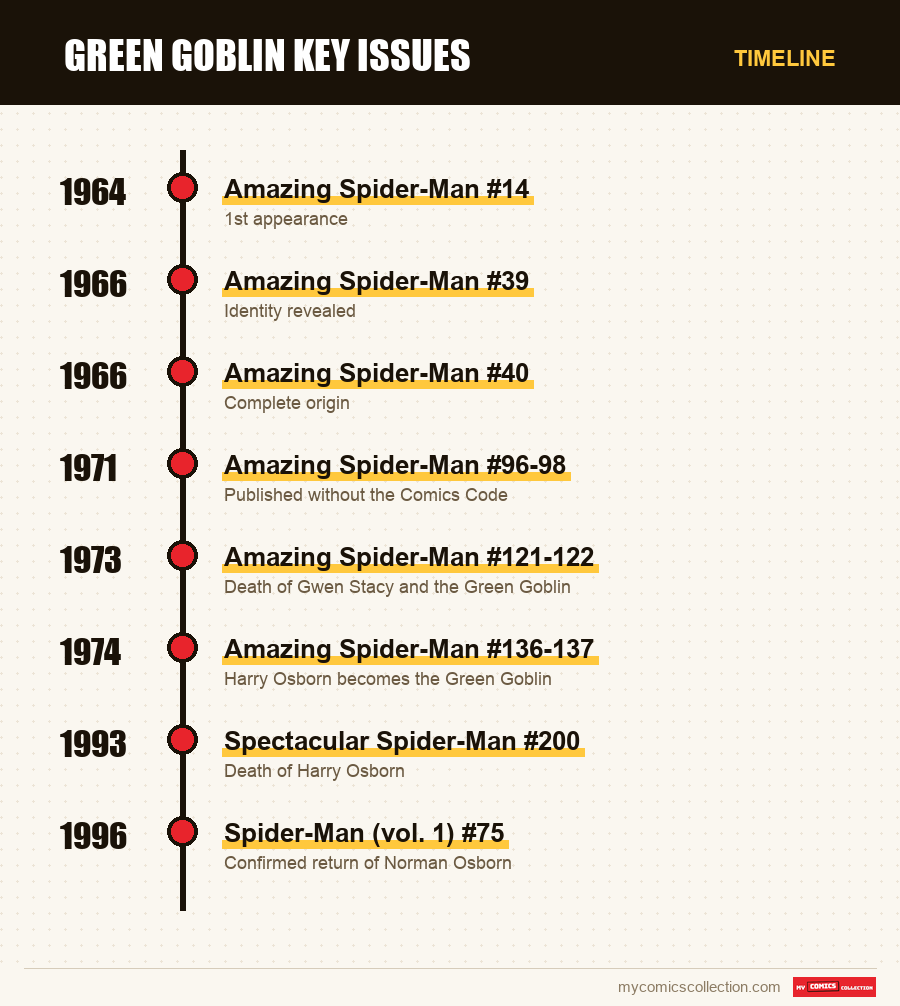
The absolute key numbers of the Green Goblin are Amazing Spider-Man #14 (July 1964, first appearance), #39-40 (1966, revelation of the identity of Norman Osborn), #96-98 (1971, the drug story published without the approval of the Comics Code) and #121-122 (1973, The Death of Gwen Stacy and the Green Goblin). To this are added #136-137 (1974, Harry Osborn takes on the costume) and Spectacular Spider-Man #200 (1993). An ASM #14 in CGC 9.8 sold for $158,600 in September 2025, while an ASM #39 in 9.8 reached $52,800 at Heritage in 2023: two benchmarks that provide a measure of the gap in value between the very first issues and the rest of the run.
Unlike most supervillains in the Marvel Universe, the Green Goblin is not limited to a handful of notable appearances: his editorial history spans more than sixty years and crosses three different identities (Norman Osborn, Harry Osborn, then Norman again). For a collector, this poses a very real problem: not all issues bearing the name "Green Goblin" in a database are equal, and confusing a late reissue with an authentic seminal issue is a costly rookie mistake.
This article has a specific purpose: to serve as a purchasing guide and quotation reference for the numbers that really count in a collection Green Goblin, with for each the creators, the context of publication, the rarity in CGC gradation when it is documented, and the sales values actually observed on the market. If you are instead looking to understand the character himself (his creation, his major arcs, his different identities and his evolution up to recent comics) our article story of the Green Goblin in comics covers this narrative angle in detail. Here, the approach is deliberately collection-oriented: which issue to buy first, why a particular copy is worth ten times more than another apparently similar one, and how to read the rarity data before taking out the bank card.
We will first see the editorial context which explains why certain issues have become essential, then we will detail eight key issues with their value benchmarks, before finishing with the impact of the adaptations on demand and a practical purchasing guide.
Why the Green Goblin Generates So Many Key Numbers
The Green Goblin first appeared in Amazing Spider-Man #14, in July 1964, under the pen of Stan Lee and the pencil of Steve Ditko. Lee's initial synopsis envisioned a demon from mythology; It was Ditko who transformed the concept into a human villain carrying a glider and pumpkin bombs, thus laying the visual foundation for the character still used today. This issue also contains the first meeting between Spider-Man and Hulk, a detail that adds a second layer of desirability for collectors seeking franchise crossovers.
Two years later, in August 1966, Amazing Spider-Man #39 marked a turning point: it was the first issue drawn by John Romita Sr. after Ditko's departure from the series, and it finally revealed the face beneath the mask: that of Norman Osborn, New York industrialist and father of Peter Parker's best friend. This double creative and narrative shift (new artist, identity revealed) largely explains why #39 is considered a pivotal number independently of #14.
The 1970s run adds a rare editorial dimension: Amazing Spider-Man #96, published in May 1971, is the first issue of a major Marvel series to appear without the approval of the Comics Code Authority, because its storyline (an order from the US Department of Health, Education and Welfare) deals head-on with drug addiction through the character of Harry Osborn. This visa refusal, followed by the publication of the issue despite everything, contributed to a lasting relaxation of the rules of the Comics Code. This historical dimension, independent of the mere presence of the Green Goblin, explains why #96-98 is of as much interest to collectors specializing in the history of editorial censorship as to fans of the character.
Finally, 1973 brought what many consider the definitive turning point from the Silver Age to the Bronze Age: the death of Gwen Stacy in Amazing Spider-Man #121-122, storyped by Gerry Conway with art by Gil Kane inked by John Romita Sr. and Tony Mortellaro. This diptych breaks a taboo of the time, the killing of a central character in the hero's entourage, and ranks 6th and 19th in the Marvel poll of the 100 greatest issues of all time. It is this accumulation of narrative and editorial breaks, spread over nearly ten years, which has built the unusual density of key issues around the Green Goblin: much greater than that of Marvel villains appearing at the same time but confined to a handful of stories.
Amazing Spider-Man #14
The very first issue to feature the Green Goblin, still without a revealed identity, confronting Spider-Man on his glider with his characteristic pumpkin bombs. The issue also contains the first meeting between Spider-Man and Hulk, making it an issue with double capital of desirability. It is ranked 37th in Overstreet's ranking of the 50 best comics of the Silver Age. The CGC census has only 2 copies certified 9.8, none above: a rarity that places this issue at the very top of the pyramid of Silver Age comics related to Spider-Man.
Amazing Spider-Man #39
Tied up in the Goblin's lair, Peter Parker witnesses a shock that will redefine the entire mythology of Spider-Man: his captor removes his mask and reveals himself to be Norman Osborn, the father of his best friend Harry. It is also the first issue entirely drawn by John Romita Sr., who succeeds Ditko and imposes a style that will mark the series for the following decade. This double shift (narrative and artistic) makes it a sought-after issue both by Green Goblin collectors and by those who follow Romita's career.
Amazing Spider-Man #40
Direct sequel to #39, this issue tells the complete origin of Norman Osborn: his betrayal of his associate Mendel Stromm, the theft of the formula which will become the Goblin serum, the explosion which gives him his powers and alters him mentally. The final fight against Spider-Man ends with the villain's amnesia rather than his death or arrest: a script choice that will allow Norman Osborn to return regularly to the series without stretching credibility. Significantly rarer number on the graded market than its direct predecessor in very high conservation, due to the age of the paper and the fragility of the Silver Age copies not protected at the time.
Amazing Spider-Man #96-98
“Green Goblin Reborn!” » is the first major Marvel series to be published without the approval of the Comics Code Authority: the story, commissioned by American health authorities to raise awareness of addiction, shows Harry Osborn descending into drug abuse while Norman Osborn regains his memory and becomes the Green Goblin again. The CCA refused approval because of its strict rule prohibiting any depiction of drugs, but Marvel published anyway and the distributors followed: a standoff that ended up permanently relaxing the Code's rules. #96 is the most sought-after number of the triptych for this historical significance specific to the history of American publishing.
Amazing Spider-Man #121-122
"The Night Gwen Stacy Died" is considered the most notable story in all of Spider-Man publishing outside of its origin. The Green Goblin, having discovered Peter Parker's secret identity, kidnaps Gwen Stacy; she dies during the confrontation on the bridge, and the fight that follows results in the death of Norman Osborn, impaled by his own glider. The Marvel poll "The 100 Greatest Marvels of All Time" ranks #121 and #122 6th and 19th respectively of all comics ever published. An example #121 in CGC 9.8 has only 28 copies certified at this grade according to 2021 Heritage data, making it one of the most difficult Bronze Age issues to find in very high conservation.
Amazing Spider-Man #136-137
“The Green Goblin Lives Again!” » marks the first appearance of Harry Osborn as the Green Goblin, a year after the death of his father. Screenwriter Gerry Conway constructed this transformation as the direct consequence of Harry's addiction developed in #96-98: the character literally inherits the family trauma at the same time as the villain identity. This is the starting point of a narrative thread that will occupy the series for nearly twenty years, until its conclusion in Spectacular Spider-Man #200. A CGC 9.8 example sold for $2,040 at Heritage Auctions in April 2022, a level that remains very affordable compared to issues from the previous decade.
Spectacular Spider-Man #200
“Best of Enemies” concludes nearly two years of work by J.M. DeMatteis and Sal Buscema on the psychology of Harry Osborn and features the final confrontation between Spider-Man and the second Green Goblin. The issue, published with a silver varnish cover typical of the 1990s market, is unanimously considered by critics to be one of the emotional peaks of all Spider-Man publishing, combining sacrifice, redemption and family tragedy. Unlike the Silver and Bronze Age issues on this list, the print runs of the period being massive, this issue remains much more affordable financially even in very high conservation: a good entry point for anyone wanting to own a narratively key issue without a five-figure budget.
Spider-Man (vol. 1) #75
Clone Saga Conclusion Number: Peter Parker is captured by a masked man who turns out to be Norman Osborn, who everyone believed to be dead since 1973. To prove that he is neither a clone nor an imposter, Osborn opens his shirt and shows the cross scar left by his impalement on the glider. The issue explains that the Goblin formula gave him a healing factor that allowed him to survive, and reveals that Harry Osborn bribed the coroner to fake the autopsy report. This return, controversial among some readers at the time, nevertheless made Norman Osborn the recurring antagonist that he has remained until today, including in the Dark Avengers runs of the 2000s.
Collecting this series?
Track what you own, what you are missing and what your collection is worth. 7 day trial.
Start my trial →The impact of adaptations on the rating
The Green Goblin is one of the rare Marvel villains to have benefited from two major cinematic incarnations played by the same actor twenty years apart. Willem Dafoe plays Norman Osborn in Spider-Man (2002) by Sam Raimi, the first major superhero film of the new millennium and a resounding commercial success which exploded demand for the character's original comics: it was during this period that the prices of ASM #14 and #39 experienced their first significant surge on the secondary market. Dafoe then reprises the role in Spider-Man: No Way Home (2021), where the film multiplies direct nods to “The Night Gwen Stacy Died”, in turn relaunching collector interest in ASM #121-122 at the time of its release.
Between these two milestones, Dane DeHaan plays Harry Osborn becoming the Green Goblin in The Amazing Spider-Man 2 (2014), a version loosely inspired by arc #136-137 and Spectacular #200, which also supported the demand for these issues with a younger audience discovering the character through the film before going back to the source comics. In the video game Marvel's Spider-Man (Insomniac Games), Norman Osborn appears in the first opus as mayor of New York before turning into a villain in the sequels, which has also fueled interest in the origins of the character among a new generation of players who have become collectors. This mechanism is classic in the comics market: each new general public adaptation acts as a reminder which pushes part of its audience to go back to the founding issues, which explains why the peaks in value of ASM #14 and #39 historically coincide with film releases rather than with purely editorial events.
Buying guide
- Always distinguish between 1st edition and reprint. Amazing Spider-Man #14 was the subject of a facsimile edition announced for its 60th anniversary; systematically check the publisher code and serial number on the back to avoid confusion with the original copy from 1964.
- Prioritize #14 and #39 if budget allows: these are the two numbers where demand structurally exceeds supply, particularly beyond grade 8.0, due to an extremely restricted CGC census on the high grades.
- Don't overlook #96-98 for their historical significance: beyond the Green Goblin, these issues are of interest to collectors of American publishing history because of the Comics Code episode, which supports their value regardless of the pure rating of the character.
- Compare grades wisely: on Silver Age comics over 60 years old like #14, #39 and #40, the price difference between an 8.0 and a 9.0 can be considerable; our comparison CGC grade 9 vs 9.8 details where the true budgetary tipping point is based on the number.
- Spectacular #200 and Spider-Man #75 are affordable entry points to narratively complete a Green Goblin collection without aiming for Silver Age issues that are out of reach: Modern Age print runs being significantly higher, a Near Mint copy remains accessible.
- Check the condition of the pages as well as the cover: on pre-1975 issues, the yellowing of the paper (“white” vs “cream to off-white” vs “tan” pages) strongly influences the CGC rating and therefore the value, often more than small cover marks.
- Follow the adaptation release windows. The prices of founding numbers tend to rise in the weeks preceding a cinema release or a series featuring the character; Buying outside of these windows limits the risk of paying a temporary premium.
- Use a collection tracker to centralize your key numbers, their grade and their origin: our comic collection app allows you to catalog each item and track its estimate over time.