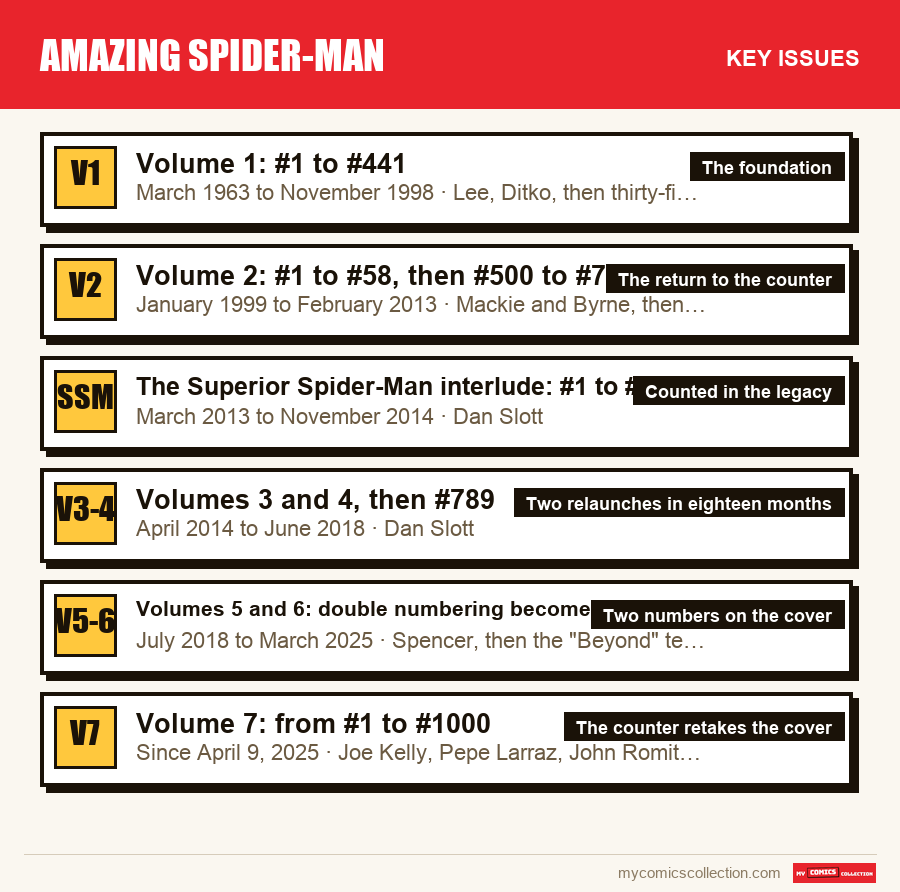
The Amazing Spider-Man has had seven volumes since March 1963, but only one continuous numbering, called legacy, which adds everything up. Volume 1 runs from #1 to #441 (November 1998). Volume 2 restarts at 1 in January 1999, shows the double numbering from #30 (= #471) and hands back to the historic counter with #500 (December 2003), which runs up to #700. Marvel then counts Superior Spider-Man (#701 to #733), volume 3 (#1 = #734), volume 4 (#1 = #757), then returns to #789 in October 2017. Volume 5 starts at #802, volume 6 at #895, volume 7 at #965 in April 2025. After #35 (= #999), the series resumes its legacy number on the cover: #1000 came out on September 30, 2026.
A collector shelving their Spider-Man books sooner or later runs into the same puzzle: two issues carry the number 1, a third shows two numbers on the same cover, and a fourth jumps from 32 to 789 with no issue missing. Nothing unusual: Marvel has relaunched the main series six times, and ended up reconciling all these relaunches in a single counter.
This counter is not a specialist's curiosity. It is what gives meaning to the #1000 released at the end of September 2026, it is what most databases use, and it is what lets you know whether a collection is complete. This article gives the correspondence table for a single title, volume by volume, then a filing method that takes both numberings into account.
Why a single series carries so many number 1s
Relaunches follow a simple commercial logic: a number 1 sells better than a number 700. Stores order more of them, new readers dare to try them, the press talks about them. So Marvel reset the counter every time it wanted to signal a new team or a new direction.
The downside is well known: one more number 1 makes people forget the title's history, and round anniversaries disappear. #500, #600 or #700 are retail events that relaunches prevent from being reached. Hence the periodic return to the historic counter, and, since 2018, a double numbering printed on the cover that tries to get both advantages at once.
For the collector, this gives two identifiers per issue. The first is the volume number, the one printed large and typed into a search engine. The second is the legacy number, more discreet, which gives the issue's place in the entire series. Neither is wrong. They answer two different questions.
The correspondence table, volume by volume
The dates are cover dates, which precede the actual on-sale date by two to three months. The legacy numbers come from the issue-by-issue records kept by the collaborative database devoted to the Marvel universe, cross-checked with the title's publication history.
| Period | Cover numbers | Legacy | Cover dates |
|---|---|---|---|
| Volume 1 | #1 to #441 | 1 to 441 | March 1963 to November 1998 |
| Volume 2 | #1 to #58 | 442 to 499 | January 1999 to November 2003 |
| Return to the counter | #500 to #700 | 500 to 700 | December 2003 to February 2013 |
| Superior Spider-Man | #1 to #33 | 701 to 733 | March 2013 to November 2014 |
| Volume 3 | #1 to #18 (and tie-in issues) | 734 to 751 for #1 to #18 | June 2014 to October 2015 |
| Volume 4 | #1 to #32 | 757 to 788 | December 2015 to November 2017 |
| Return to the counter | #789 to #801 | 789 to 801 | December 2017 to August 2018 |
| Volume 5 | #1 to #93 | 802 to 894 | September 2018 to May 2022 |
| Volume 6 | #1 to #70 | 895 to 964 | June 2022 to May 2025 |
| Volume 7 | #1 to #35, then #1000 | 965 to 999, then 1000 | since June 2025 |
A few landmarks to check a copy in hand. Volume 2 #30, dated June 2001, is the first to print the historic number (#471) next to the volume number. Volume 5 #49 corresponds to #850, #74 to #875. Volume 6 #6, dated August 2022, is #900. Volume 7 #35, on sale August 26, 2026, is #999.
The relaunches one by one
Volume 1: #1 to #441
Thirty-five years without interruption, bimonthly at first then monthly from the fifth issue. This is the part of the series where almost all the historic keys are found, from #1 to #300. The last issue, #441, is written by John Byrne. One oddity only: the #-1 of July 1997, the issue from the "Flashback" event, which databases exclude from the legacy count.
Volume 2: #1 to #58, then #500 to #700
Volume 2 #1 came out in November 1998, written by Howard Mackie and drawn by John Byrne. From #30, when J. Michael Straczynski and John Romita Jr. take over the title, the cover shows both numbers. After #58 (November 2003), Marvel drops the volume number and goes straight to #500, dated December 2003. The series then runs without a break up to #700, on sale December 26, 2012, the conclusion of "Dying Wish".
This period also contains a series of fractional issues: #654.1, #679.1, #699.1 and the five #700.1 to #700.5. They do not count in the legacy. They are full issues, with their own barcode, which a collection list must account for or risk forgetting them.
The Superior Spider-Man interlude: #1 to #33
This is the point that surprises the most. For eighteen months, Amazing Spider-Man no longer exists: the main series is called Superior Spider-Man. To calculate the #789 of 2017, however, Marvel built these issues into the counter, from #701 to #733. A collector who stops at the "Amazing" title on the cover will therefore have a gap of thirty-three issues in their legacy sequence.
Volumes 3 and 4, then #789
Volume 3 came out on April 30, 2014 and corresponds to #734. It is surrounded by tie-in issues (#1.1 to #1.5, then #16.1 to #20.1) that blur the sequence. Volume 4 starts on October 7, 2015 after Secret Wars and corresponds to #757; it stops at #32, on sale September 13, 2017, which is #788. The following month, as part of the Marvel Legacy initiative, the series resumes its counter at #789. It runs to #801, Slott's last issue, drawn by Marcos Martín.
Volumes 5 and 6: double numbering becomes the rule
With Nick Spencer's volume 5, launched on July 11, 2018, Marvel systematically prints the legacy number next to the volume number for the first time. #1 is #802, #93 is #894. Zeb Wells and John Romita Jr.'s volume 6 starts on April 27, 2022 at #895 and reaches #900 by its sixth issue. It ends at #70, which is #964.
Volume 7: from #1 to #1000
Volume 7 starts on April 9, 2025 at #965, written by Joe Kelly and drawn by Pepe Larraz. It has thirty-five issues under its own numbering. Then, instead of a #36, the series publishes #1000, released on September 30, 2026 after a two-week printing delay. The following issues keep the historic counter: #1001 is scheduled for October 14, 2026, #1002 for October 28.
The content of #1000 itself (104 pages, seven stories, more than 400,000 copies ordered) is detailed in our collection guide to Amazing Spider-Man #1000. Here, only its role in the numbering matters: it closes the period of double numbers and gives the title back the single counter it had between 2003 and 2013.
What double numbering changes for a collector
Three situations come up again and again.
Searching. A sale listing, a certification label or a database record rarely uses the same convention. One seller will write "ASM 49" for #850, another "ASM 850". Both mean the same issue. Before concluding that an issue is rare or unfindable, you need to search under both numbers.
Counting. A "complete" volume 5 collection has 93 issues, or 104 if you add the suffixed ones. A complete legacy collection from 802 to 894 has exactly 93 issues. The difference comes from the off-counter issues, which are not in the legacy but exist physically. Decide in advance whether you collect them.
Value. The market does not pay for the counter, it pays for the content. A round number has a lasting premium only if it tells a story. #850 is a pivotal Spencer episode, #900 a giant anniversary issue; their interest comes from what they contain, not from the digit. Our analysis of anniversary issues and their value covers this point for all series; here we are only concerned with filing.
How to file your Amazing Spider-Man collection
Choose a single sort key
The legacy number is the only key that places each issue in a unique spot, from the #1 of 1963 to the #1000 of 2026. It is the key to use for bins or boxes. The volume number stays noted on each record, but it does not set the order.
Decide the fate of Superior Spider-Man
If you follow the legacy, the thirty-three issues of Superior take their place between #700 and volume 3. If you prefer to file by cover title, they go in a separate box, and your legacy list must flag them as shelved elsewhere.
Insert the off-counter issues
Fractional issues (#654.1, #700.1…), suffixed ones (.HU, .LR, .BEY) and volume 3 tie-ins are shelved right after the issue whose base number they carry. A #16.1 follows #16 of the same volume. This keeps the reading order intended by the publisher.
Separate the annuals
Annuals have their own numbering: 31 for the first volume, others at each relaunch. They do not count in the legacy and are shelved in a distinct sequence, by volume then by number.
Note both numbers on each record
A record that shows "Vol. 5 #49 · legacy #850" avoids all search confusion. It is also what lets you verify that a missing list does not ask for the same issue twice.
The general method, for all renumbered series, is described in our guide to the numbering system of a collection. To learn how to combine this sorting with filing by publisher or by universe, see also filing your comics by publisher.
The numbering traps, case by case
The two #1s of 1999 and 2014. Volume 2 #1 (January 1999) and volume 3 #1 (June 2014) are two very different issues, fifteen years apart. On a shopping list, "ASM #1" with no detail almost always means the 1963 one, which has nothing to do with the other two. Always specify the year.
Volume 6 #1 and #900. Volume 6 started at #895 and not at #900, contrary to what you sometimes read. #900 is the sixth issue of the volume, dated August 2022. The two events, relaunch and round number, were brought together in the publisher's communication, hence the confusion.
The jump from #751 to #757. Between volume 3 #18 (#751) and volume 4 #1 (#757), the counter skips five values. They cover the end of volume 3, whose tie-in issues (#16.1 to #20.1) complicate the count. If your legacy list shows this gap, check the record of each volume 3 issue dated 2015 before looking for an issue that may not exist under that name.
French editions. French magazines have their own numbering, unrelated to the American counter. A magazine issue often groups several episodes. For a collector on both sides of the Atlantic, the American legacy serves as the reference to know which episode you own, whichever magazine published it.
Does #1000 change anything going forward?
For the numbering, yes: #1001 and #1002, scheduled for October 2026, will have only one number on the cover. Volume 7 keeps its name in databases, but the ambiguity disappears for the buyer. It is the same pattern as in 2003, when #500 ended five years of volume 2.
For future relaunches, nothing is guaranteed. Marvel relaunched the series in 2014, 2015, 2018, 2022 and 2025, on average every three years. A volume 8 restarting at 1 would not be improbable. If that happens, the double numbering will probably return, and the table above will gain a line. The important thing is to already have a sort key that absorbs it without reorganizing everything.
For reading the series, the legacy order is also the right reading order, apart from the interludes mentioned above. Our Spider-Man reading guide points out the arcs to prioritize in each volume.
Read also
- Amazing Spider-Man #1000: seven stories, seven teams, and what to reread from each
- Ravage: who is Spider-Man's new villain, born in #1000
- ASM #1000 second printing: recognizing the penciled covers of October 28
- From #100 to #900: what each Amazing Spider-Man centennial told
- Amazing Spider-Man by Joe Kelly and Pepe Larraz: the reading order up to #1000