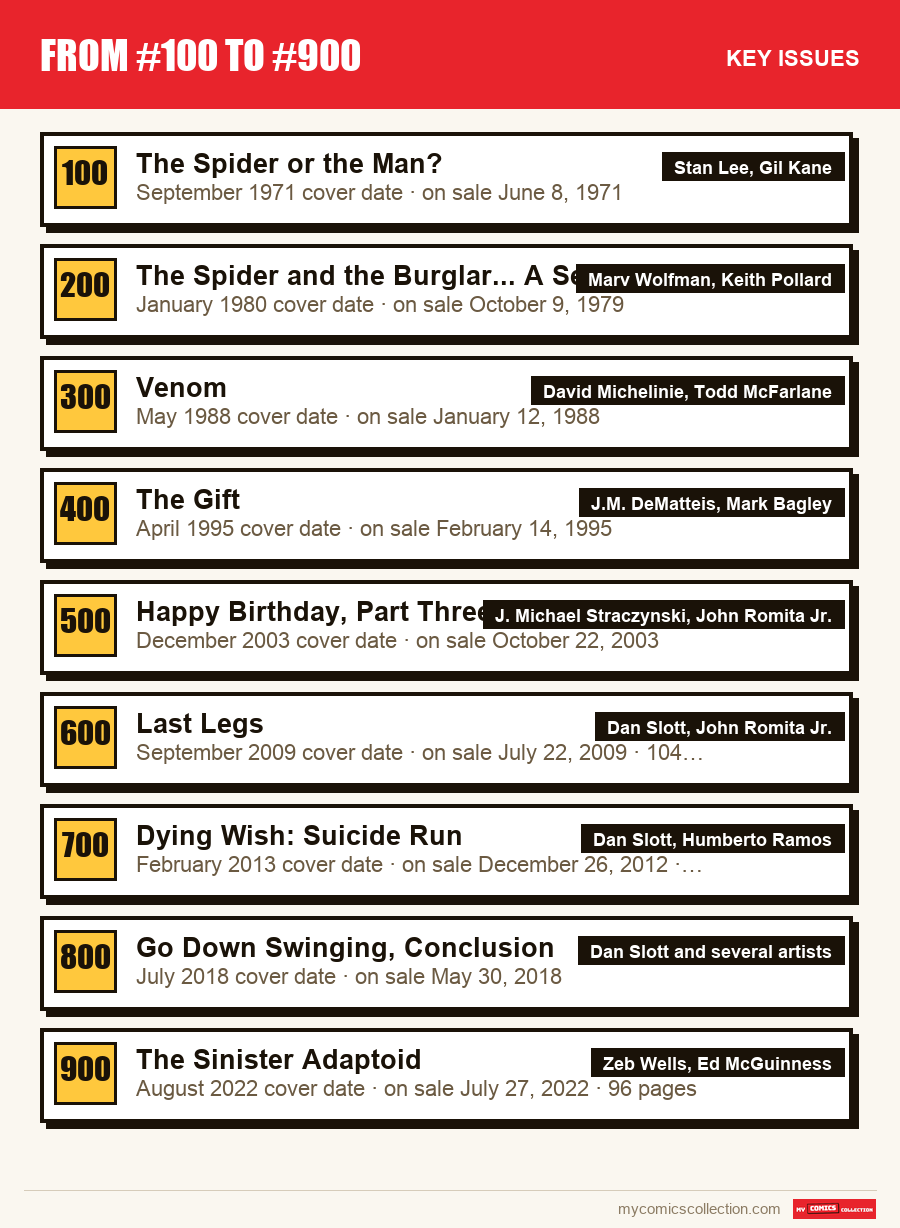
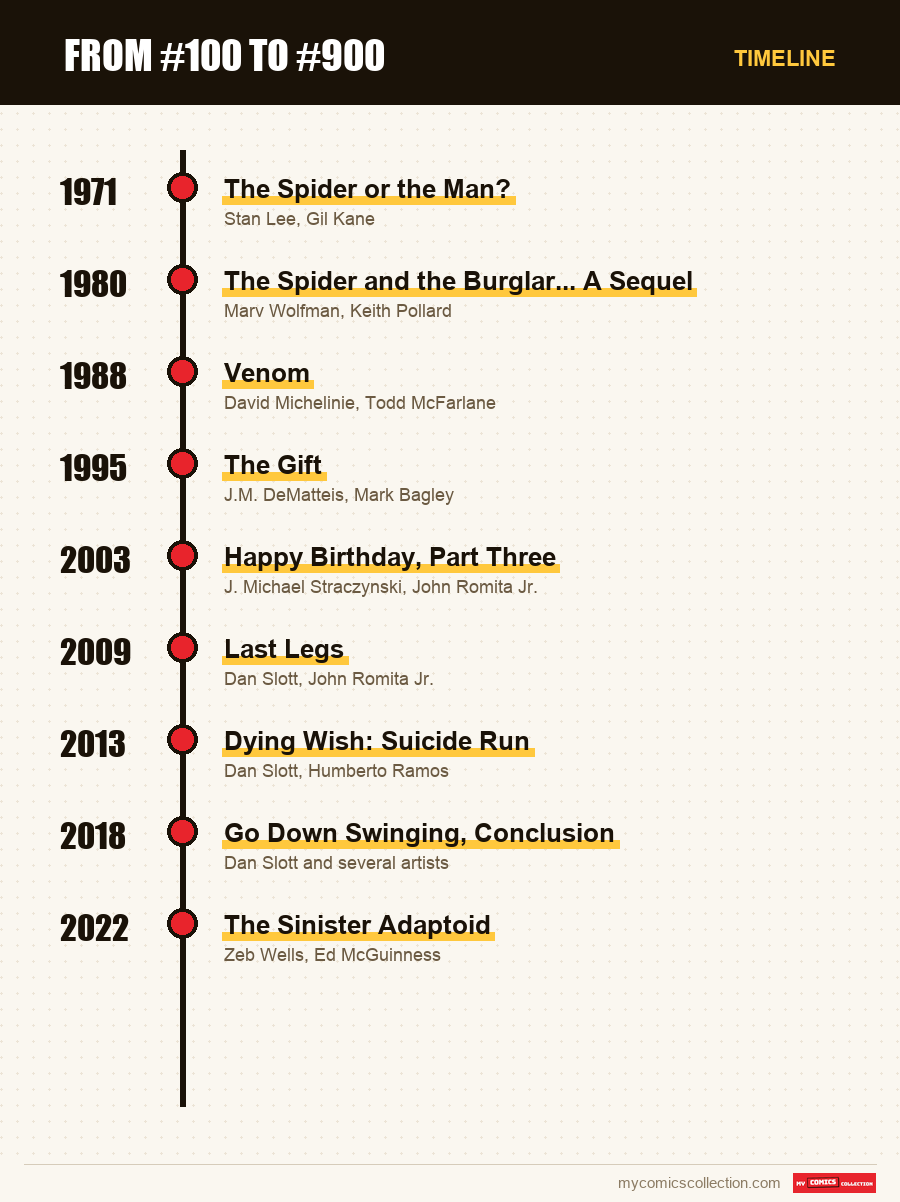
Before #1000 on September 30, 2026, Amazing Spider-Man passed nine hundred-issue milestones, and each one tells a moment in the series. #100 (1971, Stan Lee and Gil Kane) makes Peter Parker doubt his own double life and gives him six arms. #200 (1980, Marv Wolfman and Keith Pollard) closes the file on the burglar who killed Uncle Ben. #300 (1988, David Michelinie and Todd McFarlane) gives Venom his first real fight. #400 (1995, J.M. DeMatteis and Mark Bagley) kills Aunt May, at least in appearance. #500 (2003, J. Michael Straczynski and John Romita Jr.) restores the original numbering. #600 (2009), #700 (2013) and #800 (2018) belong to the Dan Slott era, and #900 (2022, Zeb Wells and Ed McGuinness) celebrates the hero's sixtieth anniversary.
A round number has nothing magical about it. It is a date on a production calendar, a figure that lands because the series lasted long enough. Yet at Marvel, every hundred of Amazing Spider-Man has been treated as a stage: more pages, a story that looks back, an event meant to be talked about. For the character himself, see the Spider-Man page. Rereading these nine issues in a row is like leafing through an unintentional summary of the character's history, and of the publisher's.
This article is not about market value. The value of #300 and the question of its newsstand versions are covered elsewhere on this site, as is the general strategy for anniversary issues. Here, we tell the story: who wrote and drew each milestone, what happens in it, and why the editors of the time chose that tale rather than another. It is the reading you should have in mind before opening #1000.
Why the hundreds matter at Marvel
In the 1960s, a monthly comic was not meant to last. Many titles stopped after a few dozen issues, and passing the hundred mark meant a series had found a lasting audience. When Amazing Spider-Man reached its #100 in 1971, the title was already the publisher's best seller, ahead of Fantastic Four. The number became a cover selling point, and the editors promised readers an "anniversary issue."
From then on, a tradition took hold. Each hundred received special treatment: a longer story, a more elaborate cover, sometimes a lasting change in the hero's life. As the decades passed, the stakes shifted. In the 1990s and 2000s, the milestone also became a commercial argument, with special presentations and alternate covers. After 2010, it also served as a tipping point for the numbering itself, since the series went through several relaunches and Marvel returns to the historic numbering at the time of the big milestones.
That is what makes the lineage interesting to read in one go. You can see the same editorial team choosing, in each era, what it considers the essence of the character: guilt, family, enemies, death, the relationship with the past.
The nine milestones, one by one
The Spider or the Man?
Stan Lee writes, Gil Kane draws, Frank Giacoia inks, and the cover is by John Romita. The plot is an examination of conscience. Peter Parker, worn out by his double life, wants to marry Gwen Stacy and decides that Spider-Man must disappear. He makes a serum meant to take away his powers, swallows it without testing it and falls asleep. A long dream follows in which his historic enemies parade by (the Vulture, the Lizard, the Green Goblin, Doctor Octopus, the Kingpin), then the ghost of Captain George Stacy, who reminds him that he has no right to an ordinary life. On waking, Peter discovers that four extra arms have sprouted.
The Spider and the Burglar... A Sequel
Marv Wolfman writes, Keith Pollard draws, Jim Mooney inks, and a final page is dialogued by Stan Lee. This issue goes back to the absolute starting point: the burglar who killed Ben Parker in Amazing Fantasy #15. The story ties up a plot running for several months around Aunt May's old house, which the man had rented to get his hands on loot hidden by a Prohibition-era gangster. Peter, stripped of his powers for part of the tale, faces his uncle's killer without a safety net.
Venom
David Michelinie writes, Todd McFarlane draws and inks himself. Eddie Brock, a journalist discredited after the Sin-Eater affair, has bonded with the symbiote Peter rejected, and he terrorizes Mary Jane before facing Spider-Man in the church where the symbiote had been rejected, a fight the hero wins by exhausting the costume. The issue also tells, in flashback, how Brock and the symbiote found each other. It is also here that Peter definitively abandons the black costume and goes back to red and blue.
The Gift
J.M. DeMatteis writes, Mark Bagley draws, Larry Mahlstedt and Randy Emberlin ink. We are in the middle of the Clone saga. Aunt May comes out of her coma, and Peter, who thinks he has finally found his footing, confesses to her that he is Spider-Man. She answers that she has known for a long time. They spend one last day together, then May dies in her sleep. The issue ends with Peter's arrest for murder. It contains two other tales, one drawn by John Romita Jr. and inked by his father, the other co-written with Stan Lee.
Happy Birthday, Part Three
J. Michael Straczynski writes, John Romita Jr. draws, joined by John Romita Sr. on some pages, with a cover by J. Scott Campbell. Peter is thrown through his own past: the spider bite, his first fights against the Sandman, the Vulture or the Lizard, the death of Gwen Stacy, the machinery scene from #33. It is a stroll through forty years of the series, at the exact moment it celebrates its fortieth anniversary.
Last Legs
Dan Slott writes the main story, John Romita Jr. draws it, Klaus Janson inks. Doctor Octopus returns, dying, and tries to leave his mark on New York, while Aunt May marries J. Jonah Jameson's father. The issue has about ten side stories, including a tale written by Stan Lee and drawn by Marcos Martín, and contributions from Mark Waid, Bob Gale, Marc Guggenheim, Zeb Wells, Joe Kelly or Brian Michael Bendis.
Dying Wish: Suicide Run
Dan Slott writes, Humberto Ramos draws, Victor Olazaba inks. Otto Octavius has swapped minds with Peter Parker. Trapped in the dying body of Doctor Octopus, Peter tries to get his own back and fails. He dies, and Octavius keeps Peter's body, life and memories. The issue also contains a tale by J.M. DeMatteis drawn by Giuseppe Camuncoli and inked by Sal Buscema.
Go Down Swinging, Conclusion
A single eighty-page tale, written by Dan Slott and cut into chapters entrusted to Nick Bradshaw, Humberto Ramos, Giuseppe Camuncoli, Stuart Immonen, Marcos Martín and Mike Hawthorne, with a cover by Alex Ross. Norman Osborn, bonded to the Carnage symbiote, has become the Red Goblin. Spider-Man faces him with his allies, and Flash Thompson, now Agent Anti-Venom, loses his life.
The Sinister Adaptoid
Zeb Wells writes, Ed McGuinness draws, and the main cover is by John Romita Jr. The issue lands in the month of the character's sixtieth anniversary. A former adversary has captured the Sinister Six and fused them into a single creature, the Sinister Adaptoid, while Peter celebrates his birthday. Short stories round out the whole, including "Save the Date" by Dan Slott and Marcos Martin.
What the lineage reveals about the series' evolution
If you line up the nine subjects, a progression appears. The first three hundredth issues are stories about identity. #100 asks whether Peter can stop being Spider-Man, #200 sends him back to the fault that created him, #300 pits him against a monstrous double fed by his former costume. The common thread is the question of who the man under the mask is.
The next three are stories of family and memory. #400 takes away his maternal figure, #500 makes him relive his own past, #600 marries Aunt May. The series is by then more than thirty years old, and its readers have aged along with it. The hundredth issues become exercises in openly embraced nostalgia, with returning former artists and heavy winks.
The last three, finally, are issues of spectacular rupture. #700 kills Peter Parker, #800 sacrifices Flash Thompson, #900 squeezes six enemies into one. At this stage, the milestone serves to make an event in a market saturated with new releases, and the editors seek shock rather than reflection.
One constant runs through it all: the desire to summon the founding fathers. Stan Lee writes in #100, adds a page to #200, co-writes a tale in #400 and writes another for #600. The Romitas, father and son, return on #400 and #500, then on the cover of #900. #1000 extends this logic, with a main cover by John Romita Jr. and a story by Larry Lieber, Stan Lee's brother.
The issues that change numbers
The lineage has a quirk that puzzles new readers: from #500 on, the hundredth issues do not necessarily carry the number you expect in catalogs. The series was relaunched in 1999 with a new #1, then Marvel resumed the historic numbering in 2003. The same pattern repeated: a stop after #700, a relaunch, a return to the historic count, a new relaunch in 2018, then in 2022, then in April 2025.
Concretely, #600 and #700 belong to the same volume as #500, which explains why they are sometimes filed as volume 2. #800 is attached to another volume, #900 to yet another, and the current volume, opened in April 2025, has as its #1 the #965 of the historic numbering. That is why #1000 could land in September 2026.
For filing a collection, the most robust rule is to record both numbers when they exist: the volume number and the legacy numbering one. A tracking tool that knows only one of the two will make you believe in duplicates or gaps that do not exist.
How to reread the lineage before opening #1000
Start with the origin
#200 only truly makes sense after Amazing Fantasy #15. Rereading the eleven pages of 1962, presented on the Amazing Fantasy #15 page, gives full weight to the face-off with the burglar.
Read the hundredth issues with their context
#100 reads with #101 and #102, #300 with the 1984 issues where Peter discovers the nature of the black costume, #700 with the issues that set up the mind swap. On its own, a hundredth issue is often a conclusion or a cliffhanger.
Spot the returning creators
Dan Slott, Marcos Martín, J.M. DeMatteis and Humberto Ramos run through several hundredth issues. Finding them again in #1000 is no accident: they are the names the editors associate with their big milestones.
Note the double numbering
From #500 on, record the volume number and the legacy number in your database. This avoids any confusion the day you complete the series at random through a sale.
And #1000 in all this
#1000 came out on September 30, 2026, two weeks later than planned, and runs 104 pages. Its main story, "Ravaged," is by Joe Kelly and Pepe Larraz, and introduces a new villain, Ravage. Around it, anniversary stories bring together Dan Slott and Marcos Martin, Brian Michael Bendis and Stuart Immonen, Frank Miller and Peach Momoko, Noah Hawley and Patrick Gleason, J.M. DeMatteis and Humberto Ramos, Larry Lieber and Giuseppe Camuncoli, plus an interview with Tom Holland.
In light of the nine previous milestones, this lineup is consistent with the tradition. It takes up the anthology formula inaugurated in #600, recalls the creators of #600, #700 and #800, invites Stan Lee's brother as #100 invited Stan Lee himself, and introduces an antagonist like #300. The complete guide to #1000 details its covers and print runs; here, all you need to remember is that it closes a lineage of ten milestones, all conceived as recaps of what the series believed itself to be in its time.
Read also
- Amazing Spider-Man #1000: seven stories, seven teams, and what to reread from each
- Ravage: who is Spider-Man's new villain born in #1000
- ASM #1000 second printing: how to recognize the October 28 pencil-sketch covers
- Amazing Spider-Man: the volumes and legacy numbering, from the 1963 #1 to #1000
- Amazing Spider-Man by Joe Kelly and Pepe Larraz: the reading order up to #1000