Dan Slott, born on July 3, 1967, is the writer who has written Amazing Spider-Man the longest in the modern era: first among four rotating writers from January 2008, then alone from November 2010 with "Big Time," through #801 in 2018. In between, he signs ASM #700 (late 2012), where Doctor Octopus takes over Peter Parker's body, then Superior Spider-Man. Before Spider-Man, he made a name with She-Hulk (from 2004). With Mike Allred, he writes Silver Surfer (from 2014), whose #11 receives the Eisner for best single issue in 2016. Next come Fantastic Four (2018), Tony Stark: Iron Man, a return to Spider-Man with Mark Bagley, then in 2025 his move to DC for Superman Unlimited. In September 2026, he returns in Amazing Spider-Man #1000 with "Now I Can Rest," drawn by Marcos Martin.
Few writers have marked a character as much in a single stint. Dan Slott wrote Spider-Man for more than ten years, over more than two hundred issues, and he made decisions that divided readers as rarely: replacing Peter Parker with his worst enemy, turning the poor photographer into the head of a multinational, gathering all versions of the hero in one story. You can love or hate his Spider-Man, but you cannot pretend he did not exist.
This portrait follows his career in order, from his beginnings in kids' comics to his return in issue 1000. It does not replace the articles devoted to his runs on She-Hulk and Silver Surfer, which place them among the other teams on those characters; it tells the writer's story.
The beginnings: comics for all ages (1991-2003)
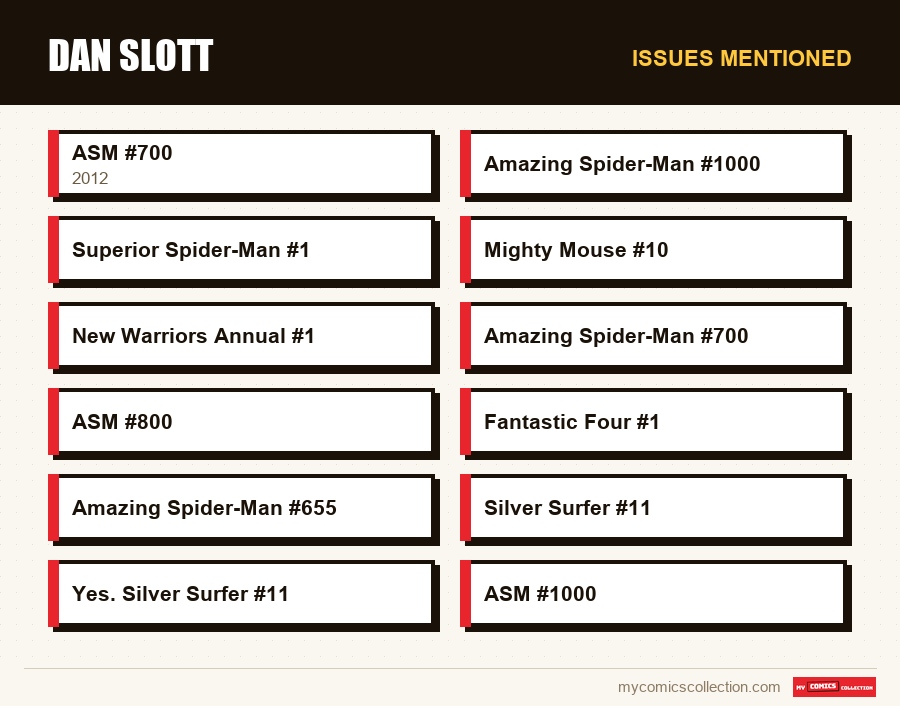
Slott's first published works at Marvel date from 1991: a story in Mighty Mouse #10 and an eight-page backup story in New Warriors Annual #1, both dated July 1991. At the end of 1992, he becomes the regular writer of the Ren & Stimpy series, based on the cartoon. He already has Spider-Man appear there, in an episode where the hero faces the series' villain.
For a decade, Slott writes a lot of comics aimed at young readers, for several publishers: Looney Tunes stories, episodes of series based on Cartoon Network cartoons, stories for digests. At DC, he writes the Batman Adventures series in 2003 and 2004, with Ty Templeton, in the style of the animated series. This past matters: it explains his sense of rhythm, his taste for visual gags and his ability to write complete stories in few pages.
The turning point comes in 2003 with Arkham Asylum: Living Hell, a six-issue miniseries at DC, which tells the story of Arkham Asylum from the point of view of a financier sent among the inmates. The series' success opens Marvel's doors to Slott for a more ambitious project.
She-Hulk and the years of humor (2004-2007)
In 2004, Slott launches a new She-Hulk series. He makes Jennifer Walters a lawyer specializing in superhuman law, working at a firm where Marvel's archives serve as case law. The series plays with continuity, multiplies winks and treats superheroes as ordinary litigants. Relaunched in October 2005, it reaches its best sales level with its ties to the "Civil War" and "World War Hulk" events. Our She-Hulk reading guide places it among the character's other periods.
During the same period, Slott writes the miniseries Spider-Man/Human Torch (2005), which follows the two heroes' friendship across the decades, each issue paying homage to an era of Marvel. He signs GLA: Misassembled, devoted to the Great Lakes Avengers, a team of failed heroes, where he resurrects an obscure character destined for a great future, Squirrel Girl. He also writes the Thing's first solo series in twenty years, stopped at the eighth issue despite his efforts to defend it.
In 2007, after "Civil War," he launches Avengers: The Initiative, devoted to the government program for training superheroes. He will then write Mighty Avengers from #21 to #36, after Brian Michael Bendis's departure.
Spider-Man, first stage: Brand New Day (2008-2010)
In January 2008, after the heavily contested story "One More Day," which erases Peter Parker and Mary Jane's marriage, Amazing Spider-Man moves to a pace of three issues a month. To keep up this cadence, Marvel assembles a group of writers who alternate on the series. Slott is one of the four. This period, called "Brand New Day," puts Peter Parker back in the situation of a young single man, broke, surrounded by new supporting characters and new villains.
Slott learns the character from the inside there, without bearing the responsibility alone. It is a demanding school: each writer must take into account what the others wrote the week before.
Spider-Man, alone at the helm (2010-2018)
In November 2010, Slott becomes the sole writer of Amazing Spider-Man, which moves to two issues a month. He opens his run with "Big Time": Peter Parker finally gets a stable job, in a research lab, and his life as a scientist becomes a plot engine. His big arcs follow: "Spider-Island" in 2011, where all of New York receives Spider-Man's powers, then "Ends of the Earth" against the dying Doctor Octopus.
Amazing Spider-Man #700
Doctor Octopus, dying, has swapped his mind with Peter Parker's. In this issue, Peter dies in Octopus's body, and Octopus remains in Peter's, determined to become a better Spider-Man. The issue, last of the original series, provoked a reaction of rare violence, up to death threats against its writer. It was also one of the year's best sellers, and went through five printings.
Superior Spider-Man #1
The series that follows Octopus's adventures in Peter Parker's body, more efficient, more arrogant and more brutal than the original. For more than a year, it replaces Amazing Spider-Man. Many readers who had rejected the premise then made it one of their favorite periods of the character.
Peter Parker returns in 2014, with a new volume of Amazing Spider-Man and the "Spider-Verse" event, which gathers dozens of Spider-Man versions from other realities, including Spider-Gwen, who appeared just before in another series. In 2015, Slott makes Peter Parker the head of Parker Industries, a global tech company, against the image of the hero always short of money. The run ends in 2018 with "Go Down Swinging," issues 797 to 800, where Spider-Man faces a Green Goblin linked to the Carnage symbiote. #801 is Slott's last issue. That same year, he signs four of the ten best-selling issues in the whole market.
The balance sheet is also measured in decade figures: when the market's main direct-market distributor published in January 2020 its ranking of the hundred best-selling comics of the 2010s, nine of the titles were written by Slott, including ASM #700, ASM #800, Superior Spider-Man #1 and the 2018 Fantastic Four #1. Our Spider-Man reading guide places his run within the whole series.
Silver Surfer with Mike Allred (2014-2017)
Alongside Spider-Man, Slott launches in May 2014 a Silver Surfer series with Mike Allred on art and Laura Allred on colors. The tone is that of a cosmic romantic comedy: the Surfer travels across the universe with Dawn Greenwood, a young Earthling. The series plays with form, with issues built as graphic games. #11 receives the Eisner Award for best single issue in 2016. Our Silver Surfer reading guide presents this series among the character's other periods.
After Spider-Man: Fantastic Four, Iron Man and the return (2018-2024)
After leaving Amazing Spider-Man, Slott relaunches Fantastic Four in 2018, after several years of the series' absence, and writes in parallel Tony Stark: Iron Man, then Iron Man 2020. He keeps Fantastic Four until 2022.
In July 2022, Marvel announces his full-time return to the Spider-Man universe with a series titled Spider-Man, drawn by Mark Bagley, which follows "Edge of Spider-Verse" and accompanies the Amazing Spider-Man of Zeb Wells and John Romita Jr. He notably creates Spider-Boy there, who then receives his own series. He also relaunches Superior Spider-Man in 2023, still with Bagley.
The move to DC (2025)
In January 2025, Slott ends his exclusivity contract with Marvel, after nearly fifteen years. He joins DC for a new monthly series, Superman Unlimited, launched on May 21, 2025 with artist Rafael Albuquerque. The first arc imagines an Earth strewn with kryptonite after an asteroid falls, which lets any criminal threaten Superman. For a writer associated for fifteen years with Spider-Man, it is a spectacular change of house, and a return to the publisher of his beginnings as an established writer. The Superman hub gathers the pages devoted to the character.
The return in Amazing Spider-Man #1000
On September 30, 2026, Marvel publishes Amazing Spider-Man #1000, a 104-page anniversary issue, with a main story by Joe Kelly and Pepe Larraz. Among the anniversary stories is "Now I Can Rest," written by Dan Slott and drawn by Marcos Martin. Martin had already collaborated with him during his run, notably on the 2011 Amazing Spider-Man #655, an almost wordless issue devoted to Peter Parker's grief.
The story's title sounds like a farewell or a reconciliation, and it is hard not to read in it a nod to Slott's relationship with the character, of whom he has written more issues than almost any other modern writer. For a reader discovering him in this issue, the 2010 to 2018 run is the reading that imposes itself, starting with "Big Time" or, for the most curious, directly with #700 and Superior Spider-Man. Our collecting guide to issue #1000 recalls the rest of the contents.
What to read, and what to collect
For reading, three entry doors depending on taste. For humor and continuity, the 2004 She-Hulk. For the big serial, Amazing Spider-Man from "Big Time," then #700 and Superior Spider-Man. For graphic poetry, Silver Surfer with Allred.
For the collection, the Slott era has a particularity: it is an era of very large print runs and multiple covers. The most followed issues are ASM #700, Superior Spider-Man #1, the first issues of "Spider-Verse" for the first appearances of characters featured there, and the award-winning Silver Surfer #11. But the abundance of copies makes condition decisive, and the multiplicity of printings requires checking the printing. No price guide is given here; for a specific copy, the free estimate starts from its real condition.