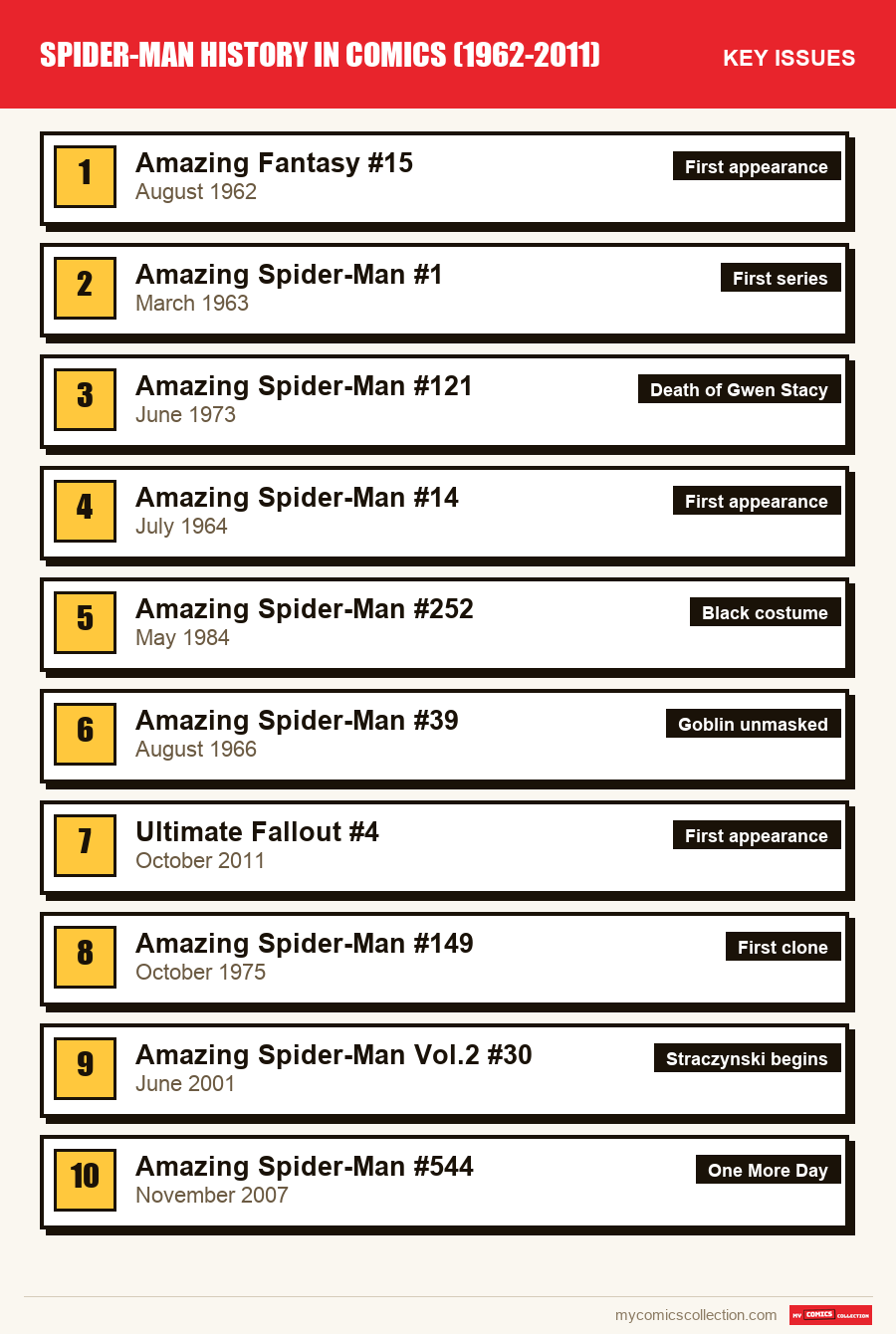
Spider-Man first appears in Amazing Fantasy #15 (cover dated August 1962), created by Stan Lee and Steve Ditko. The success was such that Marvel offered him his own series in 1963 with The Amazing Spider-Man #1. From the Ditko era to the arrival of John Romita Sr., from the death of Gwen Stacy (1973) to the black suit of Secret Wars (1984), from the Clone Saga to the J. Michael Straczynski era, until One More Day (2007) and the arrival of Miles Morales In Ultimate Fallout #4 (2011): here is more than sixty years of editorial history, told era by era.
Few fictional characters have had as much impact on popular culture as Spider-Man. However, it all began in 1962 with an almost innocuous decision: to place a teenage superhero story in the last pages of an anthology magazine doomed to disappearance. No one at Marvel expected this bespectacled, self-conscious high school student to become one of the company's commercial pillars for the next six decades.
The history of Spider-Man in the comics is not a straight line. It is a succession of eras, each carried by different creators, each responding to the expectations of its time. Some produced numbers that are now legendary and priceless; others, more controversial, have divided readers for years. Understanding this chronology means understanding why this number is sold out today and another remains accessible.
In this chronological story, we follow the narrative and editorial thread of the character, from his very first appearance until the emergence of a second Spider-Man in 2011. All dates, all numbers and all values cited here are documented and sourced.
At the origins: Marvel at the turn of the 1960s
In the early 1960s, the publisher that would become Marvel Comics sought to reinvent itself. The success of Fantastic Four #1 in 1961 showed that there was an audience for more human, fallible superheroes, grounded in a recognizable everyday life. It is in this context that Stan Lee, then editor-in-chief, imagined with the cartoonist Steve Ditko a hero against the grain: a teenager, not a muscular adult; a character consumed by doubts, money and guilt rather than a confident vigilante.
The idea was so shocking that, according to the editorial legend, the boss at the time considered the concept to be unsalesable. Spider-Man is therefore relegated to Amazing Fantasy #15, an anthological title already condemned to shutdown. What was supposed to be a one-off, short-lived appearance turned into a commercial success as soon as the sales figures rose. The reader of 1962 recognized himself in Peter Parker as never before in a superhero.
1962-1966: the Ditko era, the birth of a myth
Amazing Fantasy #15, cover dated August 1962, contains the entire basis of the character in a handful of pages. Peter Parker, a studious and ostracized high school student, is bitten by a radioactive spider during a science demonstration. Intoxicated by his new powers, he refuses to arrest a burglar who does not concern him. This same burglar will later murder his uncle Ben. From this fault is born the founding phrase: great powers imply great responsibilities. Rarely has an origin been so dense and so moral.
The success pushes Marvel to launch The Amazing Spider-Man #1, cover dated March 1963. This issue replays the origin for new readers and lays lasting foundations: first appearance of J. Jonah Jameson, the press boss who will make Spider-Man his scapegoat, and Chameleon, the gallery's first supervillain. The issue also contains the first crossover with the Fantastic Four, a sign that Marvel is already building a shared and coherent universe.
Steve Ditko is not just a designer: he co-designs the plot and shapes a gallery of villains that has remained iconic. It is under his pen that the Green Goblin , In Amazing Spider-Man #14 (July 1964), an enemy whose civilian identity would not be revealed until much later. Ditko draws the series until issue 38; its angular, expressive and slightly disturbing style defines the character's first visual identity. His departure in 1966, amid creative disagreements with Stan Lee, marked the end of an era.
1966-1972: the Romita era, Spider-Man superstar
From number 39, John Romita Sr. resumes the drawing. The change in tone is immediate and decisive. Where Ditko cultivated strangeness, Romita brings a more glamorous touch, inherited from the romantic comics he previously drew. Peter Parker gains in confidence, those around him are adorned with more attractive faces, and it is under Romita that one of the most memorable figures in mythology finally shows her face: Mary Jane Watson, who had appeared with her face hidden as early as #25 (June 1965), and whose entry on the scene in #42 (November 1966) has remained cult.
This is also the time when the Green Goblin becomes Peter's great personal enemy. In Amazing Spider-Man #39, the man behind the mask is finally revealed: Norman Osborn, an industrialist who now knows the hero's secret identity. For the first time, a villain threatens not only Spider-Man, but also Peter Parker and everyone he loves. This shift opens the way to the most significant drama of the following decade.
During the Romita era, Spider-Man became a bookstore phenomenon. Sales exploded, the character settled at the top of the Marvel catalog, and his formula (mixing action, teenage romance and moral dilemmas) became a school. This period lastingly consolidated the popularity of the hero and prepared the ground for darker stories.
1973: The night Gwen Stacy died
Few stories have changed the medium as much as “The Night Gwen Stacy Died,” published in Amazing Spider-Man #121-122 (June-July 1973). Written by Gerry Conway, drawn by Gil Kane and inked by John Romita Sr. and Tony Mortellaro, it sees the Green Goblin kidnap Gwen Stacy, Peter's girlfriend, and throw her off a bridge. Spider-Man tries to catch her with his web; he fails. In the process, the Green Goblin also dies.
Before this issue, it was rare for a major member of a superhero's entourage to be killed off. Gwen's death breaks this taboo and brings comics into a more adult and more tragic era. Many historians of the medium consider this arc to be the most important in Spider-Man's history after his origins, and as one of the turning points that mark the end of the Silver Age of comics.
The 1970s and 1980s: clones, marriage and black suits
The First Clone (1975)
From 1975, the series sowed a seed that would bear fruit twenty years later. In Amazing Spider-Man #149 (October 1975), signed Gerry Conway, Ross Andru and Mike Esposito, appears a clone of Peter Parker created by the Jackal, aka Professor Miles Warren. At the time, the character seemed to die in the very issue. But the idea of a double of Peter will remain in a corner of editorial memory, ready to resurface.
The Black Suit (1984)
In 1984, the collective event Marvel Super Heroes Secret Wars transports the heroes to a distant planet. It's there, in Secret Wars #8, that Spider-Man sees his suit damaged and accidentally activates a machine which releases a black substance. This covers his body and forms a unique costume, entirely black marked with a large white spider. For reasons of publication schedule, this costume appears first to readers in Amazing Spider-Man #252 (cover dated May 1984), under the famous slogan “The rumors are true”: even before the story explaining its origin appeared.
We will later discover that this costume is not a simple piece of clothing but a symbiote, a sound-sensitive alien life form that seeks to mentally and physically merge with its host. Once rejected by Peter, the symbiote will find a new host and give birth to Venom, one of the most popular antagonists in the entire Spider-Man universe. The black costume, originally a simple aesthetic change, thus becomes the source of one of Marvel's most fruitful spin-off franchises.
1994-1996: The Clone Saga
The seed planted in 1975 germinated in the mid-1990s with the Clone Saga, a mega-narrative that unfolds from October 1994 to December 1996 across the five Spider-Man titles published in parallel. Peter's clone, thought to be dead, actually survived. He lived for years under the name Ben Reilly: a tribute to Uncle Ben and Aunt May's maiden name: before returning to New York and adopting the superhero identity of the Scarlet Spider.
The saga pushes the concept to the point of dizziness: at one point, the story suggests that the “real” Peter Parker would in fact be the clone, and that Ben Reilly would be the original. Ben even briefly takes on the role of Spider-Man. This accumulation of twists and turns, stretched over two years and multiplied by the number of titles, has deeply divided readers. Long maligned, the Clone Saga has since been re-evaluated by part of the public, and the character of Ben Reilly has gained a loyal fan base. It remains a textbook case of possible editorial excesses when a plot gets carried away on too many fronts at once.
2001-2007: the J. Michael Straczynski era
The beginning of the 2000s brought a breath of fresh air. The screenwriter J.Michael Straczynski, coming from television, takes the reins of The Amazing Spider-Man from number 30 of the second series (June 2001), with drawing John Romita Jr., son of the legendary Romita Sr. The run mixes a return to basics (Peter's humanity, his struggles) and mythological daring.
Straczynski introduces the character of Ezekiel Sims and the idea that Spider-Man's powers might not be a pure accident: Peter would be a "totem", a bridge between man and animal, which would attract mystical predators to him. The most formidable of them, Morlun, appears from issue 30 and will become a recurring threat. This run, praised by a large part of the critics, restores to the character a breadth and a modernity that he had lost, while respecting his emotional heart.
One More Day and Brand New Day (2007-2008)
Straczynski's run concludes with the most controversial story in the entire franchise: One More Day, a four-part crossover published in 2007, written by Straczynski and Joe Quesada, and drawn by the latter. The plot begins in Amazing Spider-Man #544 and ends in Amazing Spider-Man #545 (cover-dated January 2008). Aunt May was hit by a bullet intended for Spider-Man and is dying. Desperate, Peter ends up agreeing to a deal with the demon Mephisto: he will save May in exchange not for his life, but for his marriage to Mary Jane.
The couple accepts, and this part of their history is erased: they were, in fact, never married. This editorial choice, motivated according to editor-in-chief Joe Quesada by the desire to "rejuvenate" Peter and preserve the longevity of the character, was overwhelmingly rejected by fans and critics, many considering it the worst story in the franchise. It nevertheless opens a new cycle, Brand New Day, where a rotating creative team revives The Amazing Spider-Man with an accelerated pace of publication and Peter becoming single again, closer to his origins from the first decade.
2011: Miles Morales enters the scene
In 2011, in Marvel's alternate universe "Ultimate", the Peter Parker of this continuity dies a hero. To succeed him, Brian Michael Bendis and designer Sara Pichelli created Miles Morales, an Afro-Latino teenager from Brooklyn who inherits the mantle of Spider-Man. His first appearance is in Ultimate Fallout #4, published in 2011.
Miles is not a simple replacement: he embodies a renewal of what Spider-Man can represent. Its immense popularity, driven in particular by animated cinema the following decade, brought it from the Ultimate universe to the main Marvel continuity. Today, two Spider-Mans coexist permanently in the comics, proof that the founding concept of 1962 (anyone, under the mask, can be a hero) has found its most universal form.
Collecting this series?
Track what you own, what you are missing and what your collection is worth. 7 day trial.
Start my trial →The impact of adaptations on the rating
The editorial history of Spider-Man is not only read on the pages: it is also read on the sales floors. Big announcements and movie releases put constant pressure on the key numbers market. Collectors anticipate appearances on screen, and a previously secondary character can see the price of his first appearance soar as soon as an adaptation is confirmed.
The most emblematic case remains Amazing Fantasy #15. A CGC 9.6 graded copy was sold $3.6 million during a public auction closed on September 9, 2021, an absolute record for a comic at the time, which exceeded the price paid a few months earlier for the first appearance of Superman. This sale illustrates how high the first appearance of a universally adapted character can reach. On the other end of the spectrum, Miles Morales' first appearance in Ultimate Fallout #4 remains, as a standard first edition, a much more accessible modern issue: which makes it an interesting entry point for those who want to have a significant first appearance without spending a fortune on it.
For the same title, the difference between a raw copy and a high-end graded copy can be considerable. Following the evolution of your collection through cinema announcements quickly becomes essential: a collection management application allows you to keep an eye on these variations without getting lost.
Buying guide
Approaching the story of Spider-Man as a collector requires method and caution. Here are some concrete benchmarks:
- Always check grade and authentication. On key numbers like Amazing Fantasy #15 or Amazing Spider-Man #1, a copy graded by a trusted third party (CGC, CBCS) offers security that a raw copy never provides.
- Distinguish first printing and reprints. For a modern title like Ultimate Fallout #4, only the first print has real collector's value; rare variants trade at very different levels from the standard mintage.
- Be wary of coverage dates. A comic is dated on the cover several months in advance of its actual release. This is normal and does not affect the value.
- Target the right condition according to your budget. Of the great classics, a copy in average but authentic condition remains much more affordable than a high grade, while offering the satisfaction of owning the number.
- Cross-check price sources before buying. The values vary greatly depending on the grade and the moment; rely on recent actual sales rather than an isolated estimate.
- Document your collection. A tool for Collection tracking helps you record grade, date of purchase and estimated value for each issue.
Before any major purchase, take the reflex to check a realistic range with our free estimator, based on current eBay listings.
The key issues to know
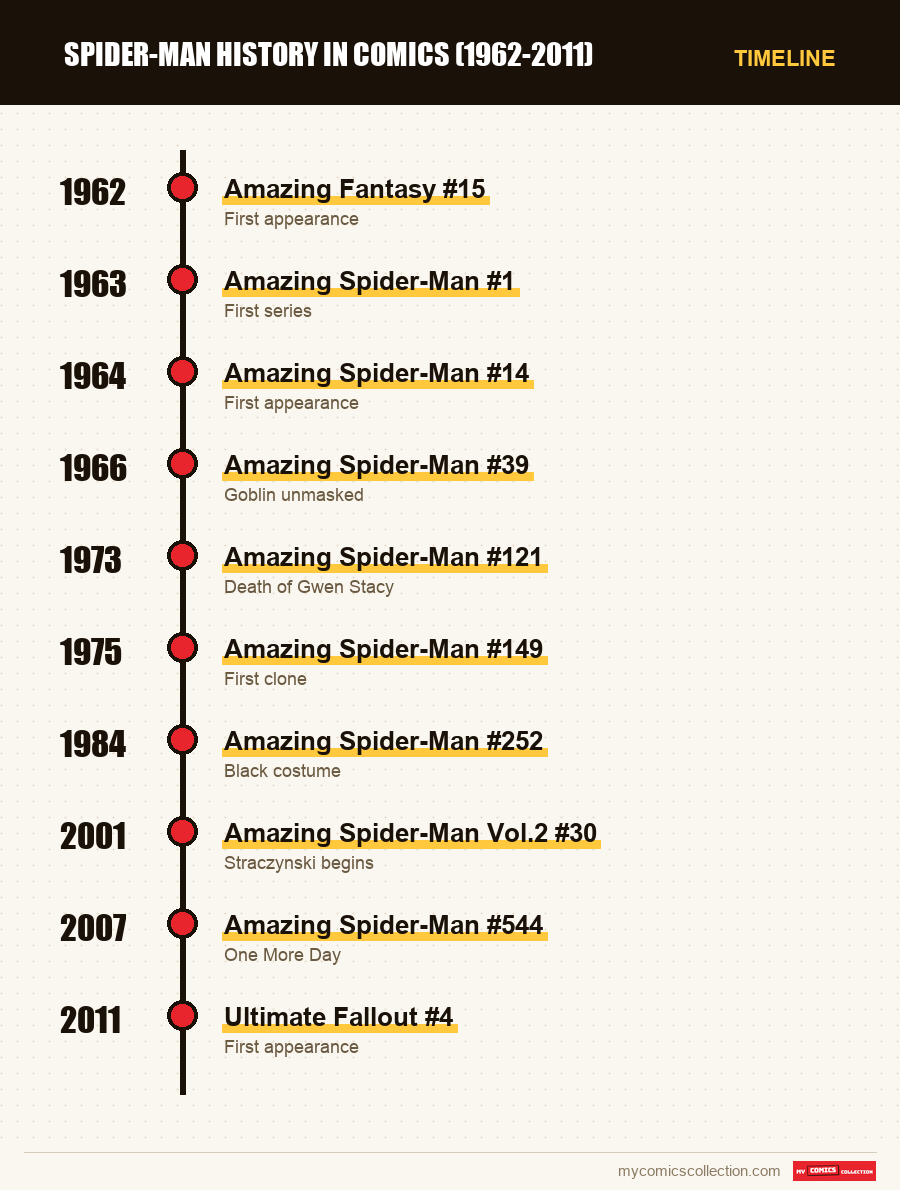
Amazing Fantasy #15
Stan Lee and Steve Ditko introduce Peter Parker, a high school student bitten by a radioactive spider. By letting a burglar escape who later kills his Uncle Ben, he learns that with great power comes great responsibility. The whole character is already contained in these few pages.
Amazing Spider-Man #1
The success of Amazing Fantasy #15 earns Spider-Man his own series. J. Jonah Jameson and the Chameleon appear here for the first time, and Peter even tries to join the Fantastic Four: Marvel's shared universe is already up and running.
Amazing Spider-Man #121
In "The Night Gwen Stacy Died", by Gerry Conway and Gil Kane, the Green Goblin kidnaps Gwen Stacy and throws her from a bridge. Spider-Man fails to save her. The Goblin dies in turn in #122 the following month, and comics enter a darker era.
Amazing Spider-Man #14
The Green Goblin bursts onto the scene in "The Grotesque Adventure of the Green Goblin", by Lee and Ditko. His identity stays secret for more than two years, long enough for him to become Peter Parker's most personal enemy.
Amazing Spider-Man #252
Tom DeFalco and Ron Frenz bring Spider-Man back from Battleworld wearing an all-black costume, before Secret Wars #8 even tells how he got it. The costume will turn out to be an alien symbiote, the origin of Venom.
Amazing Spider-Man #39
John Romita Sr. succeeds Steve Ditko as artist with this issue. The Green Goblin discovers Peter Parker's identity and reveals his own: he is Norman Osborn. The series enters its most popular period.
Ultimate Fallout #4
Brian Michael Bendis and Sara Pichelli introduce Miles Morales, the new Spider-Man of the Ultimate universe after the death of that reality's Peter Parker. The character will later join Marvel's main continuity.
Amazing Spider-Man #149
Gerry Conway, Ross Andru and Mike Esposito pit Spider-Man against his own clone, created by the Jackal, alias Professor Miles Warren. The double seems to die in the issue, but he returns almost twenty years later as Ben Reilly, at the heart of the Clone Saga.
Amazing Spider-Man Vol.2 #30
J. Michael Straczynski and John Romita Jr. open their run by introducing Ezekiel Sims and Morlun. The idea that Peter's powers might be linked to an animal totem rather than pure accident renews the character's mythology.
Amazing Spider-Man #544
The first chapter of One More Day, by J. Michael Straczynski and Joe Quesada. To save Aunt May, Peter and Mary Jane accept Mephisto's deal in #545, which erases their marriage. The franchise's most disputed story paves the way for Brand New Day.