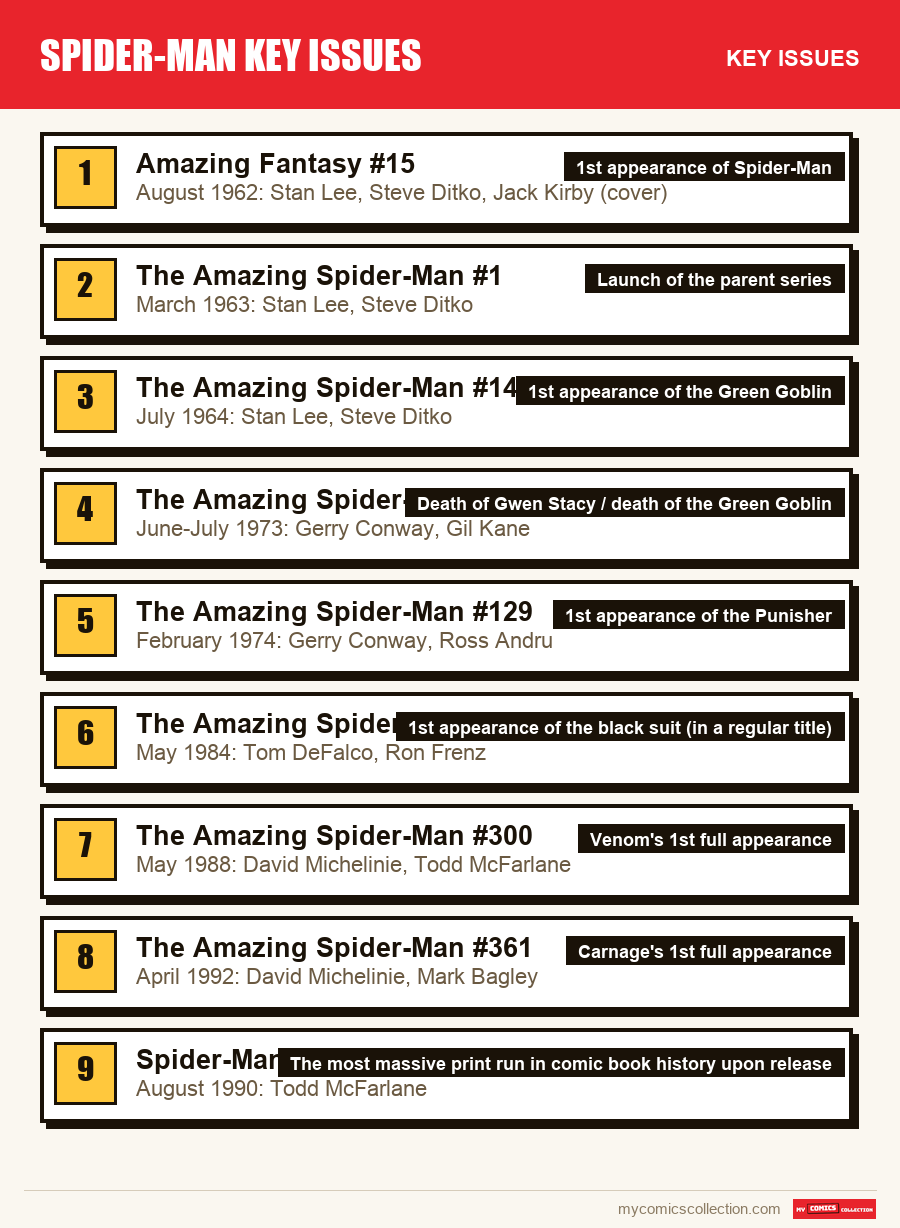
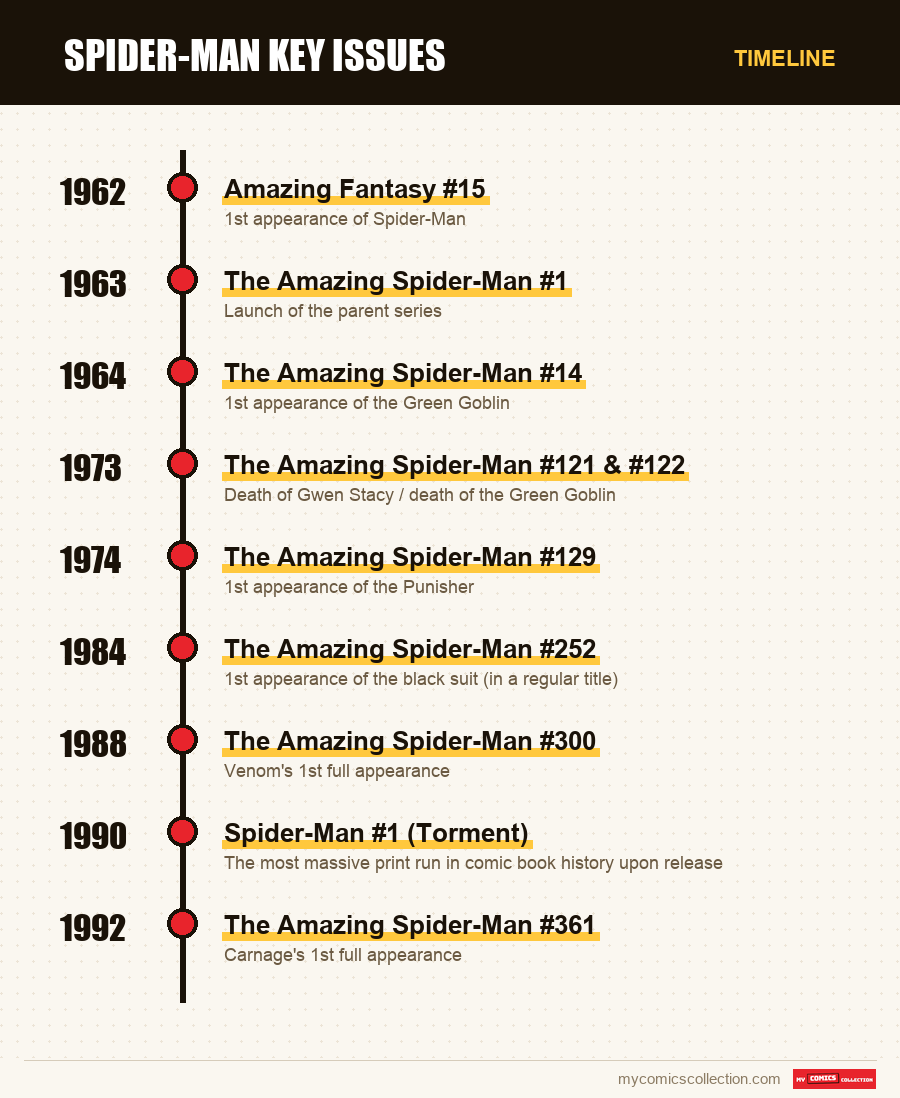
The must-have key issues of Spider-Man are Amazing Fantasy #15 (1962, first appearance, up to $3.6 million in CGC 9.6), Amazing Spider-Man #1 (1963, launch of the parent series), #14 (1964, first Green Goblin), #121-122 (1973, death of Gwen Stacy), #129 (1974, first Punisher), #252 (1984, first black suit), #300 (1988, first full Venom) and #361 (1992, first Carnage), to which is added the Spider-Man #1 by Todd McFarlane (1990), record print run in comic book history. Each title has a rating which depends above all on the CGC rating and the rarity of the original print run.
It's difficult to find a Marvel character whose bibliography has as many "must-haves" as Spider-Man. Between the launch at Atlas/Marvel in the midst of editorial change in the early 1960s, the great run sagas of Stan Lee and Steve Ditko, then Gerry Conway and Ross Andru, and the commercial explosion of the 1990s led by Todd McFarlane, the Spider-Man has generated more notable first appearances than almost any other hero in the Marvel universe.
This guide is not a chronological history of the series: we already detail this narrative aspect in our article on the story of Amazing Spider-Man: but a collector's checklist: which numbers to prioritize, why they matter, and what the market is really saying today (CGC populations, sales records, rating trends). We also do not cover the futuristic variations of the character, treated separately in our file on Spider-Man 2099.
Before you start tracking down these issues, keep a simple rule in mind: on a mass-run title like Amazing Spider-Man, it's almost never the raw rarity that drives the price, but the combination of condition + CGC population + narrative importance. This is why two copies of the same number can display a difference in value of 1 to 100 depending on their grade.
Editorial context: how Spider-Man generated so many “keys”
Spider-Man was born in August 1962 in Amazing Fantasy #15, an anthological title that Marvel was preparing to cancel due to lack of sales: Stan Lee placed the character there precisely because he had “nothing to lose” on a magazine that was already condemned. The unexpected success of the issue pushed the publisher to launch The Amazing Spider-Man from March 1963, a series which has never been interrupted since (editorial renumberings aside) and which today remains one of the longest running Marvel titles in the history of the medium.
This uninterrupted editorial continuity of more than six decades explains the profusion of "keys": each decade brought its share of first major appearances: the Green Goblin in 1964, the Jackal and the Punisher in 1974, the black suit in 1984, Venom in 1988, Carnage in 1992 - not to mention the great sagas which redefined the character, such as the death of Gwen Stacy in 1973, unanimously considered by historians of the medium as the symbolic shift between the Silver Age and the Bronze Age of comics. Added to this is a unique editorial tidal wave in the history of the sector: the launch of the title Spider-Man by Todd McFarlane in 1990, which blew up all the sales counters in the industry.
To place each number in its grading context, our article on the difference between a CGC 9 and a CGC 9.8 is a good addition to this list: on high circulation titles like those mentioned here, the difference between these two notes can represent a considerable price multiple.
Amazing Fantasy #15
The absolute Holy Grail of the Marvel collection. Published with a print run estimated by historians of between 300,000 and 400,000 copies, a modest figure for the time and never confirmed by an official archival source, this anthological issue never had a sequel planned before the character exploded in popularity. The vast majority of copies were thrown away, read to wear out or destroyed: the CGC Census recorded around 4,140 copies graded at the end of 2025, all notes combined, on a title more than 60 years old.
The Amazing Spider-Man #1
The issue that formalizes Spider-Man as a title in its own right after the first attempt at Amazing Fantasy #15. There we find the complete origin of the character redeveloped, a crossover with the Fantastic Four (their very first crossover appearance with another Marvel hero in his own title) as well as the first appearances of J. Jonah Jameson, his son John Jameson and Chameleon, the first recurring supervillain in the Spider-Man mythology. The title is ranked #7 on Overstreet's Top 50 Silver Age.
The Amazing Spider-Man #14
Norman Osborn makes his very first appearance here as a supervillain, the one who would become Spider-Man's most iconic and enduring antagonist, until his orchestrated death in Amazing Spider-Man #121-122 nine years later. The issue had, according to a 2005 CGC census, 64 copies in grade 7.5 and 182 copies in higher grades, a proportion revealing the fragility of Silver Age prints over time.
The Amazing Spider-Man #121 & #122
“The Night Gwen Stacy Died”: Norman Osborn, once again the Green Goblin, kidnaps Gwen Stacy and throws her from the top of the George Washington Bridge. Spider-Man barely catches her with his web, but the shock of stopping breaks her neck: she dies instantly, before the eyes of the hero who believes he saved her. The next issue, #122, features the death of the Green Goblin himself, impaled by his own glider. This two-part story is considered by the majority of historians of the medium to be the dividing line between the Silver Age and the Bronze Age of American comics, marking the end of the relative innocence of superheroic stories.
The Amazing Spider-Man #129
The Jackal manipulates Frank Castle into believing that Spider-Man killed his partner, causing the very first appearance of the Punisher, sent to execute him. This issue also marks the first appearance of the Jackal himself. Originally a secondary character, the Punisher will become one of the most profitable antiheroes in the entire Marvel catalog, carried by his own series, then by cinema and television. The issue is ranked #9 on Overstreet's Top 25 Bronze Age.
The Amazing Spider-Man #252
Spider-Man returns from the Secret Wars miniseries sporting a new black and white costume, in reality the alien symbiote that later becomes Venom. This issue is the first to feature the costume in a regular monthly continuity title: Secret Wars #8, published almost simultaneously, holds the absolute first appearance of it, an important point of nuance for collectors picky about the hierarchy of "firsts". #252 is ranked #24 (tied) on Overstreet's Top 25 Copper Age.
The Amazing Spider-Man #300
The black symbiote, rejected by Peter Parker in Amazing Spider-Man #258, bonds with Eddie Brock and becomes Venom in this final form for the first time. This is also the first issue entirely inked by Todd McFarlane on the title, before he became the official artist and then the creator of the Spider-Man spin-off in 1990. Unlike the Silver Age keys, this issue benefited from a massive circulation: more than 12,000 copies listed in the CGC Census, including several thousand in grade 9.8, which makes it a relatively common book to find graded: the rarity here is based on the newsstand edition (“newsstand”, approximately 200 to 250 copies in 9.8) rather than the overall circulation.
The Amazing Spider-Man #361
Cletus Kasady, a serial killer escaped from prison, bonds with the offspring of Venom's symbiote and becomes Carnage, a more bloodthirsty and unstable antagonist than his predecessor. Published at the height of the speculative comic boom of the 1990s, this issue enjoyed a high circulation, which explains the relative abundance of high grades on the market today.
Spider-Man #1 (Torment)
First issue solo written and drawn by Todd McFarlane, marking his transition from artist on Amazing Spider-Man to creator of his own title. The commercial success was unprecedented: more than 2.5 million copies sold, making it the best-selling comic book in history upon its release: a record that it only held for one year, dethroned by X-Men #1 (1991) and its more than eight million copies. Marvel has multiplied the cover variations (Platinum variant, Gold UPC, polybagged editions) for a total of thirteen versions listed, which has considerably diluted the rarity of the issue despite its cult status.
Collecting this series?
Track what you own, what you are missing and what your collection is worth. 7 day trial.
Start my trial →The impact of adaptations on the rating
Spider-Man is, with Batman, the character whose paper rating reacts most visibly to cinema and television releases. The phenomenon is documented on several of the issues listed above. Amazing Spider-Man #300, for example, experienced a speculative surge before the film's release Venom in 2018: prices had already risen to around $5,000 in anticipation, then the film's commercial success at the box office pushed some very high-grade copies up to the $8,000 to $10,000 range in the months following release.
The same mechanism is observed recurrently with each announcement of casting or scenario relating to an antagonist: the appearance of the Green Goblin in the film Spider-Man: No Way Home (2021) has reignited interest in Amazing Spider-Man #14 and #121-122, while rumors and confirmations around Venom and Carnage at the cinema (the trilogy Venom with Tom Hardy between 2018 and 2024) maintain a constant demand for #300 and #361. The Punisher, for his part, saw his rating on Amazing Spider-Man #129 multiply by more than forty between 2010 and its peak in 2022, driven by the popularity of the character in Marvel Television productions and then by the Netflix adaptations.
For a collector, the practical lesson is the following: price peaks linked to a cinema release are often followed by a decline once the craze has subsided, as shown by the trajectory of #129 between its peak in 2022 and its decline in 2023. Buying a key issue at the moment when its character is a hit on the big screen is generally buying at the peak of the cycle rather than at its fair long-term price.
Buying Guide for Spider-Man Key Issues
- Always check the restoration on Amazing Fantasy #15 and Amazing Spider-Man #1. These are high value Silver Age titles, very targeted for undeclared restorations (spine regluing, corner repair). A CGC example with the mention “Universal” (unrestored) is structurally worth more than the same grade with the “Qualified” or “Restored” label.
- Distinguish Secret Wars #8 from Amazing Spider-Man #252 if you target the black suit: the first holds the very first absolute appearance of the symbiote, the second the first appearance in a regular title of the Spider-Man continuity. Both are sought after, but for different reasons: don't confuse them in a negotiation.
- On high circulation issues (#300, #361, Spider-Man #1 from 1990), the CGC grade takes precedence over raw rarity. These titles exist in tens of thousands of copies: the difference in value is almost entirely between 9.6, 9.8 and 9.9/10.0, not on the simple existence of the number.
- Locate the newsstand (kiosk) versus direct market editions. On issues published after the mid-1980s, the UPC barcode newsstand version is almost always rarer in high grade than the specialty store version, and commands a premium of up to 30-50% on titles like #300.
- Beware of dilution on Spider-Man #1 (1990). With thirteen cover variants and a print run of several million copies, this issue remains cult but is not rare: never pay a “Silver Age” price for a standard cover, even in 9.8.
- Follow the cinema calendar before purchasing. Characters linked to the Green Goblin, Venom, Carnage or the Punisher see their rating fluctuate strongly around the release of films and series; Always compare the asking price to recent sales rather than sellers' price announcements.
- For a Bronze Age key like #121-122, focus on the condition of the pages. Paper from this period yellowed more quickly than the earlier Silver Age; a “white pages” or “off-white to white” mention has a real impact on the value at the same grade.
- Always cross-reference the CGC population before bidding on a very high grade. On Amazing Spider-Man #1, there are only two CGC 9.8s listed: at this level, each sale is a reference for the entire market and the price differences between two close sales can be significant.
If you already own one of these issues, or think you have a copy in your collection, our collection management application allows you to precisely catalog your comics (title, number, edition, grade) and follow the evolution of their rating over time. And for a one-off estimate based on actual market sales, head to our page free estimate.