Stan Lee, born Stanley Martin Lieber on December 28, 1922 in Manhattan and died on November 12, 2018, joined in 1939 as an assistant at Timely, Marvel's ancestor. Interim editor in chief before turning 19, he kept the post until 1972, when he became publisher. Between 1961 and the middle of the decade, he co-created with Jack Kirby the Fantastic Four, Hulk, Thor, Iron Man and the X-Men, with Steve Ditko Spider-Man and Doctor Strange, with Bill Everett Daredevil. His way of working, the synopsis handed to the artist before the dialogue, became the Marvel method. It also explains the debates over each person's share in these creations, which the testimony of those involved does not let us settle completely.
Stan Lee is probably the only comic writer whose face is known to people who have never opened a comic. His appearances in the Marvel films completed his making into a figure of popular culture. This fame has a downside: it has covered up the reality of a trade practiced for more than thirty years in a New York office, made of deadlines, synopses, readers' letters and negotiations with artists.
This article tells about that trade. It follows the career in order, explains concretely how Stan Lee worked, and lays out the debates over the characters' authorship as the sources document them, without claiming to close them. Another article on the site presents a book devoted to him; here, we talk about the man and his work.
A Bronx teenager at a pulp publisher
Stanley Martin Lieber was born in Manhattan, at the corner of 98th Street and West End Avenue, in a Jewish family of Romanian origin. His father, a garment cutter, worked intermittently after the 1929 crash, and the family moved several times before settling in the Bronx. He has a younger brother, Larry Lieber, who also made a career in comics and in 2026 signs a story in issue 1000 of Amazing Spider-Man.
A student at DeWitt Clinton High School, he dreams of writing a great novel and strings together odd jobs: writing obituaries for an agency, press releases for a tuberculosis-fighting center, delivering sandwiches, usher at a Broadway theater. He finished high school in 1939, at sixteen and a half. That same year, thanks to an uncle, he joined Timely as an assistant, the comics branch of pulp publisher Martin Goodman, who was his cousin's husband. It was editor Joe Simon who formally hired him.
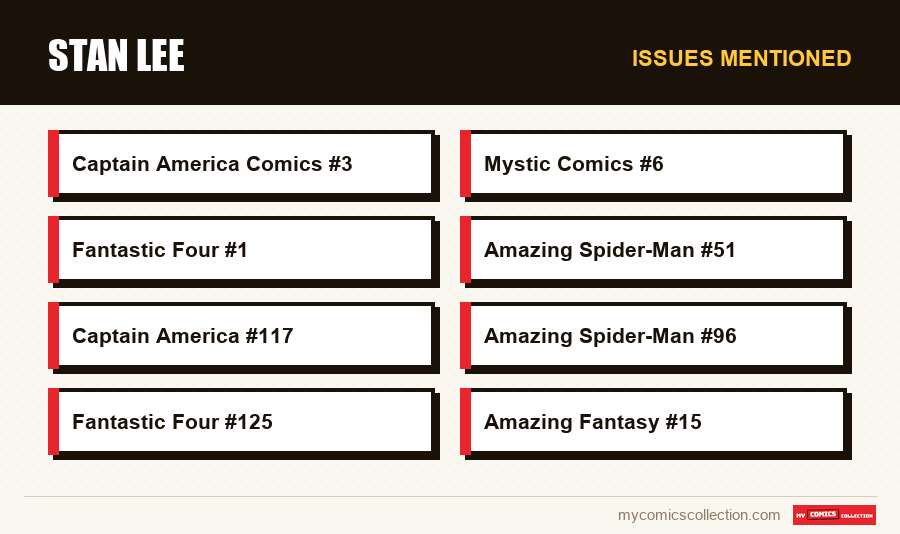
The first tasks are modest: filling the artists' inkwells, fetching their lunch, proofreading, erasing pencil lines on inked boards. His first published text is an illustrated short story, "Captain America Foils the Traitor's Revenge," in Captain America Comics #3, dated May 1941. He signs it Stan Lee, a pseudonym meant to keep his real name for the novel he intends to write one day. This text incidentally presents a gesture destined for a long career: Captain America's ricocheting shield. A few months later, he co-creates his first superhero, the Destroyer, in Mystic Comics #6.
Editor in chief at nineteen
At the end of 1941, Joe Simon and Jack Kirby leave Timely after a dispute with Goodman. The publisher gives the interim editorship to the young Lee, who is not yet nineteen. The interim lasts three decades: he remains editor in chief, and often art director, until 1972.
The war interrupts this early career. Mobilized in early 1942, Lee serves in the United States in the signal corps, then in the training film division, where he writes manuals, educational film scripts and slogans. He keeps writing for Timely from his base, at the pace of the editorial office's weekly mail.
The 1950s are those of Atlas, the name under which the company is then known. Lee writes everything: romance, western, humor, science fiction, medieval adventures, horror, suspense. He also co-signs a newspaper comic strip with Dan DeCarlo. By the end of the decade, he is tired of this trade and considers changing. It is in this context that everything shifts.
1961: the Fantastic Four, and what follows
At competitor DC, the return of superheroes is working: the Flash has been modernized, the Justice League gathers the publisher's big names. Martin Goodman asks Stan Lee for a superhero team. According to Lee's account, it is his wife, Joan, who advises him to finally write the kind of story he likes, since he is thinking of leaving the trade anyway.
The result, drawn by Jack Kirby, is Fantastic Four #1, dated November 1961. Its heroes bicker, worry about their bills, have bad tempers. The recipe takes, and the creations follow one another: with Kirby, Hulk, Thor, Iron Man, the X-Men, then the Avengers, who gather some of these newcomers; with Bill Everett, Daredevil; with Steve Ditko, Spider-Man and Doctor Strange. All live in the same New York and cross paths from one series to another, which gives the reader the feeling of a coherent universe.
The Lee and Kirby duo, whom you find in our overview of the major Fantastic Four artists, also produces the big cosmic stories of Fantastic Four, including the Galactus trilogy that begins at #48, dated March 1966, and introduces the Silver Surfer. It brings the Inhumans and the Black Panther into the series. After Ditko's departure in 1966, Lee continues Amazing Spider-Man with John Romita, and the title quickly surpasses Fantastic Four to become the publisher's best seller.
The Marvel method, concretely
In the early 1960s, Stan Lee writes, edits and supervises nearly all the series. To meet deadlines, he generalizes a way of working that existed before him in some studios, but which would henceforth carry the publisher's name.
The discussion
Lee and the artist agree on a starting idea, sometimes in a few sentences, sometimes in a real working session.
The synopsis
Lee writes a summary, not a complete panel-by-panel script.
The breakdown by the artist
The artist fills the planned number of pages, decides the sequence of panels and the rhythm, and often adds scenes or characters.
The dialogue last
The penciled pages return to Lee, who writes the balloons and captions, then supervises lettering and color.
This organization makes the artist a co-author of the plot. It is its strength, since it frees talents like Kirby and Ditko, and it is also the source of all later debates: when a character appears on a page before having a name in a balloon, who invented them?
Much more than a writer: the publisher's voice
Stan Lee's contribution goes beyond the stories. He imposes a credits box on the opening page naming the writer, artist, inker and letterer, a then little-used practice. He creates the Bullpen Bulletins page, which gives news of the team and upcoming releases in a familiar tone, and a monthly column, Stan's Soapbox, where he also defends positions against intolerance and racism. He signs his texts with an "Excelsior!" that became his trademark. Readers then write "Dear Stan and Jack" where, at competitors, one writes "Dear Editor."
Several editorial choices of this period marked the medium's history. Robbie Robertson, introduced in Amazing Spider-Man #51 in 1967, is one of the first African American characters to hold a real supporting role. The Falcon, created with Gene Colan in Captain America #117 in 1969, is the first African American superhero of mainstream comics. In 1971, at the request of a federal department, Lee writes in Amazing Spider-Man #96 to #98 a plot about drugs. The profession's self-censorship body refuses its seal; Lee publishes without it, with Goodman's agreement, and the code is relaxed shortly after.
Publisher, ambassador, then businessman
In 1972, Lee stops writing monthly series to become publisher. His last Amazing Spider-Man is #110, his last Fantastic Four #125. He then becomes Marvel's public face, multiplying lectures, conventions and campus appearances. In 1977, he launches with John Romita the daily Spider-Man comic strip. The following year appears his last collaboration with Kirby, a Silver Surfer album often presented as Marvel's first graphic novel. In 1980, he creates with John Buscema The Savage She-Hulk.
In 1981, he settles in California to develop television and film adaptations of the characters. After distancing himself from Marvel's daily management in the 1990s, he founds Stan Lee Media in 1998, which goes bankrupt in 2001 after stock manipulations by his associates, in which he was never implicated. The same year, he co-founds POW! Entertainment and writes for DC, for the first time, a series where he reinvents Superman, Batman and Wonder Woman. In 2002, he sues Marvel to obtain his share of the films' profits; a settlement is reached in 2005.
The last decades see him everywhere: cameos in films, television shows, collaborations with Japanese publishers, multiple projects. He dies in Los Angeles on November 12, 2018, at ninety-five.
The authorship debates, without settling them
The subject is sensitive and the sources contradict each other. Here is what they establish, and what they leave open.
With Jack Kirby. The two men publicly disputed, years later, the authorship of the Fantastic Four. The Marvel method makes the question nearly unsolvable: Kirby delivered whole plots in pictures, Lee wrote the dialogue and set the tone. Historians agree on the collective nature of these creations, much less on the proportion.
With Steve Ditko. The Spider-Man case is better documented. Lee first entrusted the character to Kirby, whose first pages did not convince him, then to Ditko. In a 1965 interview, Ditko credited Lee with the name and claimed the costume, the wrist-worn web-shooters and the spider signal. Irritated at not being recognized for the plots he built, he obtained from #25, in 1965, to be credited as plot co-author. He left Marvel the following year, in circumstances Lee himself said he did not fully understand.
What remains open. Nobody has a transcript of the office conversations of the 1960s. The testimony was given decades later, often in contexts of rights claims. The most honest formulation remains that of co-creation.
Collecting Stan Lee
For a collector, Lee's work breaks into a few sets. The first appearances of the 1961 to 1964 period, starting with Amazing Fantasy #15, are the most sought-after pieces of the Silver Age market, and each has its page on this site. The historic issues of his writing career, like #96 of Amazing Spider-Man published without the code seal, interest those who follow the medium's history. Finally, signed copies are a market apart, where only a signature authenticated by a recognized third party, like CGC's signature labels, offers a serious guarantee. Lee signed enormously during his life: the signature alone is not a rarity, its proof is more so.