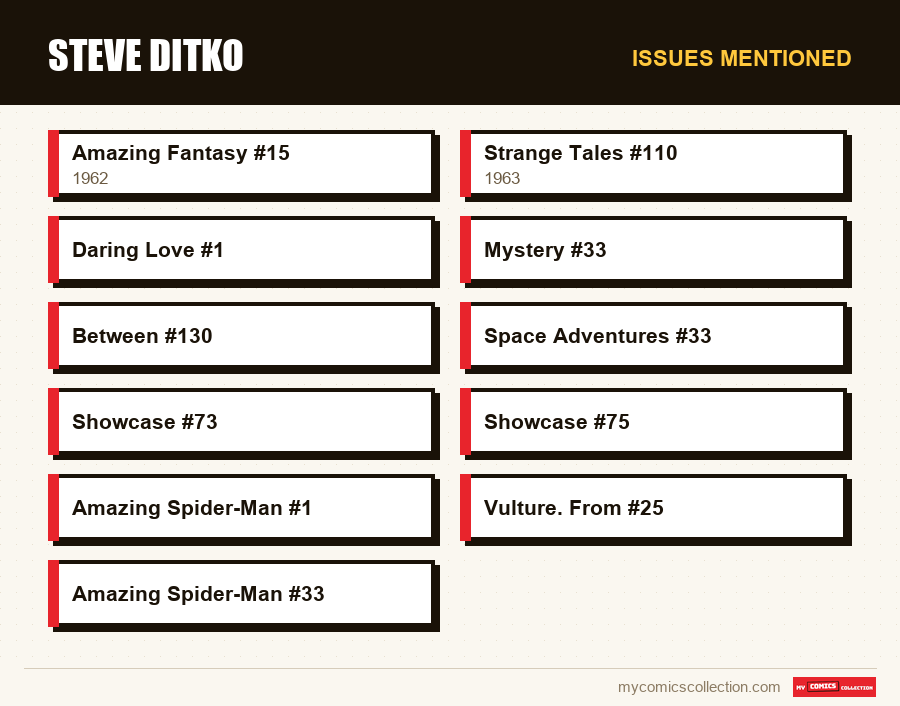
Steve Ditko (born November 2, 1927 in Johnstown, Pennsylvania, died in June 2018 in New York) is the artist who gave Spider-Man his look in Amazing Fantasy #15 (1962) and invented the visual universe of Doctor Strange in Strange Tales #110 (1963). In 38 issues of Amazing Spider-Man, he designs with Stan Lee Doctor Octopus, the Sandman, the Lizard, Electro and the Green Goblin, and from #25 obtains a plot co-author credit. He leaves Marvel in 1966, with no public explanation, and pursues a more personal body of work elsewhere: Blue Beetle, the Question and Captain Atom at Charlton, Mr. A, the Creeper and Hawk and Dove at DC, then, back at Marvel, Speedball and Squirrel Girl. He refused interviews and let his pages speak.
Steve Ditko holds a strange place in comics history. He co-created one of the best-known fictional characters in the world, and yet a large part of the public does not even know his name. He almost never gave an interview, did not show up at conventions, did not try to capitalize on his fame. He spent the second half of his life drawing, in a Manhattan studio, stories that interested him, even if they interested few others.
This article traces his career in order, from the horror stories of the 1950s to the obscure creations of the 2000s, pausing on what he truly brought to Spider-Man and Doctor Strange. The comparisons between the 2008 animated series and the comics, where his influence is visible, are covered in another article; here, it is about the creator.
Johnstown, the army, Jerry Robinson's school
Stephen John Ditko was born in a steel town in Pennsylvania, in a working-class family of Rusyn origin. His father, a carpenter at the steel mill and an amateur draftsman, passed on to him a taste for newspaper comic strips, in particular Prince Valiant. The arrival of Batman in 1939 and Will Eisner's Spirit completed his conviction. He enlisted in the army in October 1945, on leaving high school, and served in occupied Germany, where he was already drawing for a military newspaper.
Demobilized, he learned that his idol, Jerry Robinson, Batman's artist, taught at a New York illustration school. He enrolled there in 1950 thanks to the aid reserved for former soldiers. Robinson would remember a student who worked enormously and already knew how to build his own stories. It was in this class, according to Robinson, that Stan Lee first saw Ditko's drawings.
His professional beginnings date from 1953. His first published story is a six-page romance in Daring Love #1, in October 1953. He then passes through Joe Simon and Jack Kirby's studio, where he assists the inker Mort Meskin, an artist he admires. Then he begins a long collaboration with Charlton, a small Connecticut publisher, where he signs the cover of The Thing! #12 as early as 1954. Tuberculosis forces him to return to his parents' home to recover for many months.
Atlas, then the short stories with Stan Lee
On his return, in 1955, he begins working for Atlas, the name at the time of the future Marvel. His first story for the house appears in Journey into Mystery #33, in April 1956. A distribution crisis in 1957 abruptly ends the commissions, and he goes back to Charlton. Stan Lee calls him back in the summer of 1958.
Then begins an abundant production of short science fiction and fantasy stories, about five pages long, concluded by a final twist. Lee and Ditko place them in Strange Tales, Tales of Suspense, Tales to Astonish or Amazing Adventures. Their success is such that from #7, in December 1961, the latter title becomes Amazing Adult Fantasy and publishes only their stories. Lee would recount that all he needed was to give Ditko a one-line idea to receive pages far better than he had hoped. It is already the method that will make Marvel's fortune.
Spider-Man: what Ditko brought
When Stan Lee obtains from his publisher the right to launch a teenage superhero, he first entrusts the project to Jack Kirby. Kirby's first pages, too heroic for his taste, do not suit him. He turns to Ditko, who takes the character up from scratch.
Amazing Fantasy #15
Ditko draws the eleven-page story that introduces Peter Parker, detailed in our article on Spider-Man's first appearance. He creates a costume that fully covers the face, which hides a boy's face and adds mystery, soft soles for adhesion, web-shooters fixed at the wrist rather than a weapon at the belt. Irony of the story, the issue's cover is ultimately drawn by Kirby.
The issue sells well and Spider-Man gets his series. Over 38 issues, Lee and Ditko build the publisher's most solid rogues' gallery: Doctor Octopus in #3, the Sandman in #4, the Lizard in #6, Electro in #9, the Green Goblin in #14, not counting the Vulture, Mysterio or Kraven. Ditko builds a growing share of the plots within the Marvel method and asks to be credited for it. He gets it from #25, dated June 1965.
The peak of this period is generally placed at #33, third part of an arc where Spider-Man, pinned under a machine weighing several tons, frees himself through sheer willpower by thinking of his uncle and aunt. The first pages of this issue, almost without external action, have become a reference of dramatic layout. Ditko also leaves a more discreet but lasting trace: the little box at the top left of the cover, with the hero's face, the publisher's name and the price, which he introduces in #2 and which Marvel then generalizes across all its titles.
Doctor Strange, or abstraction
In July 1963, in Strange Tales #110, Ditko presents a sorcerer, Doctor Strange. He draws his adventures with a graphic freedom without equivalent at the time: impossible dimensions, twisted perspectives, landscapes that seem to come out of a dream. Between #130 and #146 of the series, from March 1965 to July 1966, a seventeen-episode arc culminates with the appearance of Eternity, a human silhouette filled with stars that personifies the universe.
These pages become a cult object on American campuses, where some readers believe them inspired by hallucinogenic drugs. Ditko, a man of great personal rigor, was deeply offended by this. He never claimed any source other than his imagination.
Ditko also draws other heroes of the publisher at the same time. He signs the last issue of the first Hulk series, then relaunches the character in Tales to Astonish from #60, where he designs the Leader. He draws three Iron Man episodes in Tales of Suspense, from late 1963 to early 1964, including the one that presents the first version of the red and gold armor.
The 1966 departure
In the mid-1960s, Lee and Ditko no longer speak to each other. The pages pass through intermediaries. The causes of the break have never been clearly established, and testimonies diverge. It was long said that the two men had clashed over the secret identity of the Green Goblin; Ditko contested this version, asserting that there were no more exchanges between them at that time. John Romita, who succeeds him on Spider-Man, would mention disagreements over about everything. Lee himself would acknowledge never having really known Ditko on a personal level.
The Bullpen Bulletins of the issues dated July 1966 announce his departure for personal reasons. He will not return to Spider-Man. In 1992, at a meeting, Lee will offer him a graphic novel of the character; Ditko will decline, explaining that he no longer felt the same feelings for him.
Charlton, DC, Mr. A: the personal work
Back at Charlton, where rates are low but freedom is great, Ditko takes up Captain Atom, whom he had co-created in 1960 in Space Adventures #33, relaunches the Blue Beetle and creates the Question, a faceless vigilante of inflexible convictions. He also draws sixteen wash-tone horror stories for the magazines Creepy and Eerie.
In 1967, in an independent magazine distributed by subscription and thus escaping the self-censorship code, he publishes Mr. A, a character who pushes to the limit the objectivist philosophy he has adopted: good and evil are absolute there, and the hero never compromises. Ditko would return to this character into the 2000s. It is the key to understanding the second part of his career: his stories become moral demonstrations, sometimes at the expense of their audience.
At DC, from 1968, he creates the Creeper in Showcase #73 and Hawk and Dove in Showcase #75, then, in the 1970s, Shade, the Changing Man and the fantasy warrior Stalker. These series are short, but several of their characters will be taken up by other writers and enjoy a second life, like Shade in the publisher's adult line.
The return to Marvel and the final decades
Ditko returns to Marvel in 1979 as a freelance artist. He takes up Machine Man, draws Micronauts, then the last two years of Rom. In 1988, with Tom DeFalco, he creates Speedball in an Amazing Spider-Man annual, and draws the ten issues of his series. In 1992, with writer Will Murray, he creates Squirrel Girl, an initially comic character who will become, decades later, one of the publisher's most popular heroines.
He also works for small independent publishers in the 1980s, then for Valiant in the early 1990s. The last decades are devoted to low-print-run publications, often made with his friend the editor Robin Snyder, where he develops his own characters and ideas. He dies in his Manhattan apartment in June 2018, at ninety years old.
Collecting Ditko
For a collector, Ditko's work divides into three circles. The first, highly sought, is that of the Marvel first appearances: Amazing Fantasy #15 (see also its value), Amazing Spider-Man #1, #14 and its Green Goblin, and Strange Tales #110. The second is that of the 38 Spider-Man issues and the Doctor Strange arc, which form complete, readable sets. The third, more obscure, groups the Charlton and DC series, as well as independent publications: they interest mostly fans of the creator, and their first issues, like that of the Question or the Creeper, have gained visibility as these characters have been adapted.
A tip specific to Ditko: his original pages and autographs are extremely rare, since he refused most requests. Any signature presented as his therefore deserves particularly careful examination.