Ravage is the villain that Joe Kelly and Pepe Larraz reveal in Amazing Spider-Man #1000, released on September 30, 2026. Under the mask is Cormac "Mac" Crane, a wealthy philanthropist who appeared unnamed in Amazing Spider-Man #26 (April 8, 2026), then was revealed over the summer as Ben and May Parker's biological son, swapped at birth with another family's stillborn child. His power touches memory: he absorbs other people's memories, erases them, and can even materialize them as weapons. After May's stroke, he replaced Peter in her mind with himself. For the collector, two issues must be distinguished: #26, first appearance of the civilian character, and #1000, first appearance under the Ravage identity. The name is not new at Marvel: two other Ravages carried it before him.
A number 1000 attracts all eyes, and that is precisely why Marvel placed a new adversary in it rather than an old name pulled out of the closet. Ravage is not one more costume in an already saturated gallery: he is built to strike the most fragile spot in Peter Parker's life, his relationship with Aunt May, and to rewrite in passing part of the Parker family history.
This article takes stock as of October 3, 2026, three days after the anniversary issue's release. It says who the character is, how Joe Kelly set him up over six months before giving him a supervillain name, what his powers change in the game, and how to find your way among the issues that matter for a collection. It gives no price guide: the character has a few days of public existence under this name, and nobody can seriously say what he will become.
Who Ravage is, in one sentence
Ravage is Cormac Crane, called Mac, a businessman of about forty-five who turned the family company he inherited into a charitable organization, and who discovers in adulthood that he was born Richard Benjamin Parker. He is therefore, in the current continuity, Peter's cousin, just as Peter is Ben and May's nephew. This blood tie is the character's engine: Mac wants neither money, nor the city, nor Spider-Man's defeat for its own sake. He wants the place of son that Peter has held with May forever.
The code name, for its part, arrives only at the last moment. For six months of publication, Mac is a civilian character, likable in appearance, generous, a little intrusive. The shift to costumed villain happens in the anniversary issue, and it is this chronology that makes the character interesting to follow, and a bit delicate to collect.
How Joe Kelly set him up, from winter to summer 2026
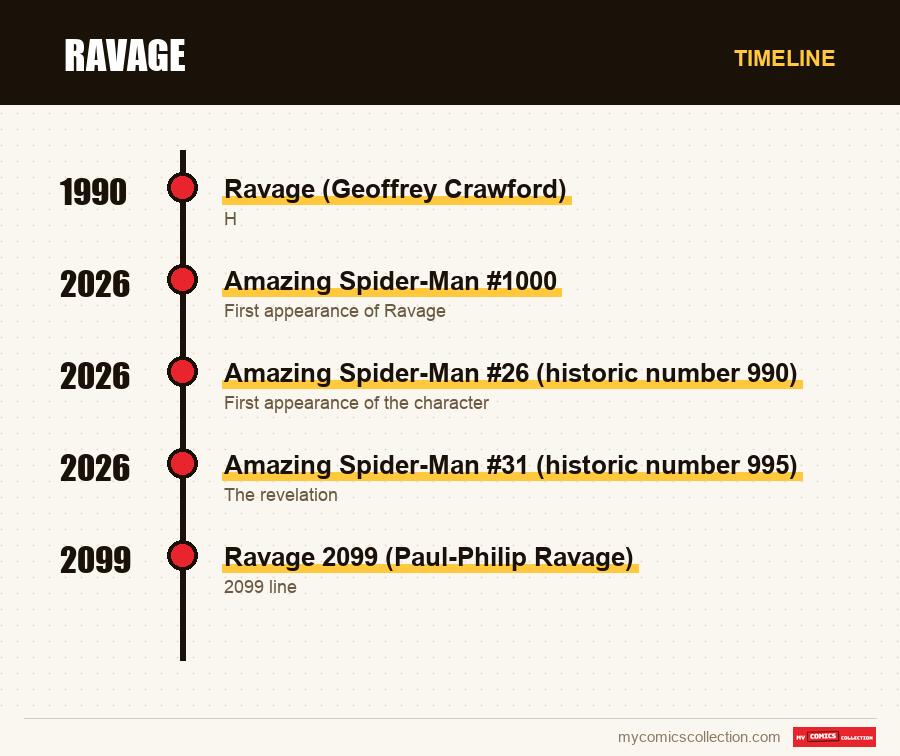
The current volume of Amazing Spider-Man began in April 2025, with a #1 that also carries the historic number 965. Mac Crane appears there only after a year, at the heart of the Death Spiral event, shared between Amazing Spider-Man and Venom. It is by this path, and not by a fanfare introduction, that he enters the series.
#26 (April 8, 2026): the stranger at the restaurant
In part seven of Death Spiral, the serial killer Torment, then bonded to the Carnage symbiote, goes after a customer in a New York restaurant. Spider-Man saves him. The man has no first name yet, only a family name. Torment, who is working to eliminate Peter Parker's entire family tree, has a precise reason to target him.
#27 (April 22, 2026): the doubt
At the conclusion of the event, the man hears Torment call Spider-Man "cousin". That is enough for him to have a genetic test done on himself. The name Crane is laid down.
#29 to #31 (May and June 2026): the revelation
Mac presents himself as a volunteer at the F.E.A.S.T. aid center that Aunt May is restoring with her partner Ricardo Villanueva. He bonds with her, gets invited, then tells the truth in front of May, Peter and Ricardo. In #31, published on June 17, 2026 and presented by Marvel as a pivotal issue, May tells of her miscarriages, the child she was told was stillborn, and produces a birth certificate whose date matches Mac's.
#32 to #35 (July and August 2026): the intruder
Peter gets Mac to promise not to reveal his secret identity to May. Mac makes a large donation to F.E.A.S.T., showers May with gifts, and #34 (August 5, 2026) finally tells of his childhood with Liam Crane and Beatrix Thyssen, the wealthy couple whose baby had died and who were handed, by mistake, the Parkers' child. Peter feels pushed aside. The reader senses something coming, without knowing yet what.
#1000 (September 30, 2026): Ravage
May is hospitalized after a stroke. On waking, she no longer remembers Peter and recognizes only Mac. In the waiting room, Mac attacks Peter and reveals himself: he "repaired" May by replacing her memories of Peter with memories of himself. The fight crosses the city, and Spider-Man only manages to push him back.
This breakdown has a practical consequence: the main story of #1000, titled "Ravaged", reads far better when you have followed at least issues 29 to 35. The anniversary issue is not designed as an entry point for this thread, even if it remains one for the rest of its contents.
Powers designed against Peter Parker
Most of Spider-Man's great adversaries have a power that answers his: strength against agility, technology against instinct, the symbiote against the spider-sense. Ravage attacks something other than the body. The abilities shown in #1000 boil down to three elements.
Memory absorption. Ravage can take a person's memories, who then loses them completely, and see through them. That is how he learns everything about Peter by going through May's memory, and that is how he reaches the conclusion that Peter is responsible for Ben's death.
Materialized memories. Once absorbed, these memories can take physical form, notably as weapons. The adversary hit by these weapons relives part of the memory that composes them. The #1000 fight plays heavily on this idea, with images sprung from Peter's past: the burglar, the wrestler Crusher Hogan, the Green Goblin.
Superhuman strength. Enough to go through a stone wall with a punch and hold his own against Spider-Man in close combat.
The dramatic effect is obvious. Spider-Man can win a fight, but he cannot win a battle whose stake is his aunt's memory. The arc's title and the #1001 presentation text go exactly in this direction: Marvel asks there whether Spider-Man has not already lost the war, with May caught between the two.
Why the link with Ben and May changes everything
Villains who touch Peter's family have a long and sometimes painful history at Marvel. The precedent that immediately comes to mind is that of the 1990s, when the publisher multiplied revelations about Peter's parents and about clones, to the point of tiring part of the readership. Joe Kelly knows it, and his choice is tighter: he touches neither Peter's parents nor his own identity. He adds a son where May had never had one, which does not directly contradict what has been published since 1962.
The script also leans on older elements. May's miscarriages are mentioned in continuity well before 2026, and the character's entry in the publisher's encyclopedic database ties these lost children to issues of the 1980s. Kelly therefore does not create a blank page: he exploits a blind spot in May's biography.
What remains is what makes Ravage unique in the gallery: he is not evil out of greed or scientific madness. He is jealous, he feels robbed, and he is convinced he acts for his mother's good. It is a register Spider-Man rarely faces, and one that recalls the Green Goblin's family dramas more than the technical threats of the 1960s. To compare with how Norman Osborn entered the series, see our article on the first appearance of the Green Goblin.
Do not confuse him with Marvel's other Ravages
The name has already been used twice at the publisher, and confusion is easy in sales listings or keyword searches.
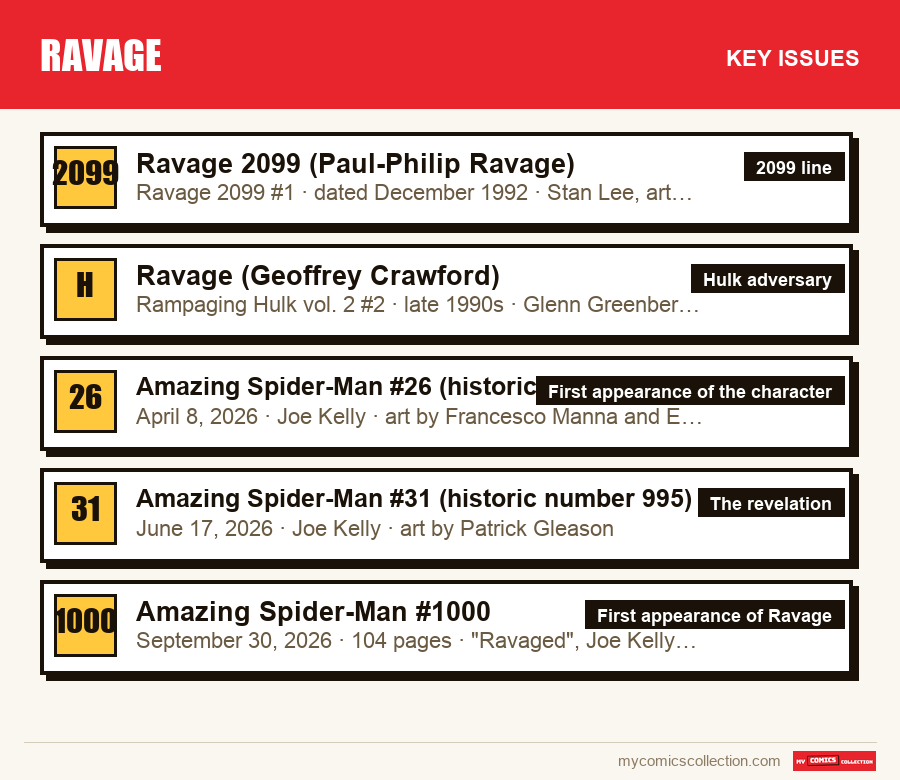
Ravage 2099 (Paul-Philip Ravage)
The best known of the namesakes is the hero of the futuristic 2099 line, in a series written by Stan Lee and drawn by Paul Ryan. It is another universe, another century and another register: an executive of the ecological industry who turns against his employers. No link with Mac Crane.
Ravage (Geoffrey Crawford)
The disambiguation page of Marvel's encyclopedia still today designates as the "main" Ravage this Geoffrey Crawford, a Hulk adversary created by Glenn Greenberg and Rick Leonardi. A very minor character, he also appears in a video game devoted to Hulk.
The issues that matter for a collection
The question already coming back is simple: what is "the" first appearance of Ravage? The honest answer is that there are two, depending on what you are looking for. We have detailed elsewhere the difference between cameo, first appearance and full first appearance, and this case illustrates it perfectly.
Amazing Spider-Man #26 (historic number 990)
It is the first issue where the man appears, in the middle of Death Spiral. He wears neither costume, nor code name, nor first name there. Marvel's encyclopedia credits his creators from this issue: Joe Kelly, Francesco Manna and Ed McGuinness.
Amazing Spider-Man #31 (historic number 995)
The issue where we learn that Mac was born Richard Benjamin Parker. It is not a first appearance, but it is the issue that gives the character his meaning. Story collectors, more than first-appearance collectors, often put it on their list.
Amazing Spider-Man #1000
The issue where Mac becomes Ravage. It was ordered at more than 400,000 copies and a second printing is planned for October 28, 2026, with penciled covers by Romita Jr. and Rivera, and by Larraz. Among the very many variants, one, signed by Ryan Stegman, is devoted to Ravage himself.
One last issue deserves flagging for completists: the character's entry also mentions the free promotional issue Amazing Spider-Man / Queen in Black distributed in 2026, in which he decides to meet his biological mother. This type of issue, handed out free in shops, is often forgotten by lists and poorly preserved.
What comes next
Two issues are scheduled for October 2026, both written by Joe Kelly and drawn by Pepe Larraz:
- Amazing Spider-Man #1001, on October 14, 2026: the direct aftermath of #1000, a new confrontation with Ravage, and May caught in the middle.
- Amazing Spider-Man #1002, on October 28, 2026: presented by Marvel as the third round between Spider-Man and Ravage.
What is unknown to date is just as important. We do not know whether Ravage will survive the arc, whether he will remain a recurring adversary, nor whether May will get back her memories of Peter. Any claim about a film, an animated series or a solo series would today be an invention. The best attitude is to read the two October issues before drawing any conclusion. The complete Spider-Man reading guide, all eras combined, is found in our Spider-Man reading guide, and the character's page on our Spider-Man hub.
How to approach it as a reasonable collector
The typical scenario of a new villain born in an anniversary issue is known: a spike of attention for a few weeks, then a slow sorting between the characters who return and those who disappear. The first become sought-after pieces, the second curiosities. It is impossible to know today into which category Ravage will fall.
Three reflexes avoid unpleasant surprises. First, read before buying in bulk: a character's interest is judged by the quality of his arc, and this one is not finished. Next, favor the issues that carry the story, #26, #31, #1000, rather than accumulating covers of the anniversary issue alone. Finally, keep these copies in good condition from now on: a recent issue never gains value if it has been handled without care, and it is condition that most often separates two copies of the same print run.
Certification is only worthwhile if the issue justifies it. On a print run of several hundred thousand copies, the stake lies only in the highest grades, and it is reasonable to wait until the character's place is established before committing fees.
Read also
- Amazing Spider-Man #1000: seven stories, seven teams, and what to reread from each
- ASM #1000 second printing: recognizing the penciled covers of October 28
- Amazing Spider-Man: volumes and legacy numbering, from the 1963 #1 to #1000
- From #100 to #900: what each Amazing Spider-Man centennial told
- Amazing Spider-Man by Joe Kelly and Pepe Larraz: the reading order up to #1000