John Romita Jr., often shortened to JRJR, was born on August 17, 1956 in New York. The son of John Romita Sr., the emblematic Spider-Man artist of the 1960s, he published his first story, "Chaos at the Coffee Bean!", in Amazing Spider-Man Annual #11 in 1977. His career spans nearly fifty years: Iron Man with Michelinie and Layton, a first stint on Amazing Spider-Man from 1980 to 1984 where he co-creates the Hobgoblin (#238), Uncanny X-Men with Claremont, Daredevil with Ann Nocenti (creation of Typhoid Mary) then The Man Without Fear with Frank Miller, J. Michael Straczynski's Spider-Man, Kick-Ass, then Superman at DC in 2014. He returns to Spider-Man with Zeb Wells in 2022, then with Joe Kelly in the 2025 volume, and with Paolo Rivera does one of the two main covers of Amazing Spider-Man #1000.
Few families have marked a character as much. John Romita Sr. succeeded Steve Ditko on Amazing Spider-Man in the mid-1960s and gave the hero and his supporting cast the face that prevailed for decades. His son, John Romita Jr., drew the same character in every subsequent era, to the point that their two careers combined cover almost the whole history of the series.
It would nonetheless be a mistake to reduce JRJR to an heir. His style was built in part against his father's: more angular, more massive, more brutal. He has drawn nearly the entire Marvel universe, then Superman and Batman at DC, and co-created one of the most adapted independent series of his generation. This article traces his career in order, flagging at each stage the issues that matter.
A child of the house
John Romita Jr. grew up in the world of comics. His first contribution to the publisher dates from when he was thirteen: a character sketch that inspired the creation of the Prowler, introduced in Amazing Spider-Man #78 in 1969 by another team. He then studied advertising design and graduated in 1976.
His first professional work was cover sketches for the publisher's British reprints. In the United States, he debuted with a full-page illustration in a western in June 1977, then, two months later, with a six-page story in Amazing Spider-Man Annual #11. He thus begins his career where his father had become famous.
Iron Man, 1978-1982: the first recognition
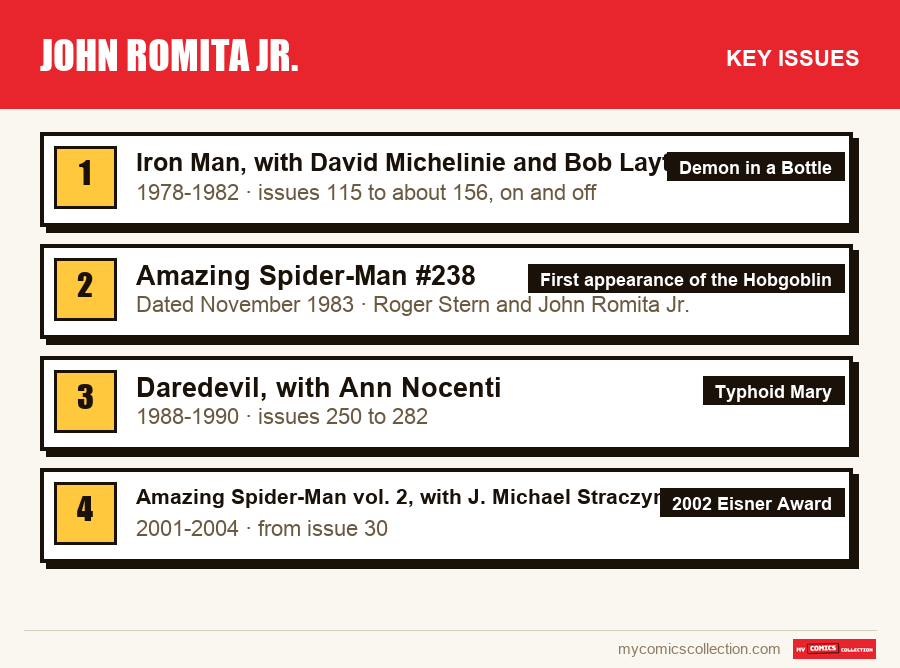
Iron Man, with David Michelinie and Bob Layton
It is on Iron Man that JRJR makes a name for himself. The team introduces Bethany Cabe, Tony Stark's bodyguard and partner, and the rival industrialist Justin Hammer. He also draws most of the issues of the arc devoted to Stark's alcoholism, which culminates in issue 128.
Amazing Spider-Man, 1980-1984: the Hobgoblin
In the early 1980s, he gets his first regular stint on his father's series. With writer Dennis O'Neil, he introduces Madame Web in issue 210 and Hydro-Man in issue 212. He also draws in 1981 the first issues of Dazzler, then in 1982 Contest of Champions, the publisher's first miniseries.
Amazing Spider-Man #238
The summit of this first period. With Roger Stern, JRJR co-creates the Hobgoblin, whose identity will remain a mystery for years. The duo also does, a few months earlier, the arc "Nothing Can Stop the Juggernaut" in issues 229 and 230, often cited among the series' best stories.
Uncanny X-Men and Star Brand: the difficult period
From 1983 to 1986, he draws Uncanny X-Men with Chris Claremont and inker Dan Green, from issue 175 to about issue 211. He co-creates Forge there. He himself downplayed this period: he felt he had created few characters, and his relationship with Claremont was cool, the writer preferring his previous artists. He would nonetheless return to the title in 1993, with Scott Lobdell, a period he says he enjoyed more.
After the X-Men, he was given Star Brand, in a line of new series launched by the publisher. The title sold poorly and he could not return to the mutants. Disillusioned by this experience and by tensions with the editorial staff, he then considered leaving the business.
Daredevil: the turning point
Daredevil, with Ann Nocenti
Editor Ralph Macchio offers him Daredevil, with writer Ann Nocenti. For the first time, he does full pencils and takes part in the plots. He jokingly asks for inker Al Williamson, and gets him the next day. The duo creates Typhoid Mary, a lasting adversary of Daredevil. JRJR said it was the first time he felt like a stakeholder in the creation.
In 1993, he returns to the character for Daredevil: The Man Without Fear, in five issues, with Frank Miller on script and Williamson on inks. The project was born from a rejected film treatment that Miller had sent him, and which grew along the way to 144 pages. JRJR has often said it was, in terms of storytelling, the best work of his career. Elements of it were taken up by a television series in 2015. To place these issues in the character's history, our selection of Daredevil key issues is a good reference point.
The 1990s: a do-it-all artist
The decade sees him move from one title to another: the second "Armor Wars" of Iron Man with John Byrne, Punisher War Zone in 1992, a Cable miniseries, the Punisher and Batman crossover. Inker Klaus Janson becomes a frequent partner. In 1998, he relaunches Thor with Dan Jurgens, and in 1999 he draws the relaunch of Peter Parker: Spider-Man with Howard Mackie. Between 1995 and 1998, he had already held this title over a long period.
Straczynski, Kick-Ass and the 2000s
Amazing Spider-Man vol. 2, with J. Michael Straczynski
The return to Spider-Man that marks a generation. With Straczynski on script and Scott Hanna on inks, the arc "Coming Home", issues 30 to 35, wins an Eisner Award in 2002. Issue 36, dated December 2001, is a tribute to the victims of the September 11 attacks.
The rest of the decade is eclectic: Wolverine with Mark Millar, Black Panther, The Sentry, a rereading of the Eternals with Neil Gaiman in 2006, the central miniseries of "World War Hulk" in 2007. In 2008, he returns again to Amazing Spider-Man, and above all launches with Millar a series they own, Kick-Ass, adapted to film in 2010. He is one of its producers and directs an animated sequence of the film. Our comparison between the Kick-Ass film and the comic revisits this adaptation.
In 2010, he also relaunches Avengers with Brian Michael Bendis, then draws Captain America in 2013 with Rick Remender.
The move to DC, 2014-2020
In 2014, a surprise: JRJR joins DC and draws Superman from issue 32, with Geoff Johns, inked by Klaus Janson. Next come All-Star Batman with Scott Snyder in 2016, The Silencer with Dan Abnett, Superman: Year One with Frank Miller in 2019, and a stint on Action Comics. For six years, the quintessential Spider-Man artist draws the competing publisher's heroes.
The return: 2022, 2025, and #1000
In 2022, he returns to Amazing Spider-Man with Zeb Wells, for the relaunch of the title. In 2023, his father, John Romita Sr., dies at 93. Then in April 2025, the new volume of the series, written by Joe Kelly, alternates on art between Pepe Larraz and him. It is in this framework that he does, with Paolo Rivera on paint, one of the two main covers of the thousandth issue, released on September 30, 2026. The second printing, planned for October 28, 2026, reuses a penciled version of it.
There is something circular about this cover. The father had given Spider-Man his face of the 1960s and 1970s; the son, fifty years after his debut in an annual of the series, does the opening image of its thousandth issue. To place these periods in the whole of the series, see our Spider-Man reading guide.
Recognizing his style
JRJR cites as influences his father, Jack Kirby, John Buscema, the painters of the Wyeth family and the illustrator Charles Dana Gibson. His line is recognizable by his stocky, powerful silhouettes, his square faces, his large hands and dense urban settings. He prefers, by his own admission, street stories to cosmic ones, even if he says he approaches all genres the same way.
Start with Daredevil
The Man Without Fear, in five issues, shows the essentials of his narrative art in few pages.
Read the two classic Spider-Man runs
The Stern period in the early 1980s, then the Straczynski period from 2001 to 2004.
Finish with the present
The 2025 volume, up to #1000, to see an artist nearly seventy years old still in regular activity.