The round-number anniversary is no longer a gilded cover slapped on an ordinary episode: it has become a complete editorial program, chaining an oversized issue, a grid of variant covers, a facsimile, a collection and sometimes the return of a creative team. The quarter now opening provides seven simultaneous examples, from Spider-Woman to Amazing Spider-Man #1000. For a collector, the consequence is counterintuitive: the anniversary rarely enriches the new issue, because a round number is by construction overprinted. It acts instead on the old issue it puts back in the spotlight, whose available stock has been fixed for decades. The method therefore comes down to a single shift: treat the celebration as a reading signal on the new, and as a calendar signal on the old.
For two or three years, a character anniversary is no longer celebrated with an episode: it is celebrated with a range. The publisher announces a round date, then builds around it a set of objects coming out over six to twelve weeks and aimed at different buyers. The reader gets a story, the completist gets a grid of covers, the nostalgic gets a facsimile, the newcomer gets a collection. This industrialization is recent in its scale, and it changes what a collector should do with it.
The fourth quarter of 2026 is a textbook case because anniversaries stack up there. Marvel relaunches Spider-Woman for the character's fiftieth year, brings back Alias for the twenty-fifth anniversary of Jessica Jones, schedules a sequel to Origin a quarter century later, reissues Mangaverse in four titles for its twenty-fifth anniversary, and has the Marvel universe cross with a television troupe whose first broadcast dates to September 5, 1976. DC brings back Hitman in December, twenty-five years later. And on September 30, Amazing Spider-Man #1000 passed 400,000 preorders with nine covers sent back to press.
Each of these cases has its own guide on this blog. This one does not treat them: it treats the common mechanics, that is, what an anniversary manufactures, what that is worth, and where the money really moves when a publisher blows out candles.
Date anniversary and numbering milestone: two objects people confuse
First we must separate two things everyday vocabulary mixes, because they do not obey the same rules.
The numbering milestone is an issue whose rank is a round number: a hundredth, a five-hundredth, a thousandth. It arrives when it arrives, at the series' publication pace, and does not fall on a symbolic date. What these issues are worth, and why the thick cover changes nothing, is the subject of another guide: round numbers and their real value.
The date anniversary is something else entirely. It is counted in years since a first appearance, a series launch or a television broadcast. It is therefore predictable years in advance, and that is precisely what makes it an industrial tool: a publisher can plan at twenty-four months a range for a character's fiftieth year, negotiate an artist's return, book press slots, calibrate a collection. The numbering milestone, for its part, is endured.
This difference in predictability explains nearly all the rest. A date anniversary arrives accompanied: several products, coordinated communication, sometimes a screen release timed to it. The secondary market sees it coming, retailers order accordingly, and the new issue's scarcity is destroyed before it is even published. Conversely, the old issue the anniversary points to has existed in a closed quantity for thirty or fifty years, and no 2026 editorial decision can increase its stock.
Retain this asymmetry: the publisher controls the supply of the new, nobody controls the supply of the old. It is the one sentence of this article from which everything else follows.
The five objects a publisher manufactures for an anniversary
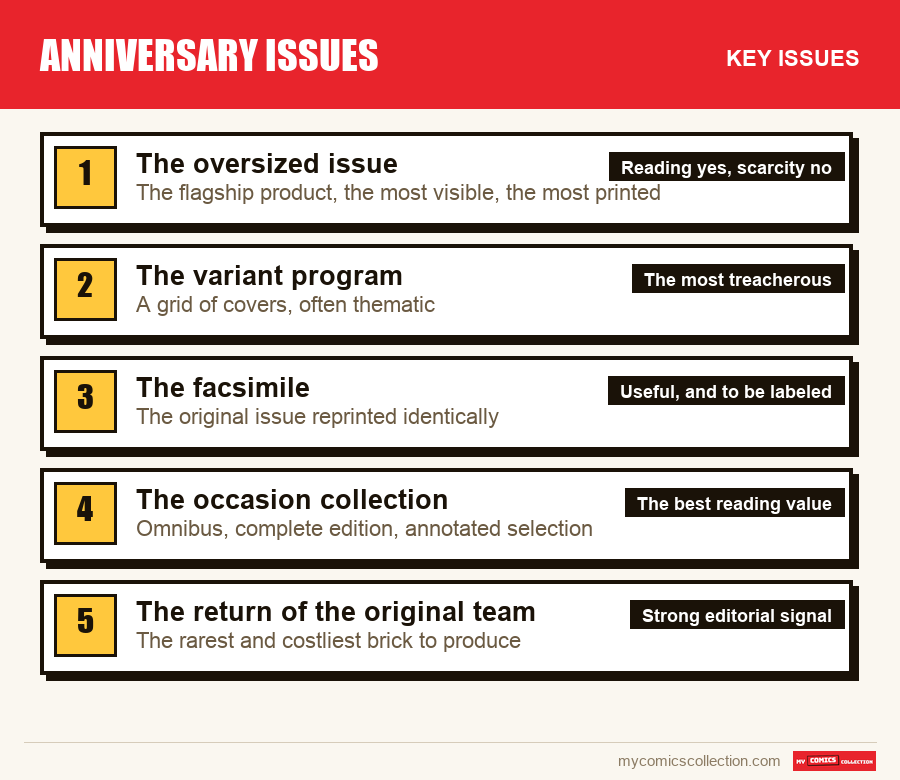
An anniversary program almost always breaks down into five bricks. Recognizing them lets you decide, object by object, what you buy and why.
The oversized issue
Doubled or tripled page count, raised cover price, anthology format with several creative teams. It is the object the publisher puts forward and the one retailers order most massively. Action Comics #1000, out on April 18, 2018 for the eightieth anniversary of Superman, is the modern model: a $7.99 anthology bringing together a dozen teams, including Dan Jurgens, Marv Wolfman, Paul Levitz, Geoff Johns, Scott Snyder, Tom King, Louise Simonson, Paul Dini, Brad Meltzer and Brian Michael Bendis. DC reproduced the setup eleven months later with Detective Comics #1000, out on March 27, 2019 for the eightieth anniversary of Batman, the second American comic to reach this rank.
The variant program
The anniversary lends itself to the conceptual cover: one per decade, one per costume, one per historic artist. Action Comics #1000 thus received a cover per decade, from Steve Rude for the 1930s to Lee Bermejo for the 2000s, via Michael Cho, Dave Gibbons, Mike Allred, Jim Steranko, Joshua Middleton and Dan Jurgens, plus a standard cover by Jim Lee and a blank version. The setup is seductive and perfectly legible: it tells an editorial history in eight images.
The facsimile
The publisher reprints the first issue or the first appearance, period ads included, at single-issue price. It is the most honest object of the lot: it gives access to the text without claiming to be the object. It also has a measurable effect on demand for the original, and that effect goes both ways. It puts the title back in conversations, so it wakes up the search; it also offers an exit to whoever only wanted to read, so it removes part of the least solvent demand.
The occasion collection
An anniversary justifies a reissue the catalog would not have funded otherwise, and it is often the real benefit for the reader. An anniversary collection gathers episodes scattered across defunct series, sometimes never reprinted, with critical apparatus. It has a counterpart: it makes the hunt for single issues optional on everything it covers.
The return of the original team
Bringing back the creators of the original material takes a negotiation, availability and a schedule. That is why it is not a systematic brick: when present, it signals the publisher is seriously betting on the anniversary rather than dressing it up. December 2026 lines up three at once, which is unusual.
The current quarter, taken as a demonstration
Seven anniversaries collide between September 2026 and January 2027. The point is not to comment on them one by one, each having its dedicated guide, but to see that they all use the same toolkit.
- Spider-Woman, fifty years: new Spider-Woman #1 in November 2026, with Carnage. An anniversary handled by series relaunch, not by special issue.
- Jessica Jones, twenty-five years: Jessica Jones: Alias #1 in December 2026, a five-issue miniseries, with the return of Brian Michael Bendis and Michael Gaydos. Anniversary handled by team return.
- Origin, twenty-five years: Wolverine: Origin III, The Dark Age #1 in December 2026, five issues, return of Paul Jenkins on script, art by Cafu, on the 1950s of Logan. Anniversary handled by late sequel.
- Hitman, twenty-five years: Hitman: It Was the Nineties Special #1 on December 9, 2026, with the return of Garth Ennis and John McCrea. Anniversary handled by single special.
- Mangaverse, twenty-five years: relaunch in four titles in September 2026, a quarter century after a range published from 2000 to 2002. Anniversary handled by line reactivation.
- The fifty years of a television troupe: Muppets Take the Marvel Universe #1 in September 2026, fifty years after the first broadcast of September 5, 1976. The title entered the top 5 of the register sales ranking for the week of September 22 to 28, 2026. Anniversary handled by license crossover.
- Amazing Spider-Man #1000: out on September 30, 2026, 104 pages, main story by Joe Kelly and Pepe Larraz, more than 400,000 preorders, nine covers allocated and sent back to press, a second printing already planned, and still a sellout on release day. Here, numbering milestone and date anniversary overlap.
Five different tools for six anniversaries, and a single common point: in no case did the publisher try to produce a rare object. It tried to produce a visible object. These are two opposite ambitions.
Why an anniversary issue is almost always overprinted
It is not a grumpy collector's impression, it is an arithmetic consequence of how the new-release market works. A retailer orders firm, weeks ahead, with no possibility of return. When a publisher announces an anniversary with a press campaign, doubled page count and a grid of covers, they order big, because the risk of missing a sale costs them more than an unsold copy. The publisher, for its part, adds up these orders and prints accordingly. Nobody in the chain has an interest in producing scarcity.
History provides two demonstrations so clear they still serve as safeguards thirty years later.
The first is X-Men #1 from October 1991, by Chris Claremont and Jim Lee, five covers including a gatefold that combines them all. Retailers preordered more than 8.1 million copies, which still makes it the best-selling comic in history according to the record book. Actual sales to readers, for their part, ran around 3 million. The gap between the two figures, more than five million issues, stayed in stockrooms and on the secondary market. An issue with five covers and eight million copies does not become rare, even in thirty-five years.
The second is Superman #75, published on November 18, 1992, with its black-bagged edition accompanied by an armband, a poster, stickers and a card. More than six million copies sold, best seller of 1992, thirty million dollars collected the first day. A few months later, a first printing no longer resold above cover price. The episode entered the medium's history, and the object never caught up with its reputation, for a single reason: there were too many.
Apply this grid to the 2026 figures and the reading becomes simple. More than 400,000 preorders and nine covers sent back to press on Amazing Spider-Man #1000 do not describe a rare piece: they describe Marvel's biggest print run of the year. The release-day sellout is a distribution problem, not a scarcity clue, and unfilled orders are announced for November 4, 2026. The general mechanism of print run and scarcity is detailed in the print run guide and in the scarcity estimation one.
One nuance, still, to be exact. The 2026 print runs are not those of 1991: the order of magnitude has dropped by a factor of ten. An issue at 400,000 copies today is a phenomenon, where it would have been an average title in 1992. It does not change the reasoning, but it changes the volumes at stake, and you must compare comparable eras rather than raw figures.
The decisive question: the new issue, or the old issue?
Here is the trade-off that sums up the whole article. An anniversary injects attention into an ecosystem. This attention is not distributed uniformly: it goes where supply cannot respond.
The new issue absorbs attention and dissolves it, because the publisher has a hand on the tap. If copies run short, it reprints, as Marvel did on its nine September 2026 covers. The anniversary therefore guarantees you, on the new, one thing and one only: you will be able to buy it. It is comfortable, and it is not an opportunity.
The old issue, for its part, is a fixed quantity. The copies of 1976, 1992 or 2001 circulating today are those that survived, and their number only decreases. When an anniversary puts this material back at the center, demand rises on a motionless supply. It is the only configuration, in all this mechanics, where a lasting shift can occur.
The most instructive case comes down to a single issue, and it comes from the market's worst moment. The Amazing Spider-Man #365, dated August 1992, is the character's thirtieth anniversary issue: doubled page count, hologram cover, the whole apparatus of the era. Thirty-four years later, this issue is not sought for its anniversary or its hologram. It is sought because it contains a five-page preview of the upcoming Spider-Man 2099 series, whose proper first issue followed in November 1992. The anniversary created nothing; it served as a showcase for a first appearance, and it is the first appearance that lasted.
Same lesson on Action Comics #1000, but in reverse. The 2018 issue is abundant and will remain so. What the eightieth anniversary really did was bring the whole conversation back for several months to Action Comics #1 from 1938, whose known copies number in the dozens. The celebration issue worked as a signpost pointing to an object whose supply has been closed for ninety years.
Hence a tenable rule of conduct: on the new, buy to read; on the old, buy to own. And never confuse the two budgets.
What has a chance of mattering in ten years, and what has none
Object by object, here is what the history of the last thirty years allows us to say. No amount is put forward here, because no recent public record publishes one: this is relative hierarchy, not price.
Has a real chance of mattering:
- A first appearance housed in the anniversary issue. It is the only mechanism with demonstrated reliability, and The Amazing Spider-Man #365 is the cleanest proof. An anniversary is a visibility slot; publishers readily place an introduction there. If that is the case, it is that fact you should follow, not the date.
- The old issue the anniversary points to, in a condition consistent with your budget. Its supply is closed, its demand has just risen.
- The never-reprinted material that an anniversary collection unearths, when it reveals that a scattered episode mattered more than believed. The effect is slow and concerns often cheap issues.
- A truly singular format: a single special, with no sequel and no announced reprint, by a team that will not return. Singularity is not a guarantee, but it is the only form of scarcity the publisher cannot cancel after the fact.
Historically has no chance:
- The oversized issue taken for itself, when it contains only a tribute. Superman #75 and X-Men #1 settled the question for a generation.
- The variant grid bought in full. A program of eight or nine covers is designed to be served. Choose the image you want to look at, not the complete series.
- The cover gimmick. Hologram, gilding, embossing, bagging: the medium's history offers not one example where the printing process sustained value over time.
- The second printing of an anniversary issue. It exists precisely because demand exceeded supply, and it removes the only thing that could have mattered.
- The facsimile treated as an original. It is not one, and is not meant to be.
The method, in five steps
Here is the procedure when a publisher announces an anniversary on a series or character you follow.
Date the anniversary, and check it
Fifty years of what, exactly? A first appearance, a series launch, a broadcast? The three do not point to the same old issue. A mistake of a year or a medium, and you buy the wrong issue. The fifty years celebrated in September 2026 by a license crossover refer to a first television broadcast of September 5, 1976, not to a comic.
List the program's objects before buying the first
Special issue, variants, facsimile, collection, miniseries. Wait until you have the complete list: a collection announced in January changes the decision made in November on fifteen single issues. It is the most frequent and easiest-to-avoid mistake.
Look for the first appearance, if there is one
Read the oversized issue's table of contents. An anthology anniversary sometimes contains a character introduction, a series foreshadowing, a segment of a few pages signed by a team preparing something else. It is the only element of the program that has historically produced lasting pieces.
Shift attention to the old, and target a condition
Identify the two or three old issues the anniversary puts back at the center, then decide on a condition before looking at listings. On a 1976 or 1992 issue, the difference between two neighboring conditions is often worth more than the choice of seller. That is where, and only there, the question of certification arises.
Wait for the post-anniversary trough on the new
An issue at 400,000 copies does not disappear. If you want it for your collection without having had it on release day, the useful moment is after the second printing and after the unfilled orders, once the wave has passed. Nothing is urgent on an abundant object.
The special case of screen anniversaries
One last variant deserves to be isolated, because it traps many: the anniversary that does not come from the comic. An adaptation celebrates its fiftieth year, an animated series its twentieth, and the publisher produces an occasion comic. The current quarter offers an example with the fiftieth anniversary of a television troupe created for British television, whose crossover with the Marvel universe climbed into the weekly top 5 at the end of September 2026.
In this configuration, the old issue to watch does not always exist, or it is very different from what you imagine. There is not necessarily a reference first appearance to go find, because the character was not born in a comic. The screen anniversary therefore often produces a purely new object, with no upstream, and the old-issue question does not arise. It is the case where the anniversary program is most frankly a reading product, and where it must be accepted as such.
The reverse exists too, and it is more interesting. When an upcoming adaptation is timed to the same window as a comic anniversary, the two effects add up on the same old material. It is a configuration to spot on a calendar, not to guess: release dates are public months ahead, and the market movement that follows is much less so.
What this method changes concretely
Applied over a quarter like the one now opening, the shift has a very simple effect: it divides the bill and increases the collection's coherence. Instead of buying seven celebration issue 1s and three variant grids, you buy the episodes you feel like reading, and devote the rest to two or three old issues the news has just put back at the center.
This discipline also has a less visible advantage: it makes the collection legible. A series of anniversary issues bought by reflex tells nothing, except the publishers' promotional calendar of the year. Two old issues chosen because they matter tell a character. In ten years, the second shelf will make sense, and the first will be a layer of sediment.
Finally, an anniversary is an occasion to keep your inventory up to date, because it produces in a few weeks a stack of similar references that all look alike: an issue 1, its second printing, nine variants, a facsimile. Without a distinct line for each, the collection becomes impossible to audit, and the confusion is paid for later, when you want to sell or insure.