You preorder Amazing Spider-Man #1 (2022) and receive the "A cover". But your retailer also offers a "B cover," a "1:25 ratio variant," and a "virgin cover." Same issue, same content, but five different prices and five potentially distinct objects on the secondary market.
You preorder Amazing Spider-Man #1 (2022) and receive the "A cover." But your retailer also offers a "B cover," a "1:25 ratio variant," and a "virgin cover." Same issue, same content, but five different prices and five potentially distinct objects on the secondary market. Welcome to the world of cover variants.
For some collectors, variants are an opportunity: a game inside the game. For others, they're a source of confusion and uncontrolled spending. This complete guide walks you through every variant type, how to identify them, the most sought-after variants in comics history, and how to manage them intelligently inside your collection.
The different types of cover variants
Retailer Incentive (1:25 / 1:50 / 1:100)
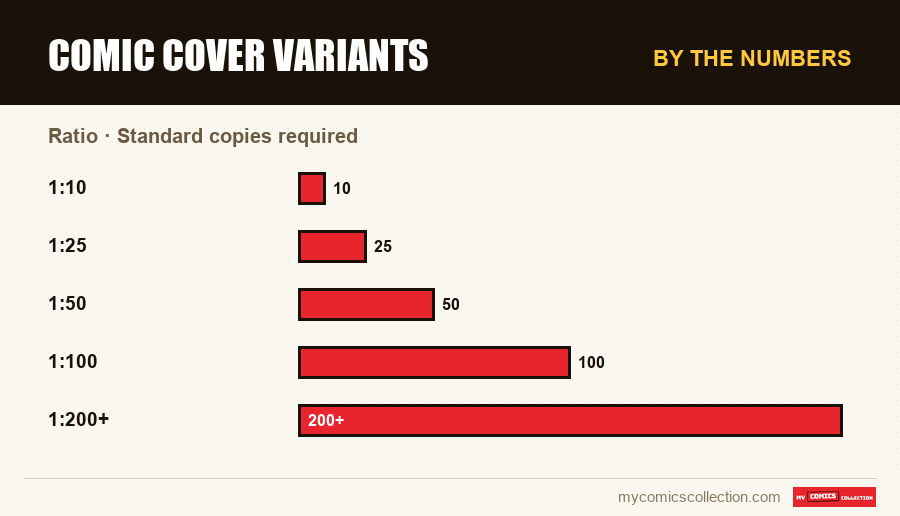
To receive one copy of this variant, the retailer must order X copies of the standard edition. A 1:25 requires 25 standard orders; a 1:100 requires 100. The higher the ratio, the rarer and potentially more valuable the variant.
Virgin cover (textless)
Same artwork as the standard cover, but without the title, publisher logo, author names, or barcode. The cover image is shown in full, without added graphic elements. Generally printed in smaller quantities than the standard cover.
Sketch cover / Blank cover
Either a black-and-white printed cover (with pencils or inks visible) or a fully blank cover intended to receive an original artist sketch. The latter, when signed or drawn by a recognized artist, can be worth hundreds of dollars.
Metallic and embossed covers
Popularized in the 1990s, these covers use metallic inks (foil), raised embossing, or holograms. Strongly associated with 1990s speculation, many have little value today due to overproduction.
Alternate A/B/C covers
The same issue is published with multiple covers by different artists, all distributed at the same price. Some readers buy their favorite; completist collectors buy every version. A common practice since the 2000s.
Comics sealed in plastic
Some issues are sold in a sealed plastic sleeve, sometimes with a bonus (poster, card, figure). Unopened polybagged comics can be worth more than opened copies, but only an opened copy can be CGC-graded.
Newsstand vs. Direct Edition: an often-forgotten distinction
Among all variants, the newsstand vs. direct edition distinction is the most misunderstood, and often the most significant in value terms for 1980s-90s comics.
Until the 1990s, American comics were distributed through two separate channels. The direct edition was sold exclusively in specialty comic shops and could not be returned to the publisher if unsold. The newsstand edition was sold at newsstands, supermarkets, and pharmacies, and could be returned unsold: often after the cover had been torn off.
Why newsstands are worth more: 1980s-90s newsstand editions were massively returned or destroyed after their sell-by date. The survivors are statistically rare. What's more, newsstand readers tended to read and toss their comics: high-grade surviving copies are even scarcer. Result: on issues like Amazing Spider-Man #300 or X-Factor #6, a newsstand copy can be worth two to five times a same-grade direct edition.
How to spot a newsstand edition
On a 1980s-90s comic, look for these clues:
- A full UPC barcode on the cover (usually bottom-left), sometimes with an extra digit for regional distribution
- A round-number price followed by the distribution code (e.g., "75¢ / 95¢ CAN")
- The absence of the publisher logo where the barcode sits (direct editions replace the barcode with the Marvel or DC logo)
Ratio variants: how they work
Retailer incentive variants (or ratio variants) are the variant type most misunderstood by new collectors. The principle: to get one copy of the variant, the retailer must order X copies of the standard edition.
| Ratio | Standard copies required | Scarcity level | Typical price vs. standard edition |
|---|---|---|---|
| 1:10 | 10 | Low | 2×: 5× |
| 1:25 | 25 | Moderate | 5×: 15× |
| 1:50 | 50 | High | 10×: 30× |
| 1:100 | 100 | Very high | 20×: 100× |
| 1:200+ | 200+ | Extreme | Variable, sometimes hundreds of dollars |
High ratios (1:50 and above) mechanically create scarcity, but actual value also depends on the comic's popularity and the cover artist. A 1:100 on a niche series is worth less than a 1:25 on Amazing Spider-Man or X-Men.
The most sought-after cover variants
Here are some emblematic examples of variants that attract strong collector demand:
- Amazing Spider-Man #300 Newsstand (1988): the first full appearance of Venom. The direct edition is already valuable; the newsstand in good condition trades for substantially more.
- X-Men #1 (1991), 5 covers: Jim Lee drew 5 covers that assemble into a panoramic illustration. The gatefold edition (all 5 covers united in a foldout version) is a sought-after collectible in its own right.
- Ultimate Fallout #4 (2011) variants: the first appearance of Miles Morales as Spider-Man. Different cover variants of this issue have exploded in value since the cinematic adaptations.
- New Mutants #98 Newsstand (1991): first Deadpool. The newsstand of this issue is significantly rarer than the direct edition, and its value reflects that scarcity.
- Batman Adventures #12 (1993): first Harley Quinn. Different printings and variants of this issue draw particular attention since the cinematic adaptations.
Collecting this series?
Track what you own, what you are missing and what your collection is worth. 7 day trial.
Start my trial →Identifying a variant: the practical guide
Facing a comic where you're not sure whether it's a variant, here's what to examine:
Variant identification checklist
- Compare the UPC/barcode with the standard edition: a different or missing code signals a variant
- Look for a "variant edition," "incentive variant," or "direct edition" marking on the cover or back cover
- Check the indicated price, which sometimes differs between variants
- Consult a worldwide comics database (comics.org), which lists every known variant with distinguishing features
- For recent comics, check the publisher's site or specialty forums (ComicBookRealm, MyComicShop) which often list available variants
Modern variants and speculation: traps to avoid
The modern variant market is saturated with offerings often designed to exploit collector FOMO (fear of missing out). A few common traps:
- Online-shop "exclusives": some retailers commission premium-priced exclusive variants. If the print run is large and the series isn't popular, secondary value can be lower than purchase price.
- Variants on hyped "event" series: a #1 with 50 variants is usually the sign of a marketing strategy more than real scarcity. Be cautious.
- Last-minute "FOC variants": some variants are announced late (just before Final Order Cut-off), creating an artificial rush. Demand can collapse once the excitement fades.
Golden rule: buy first because a variant appeals to you aesthetically or because it represents a comic that matters to you. Speculating on modern variants is a zero-sum game for the majority of ordinary collectors.
Managing variants in your collection
Variants pose a specific collection-management challenge: how do you distinguish an Amazing Spider-Man #300 newsstand from a direct edition in your inventory, or the A cover of a recent issue from its B cover? This is where a dedicated app like My Comics Collection makes the difference.
The app lets you mark each copy as a variant, with its ratio; A or B cover, newsstand, direct edition or virgin cover go into a tag or the notes. This precision is indispensable for two reasons:
- Valuation: a newsstand and a direct edition of the same issue don't have the same value. Your management app must reflect that distinction for accurate valuation.
- Avoiding false duplicates: two copies that look identical may be distinct variants, and therefore legitimately different pieces in your collection.
FAQ: Cover variants in comics
Track your variants with My Comics Collection
Newsstand, direct edition, ratio variant, virgin cover: log every detail of your copies, with the variant flag and ratio on each record and everything else in tags or notes.
🚀 Free 7-day trial, no commitment