
Jessica Jones debuts in Alias #1 (November 2001), created by Brian Michael Bendis and Michael Gaydos under the Marvel MAX imprint. A former hero who went by the alias Jewel, traumatized by Killgrave, she becomes a private investigator. She marries Luke Cage; the Netflix series ran 2015-2019 with Krysten Ritter. Alias #1 CGC 9.8 values are climbing in 2026.
Jessica Jones holds a singular place in the Marvel landscape of the 2000s. The character is born outside the usual superhero framework: no cape, no logo, no heroic origin arc up front. Her first appearance in Alias #1 (November 2001) opens on a run-down office, a client collapsing across her desk, and a protagonist who drinks, curses, and wears a black leather jacket. The tone is set immediately: Marvel MAX, the adult imprint launched in May 2001 under Joe Quesada, allowed for the first time in a Marvel publication explicit profanity, graphic sexual scenes, and violence uncensored by the Comics Code Authority, which Marvel officially abandoned in 2001.
This deep dive traces the character's creation against the editorial backdrop of Marvel's 2000-2001 relaunch, her origin under the alias Jewel and the psychological trauma inflicted by Zebediah Killgrave a.k.a. the Purple Man, the transition to the series The Pulse (2004-2006) that reintegrates Jessica into the mainstream Marvel Universe, her marriage to Luke Cage and the birth of Danielle Cage, her run through Bendis's New Avengers, the 2015-2019 Netflix adaptation carried by Krysten Ritter with its three seasons and its The Defenders crossover, and finally the 2026 value of Alias #1 and the associated modern keys. To place these purchases within a broader strategy, the useful companion piece is the guide on modern comics to invest in 2020-2026.
Bendis/Gaydos creation: Alias #1, November 2001, Marvel MAX
Alias #1 shipped on September 6, 2001 with a November 2001 cover date under the Marvel MAX imprint. The issue was the very first title launched under this new adult editorial line; alongside Alias stood Chuck Austen's U.S. War Machine and Steve Gerber's Howard the Duck , but it was Alias that opened the line in November 2001. The editorial context is precise: Joe Quesada, named Marvel's editor-in-chief in July 2000, approved the creation of Marvel MAX in May 2001 as an imprint aimed at readers 18 and up, freed from the Comics Code Authority that Marvel officially left that same year in favor of its own internal rating system.
Brian Michael Bendis, a writer then known for Powers (Image Comics, 2000) and Ultimate Spider-Man (Marvel, 2000), pitched Marvel a concept of a private investigator operating on the margins of the Marvel Universe. The initial idea was called AKA Goldfish and carried over the noir tone of his independent crime series. Bendis wanted a female lead, a jaded ex-hero, traumatized, alcoholic, capable of using raw language that would never have cleared the Comics Code filter. Marvel approved the pitch on the condition that he use a new character rather than an existing figure. Jessica Jones was created for that purpose.
Michael Gaydos, an artist trained at New York's School of Visual Arts, was recruited for his noir-and-grit style reminiscent of Alex Maleev on Daredevil. Gaydos opted for brown flats, low camera angles, and a thick line that contrasted with the dominant superhero aesthetic. The colors were by Matt Hollingsworth, a freelance colorist working in parallel on Hellboy at Dark Horse. The cover of issue #1 shows a female figure seen from behind, leather jacket, black hair, a blurred urban facade in the background. No superhero logo, no visual trace of the immediate Marvel Universe.
The debut issue opens on an office scene in Manhattan, Alias Investigations, the detective agency run by Jessica Jones. A client asks her to locate a target. The plot quickly pivots to a scene that reveals Captain America's secret identity, a narrative device that anchors the series in mainstream Marvel continuity while keeping Jessica at a distance from the Avengers. The opening pitch lays down the three pillars of the Bendis/Gaydos run: criminal investigations in the Marvel Universe, the latent presence of Jessica's superhero past, and an uncompromising adult tone. To frame this kind of appearance within an acquisition strategy, see key issues comics.
Jewel origin and the Purple Man Killgrave trauma
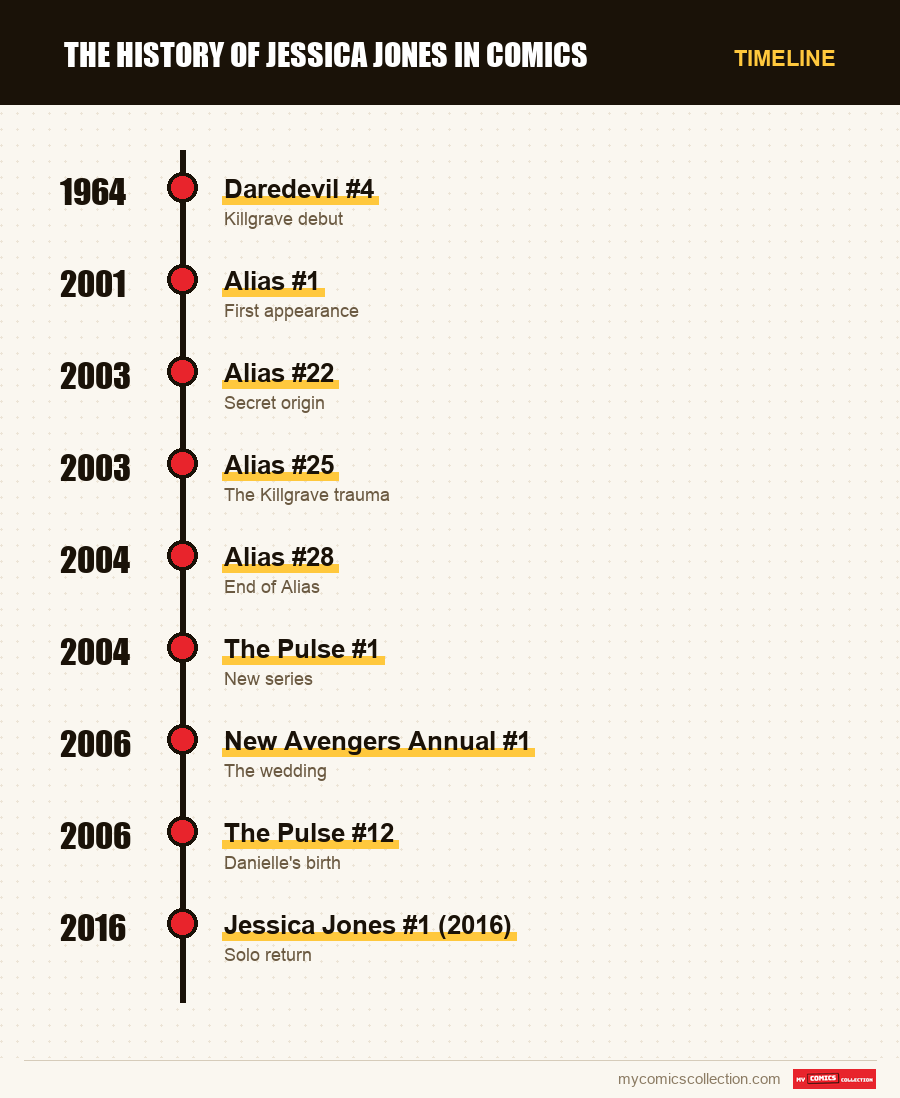
Jessica Jones's origin is revealed gradually from Alias #22 (July 2003) to Alias #28 (January 2004), through "The Secret Origin of Jessica Jones" (#22-23) and then the series' closing arc, "Purple" (#24-28). Before Alias, Jessica Jones existed in the Marvel Universe under the identity of Jewel, a minor hero briefly active in the late 1990s. Bendis used a retroactive continuity trick: Jewel had never been mentioned in existing comics, but her existence was editorially validated as having always been part of the backdrop without ever having been shown. This retcon technique allows a brand-new character to be inserted into continuity without altering prior publications.
Jewel is a high schooler from Queens named Jessica Campbell, who survives a car accident involving a military convoy carrying experimental chemicals. The crash kills her parents and her brother. Jessica spends several months in a coma, and on waking develops abilities: superhuman strength, flight, and enhanced durability. Adopted by the Jones family, she takes the name Jessica Jones and attends Midtown High alongside Peter Parker, briefly crossing paths with Spider-Man without any direct narrative connection. After graduating, she adopts the Jewel costume and makes brief, minor heroic appearances, up until her catastrophic encounter with Killgrave.
Zebediah Killgrave, a.k.a. the Purple Man, is an antagonist created in 1964 by Stan Lee and Joe Orlando in Daredevil #4. A purple-skinned mutate with the power of mind control through pheromones, he haunted Daredevil mythology for three decades without a truly developed psychological arc. Bendis reintroduces him as the central tormentor of Jessica's past. Killgrave captures Jewel as she leaves a street fight and keeps her under psychic control for eight months. During that time, he forces her to witness his acts of violence, to imagine scenarios of submission, to desire him without ever physically touching her, a dynamic that frames the trauma as essentially mental.
Jessica's release comes by accident. Killgrave orders her to attack the Avengers. Jessica obeys but mistakes her target group and strikes the Scarlet Witch, believing she is attacking a double sent by Killgrave. The Avengers knock her out, and Jean Grey of the X-Men is called in to repair the mind control. The lingering trauma drives Jessica to abandon the Jewel identity, leave superhero circles, and open a private detective agency called Alias Investigations. The "Purple" arc concludes the Alias series at 28 issues (November 2001 to January 2004) with a final confrontation between Jessica and Killgrave in prison, a key scene that permanently reverses the power dynamic between the two characters. For investment principles on this type of key, see investing in comics: a strategic guide.
The Pulse 2004-2006: Jessica in the mainstream Marvel Universe
At the end of Alias #28 (January 2004), Jessica Jones is pregnant with Luke Cage's child. Bendis moves the character from the MAX imprint to the main Marvel line through a new monthly series titled The Pulse. The first issue ships in April 2004, with art by Mark Bagley on the early arcs and then Brent Anderson toward the end of the run. The tone shifts: mainstream Marvel imposes the Marvel PSR (Parental Supervision Recommended) rating, drops the explicit profanity, tones down the sexual content, and adapts the visual language for a wider readership. Bendis keeps the noir tone but without the freedom of Alias.
The editorial pitch for The Pulse is precise: Jessica Jones is hired as a consultant by J. Jonah Jameson's Daily Bugle to feed a new column devoted to New York superheroics. The column is called "The Pulse" and serves as the book's editorial framing device. Each arc investigates a major event in the contemporary Marvel Universe: the "Thin Air" arc (issues 1 to 5) deals with the murder of Terri Kidder, a journalist killed by Norman Osborn while he was still hidden from public view, and gradually reveals to Jessica the Green Goblin's return to the New York underworld.
The "Secret War" arc (issues 6 to 9, 2005) serves as a tie-in to the Secret War miniseries by Bendis and Gabriele Dell'Otto, and casts Jessica as a journalistic witness to the covert American operation in Latveria secretly led by Nick Fury. The "Fear" arc (issues 11 to 13, 2005-2006) sees the birth of Danielle Cage, daughter of Jessica and Luke, in #12 (January 2006), then #14 closes the series with Jessica's decision to give up journalism to focus on motherhood. The Pulse ran fourteen issues in total (April 2004 to May 2006), plus a special annual released in 2005 drawn by Michael Lark.
The importance of The Pulse in the character's editorial trajectory is threefold. First: the series moves Jessica from the MAX imprint to the main Marvel line, which opens up every possibility of crossovers with the other Marvel titles. Second: the series sets up Jessica Jones as a journalist rather than a detective, a transition that later runs would not preserve but that marks a shift in her narrative identity. Third: the pregnancy and the birth of Danielle Cage produce a domestication arc that brings Jessica closer to the Avengers through Luke Cage. The current value of The Pulse #1 remains modest in high grade ($15-35 CGC 9.8), making it an accessible sleeper issue within the Bendis segment. See undervalued comics 2026: sleeper issues for the full breakdown of arbitrage opportunities.
New Avengers and marriage to Luke Cage
Brian Michael Bendis took the helm of Avengers in January 2005 with the "Avengers Disassembled" storyline that dismantles the historic team (Vision destroyed, Hawkeye killed, Scarlet Witch unstable), then launched New Avengers #1 with David Finch on art in November 2004 (January 2005 cover date). The new lineup mixes classic Avengers figures (Captain America, Iron Man) with characters drawn from other corners of the Marvel Universe (Spider-Man, Wolverine, Luke Cage, Spider-Woman Jessica Drew). The editorial pitch: rebuild the Avengers on the basis of narrative affinity rather than a symbolic team logic.
Luke Cage is one of the anchor points of this new lineup. The character, created in 1972 by Archie Goodwin and George Tuska in Luke Cage, Hero for Hire #1, had spent the 1990s in relative narrative limbo. Bendis reactivated him first in Alias, where Jessica and Luke begin a casual relationship as early as the opening issues, then in The Pulse, where the pregnancy confirms the strength of the couple. New Avengers brings Luke Cage onto the main team, and by extension pulls Jessica Jones back into the Avengers circle even though she remains a non-combatant civilian member.
The Jessica-Luke wedding takes place in New Avengers Annual #1 (June 2006) by Brian Michael Bendis and Olivier Coipel. The ceremony is held at Avengers Tower with guests including Spider-Man, Wolverine, Iron Man, Captain America, and Spider-Woman. The moment is interrupted by an attack from the Hood, a minor criminal whom Bendis turned into the archetypal superpowered crime boss during this era. The wedding is narratively confirmed in the closing arc, and since 2006 it has stood as one of the stable married couples of the Marvel Universe, alongside the Richards (Fantastic Four), Black Bolt and Medusa (Inhumans), and later Northstar and Kyle Jinadu (X-Men, Astonishing #51, June 2012).
The 2006-2007 Civil War arc by Mark Millar places Luke Cage on Captain America's side (anti-registration), which aligns Jessica in the same camp along with their daughter Danielle. The Knightress name, for its part, goes back to Alias #10: after Jewel, Jessica had briefly operated as a vigilante under that name before giving up the costume. Her return to civilian life unfolds during the Hickman-era Marvel NOW (2012-2015), with Jessica oscillating between private detective work and parental support. The value of New Avengers #1 in CGC 9.8 sits between $100 and $200 in 2026 depending on the exact grade and the variant version. To compare grading options, see CGC vs CBCS vs PGX comparison.
Netflix series Jessica Jones 2015-2019 and Defenders
The Netflix series Jessica Jones was announced in November 2013 as part of the Marvel-Netflix partnership that called for four solo series (Daredevil, Jessica Jones, Luke Cage, Iron Fist) followed by a crossover (The Defenders). Krysten Ritter was cast in the title role in December 2014. Melissa Rosenberg, a writer known for the Twilight saga, was confirmed as showrunner. Season 1 dropped in full on November 20, 2015 on Netflix, thirteen episodes, with a budget estimated at $65 million according to Variety.
Season 1 directly adapts the "Purple" arc from Alias, with David Tennant in the role of Kilgrave (spelling changed by Marvel for the series version). Ritter plays a Jessica younger than the comics character, still in the throes of active trauma, with Mike Colter as a recurring Luke Cage. The series received an exceptional critical reception: Rotten Tomatoes shows 92% positive reviews, Metacritic scores it 81 out of 100, and Ritter's performance was praised by Variety, The Hollywood Reporter, and The New York Times. Season 1 won the 2016 Peabody Award for narrative excellence.
Season 2 dropped on March 8, 2018, thirteen episodes, focusing on Jessica's origin (the car accident, the chemical experiments, the link to her presumed-dead mother). It got a more mixed reception (78% on Rotten Tomatoes), with critics pointing to uneven pacing and an antagonist less memorable than Kilgrave. Season 3 dropped on June 14, 2019, thirteen episodes, and closes out the series with an antagonist created for television (Gregory Sallinger) played by Jeremy Bobb. Netflix announced on February 18, 2019 the end of all Marvel-Netflix series as part of the rights transfer to Disney+, turning season 3 into the definitive finale.
The miniseries The Defenders, the crossover of the four Marvel-Netflix titles, dropped on August 18, 2017 with eight episodes. Krysten Ritter reprised her role alongside Charlie Cox (Daredevil), Mike Colter (Luke Cage), and Finn Jones (Iron Fist), with Sigourney Weaver as antagonist Alexandra Reid. The series loosely adapts the historic Defenders comics, a team originally formed by Doctor Strange, Hulk, Namor, and Silver Surfer in Marvel Feature #1 (December 1971). The cumulative audience of the Marvel-Netflix series exceeds 400 million global views according to Netflix's internal 2018 figures. The impact on the value of the key comics is measurable: Alias #1 rose from $25-40 CGC 9.8 in 2014 to $80-150 CGC 9.8 in 2018 according to GoCollect, with a measurable spike at each season's release. To anticipate MCU spikes, see anticipating MCU Phase 6 comics.
Collecting this series?
Track what you own, what you are missing and what your collection is worth. 7 day trial.
Start my trial →2026 value of Alias #1 and Jessica Jones modern keys
The 2026 market for Jessica Jones key issues is structured around three main variables: the CGC scarcity of Alias #1 and its variants, the MCU speculation following Disney's 2019-2022 acquisition of the Marvel-Netflix rights, and the position of Alias #1 as the first Marvel MAX title launched in November 2001, which gives it a particular editorial status. The combination of these three variables produces a value trajectory distinct from the rest of the Bendis segment.
CGC scarcity. Alias #1 counts roughly 3,200 copies graded by CGC on the public census in early 2026, including 720 in 9.8, 880 in 9.6, and 510 in 9.4. These volumes are clearly higher than the X-Men keys of the same editorial moment (New X-Men #114 counts only 2,100), a consequence of a higher initial print run for the Marvel MAX imprint launch and a wave of mass grading between 2015 and 2018 during the Netflix series' release. Alias #1 CGC 9.8 trades between $90 and $180 on eBay in 2026, with an occasional spike to $250 around the announcement of Disney's acquisition of the Marvel-Netflix rights in May 2022.
The newsstand variant of Alias #1 is significantly rarer and more expensive. The newsstand print run represents roughly 8 to 12% of the total run according to Comichron estimates, or about 8,000 to 12,000 original copies. The CGC census counts 78 graded newsstand copies in early 2026, including 12 in 9.8. A 9.8 newsstand copy trades between $400 and $800 based on recent auction sales, a 4x to 5x multiple over the direct edition. This newsstand premium is one of the most pronounced in the modern Marvel segment.
Associated Jessica Jones modern keys. The Pulse #1 (April 2004) remains undervalued at $15-35 CGC 9.8 despite its status as the first issue of the mainstream series. New Avengers #1 (January 2005) gains value through the team effect: $100-200 CGC 9.8 depending on the variant cover (standard Finch, Quesada variant, Jim Cheung retailer variant). Alias #22 (July 2003) remains accessible at $25-50 CGC 9.8 despite being the first issue of "The Secret Origin of Jessica Jones", which precedes the "Purple" arc. New Avengers Annual #1 (June 2006) featuring the Jessica-Luke wedding sits between $30 and $60 CGC 9.8.
2026 acquisition strategy. For a US collector just starting on Jessica Jones, the optimal sequence combines three approaches. First buy: Alias #1 raw NM acquired in a Bendis MAX lot ($15 to $35 apiece on eBay), with the option of grading it with CGC later. Second buy: the newsstand variant of Alias #1 if the opportunity arises, generally between $80 and $150 raw NM, to be graded systematically given the value premium. Third buy: round it out with The Pulse #1 , Alias #22 , New Avengers #1 , and New Avengers Annual #1 in raw, total budget $40 to $80. For an updated, personalized range, the free estimate tool gives a precise market value per reference.
For longer-term arbitrage principles, the Bendis MAX segment sits in the 2000-2010 key category with a trajectory similar to that of the first appearances of Ultimate Spider-Man (Ultimate Spider-Man #1, October 2000) and Miles Morales (Ultimate Fallout #4, August 2011). The post-Disney MCU speculation on the former Netflix heroes remains a medium-term bet. If Jessica Jones is formally integrated into the MCU in a Phase 6 or 7 (announced for 2027-2029), the value of Alias #1 could exceed $400 CGC 9.8 based on the pattern observed with Daredevil after Daredevil: Born Again (Disney+ 2024-2025). See the overall segment on comics and reference tracking on the most expensive comics 2026.
Key issues to know
Alias #1
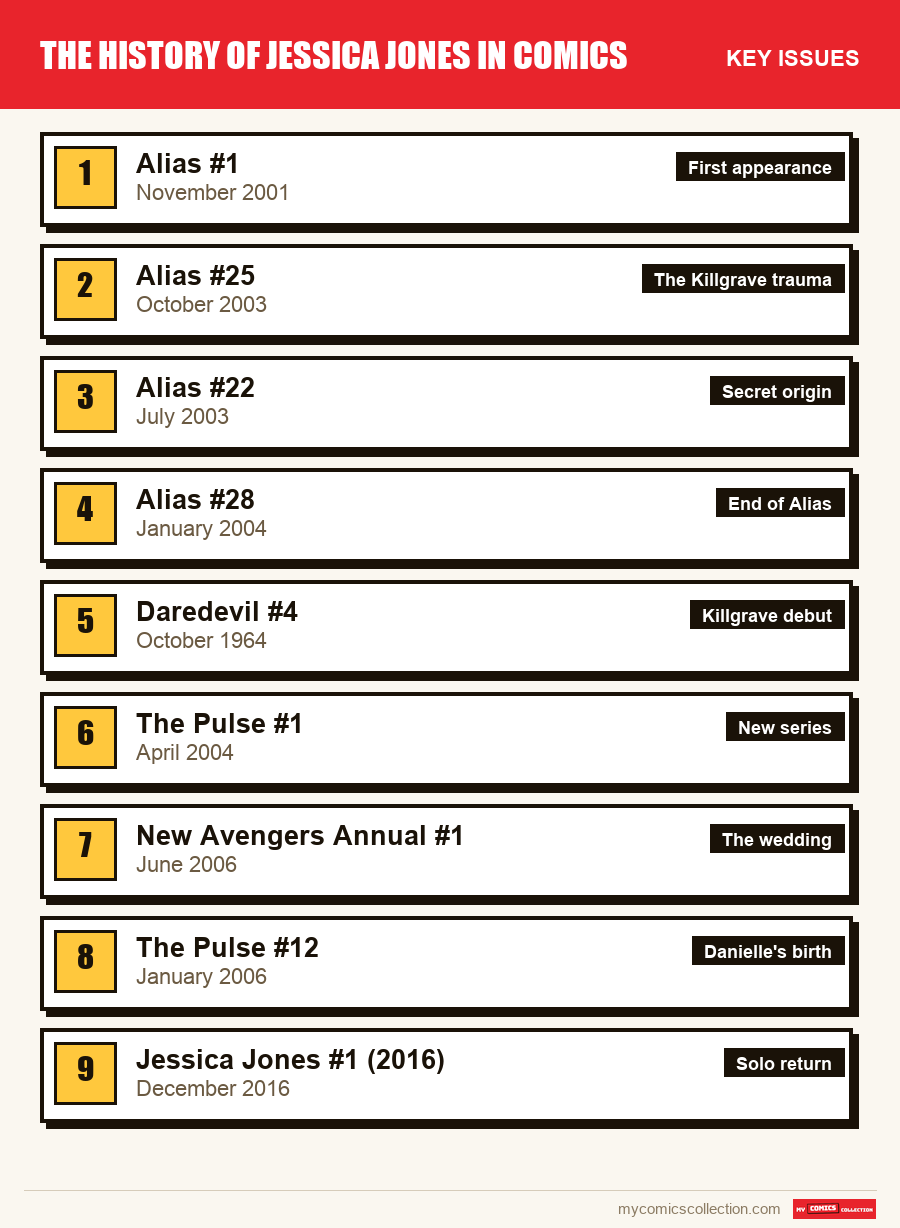
Brian Michael Bendis and Michael Gaydos introduce Jessica Jones, a former superhero turned private investigator running Alias Investigations. The first title of the adult Marvel MAX line, Alias is also the first Marvel series to carry a parental advisory on its cover. The issue came out in September 2001 with a November cover date.
Alias #25
At the heart of the "Purple" arc (#24 to #28), Jessica finally tells Luke Cage about the eight months she spent under the mind control of Killgrave, the Purple Man, back when she was the hero Jewel. Sent by him against the Avengers, she ends up striking the Scarlet Witch. This story defines the character's entire psychology.
Alias #22
Part one of "The Secret Origin of Jessica Jones" (#22 and #23). It introduces Jessica Campbell, a Midtown High student in Peter Parker's class, whose parents and brother die in a car crash with a military convoy. Waking from a coma with powers, she is adopted by the Jones family. The flashbacks mimic the Silver Age style, and page one recreates the first page of Amazing Fantasy #15.
Alias #28
The conclusion of "Purple" and of the series. Shielded by a psychic safeguard Jean Grey once planted in her mind, Jessica resists Killgrave's command and turns on him. She then tells Luke Cage that she is pregnant with his child, opening the family chapter of her story.
Daredevil #4
Stan Lee and Joe Orlando create Zebediah Killgrave, the Purple Man, who can bend anyone to his will. Nearly forty years later, Bendis turns him into the tormentor of Jessica Jones's past, making this Silver Age issue a natural companion to any collection built around the detective.
The Pulse #1
Bendis continues Jessica's story under a new title, with Mark Bagley drawing this first chapter of the "Thin Air" arc. The detective now works for J. Jonah Jameson's Daily Bugle, and the series follows her pregnancy through to the birth of her daughter.
New Avengers Annual #1
Brian Michael Bendis and Olivier Coipel celebrate the wedding of Jessica Jones and Luke Cage, surrounded by friends and family, and Jessica chooses to keep her name. Just before, in The Pulse #14 (May 2006), she had accepted Luke's proposal and quit the Daily Bugle.
The Pulse #12
Drawn by Michael Gaydos, back alongside Bendis, "Fear, Part 2" brings the birth of Danielle Cage, daughter of Jessica and Luke. With her doctor unavailable, Doctor Strange himself helps with the delivery. The issue marks Jessica's turn into motherhood.
Jessica Jones #1 (2016)
Released in October 2016, this relaunch under her own name reunites Bendis and Gaydos fifteen years after Alias. Alias Investigations is back in business, and Luke Cage immediately asks the question that drives the plot: where is their daughter?
FAQ: Jessica Jones history
Who created Jessica Jones and which comic does she appear in?
Jessica Jones was created by writer Brian Michael Bendis and artist Michael Gaydos in Alias #1, published by Marvel Comics under the Marvel MAX imprint in November 2001, with an actual release date of September 6, 2001. The issue is the very first title launched under Marvel's new adult editorial line, Marvel MAX, approved by Joe Quesada, editor-in-chief since July 2000. The series ran 28 issues published between November 2001 and January 2004, and pioneered the concept of a private investigator in the Marvel Universe with a noir tone freed from the constraints of the Comics Code Authority.
What is the connection between Jessica Jones and Killgrave the Purple Man?
Zebediah Killgrave, a.k.a. the Purple Man, is the central antagonist of Jessica Jones's past. Created in 1964 by Stan Lee and Joe Orlando in Daredevil #4, Killgrave has the power of mind control through pheromones. Under the minor heroic identity of Jewel, Jessica is captured by Killgrave, who keeps her under psychic control for eight months, inflicting an essentially mental trauma with no direct physical violence. Her release comes by accident during an attack on the Avengers. The "Purple" arc from Alias #24 to #28 (September 2003 to January 2004) tells this origin in flashback.
Is Jessica Jones married to Luke Cage in the comics?
Yes, Jessica Jones and Luke Cage have been married since New Avengers Annual #1, published in June 2006 by Brian Michael Bendis and Olivier Coipel. The ceremony is held at Avengers Tower with guests including Spider-Man, Wolverine, Iron Man, and Captain America. Their daughter Danielle Cage was born in The Pulse #12 (January 2006). The couple is one of the stable marriages of the contemporary Marvel Universe, alongside the Richards (Fantastic Four), Black Bolt and Medusa (Inhumans), and later Northstar and Kyle Jinadu (X-Men 2012).
How many seasons does the Netflix series Jessica Jones have?
The Netflix series Jessica Jones has three seasons of thirteen episodes each, aired between November 2015 and June 2019. Season 1: November 20, 2015, a direct adaptation of the "Purple" arc with David Tennant as Kilgrave. Season 2: March 8, 2018, focusing on Jessica's origin. Season 3: June 14, 2019, the finale with antagonist Gregory Sallinger. Krysten Ritter plays Jessica Jones across all three seasons and in the crossover miniseries The Defenders (August 2017, eight episodes). Netflix announced in February 2019 the end of all Marvel-Netflix series as part of the rights transfer to Disney+.
What is the value of Alias #1 in CGC 9.8 in 2026?
The value of Alias #1 in CGC 9.8 sits between $90 and $180 on eBay in early 2026, with an occasional spike measured at $250 around the announcement of Disney's acquisition of the Marvel-Netflix rights in May 2022. The CGC census counts roughly 3,200 graded copies in total, including 720 in 9.8. The newsstand variant is significantly rarer with 78 graded copies on the census and a price between $400 and $800 in 9.8, a 4x to 5x multiple over the direct edition. Raw NM copies can be found between $15 and $35 in Bendis MAX lots.